Mobile reports and market data
Documents

Shooter Monthly #3 Marathon vs the Market, Valorant Goes Massive, Marvel Rivals Misreads Progression
The shooter genre is currently navigating a period of significant strategic recalibration as developers struggle to balance live-service retention with evolving player expectations.
- Valorant Mobile has doubled the franchise's total monthly active users, proving that mobile-first design paired with established IP is the most effective strategy for international expansion.
- Bungie has delayed the launch of Marathon to March 2026, reflecting the industry-wide challenge of timing high-stakes releases against established extraction shooter benchmarks.
- Call of Duty is shifting its strategy away from rapid-fire sequel releases to combat player fatigue and prioritize long-term engagement over iterative product cycles.

🚀 Our 2026 Mobile Gaming Predictions. No fluff!
The mobile gaming industry is entering a period defined by aggressive efficiency and the strategic replication of successful market trends.
- By 2026, top ad-supported mobile titles are projected to generate $3 million in daily revenue through aggressive monetization strategies.
- Developers are increasingly utilizing web-to-app flows and browser-based playables to qualify users and optimize cost-per-install metrics before driving traffic to app stores.
- Market growth is being driven by the systematic use of genre-skinning and the repurposing of competitor assets to minimize production costs while maximizing user acquisition.

🚨📢 BREAKING NEWS: OpenAI Becomes a Platform, AI Eats Consoles, Netflix Goes All-In
The gaming industry is currently undergoing a significant structural shift driven by the rapid expansion of artificial intelligence, which is simultaneously creating new platform opportunities and disrupting hardware supply chains.
- Global RAM prices have surged by 200% due to AI-driven demand, forcing manufacturers to prioritize AI inventory over consumer hardware.
- Valve discontinued its entry-level Steam Deck model as a direct response to rising memory component costs and tightening hardware margins.
- OpenAI is positioning ChatGPT as a new distribution platform by launching an app directory that allows developers to integrate games directly into AI conversations.

12 Game Industry Predictions: The Numbers Don't Lie!
The global gaming industry faces a transformative period leading into 2026, characterized by a structural shift toward high-fidelity, cross-platform experiences and a challenging environment for traditional mobile and PC sectors.
- The global player base is projected to grow by 5% annually, reaching 1.7 billion players by 2026, supported by the rising popularity of cost-effective PC handhelds.
- Western mobile gaming firms are losing market share to Chinese publishers, who currently occupy six of the top twenty global market positions.
- Venture capital investment in gaming is expected to hit record lows as exit multiples compress, shifting investor focus toward user acquisition financing rather than traditional project funding.

🤖 AI Creative trends November 2025: How to spot AI creative?
The mobile gaming industry is undergoing a fundamental transformation in user acquisition, driven by the rapid adoption of generative artificial intelligence for creative production.
- Generative AI has reached a level of visual fidelity by late 2025 that makes machine-generated content nearly indistinguishable from authentic user-generated content.
- Market viability in mobile gaming now depends on the ability to scale creative assets through prompt engineering and consistent character modeling rather than traditional production standards.
- Developers are prioritizing high-volume iteration and rapid testing, accepting technical flaws like inconsistent physics, lighting artifacts, and anatomical errors as trade-offs for speed and cost-efficiency.

Steam Wishlist Scanner: The games that matter by Jakub Remiar
Steam wishlists serve as a critical early-warning system for identifying emerging gaming trends and potential hits, often providing actionable insights for mobile market expansion.
- Steam wishlists function as a predictive market indicator, allowing developers to validate game mechanics, art styles, and themes before full-scale production or release.
- Co-op horror games are a high-growth segment driven by strong demand for social, shared player experiences.
- Chore simulators, characterized by repetitive, satisfying tasks and intuitive mechanics, are highly scalable and represent a significant opportunity for mobile market translation.

Why Snapchat is the antidote to social media | Sara Antonelli from Snap
Snapchat has evolved from a niche messaging tool into a foundational social ecosystem that prioritizes intimate, private connections over the public, engagement-driven models of traditional social media.
- Snapchat has shifted its core demographic as its original user base has matured, with the average user now approximately 35 years old.
- Snapchat Plus has become a primary growth driver for the company, reaching 15 million paid subscribers as of Q1 2025.
- The company is moving toward a tiered subscription model that will offer users additional customization and the ability to opt out of advertisements in specific areas like chat feeds.

The Art of Scaling games: The Creative arms race
Modern mobile user acquisition is defined by a shift toward creative velocity, where the ability to produce and test massive volumes of advertising assets outweighs reliance on individual artistic talent.
- Top-grossing mobile titles earning over $2 million monthly now produce hundreds of new advertising creatives every month to combat creative fatigue and rising costs per mille.
- Modern user acquisition success is driven by high-volume industrial production pipelines rather than individual artistic talent, as platforms like Meta prioritize new uploads to determine traffic distribution.
- Studios should allocate 10 to 15 percent of their total marketing budget specifically toward creative testing to identify the high-performing assets that drive the majority of impressions.

Games industry trends 2025 review | Week in Mobile Games podcast
The global games market is projected to reach $197 billion in 2025, with mobile gaming serving as the primary engine of growth at $108 billion, representing a 7.7% year-over-year increase.
- The mobile games market is increasingly dominated by Chinese publishers, who accounted for four of the top 10 grossing publishers in 2025, including Tencent, Century Games, and FunPlus.
- Top-performing mobile games in 2025 included Roblox, White Out Survival, and Royal Match, with all top 10 most downloaded titles exceeding 100 million downloads.
- The industry is shifting toward a more distributed revenue model, as evidenced by the fact that two of the top 10 grossing games were from outside Asia, compared to none in the previous year.

🚨📢 BREAKING NEWS: Unity Fee Drama, Netflix vs WB, Casino Games Everywhere 🤯
The mobile gaming and entertainment landscape is currently defined by significant shifts in corporate monetization strategies and evolving genre dominance.
- Unity has implemented an Enterprise Minimum Commitment Program that mandates annual fees between $250,000 and $2 million for large-scale developers based on gross revenue, sparking significant industry backlash regarding developer trust.
- Warner Bros. Discovery has shifted its corporate strategy by rejecting a $108 billion takeover bid from Paramount in favor of a $72 billion deal with Netflix, highlighting the growing market dominance of streaming platforms over traditional media.
- In the U.S. mobile market, Monopoly Go and Royal Match currently lead in absolute in-app purchase (IAP) revenue, while 4X strategy titles like Last War and Whiteout Survival dominate global performance.

Analysis of K-Game Global Localization Strategies: Successful Market Expansion Models
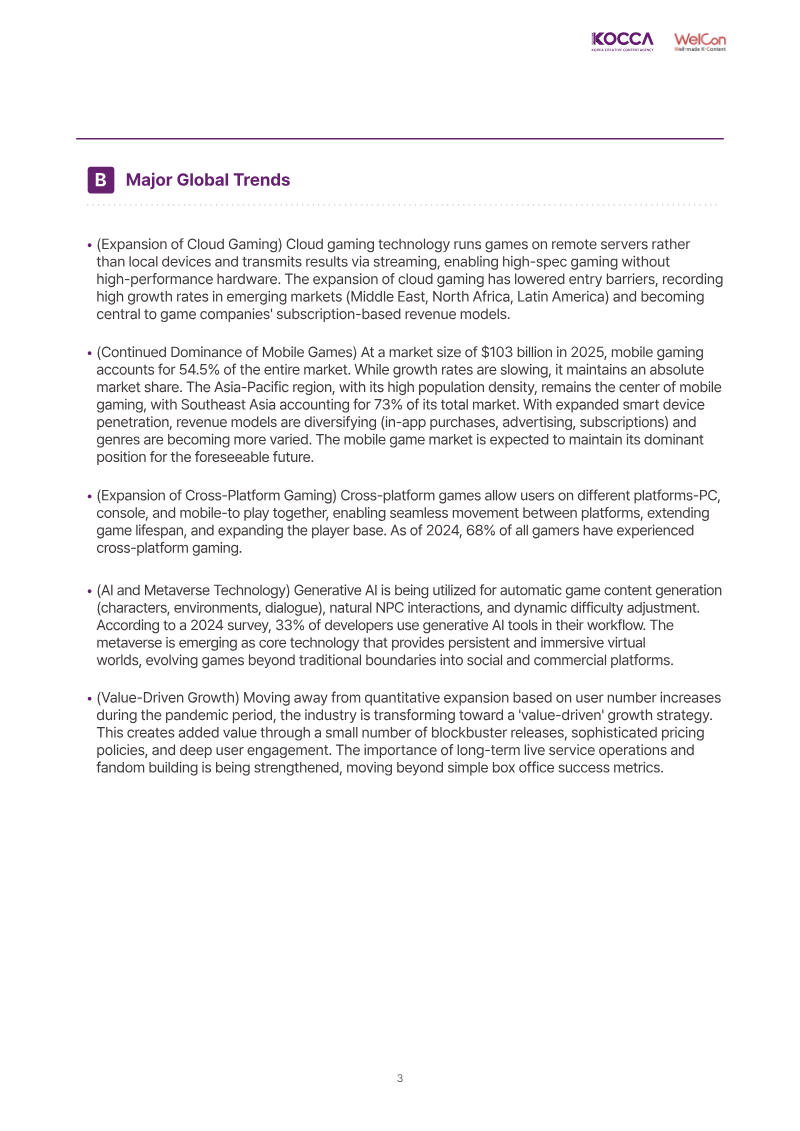
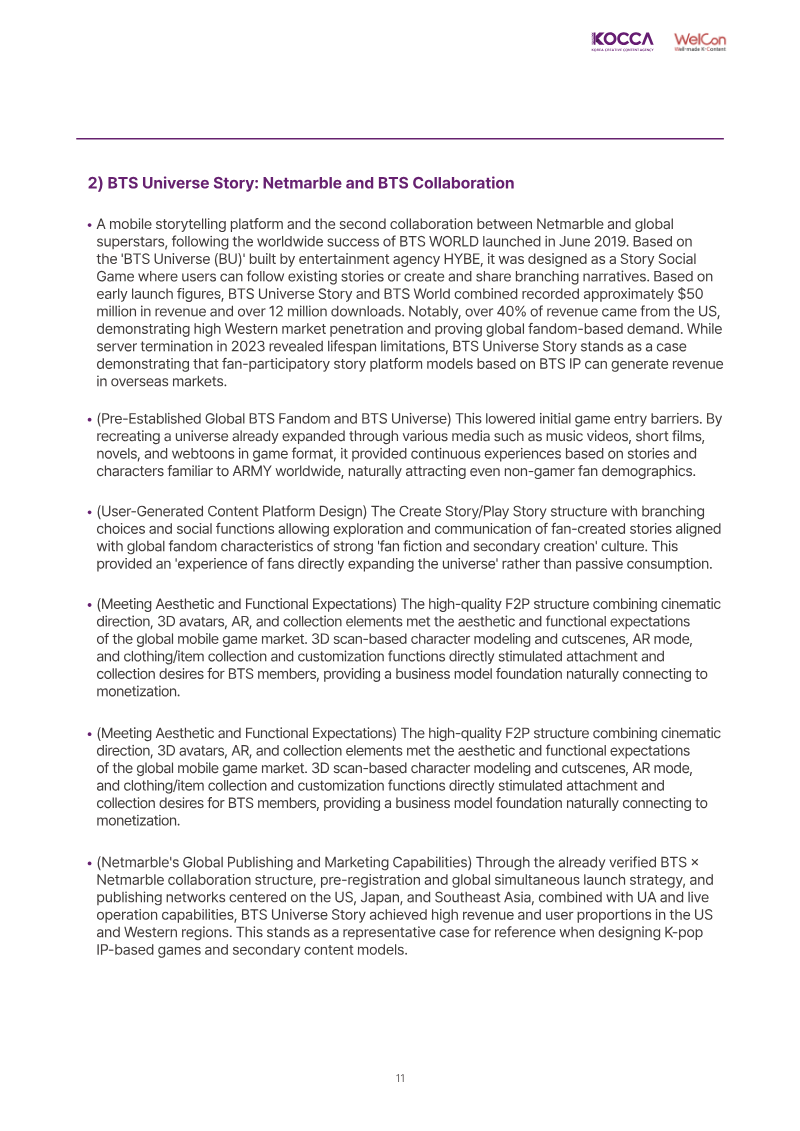
The Korean gaming industry currently faces a structural crisis characterized by an over-reliance on mobile platforms and the Chinese market, coupled with mounting geopolitical and regulatory pressures.
- The global gaming market is projected to grow at an average annual rate of 3.3% through 2028, reaching an estimated 3.95 billion players, with mobile gaming currently dominating at 83% of the total player base.
- Successful global expansion requires a shift from mobile-only strategies to multi-platform development across PC and console, as console gaming is experiencing high global growth despite localized declines in markets like Japan.
- To mitigate geopolitical and regulatory risks, developers must adopt 'China-specific builds' from the planning stage, as evidenced by the necessity of rebranding PUBG to 'Game for Peace' to satisfy Chinese censorship and licensing requirements.
Unity shenanigans, Space Ape postmortem, your games of the year, 2025 wrapped, more
The mobile gaming industry is currently navigating significant shifts in corporate strategy, consolidation, and monetization models.
- Unity is reportedly introducing a new 'Enterprise minimum commitment' fee for studios with over $25 million in annual gross revenue, with costs scaling from $250,000 for $25M+ earners up to $2 million for those exceeding $250M in revenue.
- Supercell completed its acquisition of Space Ape Games in November 2024, rebranding the studio as Supercell London and tasking it with applying lean live-ops expertise to legacy titles like Hay Day and Boom Beach.
- Space Ape Games' history under Supercell involved testing approximately 25 different games and numerous prototypes, a process that highlighted the studio's struggle to focus on winners and kill underperforming projects quickly enough.