Market Analysis
Documents

Vietnam Game Industry Monthly Report: May 2026
The Vietnam Game Industry Monthly Report for May 2026 provides a comprehensive analysis of the mobile gaming landscape, highlighting a shift in market dynamics from pure volume-based acquisition to a focus on operational depth and regulatory compliance. The report synthesizes quantitative data from AppMagic with internal insights to evaluate performance across various subgenres, emphasizing that while overall market demand remains stable, success is increasingly contingent upon localized content, strong community management, and adherence to evolving government policies.
Market data for May 2026 indicates a recovery in total mobile game downloads, which rose to 121 million, a 3.98% increase over April. However, this growth was uneven; midcore segments experienced a 4.69% decline in downloads, underscoring a reliance on consistent launch pipelines and recognizable themes. Conversely, total in-app purchase (IAP) revenue grew by 3.13% month-over-month, with midcore revenue rising by 4.44%. This revenue expansion was driven primarily by long-lifecycle titles in genres such as Battle Royale, MOBA, and Sim Sports, which leverage established communities and recurring live-ops rather than relying solely on new user acquisition.
The report identifies cultural familiarity as a critical driver for success, noting that titles featuring wuxia, xianxia, or established IP consistently outperform generic Western fantasy products. Furthermore, the industry is undergoing a structural transition toward greater professionalization. Vietnam is increasingly positioning itself as a regional hub for esports, evidenced by the formalization of tournament calendars and hosting of major international events. Simultaneously, the introduction of Decree 174/2026/NĐ-CP, effective July 2026, mandates stricter compliance regarding account verification and data management. These regulatory requirements necessitate that publishers integrate operational and legal safeguards directly into their product design, favoring those who partner with experienced local entities capable of navigating the increasingly complex Vietnamese market environment.
- Vietnam's mobile IAP revenue grew by 3.13% MoM in May 2026, driven by strong monetization in long-lifecycle genres like Battle Royale, MOBA, and Sim Sports rather than new user acquisition.
- Midcore total revenue reached its highest level between January and May 2026, rising 4.44% MoM as established titles like Free Fire MAX, Liên Quân Mobile, and Roblox VN leveraged recurring Live-Ops and event-based spending.
- New game success in Vietnam is increasingly dependent on cultural fit, with titles featuring wuxia/xianxia settings, football fandom, or nostalgic IP—such as Giang Hồ Kỳ Ngộ and Total Football VNG—outperforming generic Western fantasy products.
- Effective July 1, 2026, Decree 174/2026/NĐ-CP mandates that all online games must verify player accounts using Vietnamese mobile phone numbers, with non-compliance risking fines of up to 60 million VND (approx. $2.3K).
- While MMORPG, Team Battle, and 4X Battle remain among the largest revenue pools, these segments saw revenue declines of 8.91%, 13.39%, and 6.87% respectively in May due to weaker Live-Ops intensity.

Rewarded UA Handbook: 2026
Rewarded user acquisition (UA) has evolved into a foundational component of the mobile marketing mix, serving as a critical solution to the industry’s ongoing challenges of rising acquisition costs and high user churn. As the global mobile gaming market matures and user growth plateaus, rewarded UA provides a mechanism to drive long-term engagement and retention by incentivizing users to reach specific in-game milestones. The practice is now standard, with 93% of surveyed developers across 10 tier-1 markets currently utilizing rewarded channels, and 61% planning to increase their budget allocations in 2026.
The methodology behind this analysis involved an online survey of 912 mobile game developers conducted between December 2025 and January 2026, supplemented by performance data from over 1,200 advertisers on the Freecash platform. Findings indicate that successful campaigns are no longer treated as experimental, with 31% of studios classifying rewarded UA as an always-on, core channel. High-performing studios typically allocate between 11% and 50% of their total UA budget to these efforts, often managing a portfolio of four or more channels to optimize reach and performance.
Strategic implementation requires a shift toward long-term event architecture. Data shows that campaigns optimizing for multiple, layered events—such as daily streaks, VIP tiers, and repeat purchases—consistently outperform single-event models. By extending reward structures to 90 or 180 days, developers can significantly improve retention and return on ad spend (ROAS). Furthermore, the industry is increasingly adopting automated bidding technologies, such as dynamic ROAS-based bidding, to replace fixed cost-per-install models. While gaming remains the primary sector, the model is rapidly expanding into non-gaming verticals like fintech and e-commerce, where gamification features are being leveraged to drive similar habit-forming behaviors and sustainable user value.
- Rewarded UA is now a core marketing channel, with 61% of surveyed studios planning to increase their budget in 2026 and 65% of studios allocating between 11% and 50% of their total UA spend to the channel.
- Extending reward structures beyond traditional short-term windows is critical for retention; for example, Candivore increased their Match Masters reward structure from 50 to 90 days, resulting in a 50% increase in D60 retention and a 70% uplift in D90 ROAS.
- Campaigns that layer multiple event types outperform single-event campaigns, with IAP/hybrid games utilizing an average of 3.25 distinct event types per campaign to drive long-term engagement.
- Automation is a primary industry focus, as evidenced by Almedia’s MaxROAS system, which has delivered up to a 35% ROAS uplift and a 100% increase in spending for participating advertisers since December 2025.
- Rewarded UA is increasingly viewed as a go-to-market strategy, with 93% of studios launching rewarded campaigns within the first year of their game's lifecycle and 46% implementing them within the first three months of global launch.
Market Model Reports: Asia & MENA
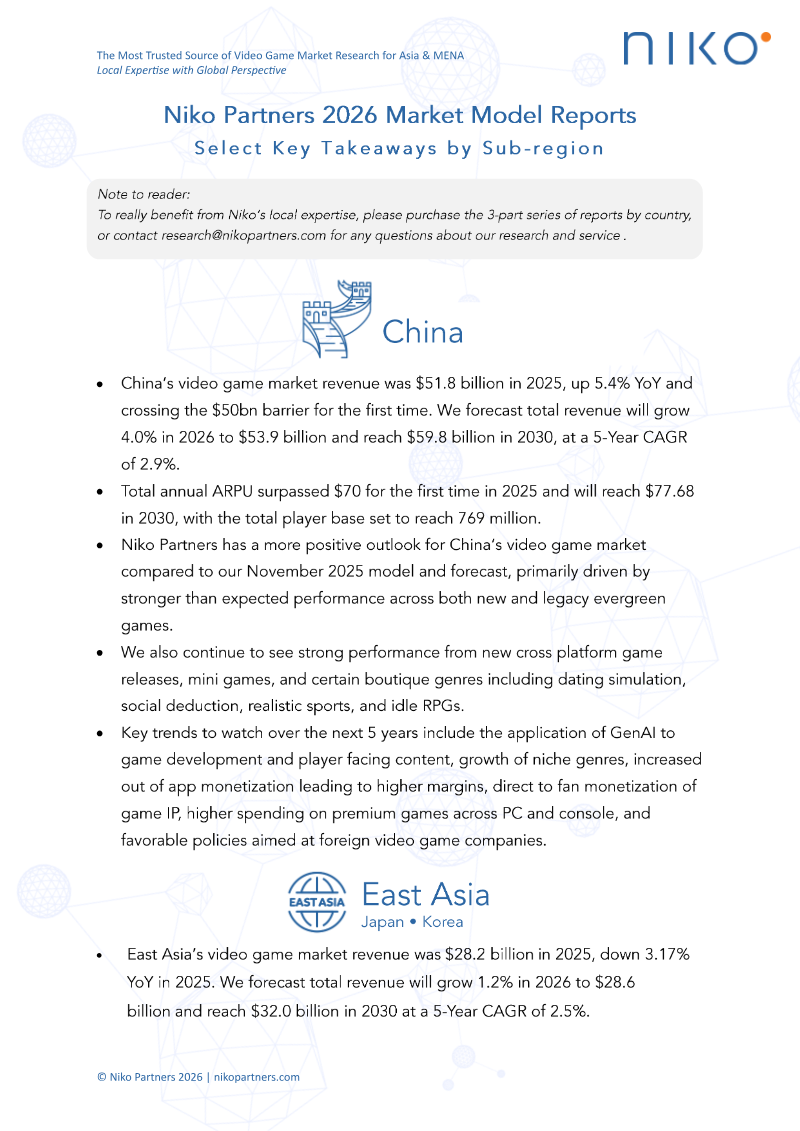
The 2026 Market Model Reports provide a comprehensive analysis of video game industry performance and growth projections across Asia and the Middle East and North Africa (MENA). Covering China, East Asia, India, Southeast Asia, and the MENA-3 region (Egypt, Saudi Arabia, and the UAE), the research evaluates revenue trends, player demographics, and macroeconomic influences through 2030. The analysis utilizes proprietary market modeling, player survey data, and regional expertise to assess the evolving landscape of mobile, PC, and console gaming.
Key findings highlight significant regional disparities in growth and maturity. China remains a dominant force, with 2025 revenue reaching $51.8 billion and a projected 2.9% CAGR through 2030. India emerges as the fastest-growing market, having surpassed $1 billion in revenue in 2025 with an expected 11.2% CAGR. Conversely, East Asia experienced a 3.17% revenue decline in 2025 due to macroeconomic pressures in Japan, though South Korea shows signs of recovery. Southeast Asia continues to expand, driven by mobile adoption and internet penetration, while the MENA-3 region benefits from strong government support and rising disposable income, despite potential geopolitical headwinds.
The research identifies several critical industry drivers, including the integration of generative AI, the rise of niche genres, and increased government regulation across Southeast Asia. Higher average revenue per user (ARPU) remains a focal point, particularly in East Asia, which maintains the highest regional spending levels. Overall, the findings suggest that while short-term volatility persists due to economic and geopolitical factors, the broader outlook for these markets remains positive, supported by increased localization, infrastructure development, and shifting consumer spending toward digital entertainment.
- China’s video game market reached $51.8 billion in 2025 and is projected to grow at a 2.9% CAGR to reach $59.8 billion by 2030.
- India is the fastest-growing market tracked, with 2025 revenue of $1.04 billion and a projected 11.2% CAGR through 2030, supported by a player base expected to reach 707 million.
- East Asia remains the region with the highest ARPU, though 2025 revenue declined 3.17% to $28.2 billion due to Japanese market stagnation and macroeconomic conditions.
- Southeast Asia’s market revenue hit $5.63 billion in 2025 and is forecast to grow at a 4.8% CAGR, with Thailand, the Philippines, and Indonesia identified as the fastest-growing sub-markets.
- The MENA-3 region (Egypt, Saudi Arabia, UAE) generated $2.15 billion in 2025 and is expected to see the strongest ARPU growth, reaching $38 by 2030 despite potential geopolitical instability.
Türkiye's Mobile Gaming Landscape 2026
Türkiye has emerged as a preeminent global force in the mobile gaming sector, characterized by a resilient ecosystem that achieved 6% year-over-year revenue growth despite broader international market stagnation. This expansion is underpinned by a maturing domestic industry where local developers have increased their collective revenue by 450% since 2020, now commanding a 5% share of the global market. The sector’s success is heavily concentrated in the puzzle genre, which accounts for nearly 97% of local earnings, while a strategic pivot toward hybrid-casual titles and sophisticated LiveOps strategies continues to influence international development trends.
The rapid professionalization of the Turkish gaming landscape is driven by a self-sustaining flywheel effect, where successful exits and high-profile valuations for studios like Dream Games and Loom Games attract consistent capital and elite technical talent. Since 2020, the number of local developers has tripled, supported by a robust network of venture capital firms and over 700 active gaming startups. This growth is further accelerated by proactive government intervention, including substantial tax incentives and user-acquisition subsidies, which provide a competitive advantage in an increasingly saturated global environment.
Looking toward 2026, the industry is transitioning from rapid iteration models toward AI-native development and deeper engagement mechanics to maintain its competitive edge. With over $3.6 billion in total investment fueling the rise of category-defining companies, the region has solidified its status as a global hub for mobile gaming innovation. By leveraging a data-driven creative playbook and a highly replicable development framework, the Turkish market is well-positioned for sustained dominance, effectively balancing rapid scaling with the long-term technical maturity required to navigate the evolving demands of the global mobile gaming audience.
- Türkiye’s mobile gaming sector has achieved a 6% year-over-year revenue growth, with local developers increasing their collective revenue by 450% since 2020 to capture a 5% global market share.
- The industry is heavily concentrated in the puzzle genre, which generates nearly 97% of local earnings, while studios increasingly pivot toward hybrid-casual titles and sophisticated LiveOps strategies.
- The ecosystem is supported by over 700 active gaming startups and $3.6 billion in total investment, which has helped triple the number of local developers since 2020.
- High-profile exits and valuations for studios like Dream Games and Loom Games have created a self-sustaining flywheel that attracts elite technical talent and venture capital.
- Proactive government intervention, including tax incentives and user-acquisition subsidies, provides a competitive advantage that helps local developers scale in a saturated global market.
Essential Facts about Video Games in Italy: 2025
In 2025, roughly 14.2 million Italians—about a third of the population aged six to seventy‑five—engage in video gaming, with a pronounced male bias and a concentration of players under 35. The industry’s total revenue remains steady at €2.4 billion, of which game sales account for 77 percent (€1.8 bn). Gaming time has risen to nearly eight hours per week, driven primarily by smart‑device play (22 percent reach, €929 m revenue) and console gaming (13 percent reach, €643 m). App‑based games now represent more than half of the market, dominated by freemium monetisation; only one percent of app revenue comes from upfront purchases.
Revenue distribution varies by platform. Smart‑device earnings are almost entirely from in‑app purchases (ARPU €84), while console sales lean heavily on digital downloads—65 percent of new game revenue comes from full‑game downloads (€502 m) and 21 percent from DLC (ARPU €99). PC revenue is largely driven by DLC (43 percent) and full‑game downloads (98 percent of console sales). Subscription services are pivotal: console ecosystem subscriptions contribute 59 percent of total gaming‑subscription revenue (€153 m), with mobile and single‑game franchises accounting for 6 percent and 35 percent respectively.
Player demographics reveal that smart devices attract a younger, male‑skewed audience (31 percent of 6–17‑year-olds), whereas console and PC gaming remain niche but heavily male‑skewed, concentrated among teens. Casual and sports titles dominate sales across all platforms, with subscription services such as PlayStation Plus and Xbox Game Pass driving a significant share of paid play. Engagement patterns show males spending the most hours on consoles (average seven hours per week), while PC gaming remains steady across age groups. Approximately one‑quarter of players follow gaming news on YouTube or vlogs, and 20 percent rely on social media or family discussions for information. The data derive from a nationally representative online survey of 3,000 respondents, weighted against an offline omnibus sample and calibrated to industry sales figures.
- The Italian video game market generated €2.4 billion in 2025, with game sales accounting for 77 percent (€1.8 billion) of total revenue.
- App-based gaming dominates the market, representing over half of total revenue with a freemium model where only one percent of earnings come from upfront purchases.
- Smart devices are the primary revenue driver at €929 million, while console gaming accounts for €643 million, supported by an average of eight hours of gameplay per week across the population.
- Console revenue is heavily reliant on digital distribution, with 65 percent of new game sales coming from full-game downloads and 21 percent from DLC.
- Console ecosystem subscriptions are the primary driver of the subscription market, contributing 59 percent (€153 million) of total subscription revenue.

2026 Mobile & PC Gaming Benchmarks
The global gaming landscape in 2026 is defined by a widening performance gap between a small elite of top-tier titles and the broader market. Data derived from over 16,000 live mobile games indicates that retention metrics, including D1, D7, and D30, are in a state of decline. With median D30 retention falling below 1%, the industry has become increasingly unforgiving, necessitating a strategic shift toward immediate, high-quality onboarding and the refinement of core gameplay loops to mitigate rising churn rates.
Mobile gaming engagement remains characterized by high-frequency, habitual daily play, yet the industry suffers from a stagnation in innovation and an over-reliance on monetization at the expense of genuine engagement. Success in this segment requires developers to move beyond generic feature sets and instead prioritize behavioral loops that foster long-term habit formation. Conversely, the PC gaming sector operates on a different paradigm, where success is measured by depth, session length, and content longevity. On this platform, retention and engagement metrics serve as indicators of long-term player commitment and the intrinsic value of immersive, long-form experiences rather than simple return frequency.
To navigate these challenges, studios are increasingly turning to advanced data-driven infrastructure to optimize player experiences. By leveraging real-time insights and sophisticated market intelligence, developers can better align their growth strategies with evolving player behaviors. Ultimately, the ability to sustain a competitive advantage in both mobile and PC markets depends on a rigorous focus on content quality and the implementation of robust, data-informed engagement strategies that cater to the specific demands of each platform.
- Mobile gaming retention is in decline, with median D30 retention rates falling below 1% across a sample of over 16,000 live titles.
- The gaming market is experiencing a widening performance gap where a small elite of top-tier titles increasingly dominates the broader landscape.
- Mobile success now requires a strategic pivot toward immediate, high-quality onboarding and core gameplay loops to counter rising churn rates.
- Mobile engagement is currently stagnant due to an over-reliance on monetization, necessitating a shift toward behavioral loops that foster long-term habit formation.
- PC gaming success is defined by long-form, immersive experiences where metrics like session length and content longevity are the primary indicators of value.
Europe and Esports: High Engagement and Even Higher Potential (2020)
The study demonstrates that Europe’s esports audience reached 92 million viewers by the end of 2020, up 7.4 % from 2019, with 33 million classified as “Esports Enthusiasts” and the remaining 59 million as occasional viewers. Revenue projections for the global market hit €973.9 million in 2020 and are expected to rise to €1.6 billion by 2023, with European figures mirroring this upward trend. The research surveyed 10 175 participants aged 18‑45 across ten Western and Northern European countries, using invitation‑only questionnaires administered over one month (29 May–28 June 2020). Respondents were nationally representative of esports viewers in each country.
Key findings reveal that engagement is highest among 21‑25‑year‑olds, with Finland showing the strongest enthusiast proportion (52 % of 18‑20‑year‑olds) versus only 21 % in the UK. COVID‑19 lockdowns increased viewership in markets with stricter restrictions, such as France and Spain, where 62 % of respondents expected continued higher viewership post‑lockdown. Women constitute 32 % of the audience, largely as occasional viewers; however, 60 % of respondents believe female participation is growing. Female spenders are slightly lower than male counterparts (46 % vs 38 %) but show a higher propensity for physical merchandise, whereas men favor digital items like skins and premium passes.
The report also highlights cross‑sport fandom: 64 % of viewers own a favorite sports team, with football and tennis being the most common. Rocket League enjoys significant popularity, especially in the UK (34 % of enthusiasts). Overall, 58 % of enthusiasts spend on esports products, with Spain leading at 62 %. These insights underscore a rapidly expanding, monetizable European esports ecosystem that offers substantial opportunities for brands across both traditional and digital channels.
- Europe's esports audience reached 92 million viewers in 2020, a 7.4% increase from 2019, consisting of 33 million enthusiasts and 59 million occasional viewers.
- Global esports revenue is projected to grow from €973.9 million in 2020 to €1.6 billion by 2023, with European market trends mirroring this expansion.
- Engagement is highest among 21–25-year-olds, with Finland reporting the highest enthusiast proportion at 52% for the 18–20 age bracket, compared to 21% in the UK.
- COVID-19 lockdowns significantly boosted viewership in countries like France and Spain, with 62% of respondents in these regions expecting sustained higher engagement post-lockdown.
- Women represent 32% of the total audience and show a higher propensity for physical merchandise spending, while men favor digital items such as skins and premium passes.

For the Game: Data Fusion Sheds a New Light on Players
Gaming is projected to reach 3.5 billion players and generate over US$225 billion in revenue by 2025, establishing the medium as a mass‑scale platform with extensive brand opportunities. Dentsu’s data‑fusion approach merges a 420,000‑respondent consumer panel with GWI gaming insights across 21 markets to create high‑fidelity gamer portraits that link lifestyle, media habits and in‑game behaviors. This methodology enables brands to segment audiences by motivation rather than device or genre, a strategy shown to produce the most authentic and attention‑driven brand experiences.
Key demographic insights reveal that 57 % of gamers are female, with gaming serving as a tool for identity reinvention and social bonding. Shooters dominate play preferences (63 %), while sports and puzzle/strategy titles attract 16 %. Device usage is nearly evenly split among console, handheld, and a growing smartphone/tablet share. Community engagement is strong: 40 % of U.S. gamers play to belong, and 63 % rely on friends for game information, with platforms such as Discord, Reddit, and Twitch amplifying fandoms.
Commercially, 71 % of gamers consume gaming content across multiple devices and 55 % of esports fans welcome sponsorships, underscoring high engagement. Brands that add genuine value—through exclusive rewards, immersive metaverse experiences, or AR scavenger hunts—achieve near‑perfect ad completion rates (96 %) and significant click‑throughs. Successful activations require clear brand rules, diversity inclusion, strategic partnerships with publishers or esports teams, and a focus on authentic integration rather than intrusive advertising. The analysis spans 22 global markets, including Australia, Brazil, Canada, China and the United States, offering a comprehensive framework for brands to identify entry points and growth opportunities within the evolving gaming ecosystem.
- The global gaming market is projected to reach 3.5 billion players and generate over US$225 billion in revenue by 2025.
- Brands that integrate value-add experiences like exclusive rewards or AR scavenger hunts achieve a 96% ad completion rate.
- Gamer demographics show that 57% of players are female, with 40% of U.S. gamers citing social belonging as a primary motivation for play.
- Shooters remain the dominant genre at 63% of play preferences, while sports and puzzle/strategy titles account for 16%.
- Consumer engagement is high, with 71% of gamers using multiple devices and 55% of esports fans expressing openness to brand sponsorships.

Is There a Shift from Content to Tech Startups Among Gaming VCs?
The analysis examines venture capital activity in the gaming sector from 2020 to early 2024, focusing on whether investment priorities are shifting from traditional content creation and publishing toward technology‑driven startups. Data show that, across all stages, content creators and publishers continue to dominate VC allocations, representing over half of both capital deployed (≈$1.76 billion) and the number of deals in early‑, mid‑, and late‑stage rounds. However, a closer look at seed and Series A financing reveals a notable trend: PC and console studios now secure more funding than mobile startups, indicating a pivot toward higher‑budget, platform‑centric projects.
In the last twelve months, gaming‑focused VC funds have increased their exposure to technology and platform companies. Capital deployed by select funds such as VENTURES, BEHOLD Venture, and Lightspeed Lvp. rose from roughly $1.3 billion in early 2020 to over $2.4 billion by H1 2024, while the number of rounds led by these funds grew from 67 to 289. This shift is evident across multiple funds, with several moving a larger share of their capital into tech‑centric ventures rather than pure content studios.
Geographically, the data encompass global markets with a concentration in North America and Europe, covering all major gaming segments—mobile, PC, console, and emerging platform technologies. The methodology aggregates publicly disclosed VC‑led rounds from 2020 through H1 2024, using capital deployed and round counts as primary metrics. The findings suggest that while content remains the core focus, gaming VCs are progressively allocating more resources to technology and platform innovations, reflecting an evolving investment landscape in the industry.
- Content creators and publishers remain the primary focus of gaming VC, accounting for over half of all capital deployed (approximately $1.76 billion) and the majority of deal volume across all stages.
- Gaming-focused VC funds, including VENTURES, BEHOLD Venture, and Lightspeed Lvp., significantly increased their activity between 2020 and H1 2024, with capital deployed rising from $1.3 billion to over $2.4 billion.
- The number of VC-led funding rounds grew substantially from 67 in early 2020 to 289 by H1 2024, reflecting an overall increase in investment activity.
- While content dominates total funding, there is a clear strategic pivot among VCs toward technology and platform-centric startups, particularly within seed and Series A financing.
- Within the content sector, investment is shifting toward higher-budget, platform-centric projects, as evidenced by PC and console studios now securing more funding than mobile startups.

Europe’s Gaming Consolidators: The Magnificent Seven Post-M&A Rush
The analysis examines the surge of M&A activity among European gaming publishers between 2020 and 2024, highlighting a capital deployment of $19 billion across more than 140 deals. Seven leading consolidators—mienn Easybrain Group, Stillfront, Keywords, Multiplay Media, Management Studios, The Label Yippee!, and SoftWare—dominated the market, with mienn Easybrain Group alone executing 78 deals worth $14.1 billion and acquiring studios such as Ashodee, CrazyLabs, and Aspyr. The largest individual acquisitions include Asmodee Group’s $3.145 billion purchase of a target in March 2022 and Plarium MO’s $620 million deal for SoftWare in November 2024.
Revenue growth data reveal that reported year‑over‑year increases were largely driven by inorganic expansion, with average revenue growth rates ranging from 21 % to 66 %. In contrast, organic growth remained modest; only a handful of firms maintained double‑digit positive trajectories without M&A. Adjusted EBITDA minus CAPEX (AEBITDAC) trends show a decline for many PC and console publishers, reflecting high‑budget projects that failed to deliver expected returns.
Share price performance indicates a post‑pandemic correction: most acquirers’ stocks fell 30–70 % from December 2019 levels, and the aggregate market cap of the seven firms peaked at $25.5 billion in April 2021 before stabilizing around $5.4 billion after share issuances financed acquisitions. Valuation multiples peaked during the 2020 bull market (EV/NTM revenue up to 30×) and subsequently contracted as investors shifted focus toward profitable organic growth.
Overall, the report underscores that aggressive inorganic strategies during low‑interest periods did not generate sustainable shareholder value, prompting leadership changes, layoffs, and restructuring initiatives across the sector.
- Between 2020 and 2024, seven major European gaming consolidators deployed $19 billion across over 140 deals, with mienn Easybrain Group accounting for 78 deals totaling $14.1 billion.
- Aggressive inorganic growth strategies failed to deliver sustainable shareholder value, as evidenced by a market cap collapse from a $25.5 billion peak in April 2021 to approximately $5.4 billion.
- Share prices for the primary acquirers corrected significantly, falling 30–70% from December 2019 levels as valuation multiples contracted from highs of 30× EV/NTM revenue.
- Revenue growth was primarily driven by M&A activity, with inorganic expansion rates ranging from 21% to 66%, while organic growth remained modest and rarely reached double digits.
- Financial performance metrics show a decline in AEBITDAC for many PC and console publishers, largely due to high-budget projects failing to meet return expectations.

The Alumni Effect: Studios Founded by Ex-Activision, Blizzard, and King Employees
The analysis examines venture capital activity directed toward studios founded by former Activision Blizzard employees between 2020 and 2024. It identifies 30 such startups that secured a total of approximately $0.7 billion across 45 VC‑led funding rounds, compared with 27 alumni studios from Riot Games that raised $0.5 billion in 38 rounds. Funding is concentrated in early‑stage rounds, with an average check size of $15.8 million for ex‑Activision studios versus $13.1 million for ex‑Riot ventures, and a notable skew toward PC & console and multiplatform projects. Web3 gaming represents a smaller share of the portfolio.
The study highlights a “first‑round momentum” effect: ex‑Activision studios are roughly twice as likely to secure a second round of financing within the same calendar year as other VC‑backed gaming startups. In 2021, 43 % of ex‑Activision studios raised a subsequent round versus only 9 % of peers; by 2023 the gap narrowed to 33 % versus 8 %. This pattern suggests stronger investor confidence in alumni teams during the 2021‑2022 peak.
Key investors include gaming‑focused funds such as GRIFFIN, PARTNERS COLLECTIVE, and SSSU, which together accounted for more than half of the capital deployed. Notable portfolio companies include Mythical Games (Series C, $262 million), Second Enap (Series B, $100 million), and TheoryCraft (Series A, $87.5 million). While many projects remain in development, releases such as Marvel Snap and Stormgate demonstrate commercial viability, whereas titles like Lightforge’s Project O.R.C.S. were shut down due to lack of traction.
Overall, the report underscores a robust investment climate for studios led by former Activision Blizzard talent, driven by early‑stage funding success and a higher likelihood of follow‑on rounds compared to broader gaming startup cohorts.
- Between 2020 and 2024, 30 studios founded by former Activision Blizzard employees secured approximately $0.7 billion in venture capital across 45 funding rounds.
- Ex-Activision studios demonstrate a 'first-round momentum' effect, being roughly four times more likely than peer startups to secure a second round of financing within the same calendar year.
- Investor confidence in alumni teams peaked in 2021, when 43% of ex-Activision studios raised a subsequent round compared to only 9% of broader gaming startups.
- Funding for ex-Activision alumni is primarily concentrated in early-stage rounds for PC, console, and multiplatform projects, with an average check size of $15.8 million.
- GRIFFIN, PARTNERS COLLECTIVE, and SSSU are the primary investors in this sector, collectively deploying more than 50% of the total capital.

Corporate Overhaul: Why Does CVC Play a Bigger Role Than Ever?
The analysis demonstrates that corporate venture capital (CVC) has become the dominant force in gaming investment from 2020 to 2024, accounting for more than half of all capital raised in the sector. CVC‑led rounds total $4.0 billion across 93 deals, while VC‑only and joint VC‑CVC rounds raise $3.5 billion in 80 deals, indicating a strategic shift toward co‑investment models that spread risk and access higher‑profile startups. Geographic focus is heavily weighted toward Asian strategics, with South Korean and Japanese firms such as Riot, NetEase, and Gigaom leading the pack; these investors collectively completed 105 deals worth $1.8 billion, surpassing Western peers in volume but not always in value.
The largest disclosed CVC‑led investments target mature gaming studios and multiplatform developers, with EPIC Games securing $2.0 billion in April 2022 and Roblox raising $150 million in February 2020. In contrast, VC‑CVC co‑investments concentrate on platform and technology (“picks and shovels”) startups, exemplified by GreenOak’s $500 million Series I in September 2021 and Samsung‑backed CENVID’s $113 million Series C in July 2021. Mobile segments have seen a decline, with CVC interest shifting toward PC and multiplatform titles; mobile deals now represent only 10–15 % of total CVC activity.
Methodologically, the study aggregates public funding announcements from 2020‑2024, categorizing deals by investor type (CVC only, VC only, or joint), segment (studio, platform/tech, mobile, PC/console), and geographic origin. Deal counts and capital raised are sourced from press releases, regulatory filings, and secondary databases, providing a comprehensive view of investment flows. The findings suggest that corporates are increasingly willing to share risk with traditional VCs, enabling larger funding rounds for gaming studios while maintaining strategic alignment and access to emerging technologies.
- Corporate venture capital (CVC) has become the dominant force in gaming investment from 2020 to 2024, accounting for over half of all capital raised with $4.0 billion across 93 CVC-led deals.
- Investment strategies have shifted toward co-investment models between CVCs and traditional VCs, which collectively raised $3.5 billion across 80 deals to spread risk and access high-profile startups.
- Asian firms, specifically from South Korea and Japan, are the most active investors, completing 105 deals worth $1.8 billion and surpassing Western peers in total deal volume.
- CVC-led investments prioritize mature studios and multiplatform developers, highlighted by major capital injections such as the $2.0 billion raised by Epic Games in April 2022.
- VC-CVC co-investments are primarily focused on 'picks and shovels' platform and technology startups, exemplified by the $500 million Series I round for GreenOak in September 2021.