Market Analysis
Documents

Swedish Game Developer Index 2019
Published by the Swedish Games Industry Illustration, cover: Pontus Ullbors Text & analysis: Johanna Nylander The Swedish Games Industry is a collaboration between trade organizations ANGI and Spelplan-ASGD. ANGI represents publishers and distributors and Spelplan-ASGD represents Dataspelsbranschen Swedish Games Industry Magnus Ladulåsgatan 3, SE-116 35 Stockholm Contact: [email protected] KEY FIGURES 2018 2017 2016 2015 ...
- The Swedish games industry experienced significant growth in 2018, with a 33% increase in value to EUR 1.87 billion, marking its tenth consecutive profitable year with total profits exceeding EUR 335 million.
- The industry is expanding, with 41 new companies and over 600 new employees added in Sweden in 2018, an increase of 12% in new companies.
- The corporate landscape has shifted, with seven companies now having revenues over EUR 100 million; Embracer Group, after acquiring Koch Media, is the largest Swedish games company, surpassing previous dominators Mojang and King.
- Swedish game companies contribute significantly to the economy, with the 25 largest companies paying EUR 114 million in tax on profits and the 15 largest contributing over EUR 100 million in wage taxes.
- Swedish game developers are expanding globally, with 31 Swedish-owned studios employing 2,604 people outside Sweden in 2018, and notable acquisitions and investments by Swedish companies in international firms.
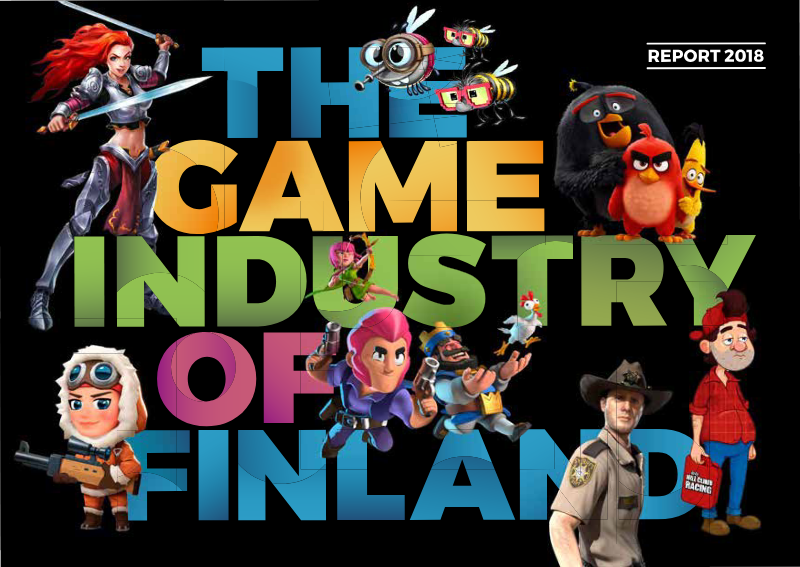
Finnish Game Industry Report 2018
Fingersoft • Ηill Climb Racing 2 Futureplay • Battlelands Royale Next Games • Τhe Walking Dead: Our World Rovio Εntertainment • Angry Birds 2 Small Giant Games • Εmpires & Puzzles Supercell • Brawl Stars, Clash Royale, Clash of Clans and Ηay Day Remedy Εntertainment • Control Rival Games • Τhief of Τhieves: Season One Superplus Games • Ηills of Steel Nitro Games • Ηeroes of Warland Κukouri Mobile Εntertainment • Pixel Worlds Publisher Neogames Finland ry (2019) 2.
- The Finnish game industry has a strong history of significant international investments and acquisitions, including Softbank acquiring 51% of Supercell (2012-2014) and Tencent acquiring 80% of Supercell (2016), alongside numerous game studio acquisitions.
- Helsinki is a global leader in mobile game development, hosting over 80 companies, 1,600 employees (28% non-Finnish), and generating a 2018 turnover of 1.7 billion EUR, with 98.4% from exports.
- Finnish developers are rapidly adopting Nintendo (Switch) as a target platform, with its popularity growing from 4% in 2016 to 20% in 2018; chat games also emerged as a new focus (5% in 2018).
- Multiplatform development is common, with Android (75%), iOS (71%), and PC/PC online (50%) being the most popular platforms in 2018, while Windows mobile and Facebook are no longer targeted.
- Finnish game developers are actively exploring new market disruptions like blockchain, cross-platform games, cloud gaming, subscription models, HTML5 (including chat games), and XR technologies, demonstrating a strong ability to adapt.
Slovak Game Industry 2019
It’s said to be a small world, and the digital games world is smaller still. Yet nevertheless, without the right partner and guidance it’s easy to get disorientated. When we started the annual monitoring of Slovakia’s game development industry, we had a clearly defined vision and goal. And the results of the first Game Developer Census comprehensive report confirmed that we were on the right track.
- The Slovak game development industry is growing, with increasing numbers of studios, profits, project quality, and employed professionals.
- Self-funding is the primary source of funding for Slovak game companies (81%), followed by public funding (35%) and investors (22%).
- 42% of Slovak game studios self-publish their games, while 42% use a publisher (11% foreign, 8% Slovak) and 16% are publisher holders.
- Programmers (10%), Game Designers (10%), and Producers (13%) are among the least represented positions occupied by women, while Graphic Artists (29%) and Marketing/Sales (19%) are more common.
- Two vocational art schools in Košice and Trenčín offer specialized programs in digital painting, animation, and digital application design, including game environment and character design.

Libro Blanco del Desarrollo Español de Videojuegos 2019
DESARROLLO ESPAÑOL<sub>DE</sub> PROMOVIDO POR: CON EL APOYO DE: CON LA COLABORACIÓN DE: FONDO EUROPEO DE DESARROLLO REGIONAL eGoGames mCR codice software GGCoM UNA MANERA DE HACER EUROPA INTRODUCCIÓN .......................................................................................................................................
- The Spanish video game industry is young, with 80% of companies less than 10 years old, and 61% of companies generating less than 200,000 euros annually. Only 3% of companies exceed 10 million euros per year, but they contribute 67% of the total annual revenue.
- In 2019, Spain's video game industry recovered from a growth stagnation in 2017-2018, now boasting over 520 established companies and 250 projects in development. However, a hundred inactive companies introduce uncertainty about future growth.
- Catalonia leads in the number of video game studios (28%), followed by Madrid (24.7%), and Andalusia (16%), which surpassed Valencia (12.2%) in 2019.
- 42% of Spanish video game companies had not published any games in 2018, and 31% had published only one, often due to long development cycles and a focus on self-financed, single-IP projects.
- Public aid for Spanish video game studios in 2018 primarily came from autonomous communities (47%), with 10% from the Ministry of Culture and Sport's Innovation in Cultural Industries program.
Czech Video Game Industry: PC, Console and Mobile Game Developers in Czech Republic 2019
PC, CONSOLE AND MOBILE GAME DEVELOPERS IN CZECH REPUBLIC 2019 DEVELOPERS IN CZECH REPUBLIC 2019 This Study was prepared by the Institute for Digital Economy (www.digitalniekonomika.cz) in cooperation with the Czech Game Developers Association (www.gda.cz) with the support of Creative Europe – MEDIA (www.kreativnievropa.cz).
- The Czech video game industry, despite lacking government support, is a significant part of the digital economy, with Czech companies comprising roughly 10% of all game companies in Central and Eastern Europe and generating twice the revenue of the Czech film industry.
- In 2018, 31 games were created in the Czech Republic, contributing to a total of 136 games released by Czech studios between 2015 and 2018; PC and console game development (67%) dominates, though over half of studios also focus on mobile platforms (61%).
- The industry faces a major obstacle in the lack of skilled developers, with almost 1,500 individuals working in game development in 2018 (83% male), and over 60% of Czech game development companies experiencing labor shortages.
- The Czech game industry is characterized by many small and micro firms (54 micro businesses, 16 small businesses), with only one large business (over 250 employees) and five medium-sized businesses (50-249 employees), influenced by labor and financing shortages.
- The Czech educational system offers very few specialized study programs for game development (only three identified), contributing to the shortage of qualified professionals.
Die Wirtschaftliche Bedeutung Der Österreichischen Spieleentwicklungsbranche 2019
Die wirtschaftliche Bedeutung der österreichischen Spieleentwicklungsbranche Unternehmensberatung Buchhaltung·IT Die wirtschaftliche Bedeutung der österreichischen Spieleentwicklungsbranche Erstellt in Kooperation mit: Gefördert von: Die wirtschaftliche Bedeutung der österreichischen Spieleentwicklungsbranche Die Studie wurde im Auftrag des Fachverbandes Unternehmensbe- ratung, Buchhaltung und Informationstechnologie (UBIT) verfasst.
- The Austrian game development industry generated 24.1 million euros in revenue in 2017, with projections to reach 26.4 million euros by 2021. For every 1 euro of revenue generated by an Austrian game development company, an additional 1.11 euros of revenue is generated nationwide.
- Four out of ten Austrian game developers (37.5%) use Augmented Reality (AR), 34.4% use Virtual Reality (VR), and 28.1% use both technologies in their games. Austrian developers use VR more than their German counterparts, where 24% use AR and/or VR.
- Personnel costs account for seven out of ten euros (70%) of total costs for an average Austrian game development company, similar to the 68% found in a comparable study by Hamburg Media School.
- The majority of Austrian game developers (70%) expect their revenue to improve over the next three years, with 57.1% anticipating a strong increase of over 10%.
- The Austrian game development sector has a highly educated workforce; 97.5% of employees have at least a higher education degree, which is three times higher than the general Austrian population aged 25-64 (31.5%).
Jahresbericht der deutschen Games-Branche 2019
01 Gamer in Deutschland 6 02 Markt für Computer- und 12 03 Games-Branche in Deutschland 22 .1 Beschäftigtenzahlen und Unternehmen .4 Die 10 Forderungen der Games-Branche 04 eSports 36 05 gamescom 40 06 Deutscher Computerspielpreis 42 07 Unterhaltungssoftware 44 08 Stiftung Digitale Spielekultur 46 09 Über den game – Verband 48 Herausgeber ...
- The German games market grew by 14% to 3.5 billion Euros in 2018, driven by a 97% increase in revenue from online service fees (to 305 million Euros) and a 57% increase in in-game purchases (to 297 million Euros).
- 34.3 million Germans play computer and video games, with 48% being female. The average age of gamers has risen to 36.4 years, with nearly 10 million players over 50 years old, representing 29% of all gamers.
- The purchase of games as downloads or on physical media is no longer the largest market segment, declining by 10% to 1.1 billion Euros. Downloads accounted for 41% of sales and 28% of revenue in 2018, a slight decrease from 2017.
- Germany's games industry faces a challenging financing situation, making game production up to 30% more expensive than in other countries like France, the UK, and Canada, which have stronger government support.
- eSports is rapidly growing in popularity and economic potential in Germany, with major events like ESL One tournaments and the League of Legends Championship Series hosted there. Many German sports clubs and companies like Mercedes-Benz, Audi, and Vodafone are investing in eSports.
Game Fokus: Esports 2019
Editorial 6 01 Einleitung 8 02 Geschichte des eSports 14 Interview mit Alexander Müller, Gründer und Geschäftsführer beim eSports-Team SK Gaming 03 Status quo von eSports 22 Interview mit Melek Balgün, freie Moderatorin und eSports-Expertin Interview mit Alexander Jobst, Vorstand Marketing und Kommunikation, FC Schalke 04 Interview mit Toan Nguyen, Executive Director und Partner bei ...
- The German eSports market is projected to reach approximately 130 million Euros by 2020, representing an average annual growth of around 27 percent.
- Despite its growing relevance, eSports in Germany faces significant hurdles due to a lack of official recognition as a sport, unlike 50 other countries (including EU states like Austria, Netherlands, and Sweden) that already acknowledge and promote it.
- The German government, through the 2018 coalition agreement, has pledged to support eSports as its own sport with club and association rights, and the Foreign Office eased entry requirements for non-EU eSports athletes in August 2018, yet full equality with traditional sports is still missing.
- Sponsoring, advertising, media rights, ticketing, and merchandising are key revenue streams for eSports, with global revenues from media rights, sponsoring, and advertising alone projected to be around 897 million US dollars in 2019.
- Major non-endemic companies like Red Bull (sponsoring athletes and events for over 10 years) and Amazon (acquiring Twitch for nearly one billion US dollars in 2014) are heavily invested in eSports, with Twitch securing Overwatch League streaming rights for 90 million US dollars.
Tencent Games Strategy 2019
Tencent’s strategic pivot in 2019 marks a recovery from the previous year’s regulatory freeze on game licenses, which had triggered the company’s first-ever profit decline. By early 2019, gaming revenue rebounded to $5.2 billion, driven largely by the successful transition of 150 million monthly active users from the unmonetized PUBG Mobile to the compliant, self-developed Peacekeeper Elite. This maneuver underscores a broader commitment to navigating strict domestic regulations while maintaining market dominance through the integration of the WeChat and QQ social ecosystems, which serve as the primary distribution channels for both internal and third-party titles.
The company is simultaneously pursuing aggressive international expansion and portfolio diversification to mitigate domestic risks. This global strategy involves high-profile intellectual property licensing, such as Call of Duty and Street Fighter, alongside strategic acquisitions of Western studios like Sharkmob. Within China, the expansion of the WeGame platform to 70 million monthly active users and a partnership to serve as the exclusive distributor for the Nintendo Switch signal a move beyond traditional free-to-play mobile models into the PC and console markets.
Future growth is anchored in emerging technologies and infrastructure, specifically cloud gaming and esports. Leveraging a cloud network that already supports 75% of China’s top mobile games, Tencent is positioned to lead the domestic market in the absence of major international competitors. With a $1 billion commitment to esports infrastructure and a pipeline of over 20 new titles, the strategy emphasizes long-term dominance through a combination of massive capital investment, mergers and acquisitions, and the development of next-generation technologies including augmented reality and blockchain-integrated gaming.
- Tencent successfully recovered from a 2018 regulatory freeze by migrating 150 million monthly active users from PUBG Mobile to the compliant, self-developed title Peacekeeper Elite, resulting in $5.2 billion in quarterly gaming revenue.
- The company is mitigating domestic regulatory risks through aggressive international expansion, including the acquisition of Western studios like Sharkmob and licensing major IP such as Call of Duty and Street Fighter.
- Tencent is diversifying beyond mobile free-to-play models by growing its WeGame platform to 70 million monthly active users and securing an exclusive partnership to distribute the Nintendo Switch in China.
- Tencent is leveraging its existing cloud infrastructure, which currently supports 75% of China’s top mobile games, to establish a dominant position in the emerging cloud gaming market.
- The company has committed $1 billion to esports infrastructure and is developing a pipeline of over 20 new titles to maintain market leadership.
Mobile Benchmarks Report GameAnalytics
The mobile gaming landscape in the first half of 2019 reflects a significant structural shift as developers increasingly pivot from in-app purchases toward ad-based monetization models. Analysis of 100,000 titles and 1.2 billion monthly active users reveals a 15-20% year-over-year decline in Average Revenue Per Paying User (ARPPU) and Average Revenue Per Daily Active User (ARPDAU). While the median ARPDAU sits at $0.02, hyper-casual games maintain viability through advertising, supported by median eCPMs of approximately $5.00. Despite these shifts, Mid-core genres like Strategy and Role-Playing Games continue to dominate financial performance, yielding the highest conversion rates and revenue generation across the industry.
Engagement metrics remain the primary indicator of long-term success, with top-performing titles aiming for a 35% Day 1 retention rate and a 4% Day 28 retention rate. Classic genres, specifically Card and Casino games, lead the market in player stickiness, boasting session lengths that can reach 22 minutes compared to the broader median of 4-5 minutes. Geographic trends further highlight the rising prominence of the Chinese market, where over 60% of the population engages in mobile gaming and median eCPMs have climbed to $3.90, nearly rivaling established Western markets like the United States.
Industry leaders utilize these benchmarks to streamline publishing pipelines, often requiring a minimum 50% Day 1 retention rate to greenlight titles for further optimization. Success in this competitive environment relies on the integration of real-time data, remote configuration, and advanced player segmentation to manage game lifecycles. By monitoring key performance indicators and error logs through automated dashboards, publishers can identify high-potential titles early and refine gameplay mechanics to meet the rigorous standards of the current mobile ecosystem.
- Mobile developers are shifting toward ad-based monetization, evidenced by a 15-20% year-over-year decline in ARPPU and ARPDAU across 100,000 analyzed titles.
- Top-tier mobile titles require a Day 1 retention rate of 35% and a Day 28 retention rate of 4% to remain competitive, with industry leaders often demanding a 50% Day 1 rate to greenlight projects.
- Strategy and Role-Playing Games remain the highest revenue generators, while hyper-casual games rely on advertising models supported by a median eCPM of approximately $5.00.
- Card and Casino games exhibit superior player stickiness with session lengths reaching 22 minutes, significantly outperforming the industry median of 4-5 minutes.
- The Chinese mobile gaming market is rapidly maturing, with over 60% of the population playing and median eCPMs reaching $3.90, nearing levels seen in the United States.
Serbian Gaming Industry Report 2018
The inaugural Serbian Games Association report maps a rapidly expanding national gaming ecosystem that now comprises more than 60 members across indie development, esports, visual‑effects houses and internationally linked studios, employing over 1,500 skilled professionals. Funding is diversified, with roughly 40 % of capital sourced from angel investors, 30 % from crowdfunding and 20 % from venture capital, and the largest single infusion recorded at €650 k. Flagship entities such as 3Lateral (recently integrated into Epic Games), Nordeus with its 200 million‑user “Top Eleven” platform, and Ubisoft Belgrade’s 107‑person team working on major AAA titles illustrate the sector’s growing global relevance.
A vibrant indie segment is driven by small, highly creative teams—often one to three developers—producing titles ranging from cyber‑punk point‑and‑click adventures to hyper‑casual mobile games. Studios like Munzesky Games, Oraharo Entertainment, PWN.RS, Stargazer, Superverse Industries, Tummy Games and Zero Gravity showcase cross‑border collaborations and distinctive artistic approaches, while highlighting the need for stronger B2B networking, regular industry events and formalized game‑art education to sustain momentum.
Technical education underpins this growth, with approximately 30 000 university students enrolled in IT‑related programs and programming introduced at the primary‑school level. Government incentives, EU grants and private investment have bolstered studio formation, yet most companies still rely on organic installs and limited ad‑network usage for user acquisition. Community initiatives—including frequent association meet‑ups, two industry‑backed GameJams, the annual GameUp expo attracting over 2 500 participants, and the Nordeus Hub co‑working space offering a six‑month mentorship—are actively closing knowledge gaps and fostering collaboration.
Media outlets such as Svet kompjutera, JVC Gamer and the online PLAY! Zine maintain visibility for Serbian developers both domestically and abroad. Surveyed stakeholders anticipate a rise in paid user‑acquisition capabilities and an increase in successful Serbian titles, positioning the country to become a more prominent player in the regional and global gaming market.
- The Serbian gaming industry comprises over 60 member entities and employs more than 1,500 professionals, anchored by major players like Nordeus, Ubisoft Belgrade, and 3Lateral.
- Funding for the sector is diversified, with 40% sourced from angel investors, 30% from crowdfunding, and 20% from venture capital, with the largest single investment reaching €650,000.
- A robust pipeline of technical talent is supported by approximately 30,000 university students in IT-related programs and the integration of programming into primary-school curricula.
- The indie segment is characterized by small, highly creative teams of one to three developers, though these studios currently rely heavily on organic installs rather than paid user-acquisition strategies.
- Industry growth is bolstered by community-led initiatives such as the GameUp expo, which attracts over 2,500 participants, and mentorship programs like the Nordeus Hub.
Serbian Gaming Industry Report 2019
The Serbian games sector is emerging as a rapidly expanding, diversified ecosystem that now supports more than 80 companies and roughly 2,000 employees, reflecting a 3.4 % year‑on‑year increase in staff. Studios range from micro‑teams of five to large developers of up to 180 personnel, many of which are actively recruiting, indicating robust talent demand. Revenue generation has risen to approximately €100 million, with 2019 mobile‑first, free‑to‑play titles produced on modest budgets of €0‑100 k and average team sizes of six to ten, while flagship projects such as Nordeus’s Top Eleven and Playrix RS’s titles have amassed over 100 million monthly active users, underscoring Serbia’s capacity for both high‑volume mobile and higher‑budget productions.
The market is highly fragmented, comprising dozens of small‑to‑mid‑size studios that specialize in mobile, hyper‑casual, AR/VR, backend services, and outsourcing. Notable commercial successes include Sozap’s Armed Heist with more than 14 million installs and PixQuake’s server‑side analytics suite. Institutional support has intensified through the Serbian Gaming Association, the Nordeus Hub, and university initiatives, including a multi‑university “Master 4.0” curriculum that integrates IT, business, and creative disciplines and has spawned dozens of new gaming degree programmes.
Mentorship and structured education that blend soft‑skill and technical training are identified as critical for talent development, with studios such as Digital Arrow, Two Desperados, and Ubisoft Belgrade highlighting the need for custom tech‑art pipelines, AI integration, and data‑driven design. The coordinated push toward professionalisation, exemplified by accelerator programs and community events, positions Serbia to sustain its growth trajectory and increase its contribution to both regional and global game markets.
- The Serbian gaming sector generated approximately €100 million in revenue in 2019, supported by an ecosystem of over 80 companies and 2,000 employees.
- Flagship mobile titles from companies like Nordeus and Playrix RS have achieved massive scale, amassing over 100 million monthly active users.
- The industry is experiencing steady growth with a 3.4% year-on-year increase in staff and robust recruitment demand across studios ranging from micro-teams to 180-person developers.
- Market production is highly diversified, ranging from low-budget mobile and hyper-casual titles costing €0–100k to specialized work in AR/VR, backend services, and server-side analytics.
- Institutional support has matured through the Serbian Gaming Association and the 'Master 4.0' university curriculum, which integrates IT, business, and creative disciplines to formalize talent development.