Updated Mar 17, 2026 by Slovak Game Developers Association
Report · January 1, 2019
Published by Slovak Game Developers Association
It’s said to be a small world, and the digital games world is smaller still. Yet nevertheless, without the right partner and guidance it’s easy to get disorientated. When we started the annual monitoring of Slovakia’s game development industry, we had a clearly defined vision and goal. And the results of the first Game Developer Census comprehensive report confirmed that we were on the right track.
It’s said to be a small world, and the digital games world is smaller still. Yet nevertheless, without the right partner and guidance it’s easy to get disorientated. When we started the annual monitoring of Slovakia’s game development industry, we had a clearly defined vision and goal. And the results of the first Game Developer Census comprehensive report confirmed that we were on the right track. According to positive feedback from game developers, the media and our partner organisations in Slovakia and abroad, our work has set an example. We take our role and our responsibilities seriously. It is tremendously gratifying to follow the trend of thriving numbers of game development studios and their profits, enhanced project quality, and the steadily growing volume of professionals employed by such studios. Yet the game development industry has its pitfalls, and must constantly face new challenges. New generations of developers need to be attracted, motivated and retained; conditions created for a stable ecosystem; limits continually challenged; and the creation of new job opportunities, public education and open communication all passionately encouraged. One of the Slovak Game Developer Association’s main purposes is to increase awareness of the current status and size of Slovakia’s game development sector. This up-to-date catalogue of Slovak video game developers aims to assist readers in navigating this industry’s creative waters.
y encouraged. One of the Slovak Game Developer Association’s main purposes is to increase awareness of the current status and size of Slovakia’s game development sector. This up-to-date catalogue of Slovak video game developers aims to assist readers in navigating this industry’s creative waters. The video game industry is only as strong as its community and its members’ cooperation. To only show the next generation the door to the digital world is insufficient. We must also pass on our knowledge, give orientation, and welcome them across the threshold into our supportive community. Marián Ferko, President of the Slovak Game Developers Association
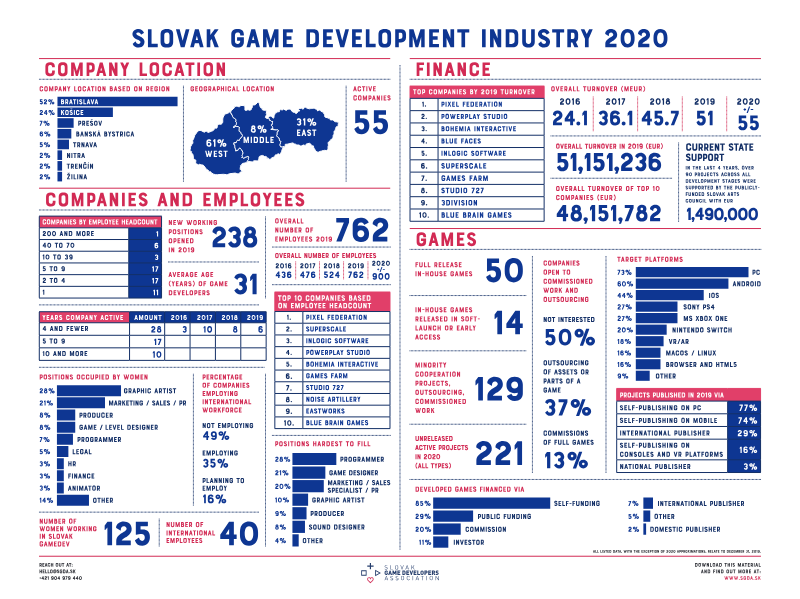
SLOVAK GAME DEVELOPMENT INDUSTRY 2019 Current State Support In the last 32% Positions Yearly Revenue (in millions of €) Number of Professionals 3 years more than 70 projects across all stages of 21% East occupied by development were supported via Slovak Arts Council with 47% Middle professionals 2019 2016 2017 2018 2019 public funding amounting 1,070,000 € West from abroad 2016 2017 2018 56.6 436 476 524 682 Companies’ age 24.1 36.1 45.7 approx. Where the Primary development approx. Games 18 43 21 18 Companies are platform 60 Games Released 444 Released So % % % % Based in 2018 Far Less than +5 +10 +15 5 years Years Years Years PC 53% Women in 38 Foreigners Working in Slovak Gamedev 35% Graphic Artist Slovak Games in Positions that are in High Demand 22% Game Designer Gamedev Development Mobile 36% 22% Programmer 72 Number of 108 50% Programmer 34% 19% 47% 9% Sound Designer Companies 16% Game Designer Web 6% 4% Animator 11% Marketing / Sales Specialist CONSOLE 3% 4% Tester 11% Graphic Artist, 3D graphic artist of studios of studios are of studios are VR/AR 3% 4% Marketing /Sales Positions Occupied by Women number of 5% 3D animator, animator are employing planning to not employing employees to be 5% PR / Community manager developers employ dev.
st CONSOLE 3% 4% Tester 11% Graphic Artist, 3D graphic artist of studios of studios are of studios are VR/AR 3% 4% Marketing /Sales Positions Occupied by Women number of 5% 3D animator, animator are employing planning to not employing employees to be 5% PR / Community manager developers employ dev. developers 100 Sources used by companies for in Slovak Gamedev hired in 2019 3% Producer from abroad from abroad from abroad 80 funding 81% Self-funding 29% Graphic artist Publishing model used for games 35% Public funding 19% Marketing, sales, PR released in 2018 60 22% Investor 16% Operations, HR 2.8 11% Foreign publisher 13% Producer 158 Games in Development in 42% 42% 16% 40 8% Slovak publisher 10% Programmer 20 3% Crowdfunding 10% Game Designer Parallel per Company Platform 3% Office manager approx. Self-publishing Publisher Holder 0 0 10 20 30 40 50
Rumble Stars Football by SuperScale RUMBLE SuperScale www.superscale.com T STARS SuperScale is a growth partner of the world’s top game developers and pub - lishers (like Supercell, Frogmind, Fingersoft, BoomBit and Kolibri), helping to scale their flagship titles through business intelligence, monetization, opti - mization and user acquisition. The team has over 65 specialists in Bratislava, Prague, Warsaw, London, Berlin, Helsinki and Las Vegas. SuperScale helps to global launch and scale approximately one new game per month into leading charts, such as Rumble Stars (Top 10 in Japan), Idle Coffee Corp (Top 1 Strategy in US), and Hill Climb Racing 2 (Top 1 Worldwide). Based in: Bratislava Founded in: 2016 Number of employees: 65 Selected published titles: Rumble Stars, Hill Climb Explosive multiplayer game with crazy physics - easy-to-learn but hard-to-master gameplay! Assemble Racing 2, Tanks A Lot! your epic team of Rumble Stars and rise through the leagues in this action packed real-time PvP soccer game! Sling your Rumblers into perfect position, master your timing and build strategic combos to Public e-mail contact: soccer outwit your opponents and score some serious goals! timing and build strategic combos to [email protected] outwit youropponentsandscoresomeseriousgoals! Target platform: Mobile | Game status: Globally launched Target platform:Mobile status:Globally launched Game
DAYZ by BOHEMIA INTERACTIVE Bohemia Interactive www.bohemia.net Bohemia Interactive is an independent game development studio that focuses on creating original and state-of-the-art video games. By pursuing aspects of simulation and freedom, Bohemia Interactive has built up a diverse portfolio of products such as the popular Arma® series, DayZ®, Ylands®, Vigor®, and various proprietary software. With high-profile intellectual properties, mul - tiple development teams across several locations, and own motion-capturing and sound recording studio, Bohemia Interactive has grown to be a key game industry player. Based in: Bratislava Founded in: 2014 Number of employees: 46 Selected published titles: Arma, Vigor, DayZ DayZ is an unforgiving open-world sandbox online game, where each of 60 players on a server pursues a single goal: to survive as long as possible - by all means necessary. No superficial tips, waypoints, Public e-mail contact: tutorials, or additional help are offered. You’re on your own. Every decision counts - with no save games [email protected] or extra lives, the smallest mistake can be fatal. Failure means losing everything - and starting over. or extra lives, the smallest mistake can be fatal. Failure means losing everything - and starting over. Target platform: PC, PlayStation 4, Xbox One | Game status: Released Target platform: PC, PlayStation 4, Xbox One I Game status: Released
04 Slovak Game Development Industry 2020 59 Outsourcing and Services To currently speak about the games industry without mentioning the unprecedented times we’re all living through is a neary impossible task. I would like to express a huge amount of gratitude towards every single studio’s and individual’s hard work and dedication - continuing not only to create, but also to support our association.
Dear friends, I am proud to present the brand new Slovak also see the post-IDFA peak making game Game Industry 2022 report by the Slovak Game marketing more challenging than ever. Plus Developers Association. Firstly, allow me to give spiralling inflation and low availability of free some perspective about our small yet thriving capital will ratchet up the difficulty to hell mode industry in the larger context. with perma-death.
The inaugural Serbian Games Association report maps a rapidly expanding national gaming ecosystem that now comprises more than 60 members across indie development, esports, visual‑effects houses and internationally linked studios, employing over 1,500 skilled professionals. Funding is diversified, with roughly 40 % of capital sourced from angel investors, 30 % from crowdfunding and 20 % from venture capital, and the largest single infusion recorded at €650 k. Flagship entities such as 3Lateral (recently integrated into Epic Games), Nordeus with its 200 million‑user “Top Eleven” platform, and Ubisoft Belgrade’s 107‑person team working on major AAA titles illustrate the sector’s growing global relevance. A vibrant indie segment is driven by small, highly creative teams—often one to three developers—producing titles ranging from cyber‑punk point‑and‑click adventures to hyper‑casual mobile games. Studios like Munzesky Games, Oraharo Entertainment, PWN.RS, Stargazer, Superverse Industries, Tummy Games and Zero Gravity showcase cross‑border collaborations and distinctive artistic approaches, while highlighting the need for stronger B2B networking, regular industry events and formalized game‑art education to sustain momentum. Technical education underpins this growth, with approximately 30 000 university students enrolled in IT‑related programs and programming introduced at the primary‑school level. Government incentives, EU grants and private investment have bolstered studio formation, yet most companies still rely on organic installs and limited ad‑network usage for user acquisition. Community initiatives—including frequent association meet‑ups, two industry‑backed GameJams, the annual GameUp expo attracting over 2 500 participants, and the Nordeus Hub co‑working space offering a six‑month mentorship—are actively closing knowledge gaps and fostering collaboration. Media outlets such as Svet kompjutera, JVC Gamer and the online PLAY! Zine maintain visibility for Serbian developers both domestically and abroad. Surveyed stakeholders anticipate a rise in paid user‑acquisition capabilities and an increase in successful Serbian titles, positioning the country to become a more prominent player in the regional and global gaming market.
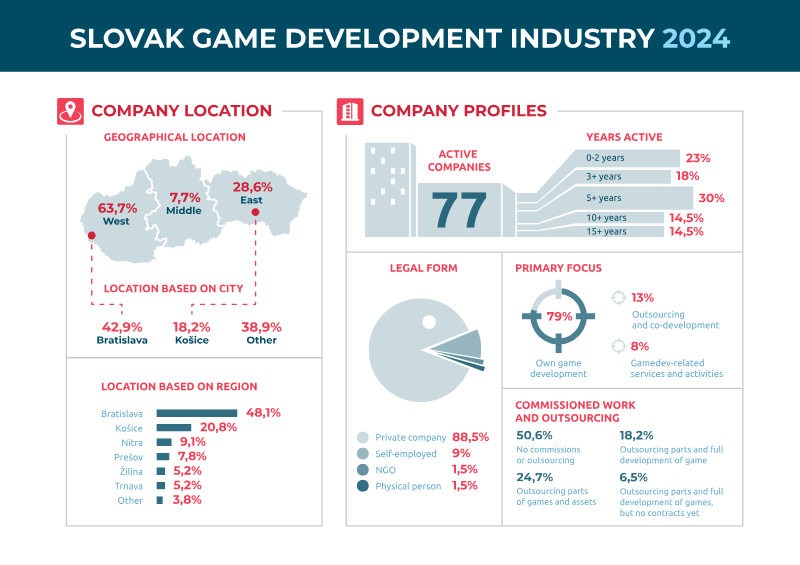
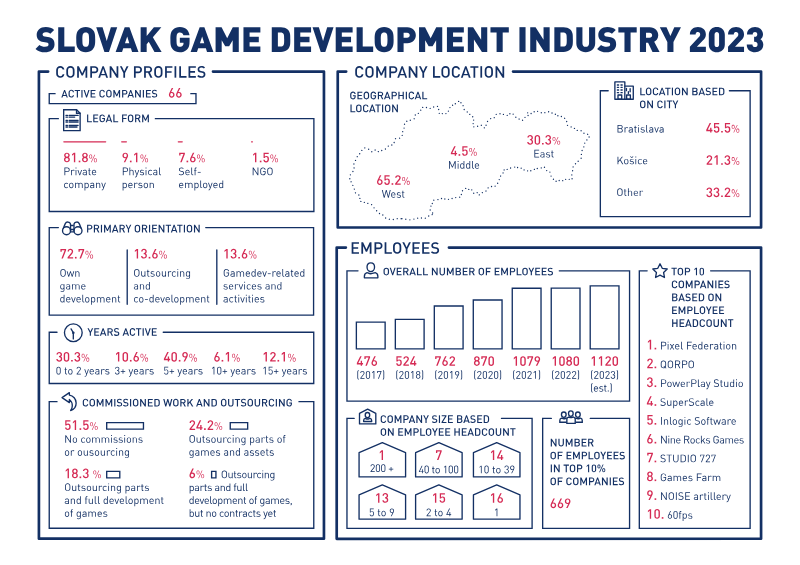
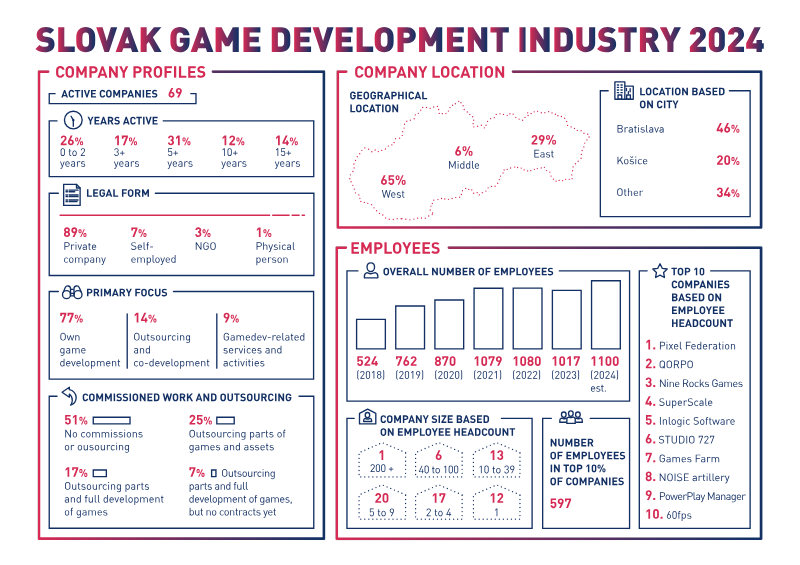
The Slovak game development industry in 2023 is characterized by a stable ecosystem of 66 active companies, primarily concentrated in the western region of the country. The sector is dominated by private entities, with 72.7% focusing on core game development and the remainder providing outsourcing or specialized services. While the industry features a mix of experience levels, over 40% of companies have been active for more than five years. The workforce has seen consistent growth, rising from 476 employees in 2017 to an estimated 1,120 in 2023. However, the industry exhibits significant centralization, with the top 10% of companies employing approximately 60% of the total workforce and generating 84.6% of the annual turnover. Financial data indicates a mature but plateauing market, with an overall turnover of €77.1 million in 2022 and a nearly identical estimate of €76.9 million for 2023. Pixel Federation, SuperScale, and Inlogic Software lead the market in both headcount and revenue. Development is largely self-funded, though 37.9% of companies utilize public funding. PC remains the primary target platform for development, followed by mobile and consoles. Notably, half of all projects remain unpublished, while those that reach the market are predominantly self-published via digital storefronts like Steam, Google Play, and the App Store. The labor market reveals a workforce with a median age of 30, where women represent 19% of the total headcount, primarily occupying roles in graphic arts and community management. Recruitment remains a challenge for specialized roles, particularly for programmers and game designers. To address talent shortages, nearly half of Slovak firms employ international staff, largely from Czechia and Ukraine. Operational trends show a decisive shift toward flexible work arrangements, with over 89% of companies utilizing remote or hybrid office models. Industry stakeholders express a strong desire for increased state support, specifically through tax incentives and improved education for the digital arts.