Investment
Documents

Sega Sammy Holdings Integrated Report 2025
Sega Sammy Holdings’ 2025 Integrated Report details a transformative strategic shift aimed at establishing a more balanced and resilient business portfolio. Historically reliant on the volatile Pachislot & Pachinko market, the Group is transitioning to a three-pillar structure: Entertainment Contents, Pachislot & Pachinko, and a newly formed Gaming Business. This "Welcome to the Next Level!" plan focuses on global expansion and transmedia integration to drive long-term growth through 2030.
The Entertainment Contents segment remains the primary revenue driver, contributing ¥321.5 billion of the Group’s ¥428.9 billion in FY2025 net sales. This growth is fueled by a "mille-feuille" revenue model that leverages major intellectual properties like Sonic the Hedgehog, Persona, and Like a Dragon across games, film, and licensing. Meanwhile, the Pachislot & Pachinko segment is being repositioned as a stable cash generator. To combat a shrinking domestic market, the Group is introducing innovative modular cabinet systems to reduce costs for operators and improve player engagement.
The most significant strategic development is the establishment of the Gaming Business as a third pillar, targeting the North American iGaming and B2B casino solutions markets. This expansion is underpinned by the major acquisitions of Rovio, GAN, and Stakelogic, totaling over ¥130 billion, alongside the divestment of non-core assets like the Phoenix Seagaia Resort. Financially, the Group reported a robust FY2025 performance with a profit of ¥45.1 billion and an ROE of 12.2%. Looking ahead, the Group targets a cumulative adjusted EBITDA of over ¥230 billion by FY2027, supported by a commitment to shareholder returns including a 50% total return ratio and a 3% dividend on equity. Sustainability and governance also remain central, with goals for carbon neutrality by 2050 and enhanced diversity within its global workforce.
- Sega Sammy is restructuring into a three-pillar business model comprising Entertainment Contents, Pachislot & Pachinko, and a new Gaming Business to reduce reliance on volatile domestic markets.
- The Entertainment Contents segment generated ¥321.5 billion of the Group's ¥428.9 billion total FY2025 net sales, driven by a transmedia strategy utilizing IPs like Sonic, Persona, and Like a Dragon.
- The company is aggressively entering the North American iGaming and B2B casino markets through over ¥130 billion in acquisitions, including Rovio, GAN, and Stakelogic.
- The Group reported a robust FY2025 financial performance with a profit of ¥45.1 billion and an ROE of 12.2%.
- Management has set a target of over ¥230 billion in cumulative adjusted EBITDA by FY2027, supported by a 50% total return ratio and a 3% dividend on equity.
Wyniki Finansowe 1H25
This financial summary details the performance of PCF Group (People Can Fly) for the first half of 2025, reflecting a period of organizational restructuring and portfolio transition. The group operates across two continents with a total workforce of 756 people as of June 30, 2025, a slight decrease from 2024 levels. This team is distributed primarily across studios in Warsaw, North America, and various European satellite locations, following the merger of PCF Chicago into PCF US.
Financial results for 1H 2025 show a significant recovery in profitability compared to the previous year. Revenue for the first half of 2025 reached 115.3 million PLN, a substantial increase over the 76.3 million PLN reported in 1H 2024. EBITDA improved from a loss of 11.3 million PLN in 1H 2024 to a positive 2.9 million PLN in 1H 2025. Despite these operational improvements, the group recorded a net loss of 21.3 million PLN for the period, though this represents a narrowing of the 33.3 million PLN net loss seen in the prior year. Key drivers for these results include the increased contribution of Project Echo, the inclusion of Project Delta in financial reporting, and accounting write-offs related to goodwill and licenses following the Chicago studio merger.
The group’s product strategy highlights a shift in its VR segment managed by Incuvo. While Green Hell VR continues to receive updates, including a successful co-op mode launch, the upcoming title Tracked: Shoot to Survive (Project Bison) is scheduled for a Q4 2025 release. This title will mark the final VR game published by PCF Group as it refines its long-term development focus. Quarterly revenue trends indicate a stabilization in the 50-60 million PLN range per quarter throughout late 2024 and early 2025, supported by a mix of work-for-hire projects and internal IP development.
- PCF Group revenue grew to 115.3 million PLN in 1H 2025, up from 76.3 million PLN in 1H 2024.
- EBITDA turned positive at 2.9 million PLN in 1H 2025, recovering from an 11.3 million PLN loss in the same period last year.
- The company narrowed its net loss to 21.3 million PLN in 1H 2025, compared to a 33.3 million PLN loss in 1H 2024, despite accounting write-offs from the Chicago studio merger.
- PCF Group is exiting the VR segment, with the Q4 2025 release of 'Tracked: Shoot to Survive' (Project Bison) serving as its final VR title.
- Quarterly revenue has stabilized in the 50-60 million PLN range, supported by a combination of work-for-hire projects and internal IP development.
Global Gaming Report Q3 2025
The third quarter of 2025 underscores the continued premium placed on hardware and platform players within the global gaming ecosystem, as investors assign a wide spectrum of valuation multiples that reflect divergent growth narratives and market positioning. Enterprise‑valued firms such as Dell and HP trade near a 1‑times EV/EBITDA ratio, indicating modest expectations for earnings expansion, while high‑growth entities like Nvidia and AppLovin command multiples exceeding 25‑times, with the latter reaching 42.8‑times, highlighting the market’s appetite for cutting‑edge processing power and mobile advertising integration. Across the board, most companies in the segment posted double‑digit year‑over‑year revenue increases, confirming robust demand for both traditional PC hardware and emerging cloud‑based gaming services.
Equity performance further illustrates the split between established hardware manufacturers and platform‑centric developers. Roblox delivered the strongest year‑to‑date appreciation at 136.9%, driven by expanding user engagement and monetization initiatives, while Unity recorded a 77‑percent gain, reflecting its pivotal role in cross‑platform development tools and the growing adoption of real‑time 3D content. These returns contrast sharply with the more muted trajectories of hardware‑only firms, suggesting that investors are rewarding firms that blend hardware capabilities with scalable software ecosystems.
Overall, the data portray a gaming market in which valuation is increasingly tied to the ability to integrate hardware performance with platform services, and where growth‑oriented companies enjoy markedly higher multiples and stock appreciation. The findings span a global landscape, covering major North American, European, and Asian players, and focus on the quarter ending September 2025, offering a snapshot of valuation dynamics and performance trends that are likely to shape strategic investment decisions throughout the remainder of the year.
- Investors are heavily favoring platform-centric companies over traditional hardware manufacturers, with high-growth firms like AppLovin and Nvidia commanding EV/EBITDA multiples exceeding 25x, compared to roughly 1x for legacy hardware firms like Dell and HP.
- Roblox led equity performance with a 136.9% year-to-date appreciation, driven by successful user engagement and monetization strategies.
- Unity recorded a 77% year-to-date gain, underscoring the market's high valuation of cross-platform development tools and real-time 3D content adoption.
- AppLovin reached a 42.8x EV/EBITDA multiple, reflecting strong market confidence in the integration of mobile advertising with gaming ecosystems.
- Most gaming companies reported double-digit year-over-year revenue growth in Q3 2025, confirming sustained demand across both PC hardware and cloud-based gaming services.
Consolidated Financial Results Briefing Materials: FY3/26 Q1
Akatsuki Inc. experienced a challenging start to the fiscal year ending March 2026, reporting a 44% year-over-year decline in consolidated sales to ¥2,313 million and an operating loss of ¥1,698 million for the first quarter. This downturn was primarily driven by a 52% revenue contraction in the core Games business, resulting from a reactionary fall following a strong prior quarter, strategic title withdrawals, and heightened development costs associated with the upcoming global launch of Kaiju No. 8 The Game. While total operating expenses decreased by 18% due to a 42% reduction in research and development spending and a streamlined portfolio, these savings were insufficient to offset the revenue decline and typical seasonal fluctuations.
Despite the volatility in gaming, the IP Solutions and Comics segments demonstrated robust growth. IP Solutions sales surged 168% to ¥298 million, bolstered by the consolidation of CRAYON, Inc. and the rapid expansion of the Slash Gift online lottery service. Simultaneously, the Comics segment broadened its international footprint through the MANGA MIRAI service in the United States, integrating high-profile titles such as One Piece and Naruto. The company also accelerated its expansion into new business domains through the full acquisition of the creator agency Natee Co., Ltd. and realized ¥1.2 billion in investment proceeds following the IPO of LIFE CREATE Co., Ltd.
The financial position remains liquid with ¥33.2 billion in cash and deposits, providing a stable foundation for ongoing strategic investments despite a slight decrease in total assets to ¥50.9 billion. The current fiscal trajectory reflects a transition period as the company rebalances its portfolio, shifting focus toward high-potential global IP launches and diversified digital entertainment services to mitigate the inherent cyclicality of the mobile gaming market.
- Akatsuki Inc. reported a 44% year-over-year decline in consolidated sales to ¥2,313 million and an operating loss of ¥1,698 million for Q1 FY3/26.
- The core Games business revenue contracted by 52% due to title withdrawals, a reactionary decline from the previous quarter, and high development costs for the upcoming 'Kaiju No. 8 The Game'.
- IP Solutions revenue grew 168% to ¥298 million, driven by the consolidation of CRAYON, Inc. and the expansion of the Slash Gift online lottery service.
- The company maintains a liquid financial position with ¥33.2 billion in cash and deposits, despite total assets decreasing to ¥50.9 billion.
- Operating expenses fell by 18% overall, supported by a 42% reduction in research and development spending and a streamlined game portfolio.

Annual Report 2025
Annual Report 2025 details a landmark financial year for Games Workshop, characterized by record-breaking growth and the company’s promotion to the FTSE 100. For the 2024/25 period, total revenue rose to £617.5 million, with profit before taxation reaching £262.8 million. This performance was driven by a 14.2% increase in core sales—particularly within the trade channel and North American markets—and a near-doubling of licensing operating profit to £49.5 million, bolstered by the exceptional success of the Space Marine 2 video game.
The company continues to leverage a vertically integrated model, expanding its global footprint to 570 retail stores across 24 countries and an independent retailer network spanning 71 nations. To support this growth, significant capital investments are underway, including the construction of a fourth manufacturing facility by 2026 and a comprehensive IT systems overhaul slated for completion by 2029. While navigating macroeconomic challenges such as projected tariff impacts and supply chain disruptions, the Group maintained a robust liquidity position with £132.6 million in cash and distributed a record £20 million in profit-sharing to its workforce.
Strategic priorities have shifted toward long-term value alignment, evidenced by a new remuneration policy that introduces share-based compensation for executives and a "Triennial Share Award" linked to revenue and profit targets. Sustainability remains a core focus; despite a rise in total emissions driven by global freight, the company surpassed its 2032 reduction targets for Scope 1 and 2 emissions through facility electrification. Looking forward, the Group is prioritizing internal talent development, digital engagement through Warhammer+, and a potential media partnership with Amazon to further scale the brand's global reach.
- Games Workshop achieved record financial results for 2024/25 with £617.5 million in revenue and £262.8 million in profit before taxation, leading to its promotion to the FTSE 100.
- Licensing operating profit nearly doubled to £49.5 million, largely driven by the commercial success of the Space Marine 2 video game.
- Core sales grew by 14.2%, fueled by strong performance in the trade channel and North American markets.
- The company is scaling infrastructure with a fourth manufacturing facility scheduled for 2026 and a major IT systems overhaul targeted for 2029.
- Management has implemented a new executive remuneration policy featuring share-based compensation and a Triennial Share Award tied to specific revenue and profit targets.
Video Game Industry Inspection Mission: Canary Islands
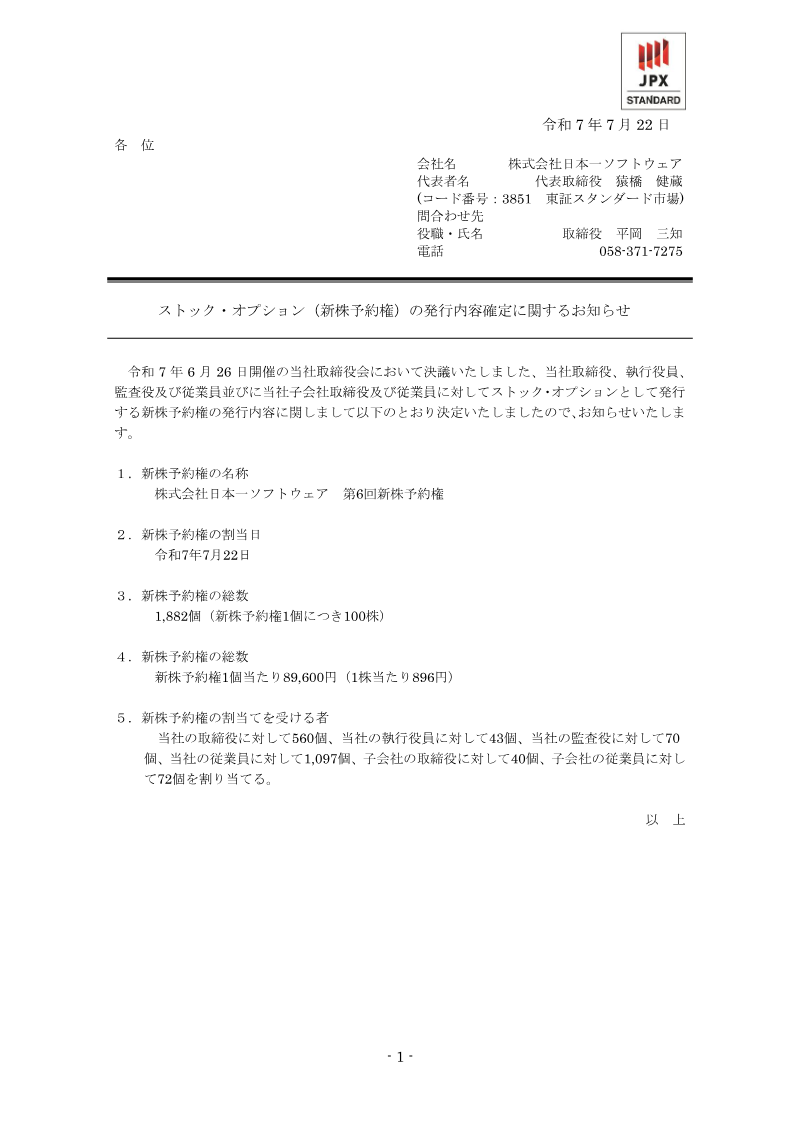
The announcement serves to formalize the issuance of a new series of stock options by Nippon Ichi Software Co., Ltd., a listed entity on the Tokyo Stock Exchange Standard Market. Following a board resolution on 26 June 2025, the company will allocate 1,882 stock options, each representing 100 shares, with an exercise price of ¥89,600 per option (equivalent to ¥896 per share). The allocation date is set for 22 July 2025, and the distribution targets internal stakeholders across the corporate hierarchy and its subsidiaries.
The breakdown of the allocation assigns 560 options to company directors, 43 to executive officers, 70 to auditors, and 1,097 to employees. Within the subsidiary structure, 40 options are designated for subsidiary directors and 72 for subsidiary employees. This distribution reflects a strategic effort to align the interests of management and staff with shareholder value, reinforcing incentive structures within the organization.
Contact details for inquiries are provided, listing Director Hiraka Mitsuchi as the point of reference, with a telephone number for direct communication. The notice underscores compliance with corporate governance standards and aims to ensure transparency regarding equity compensation for all eligible participants.
- Nippon Ichi Software will issue 1,882 stock options on 22 July 2025, with each option representing 100 shares.
- The exercise price for the new stock options is set at ¥89,600 per option, or ¥896 per share.
- The allocation targets a broad range of internal stakeholders, including 560 options for company directors and 1,097 for employees.
- Subsidiary staff and directors will receive a combined total of 112 options as part of the incentive program.
- Executive officers and auditors are allocated 43 and 70 options, respectively, to align internal interests with shareholder value.

Llibre Blanc de la Indústria Catalana del Videojoc 2024
I’m ready to combine the section summaries into a cohesive overview, but I’ll need the remaining sections to capture the full scope, key data points, and conclusions of the 2024 Catalan video‑game industry analysis. Could you please provide the rest of the section summaries?
- The Catalan video game industry generated €756 million in 2023, representing 53% of Spain's total revenue and a 6.6% increase from 2022. It employed 5,174 professionals, accounting for 50% of the national total.
- The industry is projected to reach €893 million by 2027, with an estimated compound annual growth rate (CAGR) of 4.3% for 2023-2027, despite an anticipated stagnation in 2024.
- In 2024, there were 262 video game studios in Catalonia, with 161 formally constituted as companies, a 10% increase from the previous year.
- Catalan studios primarily focus on original intellectual properties (91%), with self-publishing (54%) and third-party development (39%) being other popular activities. Serious games development increased to 22%.
- Digital premium sales are the main revenue source (40%), followed by outsourcing (16%) and service sales (14%). 74% of games developed in Catalonia include a Catalan language version.
Financial Results Q1 2025
The financial results for the first quarter of 2025 detail the operational and fiscal performance of PCF Group S.A., a global video game developer. The data reflects a period of strategic transition, characterized by rising quarterly revenues alongside shifting profitability margins. Total revenue for the first quarter of 2025 reached 63.0 million PLN, an increase from 56.9 million PLN in the same period of the previous year. Despite this growth, the group reported a net loss of 3.9 million PLN for the quarter, compared to a narrow loss of 0.9 million PLN in the first quarter of 2024. Adjusted EBITDA also saw a decline from 11.0 million PLN to 1.7 million PLN year-over-year.
The financial performance was influenced by several key operational factors, including the integration of PCF Chicago into PCF US and the inclusion of new projects such as Project Delta and Project Echo. Conversely, profitability was impacted by lower revenues from Project Gemini and the recognition of costs related to Project Bifrost within the cost of goods sold. The group’s workforce remained stable at 675 employees as of March 31, 2025, with a significant concentration of developers in Warsaw and North American studios.
In the virtual reality segment, the subsidiary Incuvo continues to manage Green Hell VR, which saw a successful co-op mode launch in late 2024. The group plans to release Project Bison in the fourth quarter of 2025, which is intended to be the final VR title published by PCF Group. Geographically, the group maintains a strong presence across Europe and North America, with its primary development hubs located in Poland and Canada. The methodology relies on consolidated financial data and internal project tracking as of the end of the first quarter of 2025.
- PCF Group S.A. reported Q1 2025 revenue of 63.0 million PLN, an increase from 56.9 million PLN in Q1 2024.
- The company recorded a net loss of 3.9 million PLN in Q1 2025, widening from a 0.9 million PLN loss in the same period last year.
- Adjusted EBITDA fell significantly year-over-year, dropping from 11.0 million PLN to 1.7 million PLN.
- Profitability was negatively impacted by lower revenues from Project Gemini and the recognition of costs associated with Project Bifrost.
- The group maintains a stable workforce of 675 employees, with primary development operations concentrated in Poland and North America.
Video Game Business Snapshot: Q2 2025
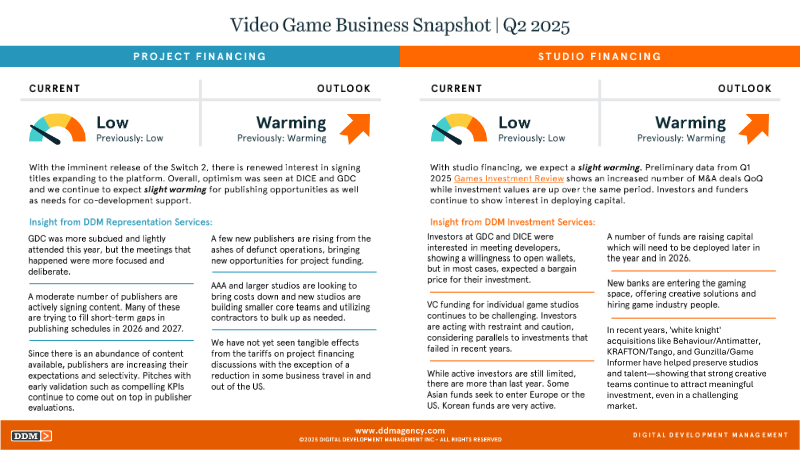
The second quarter of 2025 highlights a strategic shift in the video game industry’s mergers and acquisitions landscape, characterized by a rise in rescue-style investments often referred to as white knight acquisitions. These transactions involve established global entities stepping in to acquire studios or media outlets that might otherwise face closure or significant downsizing. Notable examples include KRAFTON’s acquisition of Tango Gameworks, Behaviour Interactive’s absorption of Antimatter, and Gunzilla Games’ involvement with Game Informer. These moves suggest that despite broader economic volatility and a contraction in traditional venture capital, high-quality creative talent and established intellectual properties remain highly valuable assets for diversified gaming conglomerates.
The current market environment reflects a transition where strategic preservation is prioritized over speculative growth. Large-scale publishers are increasingly focused on securing proven development teams to bolster their long-term pipelines, viewing these acquisitions as opportunities to integrate specialized expertise at a time when independent sustainability is difficult. This trend underscores a broader industry sentiment that while the capital market remains challenging, the underlying value of experienced human capital continues to drive significant deal flow. These developments indicate that the industry is moving toward a more consolidated but stable structure, where the survival of key creative hubs is facilitated by the strategic interests of larger market players.
- Q2 2025 is defined by a surge in 'white knight' acquisitions, where major conglomerates are purchasing studios facing closure or downsizing to preserve creative talent and intellectual property.
- Notable rescue acquisitions this quarter include KRAFTON’s purchase of Tango Gameworks, Behaviour Interactive’s absorption of Antimatter, and Gunzilla Games’ involvement with Game Informer.
- The industry is shifting away from speculative growth toward strategic preservation, as large publishers prioritize securing proven development teams to stabilize long-term production pipelines.
- Despite a contraction in traditional venture capital and broader economic volatility, experienced human capital remains a high-value asset driving deal flow.
- The current market environment is trending toward a more consolidated industry structure, where the survival of independent creative hubs is increasingly dependent on the strategic interests of larger market players.
FY2025.3 4Q Financial Results Presentation: Round One Corporation
FY2025.3 4Q Financial Results Presentation [Company Name] ROUND ONE Corporation [Company ID] 4680-QCODE [Event Type] Earnings Announcement [Event Name] Financial Results Briefing for the Fiscal Year Ended March 2025 [Fiscal Period] FY2025 4Q [Date] May 12, 2025 [Time] 15:30 – 16:30 (Total: 60 minutes, Presentation: 37 minutes, Q&A: 23 minutes) [Venue] Webcast President and Chief Executive ...
- ROUND ONE Corporation exceeded its FY2025.3 financial plan, achieving ¥27.22 billion in Ordinary Profit (8.6% above plan) and ¥27.00 billion in Operating Profit (5.0% above plan) on total sales of ¥177.05 billion (3.3% above plan).
- The company plans to adopt IFRS from FY2026.3, projecting a consolidated operating profit of ¥31.22 billion (IFRS), up from ¥27.00 billion (JGAAP) in FY2025.3, with the USA segment contributing ¥14.68 billion (IFRS) and Japan ¥18.18 billion (IFRS).
- ROUND ONE is considering price revisions of approximately 3% for Japan (excluding Amusement) and 4-5% for the USA, both starting from Q2 FY2026.3, to mitigate rising costs, including potential impacts from Trump tariffs on amusement prizes.
- The company is expanding its 'Delicious Project' in Japan, having signed contracts with 17 high-end cooperating merchants as of May 1, 2025, to offer Japanese B-grade/C-grade gourmet in a Food Hall format, targeting inbound American tourists.
- Capital allocation for FY2026.3 includes ¥9.6 billion for existing store facility investments (¥7.1 billion in the USA for amusement machines) and ¥33.9 billion for new store facility investments (¥27.9 billion in the USA).
Consolidated Financial Results Briefing Materials: FY3/25
Akatsuki Inc. demonstrated significant financial resilience in FY3/25, characterized by a 46% year-over-year surge in consolidated operating profit to ¥3,915 million. While total sales experienced a marginal 1% decline, the core Games segment maintained stability through high-performing legacy titles such as Dragon Ball Z Dokkan Battle and Romancing SaGa Re;univerSe. Strong overseas performance and successful large-scale events effectively offset nearly ¥6 billion in development expenses for upcoming projects. This period also marked a strategic turning point as the Comics and IP Solutions segments achieved profitability, driven by the international launch of the MANGA MIRAI service and the rapid expansion of the Slash Gift online lottery platform.
The company’s investment arm further bolstered the balance sheet, realizing ¥2,840 million in proceeds during the fiscal year with additional capital gains anticipated from the IPO of LIFE CREATE Co., Ltd. in early FY3/26. Despite a reduction in total headcount from 803 to 697, primarily within the Games division, permanent staffing levels remained consistent, reflecting a shift toward operational efficiency. This lean organizational structure supports a robust financial position, with ¥33.3 billion in cash reserves earmarked for a ¥35 billion growth investment plan over the next three years, focusing on mergers, acquisitions, and next-generation game development.
Looking toward FY3/26, the group anticipates sustained growth in sales and profit, anchored by the upcoming release of Kaiju No. 8 The Game and the continued scaling of its digital content divisions. To reflect this positive outlook and strong liquidity, the shareholder return policy has been revised upward, increasing the target Dividend on Equity from 3% to 4%. This strategy signals a transition into a new growth phase where diversified IP solutions and global service expansions complement the established mobile gaming portfolio.
- Akatsuki Inc. achieved a 46% year-over-year increase in consolidated operating profit to ¥3,915 million for FY3/25, despite a 1% decline in total sales.
- The company maintains ¥33.3 billion in cash reserves to fund a ¥35 billion growth investment plan over the next three years, targeting M&A and next-generation game development.
- Shareholder returns are increasing as the target Dividend on Equity (DOE) has been raised from 3% to 4% due to strong liquidity and a positive outlook.
- The Comics and IP Solutions segments reached profitability, supported by the international launch of MANGA MIRAI and the expansion of the Slash Gift online lottery platform.
- Investment activities generated ¥2,840 million in proceeds during FY3/25, with further capital gains expected from the upcoming IPO of LIFE CREATE Co., Ltd. in early FY3/26.
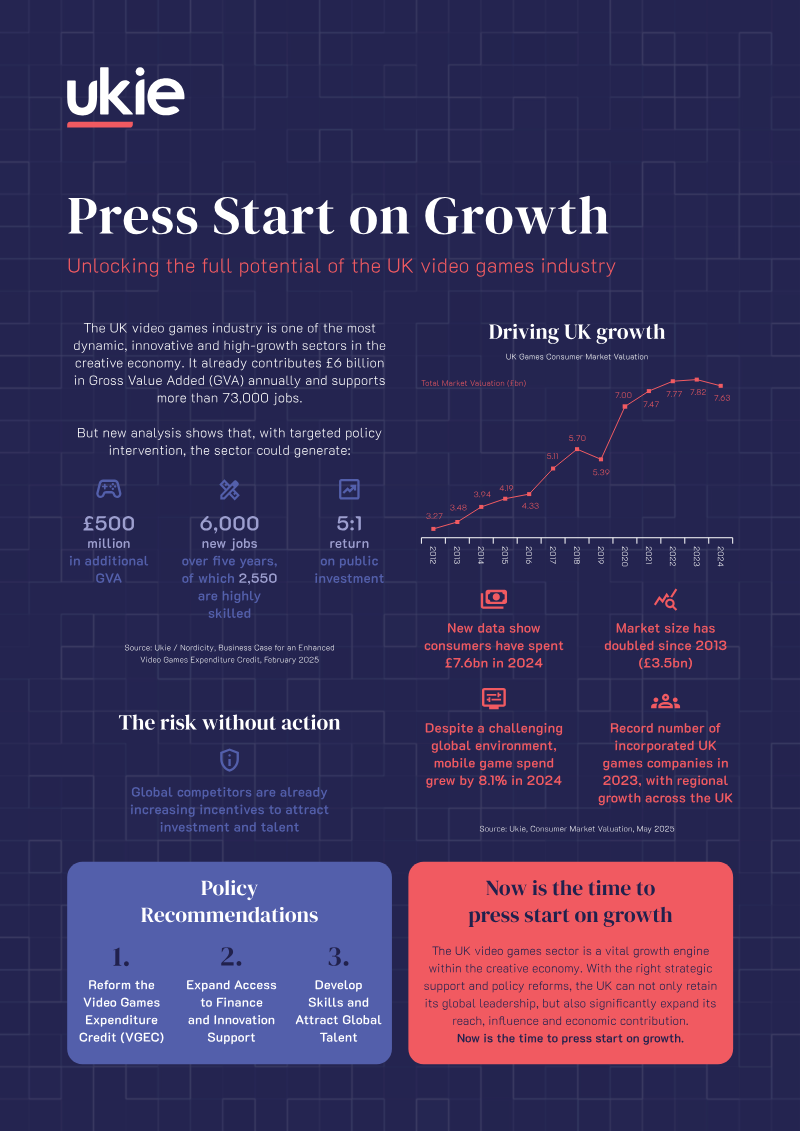
Press Start on Growth: Unlocking the Full Potential of the UK Video Games Industry
The analysis argues that the United Kingdom’s video‑games sector is a high‑growth pillar of the creative economy, already delivering roughly £6 billion in gross value added (GVA) and supporting more than 73 000 jobs, and that strategic policy action could lift its contribution to about £7.6 billion in 2024 and generate an additional £5.7 billion GVA and up to 5.4 million jobs over the next five years. The assessment covers the full UK market from 2022 through 2024, spanning software, hardware, live events, esports, ancillary merchandise and related media, and benchmarks performance against Western‑European averages.
Key findings show a continued erosion of physical boxed software, which fell 34 % year‑on‑year and now accounts for only 4 % of total spend, while mobile games grew 8 %—still below the 13 % regional average. Full‑game digital purchases slipped due to a thin slate of blockbuster releases, yet overall game volume remained stable. Live‑event spending contracted 15 % after pandemic‑related cancellations, whereas esports surged 44 % YoY, driven by a rise in UK‑based tournaments. Subscription revenue rose modestly as price hikes offset a near‑saturation of console subscriber bases. Hardware sales weakened for PS5 disc and Xbox consoles and for the Nintendo Switch, while the PS5 digital edition posted record software sales at a lower price point. Game‑culture engagement declined 13 % across PC and console categories, and related toy and merchandise sales fell 8.5 %.
The conclusions stress that without targeted reforms—particularly in financing, skills development, and talent support—the sector risks losing its global leadership. Conversely, coordinated policy could unlock further growth, broaden international reach, and reinforce the UK’s position as a leading hub for video‑games innovation and cultural influence. Data are drawn from industry sources such as Omdia, Ukie, NielsenIQ/GfK Entertainment, BFI, Comscore and the Official Charts Company, reflecting a comprehensive market‑valuation approach across multiple
- The UK video games industry currently contributes £6 billion in gross value added (GVA) and supports over 73,000 jobs, with the potential to add £5.7 billion in GVA and 5.4 million jobs over the next five years through strategic policy intervention.
- Physical boxed software sales have collapsed, falling 34% year-on-year to represent only 4% of total market spend.
- Esports experienced a significant surge of 44% year-on-year, driven by an increase in UK-based tournaments, contrasting with a 15% contraction in live-event spending.
- Mobile gaming in the UK grew by 8%, though this remains below the 13% regional Western-European average.
- Hardware sales for major consoles, including the PS5 disc edition, Xbox, and Nintendo Switch, weakened, while the PS5 digital edition achieved record software sales at a lower price point.