Global
Documents
Integrated Report 2018
I N T E G R AT E D R E P O R T 2 0 1 8 develops entertainment-related toys, network content, home video games, amusement machines, amusement facilities, and visual and music content. Under the Mid-term Plan, which was launched in April 2018, the Group aims to achieve “CHANGE” to progress to the next stage, with a Mid-term Vision of CHANGE for the NEXT: Empower, Gain Momentum, and Accelerate Evolution. “Dreams, Fun and Inspiration”are the Engine of Happiness.
- BANDAI NAMCO Group aims for ¥750 billion in net sales and ¥75 billion in operating profit by March 31, 2021, with an operating profit margin and ROE of 10% or more.
- The Group's business is segmented into Toys and Hobby, Network Entertainment, and Visual and Music Production, with Network Entertainment encompassing network content, home video games, arcade machines, and amusement facilities.
- In FY2018.3, amusement facilities generated ¥64.2 billion in sales from 1,870 facilities (293 directly managed, 1,563 revenue-sharing), while amusement machines generated ¥28.2 billion.
- BANDAI NAMCO Group was ranked among the top global app market publishers in 2017 based on revenue for iOS and Google Play, with Tencent being the top publisher.
- The Group emphasizes work-life balance through systems like extended childcare leave, flextime, shorter working hours, and support for family caregiving, exceeding legal requirements.
Fact Book 2019
1 BANDAI NAMCO Group Outline 3 Related Market Data Group Organization Toys and Hobby 01 Overview of Group Organization 20 Toy Market Results of Operations Figure Market 02 Consolidated Business Performance Capsule Toy Market Management Indicators Card Product Market 03 Sales by Category 22 Candy Toy Market Children’s Lifestyle (Sundries) Market Products ...
- The DRAGON BALL series was BANDAI NAMCO Group's top-performing IP in FY2019.3, generating ¥129.0 billion in groupwide sales, a significant increase from ¥97.9 billion in FY2018.3.
- The Mobile Suit Gundam series also showed strong growth, with groupwide sales increasing from ¥68.3 billion in FY2018.3 to ¥79.3 billion in FY2019.3.
- The Toys and Hobby Unit's sales of KAMEN RIDER series in Japan increased from ¥24.8 billion in FY2018.3 to ¥27.3 billion in FY2019.3, while the Super Sentai series saw a decrease from ¥9.1 billion to ¥6.0 billion in the same period.
- Cumulative worldwide shipments of the Tamagotchi (March 2004 to March 2019) reached 42.33 million units, following the first-generation Tamagotchi's 40.00 million units shipped between November 1996 and March 1999.
- The Real Entertainment Unit's amusement machine sales increased from ¥28.2 billion in FY2018.3 to ¥35.6 billion in FY2019.3, while amusement facilities sales slightly increased from ¥64.2 billion to ¥66.8 billion.
Integrated Report 2020
I N T E G R AT E D R E P O R T 2 0 2 0 The BANDAI NAMCO Group develops entertainment-related products and services in a wide range of fields, including toys, network content, home video games, amusement machines, amusement facilities, and visual and music content. “Dreams, Fun and Inspiration” are the Engine of Happiness.
- BANDAI NAMCO Group's Mid-Term Plan (April 2018-March 2021) aims to maximize IP value, expand globally, and develop high-growth regions/businesses, with a consolidated net sales forecast of ¥650,000 million and segment profit of ¥50,000 million for the fiscal year ending March 31, 2021.
- The company is strategically expanding in North America and China, focusing on Japanese IP, enhancing e-commerce, and bolstering sales to mature fans, including a joint venture with Shueisha Inc. established in 2019.
- BANDAI NAMCO's Toys and Hobby unit is celebrating the 40th anniversary of Gundam plastic models with strategic product launches, large-scale promotions, and media collaborations, while also expanding production facilities in Japan to meet overseas demand.
- In 2020, BANDAI CO., LTD. partnered with TOEI COMPANY, LTD. to open KAMEN RIDER STORE TOKYO, the world's first official Kamen Rider flagship store, targeting a wide range of customers from children to adults.
- The company views human resources as its most important asset, implementing performance-linked remuneration, systems for idea proposals across departments, and a group-wide recognition system (BANDAI NAMCO Awards) to foster innovation and employee engagement.
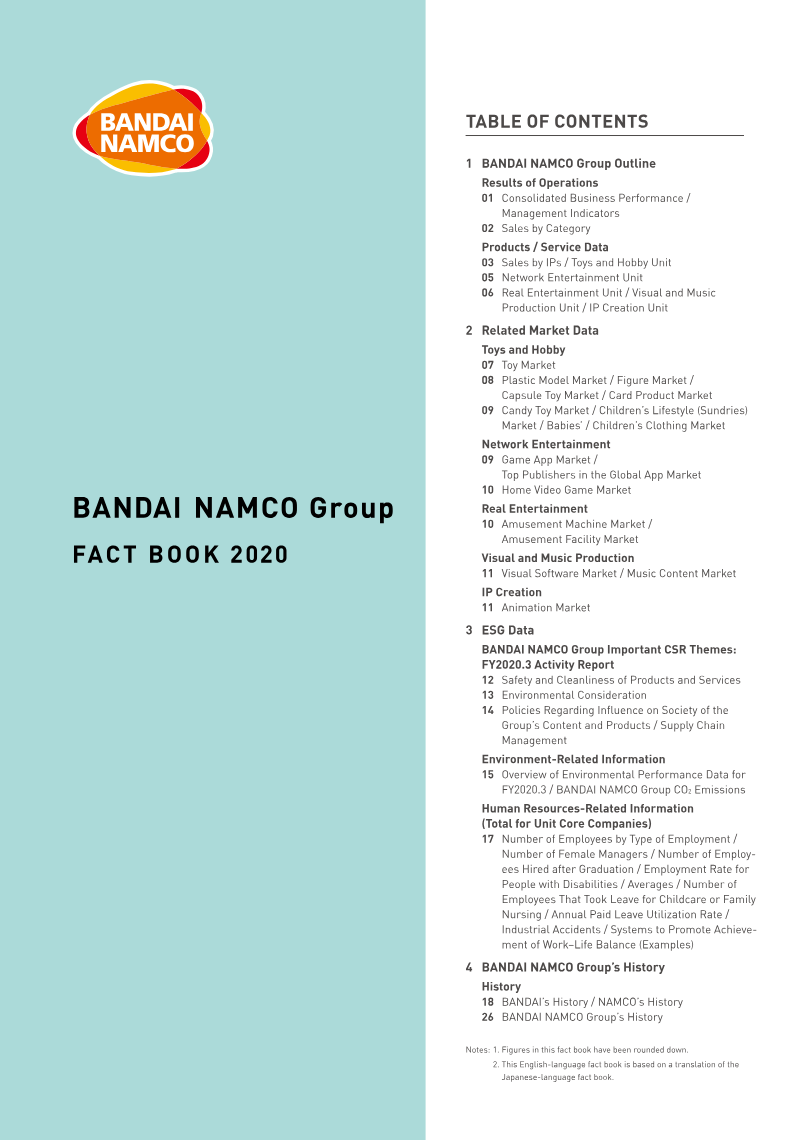
Bandai Namco Group Fact Book 2020
01 Consolidated Business Performance / 03 Sales by IPs / Toys and Hobby Unit 05 Network Entertainment Unit 06 Real Entertainment Unit / Visual and Music Production Unit / IP Creation Unit 08 Plastic Model Market / Figure Market / Capsule Toy Market / Card Product Market 09 Candy Toy Market / Children’s Lifestyle (Sundries) Market / Babies’ / Children’s Clothing Market Top Publishers in the Global App Market BANDAI NAMCO Group 10 Home Video Game Market 10 Amusement Machine Market /...
- Bandai Namco Group's Toys and Hobby Unit has achieved significant cumulative shipment volumes for key product lines as of March 2020: Gundam plastic models (696.73 million units), Ultraman soft figures (98.77 million units), Super Sentai series robots (30.45 million units), and Digital Monsters (14.15 million units).
- The Network Entertainment Unit's sales for network content decreased from ¥211.1 billion in FY2019.3 to ¥200.9 billion in FY2020.3, while home video game sales also slightly declined from ¥102.1 billion to ¥99.0 billion in the same period.
- As of March 2020, Bandai Namco Rights Marketing Inc. reported a cumulative total of 492,924,783 fee-based viewings for on-demand animation delivery since October 2002, with 4,508 productions (71,739 episodes) available.
- Bandai Namco Group was formed in September 2005 through the management integration of BANDAI and NAMCO, establishing NAMCO BANDAI Holdings Inc.
- The Japanese figure market reached ¥30.5 billion in FY2019, while the digital card market, where Bandai holds a significant share (60.8% in FY2019), was ¥24.7 billion in FY2019.
Bandai Namco Group Fact Book 2021
1 BANDAI NAMCO Group Outline 01 Consolidated Business Performance / 03 Sales by IPs / Facts & Figures Entertainment Unit (Digital Business) / Entertainment Unit (Toys and Hobby Business) 06 IP Production Unit (Visual and Music Business / Creation Business) / IP Production Unit (Visual and Music Business) / IP Production Unit (Creation Business) / Amusement Unit Entertainment Unit (Digital Business) 07 Game App Market / Top Publishers in the Global App Market / Home Video Game Market ...
- Bandai Namco Group's top-performing IP by sales (worldwide) in FY2021.3 was DRAGON BALL series at ¥127.4 billion, followed by Mobile Suit Gundam series at ¥95.0 billion and ONE PIECE at ¥38.0 billion.
- Network content sales (digital business) grew from ¥200.9 billion in FY2020.3 to ¥207.7 billion in FY2021.3, while home video game sales increased from ¥99.0 billion to ¥118.1 billion in the same period.
- Amusement unit sales declined significantly from FY2020.3 to FY2021.3, with amusement machines dropping from ¥27.1 billion to ¥16.7 billion and amusement facilities from ¥64.7 billion to ¥47.1 billion.
- Bandai Namco Group was ranked 6th globally among app market publishers in 2020, behind Nintendo, Playrix Ireland, Koei Tecmo, Activision Blizzard, and Zynga.
- The company has a strong history of product longevity, with cumulative shipments including 2.65 billion candy toys (since 1995), 101.87 million Ultraman soft figures (since 1983), and 30.89 million Super Sentai series robots (since 1979).
Integrated Report 2023
オンプロダクト-スタンドードタイプ 英語版 オンプロダクト-ミニラベル 英語版<sub>(印刷スペースが無い場合)</sub> https://www.bandainamco.co.jp/ 4C Bandai Namco exists to share dreams, fun and inspiration with people around the world. Connecting people and societies in the enjoyment of uniquely entertaining products and services, we’re working to create a brighter future for everyone.
- Bandai Namco Group's financial strategy aims to secure one year of labor costs (¥80.0 billion to ¥90.0 billion) and one to one-and-a-half months of working capital (approximately ¥100.0 billion) for stable operations.
- The company plans ¥40.0 billion in strategic investment to advance its IP axis strategy.
- Bandai Namco is standardizing information security across Group companies, with a test opening planned for October 2023, and is enhancing IT literacy through e-learning.
- The company is actively expanding the global reach of its Gundam and ONE PIECE IPs, particularly in North America and Europe, through online distribution and collaborations with local companies.
- Bandai Namco is addressing social issues through initiatives like plastic recycling campaigns with THE IDOLM@STER SHINY COLORS, and research into using games to solve social problems with Aoyama Gakuin University.
Bandai Namco Group Fact Book 2022
www.bandainamco.co.jp TABLE OF CONTENTS 1 Bandai Namco Group Outline 01 Consolidated Business Performance / Entertainment Unit (Digital Business) 04 Entertainment Unit (Toys and Hobby Business) 06 IP Production Unit (Visual and Music Business / Entertainment Unit (Digital Business) Entertainment Unit (Toys and Hobby Business) 09 Plastic Model Market / Figure Market / Capsule Toy Market / Card Product Market Children’s Lifestyle (Sundries) M...
- Bandai Namco Group's top-performing IPs by sales in FY2022.3 were DRAGON BALL series (¥127.6 billion), Mobile Suit Gundam series (¥101.7 billion), and ONE PIECE (¥44.1 billion).
- The Digital Business segment saw a decrease in network content sales from ¥207.7 billion in FY2021.3 to ¥185.5 billion in FY2022.3, but home video game sales increased significantly from ¥118.1 billion to ¥174.4 billion in the same period.
- As of March 2022, Bandai Namco Entertainment Inc. had 34 game app titles each on Google Play and the App Store, and 5 social media titles in Japan.
- The Toys and Hobby Business unit has achieved substantial cumulative shipment volumes for key products, including 2,699.59 million candy toys (since 1995) and 104.93 million Ultraman soft figures (since 1983).
- The Amusement Unit's sales increased from ¥63.8 billion in FY2021.3 to ¥82.3 billion in FY2022.3, with amusement facilities contributing the majority of sales (¥61.5 billion in FY2022.3).
Bandai Namco Group Fact Book 2023
www.bandainamco.co.jp TABLE OF CONTENTS 01 Consolidated Business Performance / 03 Sales by IPs / Entertainment Unit (Digital Business) 04 Entertainment Unit (Toys and Hobby Business) 06 IP Production Unit / Amusement Unit Entertainment Unit (Digital Business) 07 Game App Market / Home Video Game Market Entertainment Unit (Toys and Hobby Business) 09 Plastic Model Market / Figure Market / Capsule Toy Market / 10 Candy Toy Market / Children’s Lifestyle (Sundries) Mar...
- Bandai Namco Group's history includes the independent founding of Bandaiya in 1950 (later BANDAI) and Nakamura Manufacturing Ltd. in 1955 (later NAMCO), with significant milestones like PAC-MAN's introduction in 1980 and Tamagotchi's launch in 1996.
- The Gundam series is a major IP for Bandai Namco, with cumulative plastic model shipments reaching 761.11 million units by March 2023, including 577.05 million Real series and 1.27 million SD series units.
- Bandai Namco's Toys and Hobby Business saw significant sales from the Gundam series (¥60.5 billion in FY2023.3, up from ¥44.2 billion in FY2022.3) and KAMEN RIDER series (¥23.0 billion in FY2023.3, up from ¥22.8 billion in FY2022.3).
- The company's home video game titles have achieved substantial cumulative shipments, including the TEKKEN series (55.00 million units by March 2023) and the Super Robot Wars series (20.24 million units by March 2023).
- Bandai Namco is actively engaged in ESG initiatives, including sustainability activities utilizing IP to reduce environmental burdens (e.g., clothing donations for upcycling, plastic recycling PR with the Ministry of the Environment) and regional contribution activities like the Gundam Educational Program.
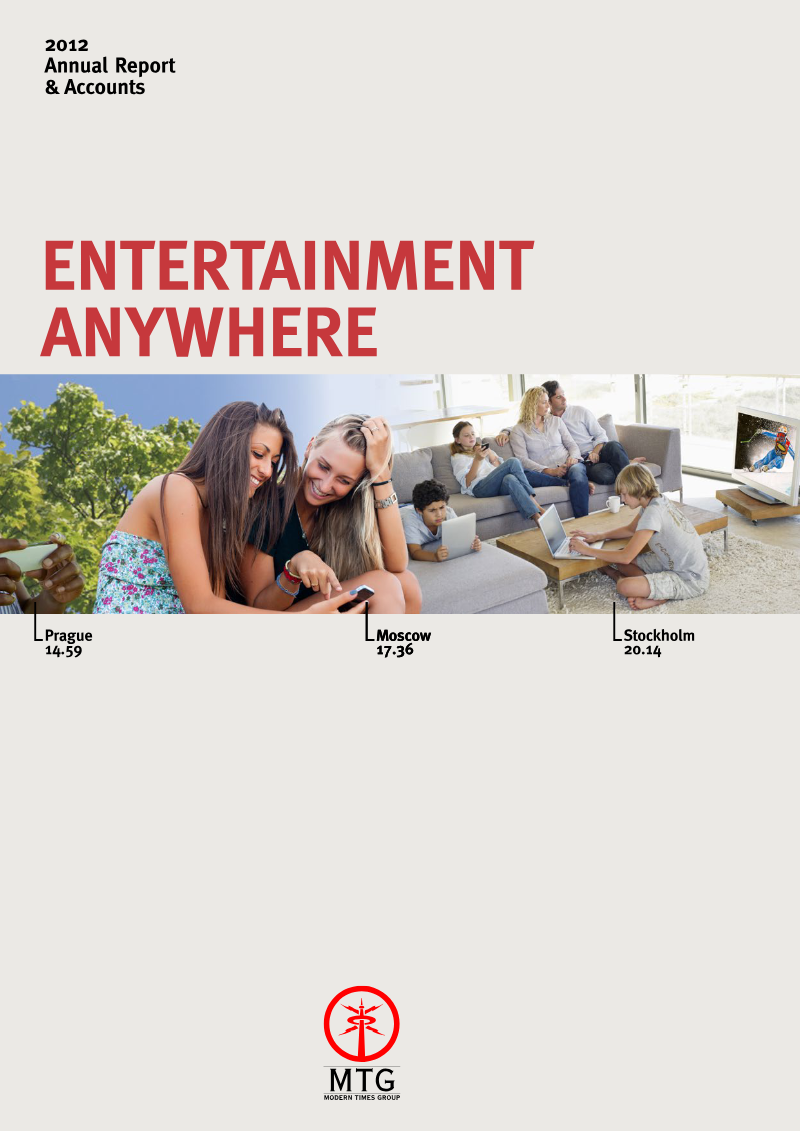
Annual Report and Accounts 2012
14.59 Moscow Stockholm CEO’s Review 1 CFO’s Review 4 Five Year Summary 6 Modern Responsibility 10 Directors’ Report 16 The MTG Share 46 Corporate Governance Report 50 Board of Directors 60 Executive Management 63 Consolidated Financial Statements 67 Parent Company Financial Statements ...
- In 2012, the Group acquired 80% of Zitius Service Delivery AB (Sweden's leading independent Open Access Communications Operator with ~150,000 connected fibre households), a 53% stake in Paprika Latino (a Central and Eastern European TV production group), and 100% of AS Latvijas Neatkarīgā Televīzija (Latvia's second largest free-TV channel operator).
- The Group sold its Bet24 operations to Unibet Group plc for approximately EUR 13.5 million on May 3, 2012.
- MTG received USD 7.8 million in dividends from CTC Media in December 2012, bringing total dividend payments from CTC Media in 2012 to USD 31.2 million.
- The Group's total operations generated revenues of 2,124 SEK million in 2012, compared to 2,492 SEK million in 2011 and 1,855 SEK million in 2010.
- Asset impairment charges and non-recurring costs were 3,352 SEK million in 2011, primarily due to charges in Bulgaria and Slovenia.
Annual Report & Accounts 2014: Sweden
CEO’s Review 1 Directors’ Report 11 The MTG Share 32 Corporate Governance Report 36 Board of Directors 46 Executive Management 49 Consolidated Financial Statements 54 Parent Company Financial Statements 59 Notes to the Accounts 64 Audit Report 119 Definitions 121 Glossary 12...
- MTG's net sales increased to SEK 15,746 million in 2014 from SEK 14,073 million in 2013, while total net income remained relatively stable at SEK 1,172 million in 2014 compared to SEK 1,168 million in 2013.
- The company's average number of employees grew significantly from 3,361 in 2013 to 4,059 in 2014, with a notable increase in Sweden (from 1,022 to 1,273 employees) and the UK (from 373 to 402 employees).
- MTG faces potential adverse impacts on its business from ongoing legal uncertainties regarding additional rights clearance for satellite TV transmissions and investigations into exclusive broadcasting rights for pay-TV services.
- The share capital of MTG consists of Class A, Class B, and Class C shares, with Class A shares carrying ten voting rights, and Class B and C shares carrying one voting right each; Class C shares do not entitle holders to dividends.
- The gender distribution among senior executives in 2014 showed 71% men and 29% women for the Group, and for the Parent Company, the Board of Directors was 71% men and 29% women, while other senior executives were 67% men and 33% women.
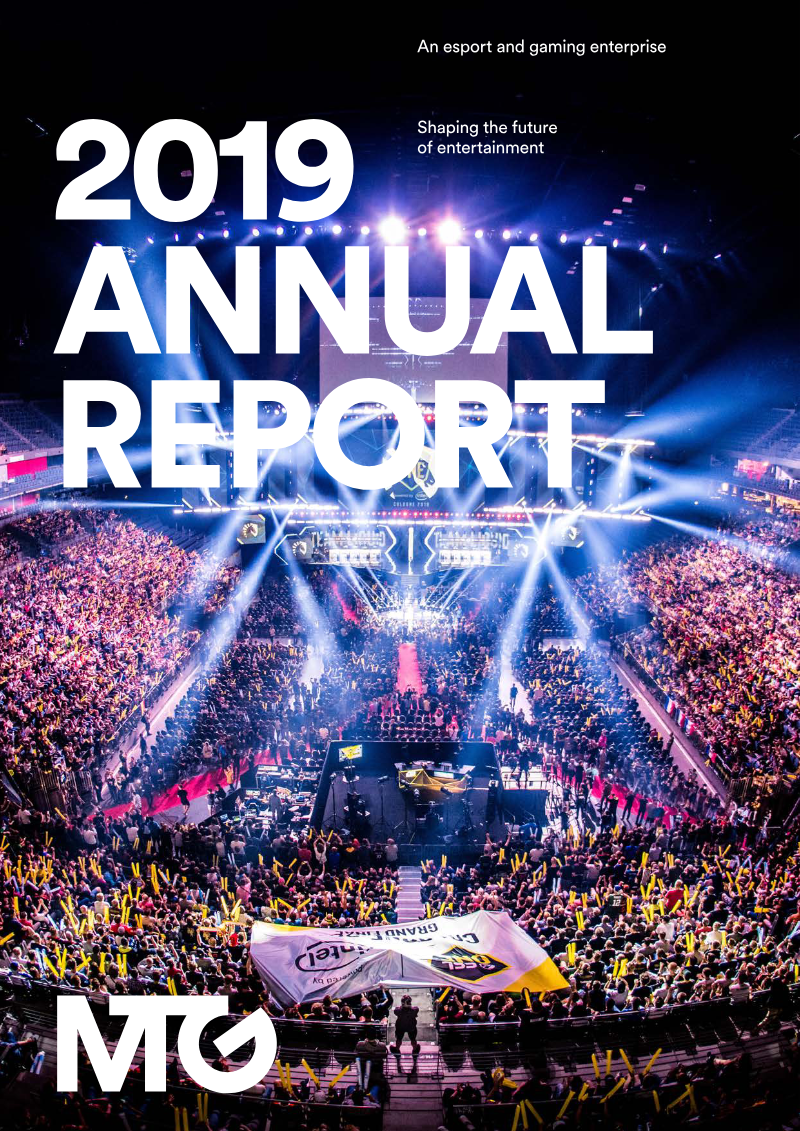
Annual Report 2019: Shaping the Future of Entertainment
Corporate responsibility and sustainability priorities are covered in MTG’s Annual Corporate Responsibility Report, published 19 S EGMENTAL PERFORMANCE 31 Other Group Information 34 Financial Policies and Risk Management 36 Governance and Responsibilities 41 Internal Control Report 101 ALTERNATIVE PERFORMANCE It’s impossible to reflect on 2019 without first commenting on the split of MTG into two companies in March – Nordic Enter- tainment and new MTG.
- MTG's 2019 strategy focused on profitable growth in esports and gaming, driven by the ESL Pro Tour launch, Kongregate's revised strategy, and Innogames' mobile revenue optimization.
- MTG divested Nova Broadcasting Group in Bulgaria for EUR 185 million (SEK 1,917 million) in January 2019 and Zoomin in October 2019, to focus on its core esports and gaming verticals.
- MTG announced annual savings, redundancy costs, and impairment charges in 2019 as part of a strategic review and evaluation of its gaming portfolio.
- MTG's esports vertical, comprising ESL and DreamHack, saw external sales of SEK 1,712 million in 2019, up from SEK 1,515 million in 2018, but reported an EBIT loss of SEK -430 million.
- The gaming vertical generated SEK 2,531 million in external sales in 2019, an increase from SEK 2,296 million in 2018, with an EBIT of SEK 269 million.
Q4 2025 Investor Presentation
The Q4 2025 investor presentation details a period of record financial performance for the company, characterized by significant revenue growth and successful strategic integration. The primary thesis centers on the company’s transformative year, highlighted by the successful consolidation of Plarium and a shift toward a midcore gaming focus. For the fourth quarter of 2025, the company achieved net sales of SEK 3,123 million, representing an 8% organic growth rate and a 108% increase in constant currency year-over-year. Adjusted EBITDA reached SEK 717 million, maintaining a 23% margin, while unlevered free cash flow totaled SEK 878 million with a 66% conversion rate.
The scope of the report covers the global gaming operations of the company throughout the 2025 fiscal year, with specific emphasis on the fourth quarter. Key operational findings indicate that user acquisition (UA) spending rose to 38% of revenue in Q4, a 98% year-over-year increase in constant currency, largely driven by the integration of Plarium and the scaling of casual and racing franchises. Revenue streams showed a notable shift, with direct-to-consumer contributions rising 600 basis points to 32% of the total. Franchise performance was bolstered by strong results in the racing and word game segments, which saw year-over-year growth of 43% and 28%, respectively.
Methodologically, the financial data is presented on a reported basis, with constant currency adjustments applied to isolate organic growth trends. The report incorporates full-year 2025 figures and highlights the impact of the Plarium acquisition, which was integrated into the group starting in February 2025. Looking ahead, the company concludes the period with a stable leverage ratio and a new organizational structure, positioning itself for continued midcore expansion and the potential public offering of its PlaySimple division.
- The company achieved Q4 2025 net sales of SEK 3,123 million, marking 8% organic growth and a 108% year-over-year increase in constant currency.
- Adjusted EBITDA for Q4 2025 reached SEK 717 million with a 23% margin, supported by an unlevered free cash flow of SEK 878 million.
- User acquisition spending surged to 38% of revenue in Q4, representing a 98% year-over-year increase driven by the integration of Plarium and scaling of casual and racing franchises.
- Direct-to-consumer revenue contributions grew by 600 basis points to reach 32% of total Q4 revenue.
- Key franchise segments showed strong momentum, with racing games growing 43% and word games growing 28% year-over-year.