Game Design reports and market data
Documents

Why I Spent 5 Years On My Game (And Was It Worth It?)
The primary motivation for long-term game development is personal passion rather than purely commercial optimization.
- Prioritizing personal passion for a project is essential for long-term development, as creators are unlikely to finish games they do not love during multi-year production cycles.
- Game development cycles can be lengthy, with the speaker spending five years developing his BioShock-inspired title, Twisted Tower.
- Niche projects driven by deep personal interest can still find a viable audience, as there are likely 10,000 to 100,000 players globally who share specific, unconventional thematic tastes.
Space Marine 2 developer: “We can just do AAA games smarter”
Saber Interactive, led by Chief Creative Officer Tim Willits, has established a successful business model centered on delivering high-quality, AAA-style experiences through disciplined scoping and operational efficiency.
- Saber Interactive maintains a workforce of 3,500 employees and achieves AAA-quality output by strictly avoiding over-scoping and prioritizing operational efficiency.
- The studio focuses on core gameplay loops, such as the swarm mechanics in World War Z, which helped the title reach over 30 million players.
- Saber utilizes a flexible, non-siloed internal culture that allows talent to move dynamically between projects to optimize resource allocation.

Let's Review Your Games — Ep. 051
Indie game development success hinges on the ability to balance atmospheric ambition with rigorous technical polish and intuitive player onboarding.
- Games must provide players with clear objectives, motives, and a sense of destination within the first few minutes of gameplay to maintain engagement.
- Inconsistent visual fidelity, such as mixing low-poly character models with high-fidelity environments or mismatched art styles, undermines the professional presentation of a game.
- Effective level design should utilize a grid-based system to prevent collision issues and ensure player movement remains fluid and frustration-free.

He Made Games For Twenty Years... And Finally Went Viral (w/ Jake Birkett) — Ep 69
Achieving breakout success in the independent game industry requires a transition from solitary development to a data-driven, collaborative strategy.
- To validate a game concept before full production, create a 'smoke and mirrors' trailer combining gameplay and real-life footage to test audience interest and prevent spending years on a 'dead duck'.
- Demos serve as critical marketing and testing tools; using AI to summarize player feedback from demos allows developers to identify sentiment and make necessary adjustments before the 1.0 launch.
- Managing player expectations is vital for high review scores; by clearly defining the game genre and avoiding misleading labels, developers can filter their audience to ensure the game reaches players who actually enjoy that specific type of experience.

Inside New York Times Games: Why Killing 96% of New Ideas Is the Win
New York Times Games operates on a subscription-based model that prioritizes long-term player engagement and brand integrity over the aggressive monetization tactics prevalent in the broader mobile gaming industry.
- New York Times Games maintains a rigorous development filter, greenlighting only 3% to 4% of all proposed game concepts.
- The division prioritizes a subscription-based model over aggressive monetization, explicitly avoiding gacha mechanics and in-app purchases to focus on long-term player engagement.
- New game concepts undergo soft launches in Canada to validate retention metrics, specifically analyzing D7/D1 and D30/D7 slopes before global release.

🎮 Clash of Critters: Pokémon from Wish! Coin Looter + Pachinko + Idle RPG
Clash of Critters represents a strategic attempt to capture market share by blending coin-looter mechanics with idle RPG progression and social-casino raid features.
- Clash of Critters currently generates approximately $200,000 in daily revenue, with its long-term viability dependent on a successful, full-scale launch in Asian markets.
- The game utilizes a hybrid model that integrates pachinko-style coin-looter mechanics with idle RPG progression and social-casino raid features.
- The project’s marketing strategy relied heavily on aggressive use of Pokémon intellectual property and AI-generated creatives to lower initial user acquisition costs, particularly in Japan.

🎮 Full Steam Ahead: The Q1 Steam games that should hit mobile
Mobile gaming currently suffers from a stagnation of creative concepts, relying heavily on the adaptation of successful mechanics pioneered on the Steam platform.
- The deck-building genre represents a massive growth opportunity, evidenced by Slay the Spire increasing its revenue from $53 million to $140 million in a single quarter, with projections reaching $250 million by year-end.
- High-performing Q1 Steam titles demonstrate that unique gameplay loops—such as physics-based puzzles, room-cleaning simulations, and roguelike variations of traditional gambling games—are prime candidates for mobile adaptation.
- Mobile gaming currently relies on adapting successful Steam mechanics to overcome creative stagnation and drive user acquisition.
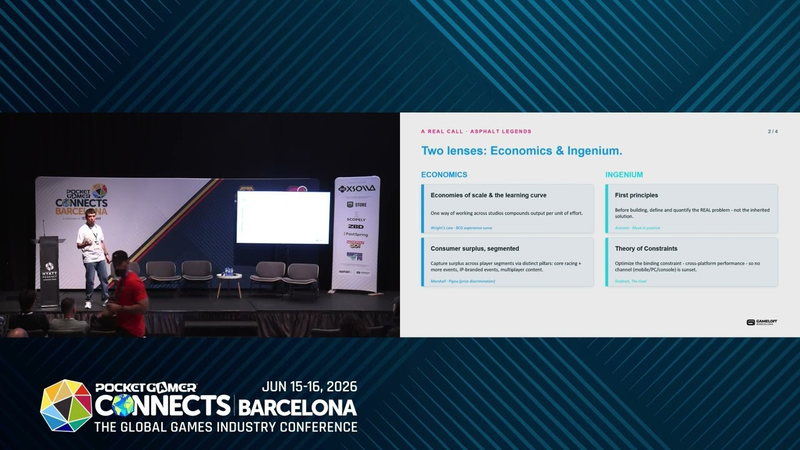
NEW ** Session: Time To Resolve - Raúl Orrego del Río, Gameloft Barcelona.
The presentation explores the intersection of decision-making, psychology, and game development, arguing that success in the industry is a hybrid of skill and luck.
- The video game industry operates closer to poker than chess, meaning success is heavily influenced by luck; therefore, leaders must focus on the quality of their decision-making process rather than just the outcome of individual projects.
- To improve project performance, shift from solution-oriented development to 'Gate Zero'—a process that prioritizes identifying the core problem from a quantitative perspective before defining features.
- Decision-making capacity is a finite resource; leaders should prioritize critical choices and delegate or defer minor ones to avoid exhausting the prefrontal cortex's limited 'mana' or logical energy budget.

🎮 Live Review Tetris Block Party: Block + Coin Looter into one liveops machine
Tetris Block Party represents a strategic evolution in mobile gaming by merging traditional block-puzzle mechanics with a coin-looter meta.
- Tetris Block Party increases player agency by replacing passive slot-based mechanics with a hybrid model that combines skill-oriented block puzzles with a coin-looter meta.
- The game utilizes template-based event builders that allow monetization managers to deploy complex features like reward wheels and segmented store configurations without requiring engineering support.
- Predictive data models enable automated, proactive interventions, such as granting boosters to players at high risk of churn, which has reduced churn rates by low double-digit percentages.
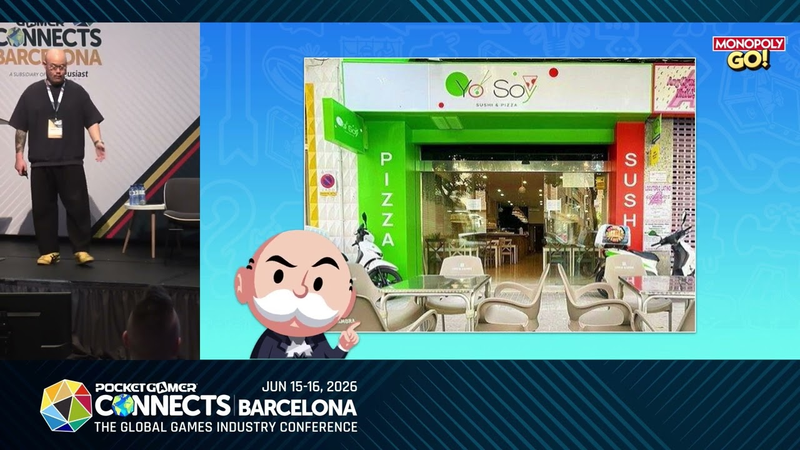
Session: Designing For Billions: Crafting A Distinct Visual Identity For A Hit Global Game. H. Shin.
The development of the mobile game Monopoly Go required a strategic pivot after an initial two-and-a-half-year development cycle failed to resonate with the target audience.
- To avoid the trap of creating a game that tries to please everyone but satisfies no one, the development team moved away from generic casual art styles to establish a cohesive, distinct visual identity rooted in specific design pillars.
- The team defined the game's visual language through three core pillars inspired by 1930s culture: the physical comedy and movement of Charlie Chaplin, the timeless volume and color theory of 1930s animation, and the modular, consistent design philosophy of Lego.
- To solve the challenge of making 'capitalism fun,' the team adopted the humor and visual tone of the cartoon DuckTales to guide character expressions and gameplay interactions.
Number Go Up Featuring Orb of Creation 1.0 | Design Club
Incremental games, often categorized as idlers or clickers, are defined by a core design loop centered on the optimization of systems to achieve exponentially increasing values.
- Incremental games shift the player's role from a passive clicker to a manager of complex, interdependent systems by prioritizing the optimization of exponentially increasing values.
- Orb of Creation distinguishes itself within the genre by requiring active, strategic input across multi-layered systems like alchemy, gardening, and combat rituals rather than relying on passive idling.
- Long-term engagement in incremental games depends on balancing accessible early-game loops with high-complexity thresholds that prevent optimization traps and time-based penalties.
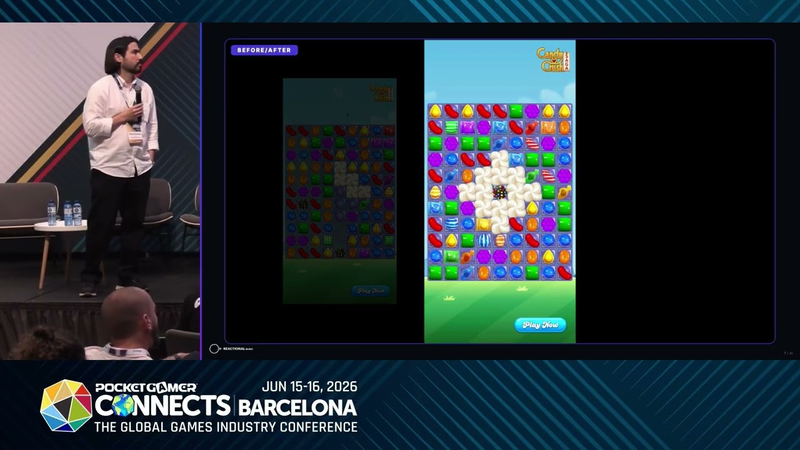
Session: Hit Music In UA-Unpacking the Impact of Commercial Hit Music In Mobile Games - T. Jenneborg
The integration of commercial hit music into mobile game user acquisition (UA) represents a significant, largely untapped opportunity to drive engagement and install rates.
- Reactional Music provides a platform that handles music licensing and technical integration to enable the use of popular, high-stream-count music in mobile game user acquisition (UA) campaigns.
- Early testing indicates that incorporating hit music into playable ads increases install rates and engagement compared to baseline assets.
- The platform utilizes a patented engine to synchronize game events with music, allowing publishers to batch-export multiple ad variations that react to specific beats or vocal melodies.