AI reports and market data
Documents

From missile defense to user acquisition – How advanced AI models predict performance
Predictive intelligence technology, specifically machine learning, serves as a transformative tool for optimizing user acquisition (UA) and mitigating wasted advertising spend.
- Integrating predictive AI into user acquisition can nearly double the success rate of campaign management decisions compared to manual oversight alone.
- Predictive models identify an 'optimum CPI' threshold where additional advertising spend transitions from boosting ROI to yielding diminishing returns.
- Machine learning algorithms analyze granular metrics, such as day-by-day ROI accumulation and the correlation between CPI and user value, to forecast future performance with high precision.
Modeling AI Perception and Awareness in Splinter Cell: Blacklist
The design of artificial intelligence in Splinter Cell: Blacklist centers on the philosophy that player experience and perceived fairness must take precedence over strict, uncompromising simulation.
- To ensure AI feels intelligent, developers should prioritize 'plausibility' over complex simulation, focusing on what the player perceives rather than what the AI technically knows.
- The Tactical Environment System (TESS) uses position nodes linked by choke points to prevent NPCs from staring at players through walls, ensuring they only react to threats within a logical pathing or line-of-sight connection.
- Detection models should utilize raycasting against multiple body bones to determine visibility, with the number of required visible bones scaling based on the player's stance and cover state.

Math for Game Programmers: Mixing Geodetic, Hand-crafted and Procedural Geometry
This presentation explores the application of implicit geometry and radial basis functions (RBFs) for procedural content generation and simulation in video games.
- Implicit geometry using radial basis functions (RBFs) allows for continuous, morphing surfaces that interpolate scattered data points more effectively than traditional mesh-based methods.
- Unbounded kernel functions are superior to bounded kernels like Gaussians for complex surface interpolation because they provide the infinite support necessary to eliminate gaps between control points.
- Potential flow fields governed by Laplace’s equation can generate high-quality offset surfaces by solving a linear system based on source elements placed on handcrafted mesh polygons.

Turing Tantrums 2017: AI Devs Rant
The game development industry currently suffers from a rigid, outdated professional classification system that stifles individual growth and team efficiency.
- The industry must transition from broad professional labels like 'programmer' or 'designer' to a granular, skill-based framework to improve team efficiency and individual growth.
- Artificial intelligence development is currently stagnant due to an over-reliance on legacy architectures like behavior trees and a preference for mundane solutions over innovation.
- Machine learning has failed to provide meaningful improvements to player experiences or secure increased resource allocation despite significant industry hype.
User acquisition – Can robots do it better?
Automating user acquisition requires a foundational shift toward robust data infrastructure, where the integration of cost data with lifetime value and return on investment metrics serves as the primary engine for growth.
- Automating user acquisition requires building a robust data infrastructure that integrates cost data with lifetime value (LTV) and return on investment (ROI) metrics to enable dynamic, profit-reinvestment strategies.
- Transitioning from manual reporting and fixed-budget models to automated systems allows marketing teams to shift focus from administrative tasks to high-level strategic variables that drive competitive advantage.
- A hybrid approach is currently necessary because technological limitations, such as fragmented API integrations and the inability of ad networks to optimize for post-install events, prevent full automation.
Lessons learnt from working with new platforms
Successful innovation in the gaming industry requires a fundamental shift in design philosophy when transitioning to emerging technologies such as augmented reality, virtual reality, and artificial intelligence.
- Successful innovation on emerging platforms requires designing native mechanics rather than porting legacy systems, such as using mobile devices as physical controllers or integrating procedural dialogue.
- Early adoption of bleeding-edge technologies provides strategic advantages, including direct access to platform holders, increased market visibility, and the ability to define industry best practices.
- Development teams must maintain organizational agility and utilize flexible game engines to adapt to the high technical volatility and shifting hardware specifications inherent in new platforms.

User acquisition – can robots do it better?
Industry-academia partnerships serve as a critical engine for innovation within the gaming sector, bridging the gap between theoretical research and commercial application.
- Industry-academia partnerships enable the integration of AI-driven performance capture, which can reduce manual labor requirements in game development by up to 80 percent.
- Collaborations are most effective when following a structured Theory-Research-Development-Application process, which prevents research goals from becoming diluted by overly broad agendas.
- Strategic partnerships serve as a long-term mechanism for high-risk innovation and the recruitment of specialized talent, providing companies with early access to highly skilled graduates.
What Are You Driving At? Vehicle AI in Assassin's Creed Syndicate
The implementation of vehicle artificial intelligence in Assassin’s Creed Syndicate was driven by the need to integrate dynamic, physics-based carriages into a world defined by parkour, stealth, and historical accuracy.
- To integrate carriages into Assassin's Creed Syndicate, developers implemented 'navmesh patching,' which dynamically alters the navigation mesh by punching holes in it based on the vehicle's rigid body size to allow NPCs to interact with moving vehicles.
- Due to the high computational cost of navmesh patching, the system was limited to updating only one vehicle per frame and prioritized patching based on the vehicle's proximity to the player.
- The team utilized 'virtual vehicles'—fake entities existing in virtual space—to group NPCs by faction, allowing multiple NPCs to spawn with a single vehicle request rather than spawning individual vehicles for every enemy.
Creating Complex AI Behavior in Stellaris Through Data-Driven Design
Stellaris employs a sophisticated, data-driven, utility-based artificial intelligence architecture designed to manage complex decision-making processes within a grand strategy framework.
- Paradox Interactive utilizes a data-driven AI architecture in Stellaris to separate game logic from content, allowing designers to modify NPC behavior via scripts without requiring constant code recompilation.
- The system uses a weighted algorithm to drive AI decision-making, where designers assign values to specific actions (such as ship construction or perk selection) that the AI evaluates against current game states.
- Data-driven design enables rapid content expansion; for example, implementing complex features like traditions and ascension perks required less than a day of programming work because the underlying logic was already modular.
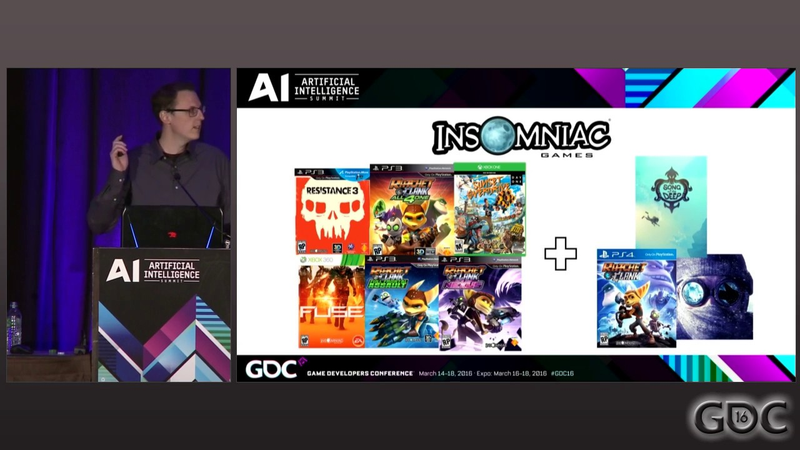
Mind Your Step: Avoiding 3 Common Pitfalls in AI Development
Effective artificial intelligence in gaming relies on prioritizing bespoke, interaction-focused mechanics over generic, reusable code.
- Prioritize bespoke, interaction-focused AI behaviors over generic, reusable code to ensure gameplay moments remain contextually nuanced and memorable.
- Align AI character roles with specific archetypes—such as the Teacher, VIP, or Soldier—to manage player expectations and prevent frustration or disengagement.
- Avoid over-automating support tasks like ammunition replenishment or infinite revives, as these systems can diminish the player's sense of accomplishment.
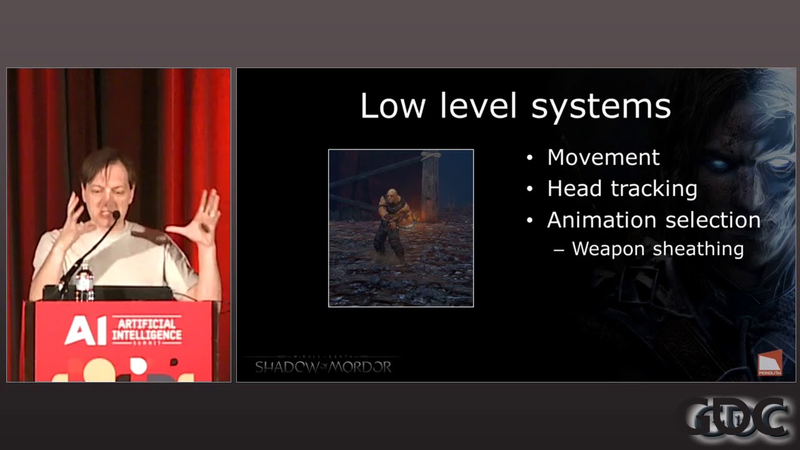
Goal-Oriented Action Planning: Ten Years of AI Programming
Goal-Oriented Action Planning (GOAP) serves as a robust framework for creating reactive, intelligent non-player characters by utilizing A search algorithms to navigate sequences of world-state variables.
- Goal-Oriented Action Planning (GOAP) utilizes A search algorithms to replace rigid, hard-coded scripts with dynamic, state-driven NPC behaviors.
- Performance in complex environments like F.E.A.R., Shadow of Mordor, and Ryse is maintained by focusing computational power on the 20 percent of actions that drive 80 percent of AI behavior.
- Scalability is achieved by offloading low-level tasks, such as animation or weapon equipping, to external systems while using hierarchical blackboards for group-level coordination.
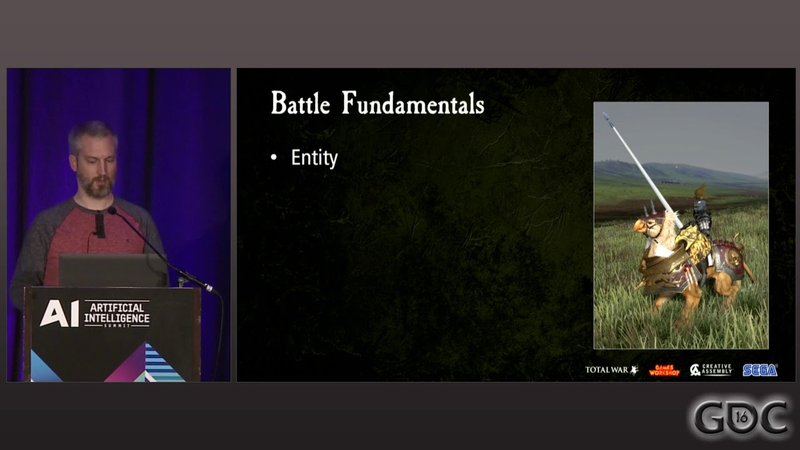
Siege Battle AI in Total War: Warhammer
The siege AI architecture in Total War: Warhammer represents a fundamental shift from the deliberate, multi-phase engagements of previous titles toward a high-intensity, streamlined combat model.
- The siege AI utilizes a hierarchical structure governed by a Grand Tactical Analyzer, replacing traditional finite state machines to enable coordinated, human-like maneuvers during wall assaults and street fighting.
- A flexible bit-field flag system replaces rigid unit classifications, allowing the AI to dynamically assign roles based on functional capabilities like gate-breaking or melee combat.
- The system employs a prefab-based layout architecture that integrates AI hints and settlement perimeters to ensure consistent tactical performance across diverse urban maps.