AI reports and market data
Documents
Winding Road Ahead: Designing Utility AI with Curvature
The presentation introduces Curvature, a standalone, open-source utility AI design tool developed to address the common industry challenge of making complex AI behaviors intuitive and accessible for designers.
- Curvature is an open-source, engine-agnostic utility AI tool designed to decouple AI logic from game engine pipelines, enabling real-time editing and faster iteration.
- The tool utilizes a natural language-based preset generator that maps plain-language behavioral descriptions to complex mathematical response curves, lowering the barrier to entry for designers.
- Designers can achieve 'intuition through play' by visualizing how specific input variables, such as distance or team affiliation, directly influence agent scores and final behavioral outcomes.
Virtual Insanity: Meta AI on Assassin's Creed: Origins
The development of Assassin’s Creed: Origins introduced a sophisticated Meta AI architecture designed to sustain a persistent, living ecosystem within a massive open-world environment.
- Ubisoft implemented a 'Meta AI' system for Assassin's Creed: Origins that manages NPCs and objects globally, allowing them to function autonomously, navigate, and maintain persistent states even when they are far from the player or outside the loaded nav mesh.
- The game utilizes an AI network graph to handle long-range navigation for entities, enabling NPCs to travel across the map and perform scheduled tasks like eating or socializing without requiring the player's presence.
- To optimize performance, the engine uses a component-level Level of Detail (LOD) system with six states based on distance and visibility, allowing the game to disable or reduce the update frequency of specific components like head-tracking or AI logic.
Beyond Bots: Making Machine Learning Accessible and Useful
Machine learning is rapidly transitioning from a theoretical research discipline into a practical, scalable toolkit for modern game development.
- Machine learning is shifting from theoretical research to a practical toolkit for automating complex engineering tasks like character locomotion and physics-based behavioral modeling.
- Reinforcement learning, when implemented via iterative experimentation and defined reward functions, serves as a primary method for increasing development productivity and software reliability.
- Generative models—including grid search for neural network optimization, style transfer, and latent space interpolation—act as creative force multipliers for artists and designers.
Massive Crowd on Assassin's Creed Unity: AI Recycling
Achieving unprecedented crowd density in Assassin's Creed Unity required the development of a sophisticated AI Level of Detail framework known as the Bulk system.
- The 'Bulk' system manages up to 10,000 NPCs by categorizing them into three proximity-based states: high-fidelity autonomous NPCs, mid-range Puppet NPCs, and long-range Low-Res meshes.
- Engine performance is optimized by reducing polygon counts for distant entities from 20,000 to 2,000, allowing the crowd system to consume only 5% of the total RAM budget.
- The architecture utilizes a deterministic 'Shepherd' container that employs pre-calculated paths and pooled assets to maintain consistent CPU and memory efficiency.

More "I", Less "A" in AI Interviews
Effective technical hiring in the game industry requires a shift away from abstract trivia and toward practical, iterative assessment.
- Replace abstract trivia and whiteboard tests with a structured, three-phase evaluation process consisting of a take-home programming task, a foundational phone screen, and an in-person architectural discussion.
- Prioritize assessments that evaluate code maintainability, data structure selection, and the ability to adapt to design changes rather than testing for memorized API details or obscure language quirks.
- Use hands-on programming tests as a primary filter to distinguish developers with genuine technical proficiency from those who rely on rehearsed buzzwords.

Can You See Me Now? Building Robust AI Sensory Systems
Robust AI sensory systems function as the foundational binary check for all subsequent non-player character behaviors, requiring a collaborative development approach that integrates programming, game design, and animation.
- Align NPC sensory systems with the head bone rather than the chest to ensure perception matches visual animations, preventing immersion-breaking detection failures.
- Implement a modular library of geometric sensor shapes—such as cones, spheres, and cylinders—dynamically attached to specific character bones to provide flexible, designer-friendly tools.
- Optimize performance by utilizing local space computations and dedicated sensor bones instead of root-based positioning, while employing deferred raycast requests and stacked modifiers.
Noise-Based RNG
Procedural content generation in modern game development requires a shift away from traditional state-based random number generators toward stateless noise functions.
- Stateless noise functions should replace traditional state-based random number generators like the Mersenne Twister to eliminate sequential dependencies and memory bottlenecks in multi-threaded game environments.
- Noise-based functions enable true random access by mapping inputs directly to deterministic outputs, allowing for the generation of specific content without processing preceding data.
- The stateless nature of noise functions facilitates efficient parallelization and ensures consistent, reproducible results across different hardware platforms.
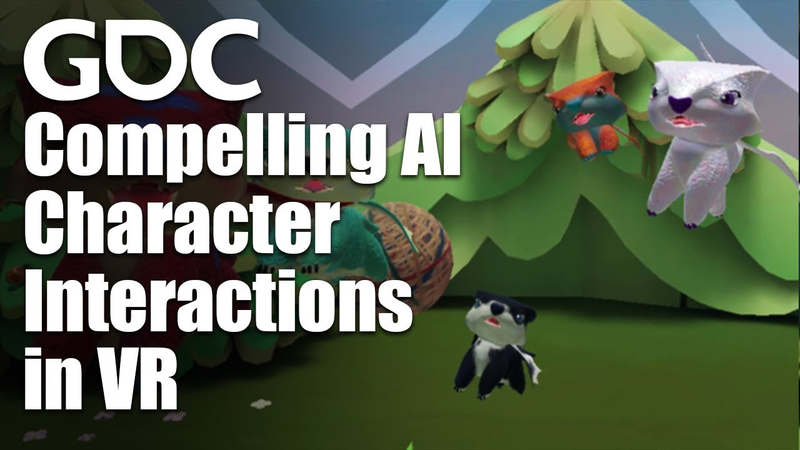
Designing Compelling AI Character Interactions in VR Using Body Language
Body language serves as the primary mechanism for establishing believable AI interactions within virtual reality, often outweighing the importance of complex dialogue or high-fidelity animation.
- Body language, specifically spatial presence and vertical positioning, is more effective than dialogue or high-fidelity animation for establishing believable AI interactions in VR.
- Designers should use physical cues like scale and proximity to communicate power dynamics and guide player behavior, eliminating the need for intrusive text-based menus.
- Managing attention pressure is critical, as excessive proximity, eye contact, or character density can trigger player anxiety even with benign AI.
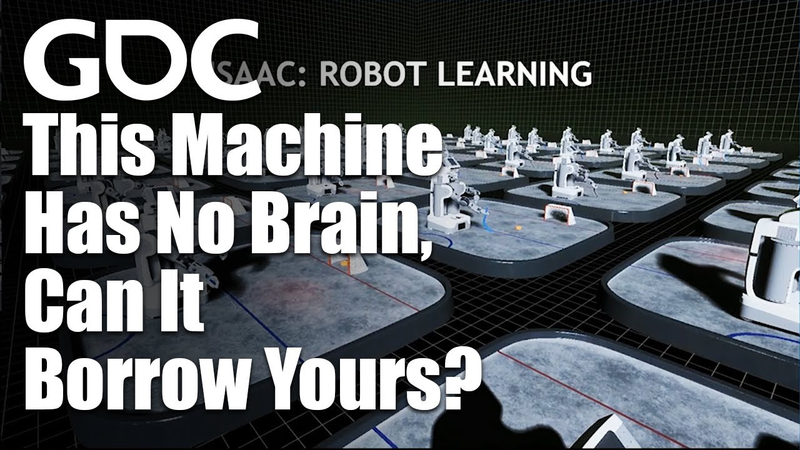
This Machine Has No Brain, Can It Borrow Yours?
The integration of autonomous systems into daily life necessitates a shift in training methodologies to overcome the limitations of traditional data-driven machine learning.
- High-fidelity simulation platforms like NVIDIA’s Isaac and Drive Sim are replacing traditional data-driven training to overcome the limitations of real-world datasets in handling rare or ethically ambiguous scenarios.
- A modular development architecture—decoupling vision, gameplay policy, and physical control—allows researchers to treat virtual and physical environments as interchangeable, significantly accelerating debugging and deployment.
- Human-in-the-loop systems using virtual reality enable robots to learn nuanced human motion through imitation, bypassing the need for traditional, cumbersome motion capture techniques.
I Got Beaten Up by my Producer (Devlog)
Independent game development is characterized by a deceptive pace where significant effort often results in subtle, incremental progress.
- Solo indie development often requires a significant 'invisible' phase, as demonstrated by the developer spending 12 months on localization, accessibility, UI, and optimization after core gameplay was already finished.
- The project timeline for 'Will You Snail' extended to two and a half years due to the compounding effect of minor bug fixes, polish tasks, and the psychological pressure to achieve a high-quality final product.
- Workflow efficiency was improved by externalizing color palettes into text files, allowing for real-time visual adjustments without the need to restart the game engine.
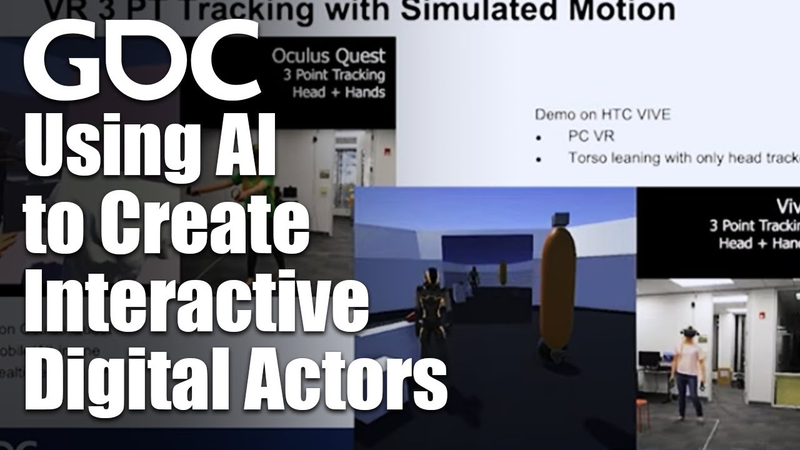
Using AI to Create Interactive Digital Actors
Physics-based simulation and reinforcement learning are transforming the creation of interactive digital actors, shifting the industry away from labor-intensive, static keyframe animation.
- Physics-based simulation and reinforcement learning are replacing manual keyframe animation with dynamic, autonomous character movement.
- The development time for sophisticated character behaviors is reduced from months to days by automating physical constraints and muscle control through machine learning.
- Robotics-based balancing algorithms and muscle models allow digital avatars to maintain posture and navigate environments using as few as three points of sensor data.
Character Control with Neural Networks and Machine Learning
Modern AAA game development faces significant challenges as traditional hierarchical state machines become increasingly unmanageable due to the sheer volume of states and animations required for complex character movement.
- Modern game development, exemplified by the growth from Assassin's Creed Syndicate (2015) to Origins (2017), requires managing massive animation libraries, with Origins utilizing approximately 15,000 individual animation clips.
- Traditional animation systems rely on complex, hierarchical state machines and blend trees that become increasingly difficult to scale and maintain as project scope grows.
- Motion matching replaces rigid state machines by treating animation as a database retrieval problem, using nearest-neighbor regression to find the best-fitting animation clip based on current gameplay variables.