Action-Adventure reports and market data
Documents
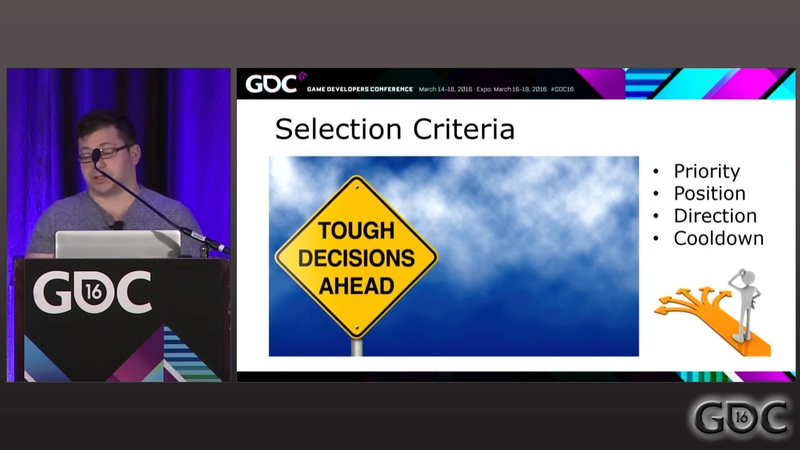
Adding Life to your Level
Creating a believable, living game world requires a fundamental shift from rigid, scripted AI behaviors toward systemic, opportunistic interactions.
- Shift AI design from rigid, scripted sequences to systemic, opportunistic interactions where characters engage dynamically with smart objects in the environment.
- Categorize character behaviors into distinct, centralized layers—such as locomotion, idle states, and combat—to ensure logical consistency across all AI actions.
- Enhance the illusion of human presence through rule-based mechanics like gaze tracking, look-at markers, and context-aware idle fidgeting.
Gears of War 4, Project Triton: Pre-Computed Environmental Wave Acoustics
Project Triton serves as a sophisticated acoustic modeling framework designed to automate the simulation of complex wave phenomena, including diffraction, reflection, and reverberation, within the high-fidelity environment of Gears of War 4.
- Project Triton automates acoustic simulation for complex wave phenomena like diffraction and reflection, replacing labor-intensive manual reverb volume placement with an offline baking process similar to light mapping.
- The system extracts critical perceptual parameters—initial energy, reflected energy, decay rates, and occlusion—and compresses them into a 100 to 110 MB footprint per map to fit within a 500 MB total RAM budget.
- Development teams should prioritize aesthetic interpretation over strict physical accuracy, as evidenced by the shift from a complex 12-reverb matrix to a more manageable and debuggable six-bus system.

360 Approach for Open World Mission Design in Far Cry and Assassin's Creed
Modern open-world mission design requires a fundamental shift from the linear, scripted progression characteristic of earlier titles like Prince of Persia toward a systemic, radial framework.
- The '360 approach' replaces linear, scripted mission paths with concentric zones of engagement, allowing developers to accommodate unpredictable player exploration in open-world environments.
- Designers should utilize rigorous 2D top-down planning to map out thematic zones and gameplay pillars before beginning engine-based development.
- Gameplay ingredients—such as enemies, environmental cues, and interactive objects—must be distributed spatially to guide players toward objectives while maintaining their sense of agency.
Realizing Responsive High Fidelity Character Movement in Just Cause 3
Achieving high-fidelity character movement in Just Cause 3 requires a sophisticated hybrid architecture that prioritizes player responsiveness without sacrificing the visual integrity of authored animations.
- Avalanche Studios achieved responsive character movement in Just Cause 3 by decoupling animation-driven motion from player input, allowing for real-time adjustments to rotation and speed without relying solely on pre-authored animation data.
- To maintain responsiveness during start animations, the team extracted rotation data from the animation and applied a fixed adjustment to the character's facing direction to match the player's target input in real-time.
- The developers used authored angular acceleration curves to smooth character orientation changes, ensuring consistent movement responsiveness across different gameplay scenarios like transitioning from a parachute landing to a run.
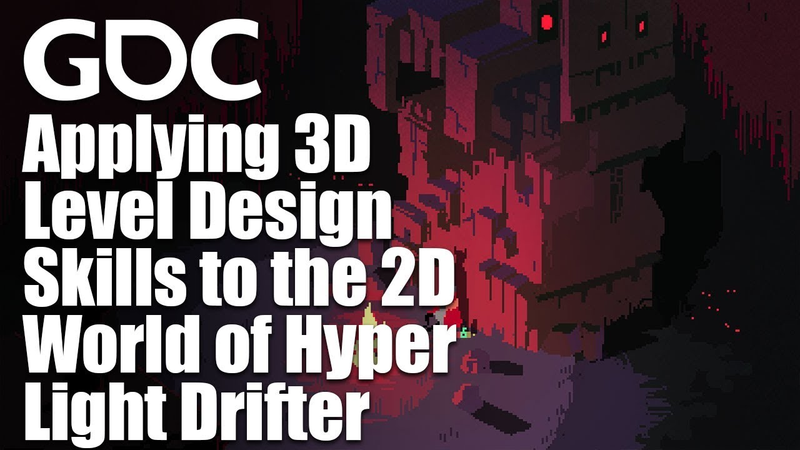
Applying 3D Level Design Skills to the 2D World of Hyper Light Drifter
Core level design principles are fundamentally universal, transcending the technical divide between 3D action titles and 2D environments.
- Level design principles are highly transferable between 3D and 2D; core concepts like 'prospect and refuge'—the contrast between vulnerable open areas and safe, enclosed spaces—remain effective regardless of the game's dimensionality.
- Instead of using a subtractive 'sculpting' method to block out levels, designers can use a metrics-driven approach by establishing fixed distances for movement and combat, then growing the level outward from those connected pieces.
- In 2D overhead games like Hyper Light Drifter, designers can effectively use camera locks to isolate combat encounters, forcing player focus and creating distinct, self-contained pacing beats.

Far Cry 4: Gameplay Team Workflow, Iteration and Philosophy
The development of Far Cry 4 centered on a cross-functional, autonomous team structure designed to prioritize systemic gameplay and player agency over mere visual fidelity.
- The development team utilized a cross-functional, autonomous structure that embedded programmers, animators, designers, and testers into single units to prioritize systemic gameplay and player agency over visual fidelity.
- Development was managed across six global locations by treating remote studios as integrated partners rather than traditional outsourcing vendors, utilizing dedicated co-dev teams to manage communication and ownership boundaries.
- The project employed a rigorous de-risking strategy that evaluated the return on investment for every mechanic, resulting in the elimination of features that lacked depth or introduced excessive technical debt.

Designing System Driven Dialogue in Mafia III
The design of Mafia III centers on a system-driven dialogue framework that replaces traditional, static branching narratives with a dynamic, state-based architecture.
- Mafia III replaces static branching narratives with a state-based architecture that triggers dialogue based on gameplay variables rather than linear scripts.
- The 'Sit Down' mechanic forces players to manage underboss loyalty by distributing conquered districts, directly linking economic strategy to narrative outcomes.
- Character behavior is governed by a database-driven system that tracks specific personality variables including greed, jealousy, and impatience.

An Approach to Holistic Level Design
Holistic level design functions as a synthesis of gameplay, visual presentation, and narrative, moving beyond the traditional practice of treating these elements as isolated, additive components.
- Holistic level design integrates gameplay, visual presentation, and narrative into a unified system rather than treating them as isolated, additive components.
- Designers should prioritize player intentionality by using environmental affordances and consistent visual language to guide goal-oriented decisions instead of relying on explicit tutorials.
- World-building becomes a driver for engagement when environmental details, loot, and NPCs are specifically crafted to reflect core narrative themes and power dynamics.

Designing the Tutorial for The Last of Us
Professional adaptability and a commitment to continuous learning are essential for navigating the complexities of modern game development.
- Effective combat tutorials should prioritize spatial design and companion modeling over intrusive, text-heavy prompts to teach complex mechanics.
- Designers improved AI performance and player agency in The Last of Us by shifting from cramped environments to more open, flexible layouts.
- Companion characters serve as vital teaching tools by actively modeling stealth behaviors and guiding players through combat systems.
BioShock Infinite: Scoring in the Sky, a Postmortem
The musical direction for BioShock Infinite represents a deliberate departure from the grand, large-scale orchestral scores characteristic of the series' predecessors.
- The score moved away from traditional large-scale orchestral arrangements in favor of a minimalist ten-piece string ensemble to emphasize emotional intimacy and character-driven narrative.
- The composition utilized aleatoric writing and unquantized performances to create organic, visceral textures that reflect the game's 1912 setting and its underlying dystopian themes.
- A recurring open-fifth motif was implemented as a foundational anchor to symbolically represent the core narrative themes of infinity and time.

Games You Might Not Have Tried - ep 12 - Find New Console Games - Extra Credits
The primary purpose of this analysis is to highlight a selection of console games that offer unique design philosophies, novel storytelling, or ambitious mechanics, even if they are not universally polished or widely recognized.
- Creative risk-taking and thematic depth often provide more long-term value to the industry than traditional technical polish.
- Let It Die demonstrates that roguelike games can successfully implement fair, arcade-style microtransaction models.
- Yakuza 0 serves as a benchmark for dense, activity-rich open-world design that maximizes player engagement within a confined map.

Perversion Subversion - Examining Hentai Sensibility - Extra Credits
- Developers can effectively subvert the 'hentai sensibility' trope by using self-aware humor to critique the player's own objectifying behavior, as seen in Yakuza 0's Mr. Libido character.
- Games that attempt to address serious themes like sexual coercion, such as Persona 5, risk undermining their own message if they simultaneously rely on non-consensual or objectifying tropes in other narrative arcs.
- Yakuza 0 demonstrates that sexual themes can be humanized rather than mocked by focusing on character insecurities, such as the subplot involving a shy, professional dominatrix.