Showing 30 of 80 results · 0.19s
Jan 2019
Evolution of Mobile Esports for the Mass Market
Niko Partners
into a scalable mass-market powerhouse. While professional PC esports historically dominated revenue, mobile esports is rapidly closing the gap, fueled by sophisticated monetization strategies including media rights
Report45 pages
Jan 2023
Five Key Mobile Game Genres in Asia and MENA
Niko Partners
levels. The methodology blends survey‑derived player profiles with AppMagic’s download, revenue, and esports viewership data across 21 metrics, weighted into four categories—monetization, engagement, esports appeal
Report15 pages
May 2021
Esports Rising: State of the Global Esports Market
Newzoo
position as the primary market leader, maintaining the largest share of both global esports revenues and the highest concentration of esports enthusiasts. Audience engagement has surged significantly, with
Report16 pages
Jan 2024
Interactive Entertainment 2025: Global Market Sizing & Forecast
Aldora
anticipation of new hardware cycles. In contrast, the esports and live-streaming sectors face ongoing profitability challenges; esports revenue is projected to decline by 8.3% in 2025, while
Report15 pages
Jul 2020
Rise of the Player-Fan: The Growing Opportunity of Mobile Esports in Asia
Niko Partners
with global esports prize pools increasing 40% between 2017 and 2019 to exceed $228 million. In 2019 alone, mobile esports generated $19.5 billion in global revenue, with Asia
Report12 pages
Jan 2020
The Past, Present and Future of Games
Newzoo
highlights the rise of “games as a service,” cloud gaming, and esports ecosystems, citing 2020 revenue growth of 29 % in PC games and a 19.6 % increase in mobile
Report33 pages
Jan 2022
Global Esports & Live Streaming Market Report 2022
Newzoo
global esports and live streaming industry is undergoing a period of robust expansion, with total esports revenue projected to reach $1.38 billion in 2022 and an audience base
Report51 pages
Jan 2024
India's Media & Entertainment Sector: March 2024
EY
with Free Fire and BGMI generating a quarter of in‑app purchase revenue, while esports viewership climbs to 78 % of gamers. Music and radio also expand through digital
Report276 pages
Jan 2025
Japan’s World of Gaming & Influencer Marketing 2025
Nintendo
increasingly defined by the convergence of gaming, live streaming, and broader entertainment. Esports revenue is expected to reach ¥21.8 billion by 2025, supported by a shift in viewership
Report74 pages
Jan 2022
Games, Esports, Live Streaming, Cloud and the Metaverse: 2022 Trends to Watch
Newzoo
open app store ecosystems, challenging traditional distribution gatekeepers. Within the esports sector, organizations are actively diversifying revenue streams by prioritizing mobile-first titles and leveraging co-streaming
Report30 pages
Dec 2025
The Value of Esports in the UK
Ukie, Olsberg SPI, Nordicity
alone, the sector generated approximately £60 million in revenue—about eight per cent of global esports earnings—and contributed £111.5 million to the national Gross Value Added, supporting
Report45 pages
Jan 2020
Los Esports en España: Situación Actual y Posición de la Industria
AEVI
doubled, rising from €14.5 million to €35 million in revenue, which now represents roughly four percent of global esports income. Employment grew to about 600 individuals, including
Report35 pages
Jan 2021
Video Games – a Force for Good (2021)
European Games Developer Federation
Agreement to reduce energy consumption. Finally, the report identifies esports as a high-growth segment, with global revenues surpassing $1 billion
Report19 pages
Jan 2024
Italian Esports Report 2024: Market & Streaming Trends
IIDEA – Italian Interactive Digital Entertainment Association
analysis evaluates Italy’s esports ecosystem in 2024, aiming to map its audience composition, revenue structure, and strategic priorities for industry participants. Findings reveal a core fan base
Report33 pages
Europe and Esports: High Engagement and Even Higher Potential (2020)
PayPal
from 2019, with 33 million classified as “Esports Enthusiasts” and the remaining 59 million as occasional viewers. Revenue projections for the global market hit €973.9 million
Report14 pages
Jan 2020
Level Up: A Guide to Succeed in Asia’s Gaming Market
Newzoo
mobile revenue and all top-grossing titles. While China and Japan lead in total revenue, Japan maintains the highest value per user with an average revenue per download
Report62 pages
Jul 2021
A Rising Market: Southeast Asia
Newzoo
represents a rapidly accelerating segment of the global esports market, characterized by high growth rates in both viewership and revenue. Between 2019 and 2024, the region is projected
Report25 pages
Dec 2025
The Power of Play: Exploring the Growing Gaming Market
Basic Roots Consulting
genres such as hyper‑casual games and esports. RMG now accounts for approximately 82 % of India’s gaming revenue, yet monetization remains weak relative to download volumes; only
Report38 pages
May 2025
Press Start on Growth: Unlocking the Full Potential of the UK Video Games Industry
Ukie
contracted 15 % after pandemic‑related cancellations, whereas esports surged 44 % YoY, driven by a rise in UK‑based tournaments. Subscription revenue rose modestly as price hikes offset
Report2 pages
Jan 2021
Guida agli Esports: Italia
IIDEA – Italian Interactive Digital Entertainment Association
analysis positions esports as a rapidly expanding digital sport that, in 2021, generated $947.1 million in revenue and attracted more than 215 million fans worldwide, with total direct
Report35 pages
Annual Report 2024: Savvy Games Group
Savvy Games Group
currently ranking eighth worldwide by net revenue. The organization serves as the primary vehicle for Saudi Arabia’s National Gaming and Esports Strategy, which seeks to generate
Report62 pages
Jan 2024
Live Streaming Trends Annual Report 2024
Stream Hatchet
larger share of the competitive esports market. Emerging platforms like Kick have successfully disrupted traditional market shares by offering aggressive revenue splits, leading to a more fragmented
Report54 pages
Jan 2022
Southeast Asia’s Games Market
Niko Partners
total Asian games revenue, the region is projected to maintain a compound annual growth rate of 8.6% through 2025. Esports serves as a primary driver for this growth
Report4 pages
Jan 2022
Türkiye Game Market 2022 Report
Riot Games
contraction in total revenue to $625 million, the industry solidified its position as a major global hub for mobile development and esports. The primary thesis of the market
Report230 pages
Jan 2023
The MENA Games Market: From Sand to Stardom
Niko Partners
generated $1.8 billion in revenue and supported 67.4 million gamers. This growth is underpinned by a strong mobile-first ecosystem and a burgeoning esports sector that benefits from
Report25 pages
Jan 2025
The Global State of Game Publishing & Marketing 2025 Industry Report
Game Publishing & Marketing Summit
services and the esports sector. Subscriptions are expected to reach 318 million active users and a $21.6 billion valuation by 2030, while the esports market is projected
Report46 pages
Nov 2022
Analyzing the Consumer and Market Impacts of Chinese Games Market Policies
Newzoo
revenue for major firms like Tencent and NetEase, these regulations threaten long-term market growth by reducing the future pipeline of engaged players and esports talent. The administrative
Report29 pages
Jan 2023
Gametech Report Q1 2023: Global & MENAP Outlook
Shorooq Partners
esports expansion. Mobile‑first development dominates, with 70 % of developers prioritising data analytics and 50 % investing in AI tools. In‑app purchases, advertising and subscriptions drive revenue, with
Report98 pages
Dec 2025
Esports 2023: Challenges and Opportunities in the UK
British Esports, Ukie
revenue streams but require regulatory clarity and infrastructure investment. Coordinated action across stakeholders is essential to unlock the UK’s full economic and cultural potential in esports
Report46 pages
Feb 2026
Southeast Asia Gaming Consumer Economy
Telekom Malaysia, Twimbit
highly spend‑active. eSports viewership is nascent but growing, with SEA tournaments ranking among the world’s most‑watched events; mobile eSports is expected to lead future growth
Report19 pages

Evolution of Mobile Esports for the Mass Market
Jan 201945 pages13k words
Summary
Mobile esports is positioned to become the primary catalyst for growth in the digital games industry over the next five years, leveraging a global player base of 2.53 billion that already surpasses the combined reach of PC and console gaming. In 2018, mobile esports titles generated $15.32 billion in revenue, representing over a quarter of the total mobile market. This expansion is driven by high smartphone penetration and a fundamental shift from high-profile spectator events toward a pervasive ecosystem of regional and online-only competitions. By lowering barriers to entry, the sector has successfully attracted a more diverse and gender-balanced audience than traditional competitive gaming platforms.
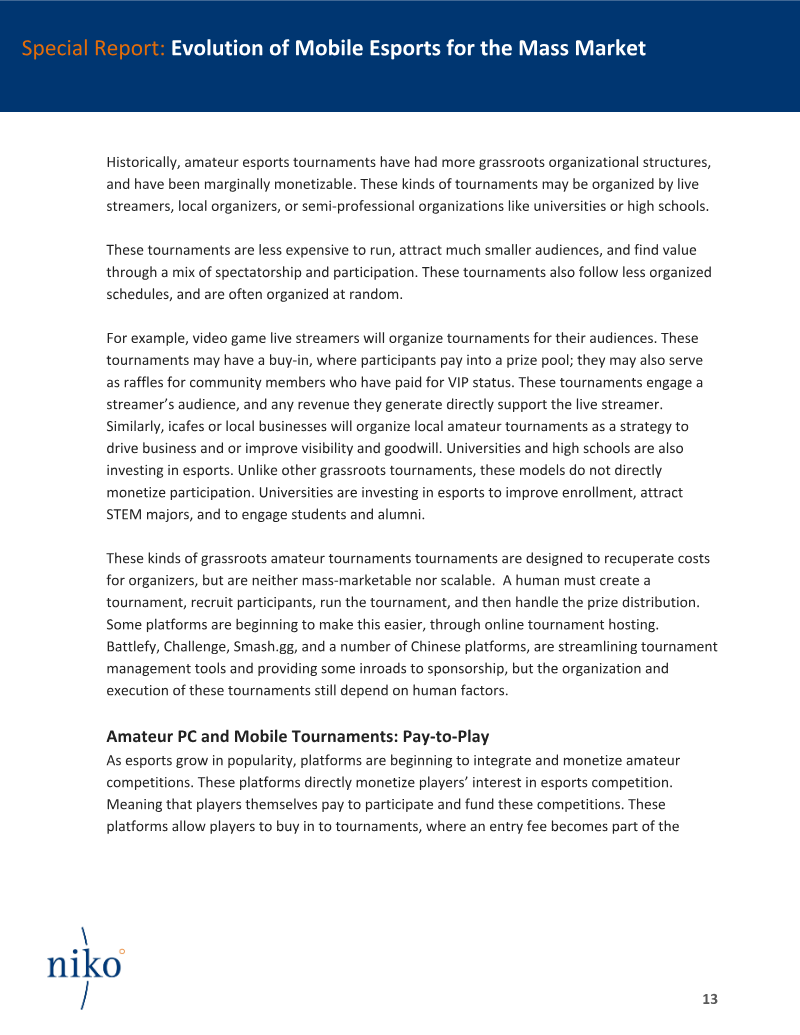
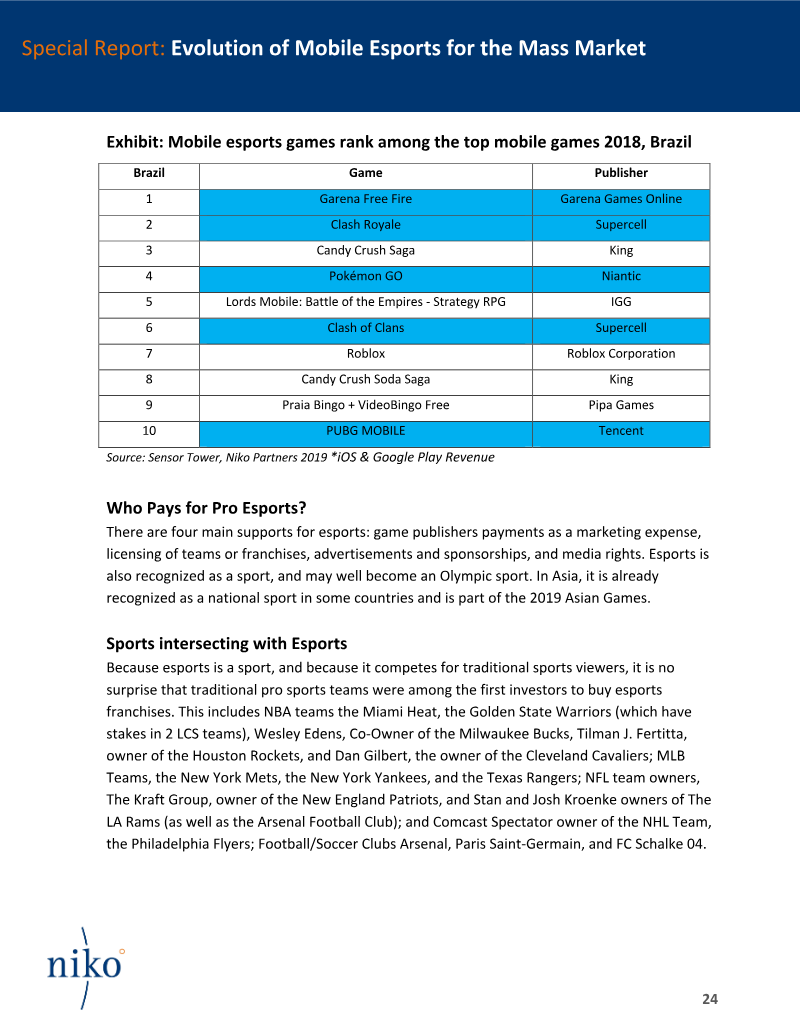
The industry is currently transitioning from a publisher-funded marketing tool into a scalable mass-market powerhouse. While professional PC esports historically dominated revenue, mobile esports is rapidly closing the gap, fueled by sophisticated monetization strategies including media rights, sponsorships, and microtransaction-based models like season passes. Asia serves as the epicenter of this evolution, with China and Southeast Asia hosting the most concentrated markets for competitive mobile titles. Significant investments from traditional sports franchises and the expansion of media rights into mainstream cable television further signal the professionalization and maturation of the sector.
Technological advancements in 5G and cloud gaming are disrupting the historical dominance of PC titles by delivering high-quality competitive experiences on accessible hardware. This technological shift, combined with strong government support in Asian markets, has led to explosive growth, exemplified by a 44.5% revenue increase in top Belt and Road markets during the first half of 2019. As industry leaders establish franchised leagues and record-breaking prize pools, the mobile esports model is proving more sustainable and participatory than its predecessors. Ultimately, the sector’s massive reach and superior monetization capabilities ensure its trajectory to overtake PC esports as the dominant global competitive gaming format.
Pages


Insights
- Mobile esports is projected to overtake PC esports as the dominant global competitive gaming format, leveraging a player base of 2.53 billion that exceeds the combined reach of PC and console gaming.
- Mobile esports titles generated $15.32 billion in revenue in 2018, accounting for more than 25% of the total mobile gaming market.
- The sector is shifting from a publisher-funded marketing tool to a scalable, professionalized industry supported by media rights, sponsorships, and microtransaction-based models like season passes.
- Technological advancements in 5G and cloud gaming are enabling high-quality competitive experiences on accessible hardware, effectively disrupting the historical dominance of PC-based titles.
- Growth in top Belt and Road markets reached 44.5% in the first half of 2019, with Asia—specifically China and Southeast Asia—serving as the primary epicenter for competitive mobile gaming.
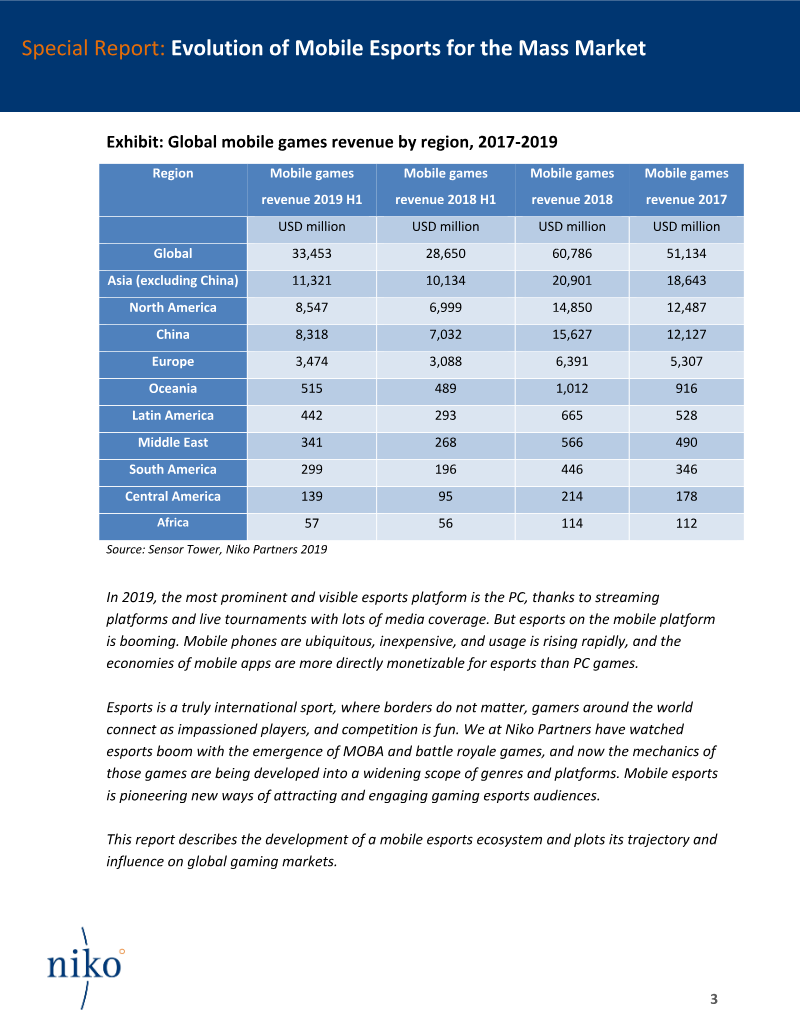
Global mobile games revenue by region, 2017-2019
Showing 1 – 30 of 80