Showing 30 of 156 results · 0.26s
Jan 2019
Evolution of Mobile Esports for the Mass Market
Niko Partners
into a scalable mass-market powerhouse. While professional PC esports historically dominated revenue, mobile esports is rapidly closing the gap, fueled by sophisticated monetization strategies including media rights
Report45 pages
Jan 2023
Five Key Mobile Game Genres in Asia and MENA
Niko Partners
levels. The methodology blends survey‑derived player profiles with AppMagic’s download, revenue, and esports viewership data across 21 metrics, weighted into four categories—monetization, engagement, esports appeal
Report15 pages
Aug 2022
FaZed and Confused: The $19 Million Sell-off of Esports Collective FaZe Clan
SuperJoost
highlight the disparity between industry optimism and financial reality. While some forecasts predicted esports revenues would reach $1.6 billion by 2023, the combined income of all major publicly
Article
Oct 2021
Amusing Ourselves to Death: FaZe's Public Listing and Esports' Next Era
SuperJoost
valuation is supported by a diversified revenue mix: in 2020, only 8% of its $38 million revenue came from esports, while the majority was driven by brand sponsorships
Article
May 2021
Esports Rising: State of the Global Esports Market
Newzoo
position as the primary market leader, maintaining the largest share of both global esports revenues and the highest concentration of esports enthusiasts. Audience engagement has surged significantly, with
Report16 pages
Apr 2022
The $250 Billion Video Games Market: Market Sizing and Forecast for 2025
SuperJoost
cryptocurrency appreciation. However, the esports and live-streaming sectors continue to struggle with monetization and profitability, with esports revenue projected to decline by 8% in 2025. The analysis
Article
Jan 2024
Interactive Entertainment 2025: Global Market Sizing & Forecast
Aldora
anticipation of new hardware cycles. In contrast, the esports and live-streaming sectors face ongoing profitability challenges; esports revenue is projected to decline by 8.3% in 2025, while
Report15 pages
Jul 2020
Rise of the Player-Fan: The Growing Opportunity of Mobile Esports in Asia
Niko Partners
with global esports prize pools increasing 40% between 2017 and 2019 to exceed $228 million. In 2019 alone, mobile esports generated $19.5 billion in global revenue, with Asia
Report12 pages
Jan 2020
The Past, Present and Future of Games
Newzoo
highlights the rise of “games as a service,” cloud gaming, and esports ecosystems, citing 2020 revenue growth of 29 % in PC games and a 19.6 % increase in mobile
Report33 pages
Jan 2022
Global Esports & Live Streaming Market Report 2022
Newzoo
global esports and live streaming industry is undergoing a period of robust expansion, with total esports revenue projected to reach $1.38 billion in 2022 and an audience base
Report51 pages
Jan 2024
India's Media & Entertainment Sector: March 2024
EY
with Free Fire and BGMI generating a quarter of in‑app purchase revenue, while esports viewership climbs to 78 % of gamers. Music and radio also expand through digital
Report276 pages
Jul 2026
Hero Esports CEO Uses Cannes Lions Stage to Pitch Esports’ Global Brand Appeal
The Esports Advocate
like documentaries and scripted dramas, rather than relying solely on tournament-based revenue. By positioning esports as a youth-culture platform, operators aim to overcome historical profitability challenges
Article1 pages
Jan 2025
Japan’s World of Gaming & Influencer Marketing 2025
Nintendo
increasingly defined by the convergence of gaming, live streaming, and broader entertainment. Esports revenue is expected to reach ¥21.8 billion by 2025, supported by a shift in viewership
Report74 pages
Apr 2024
Fallout Series Boosts Microsoft Player Count
SuperJoost
stabilize the professional ecosystem. This move addresses the broader esports category's struggle to generate sustainable revenue despite record-breaking viewership and attendance. By offering minimum revenue guarantees
Article
May 2026
PGL Astana 2026: Group Stage Viewership Jumps 46%
Esports Charts
match scheduling and competitive surprises can significantly amplify audience size, engagement, and revenue in the esports arena
Article1 pages
Aug 2021
Deep Dive: Analyzing Slapshot Rebound's F2P Steam Success
GameDiscoverCo
community management to combat toxicity, they offer sustainable indie opportunities through eSports integration and diversified revenue streams beyond traditional microtransactions
Article
Apr 2026
Enthusiast Gaming Holdings Inc. Consolidated Financial Statements: 2025 and 2024
Enthusiast Gaming Holdings
accounting policies emphasize foreign‑currency translation, principal‑vs‑agent revenue recognition across media, subscription, events, esports and merchandise streams, and goodwill impairment testing. IFRS‑based policies apply
Financial54 pages
Jan 2022
Games, Esports, Live Streaming, Cloud and the Metaverse: 2022 Trends to Watch
Newzoo
open app store ecosystems, challenging traditional distribution gatekeepers. Within the esports sector, organizations are actively diversifying revenue streams by prioritizing mobile-first titles and leveraging co-streaming
Report30 pages
Dec 2025
The Value of Esports in the UK
Ukie, Olsberg SPI, Nordicity
alone, the sector generated approximately £60 million in revenue—about eight per cent of global esports earnings—and contributed £111.5 million to the national Gross Value Added, supporting
Report45 pages
Nov 2024
Outcome of Board Meeting held on Thursday, November 14, 2024
Nazara Technologies
company reported a 7% year-over-year increase in consolidated revenue, reaching ₹56,902 lakh, with the eSports segment serving as the primary growth engine. While standalone
Financial22 pages
Mar 2026
How Esports Charts Powers ESL’s $2.95M Viewership-Based Incentive Program
Esports Charts
engagement. By utilizing granular, platform-agnostic viewership data provided by Esports Charts, the initiative creates a transparent revenue-sharing model that rewards organizations for their ability to attract
Article1 pages
Jul 2026
Gen Z Esports Fans in 2026
Niko Partners, ESL FACEIT Group
million fans and $3 billion in annual revenue. Key findings indicate that the Gen Z esports fan base is increasingly diverse, with the gender ratio shifting toward greater
Article1 pages
Sep 2025
Delta Force's $6.5M Day: How They Crushed PUBG by 75% | MAG #5
GameMakers
increase over Delta Force’s typical daily revenue, driven primarily by the Delta Force Invitational esports championship and sophisticated LiveOps strategies, including tournament-linked wagering and specialized
Article1 pages
PUBG Esports: How New Formats and Broadcasts Boosted Engagement
Esports Charts
coupled with personalized viewing options, proved effective in stabilizing revenue and sustaining audience interest for the global esports title. Collectively, these initiatives demonstrate that decentralized broadcasting, incentive‑aligned
Article1 pages
Jun 2026
Asian Games SEA MLBB Qualifiers: 2026 Popularity Analysis
Esports Charts
This surge underscores a growing regional appetite for mobile esports and positions the qualifiers as a pivotal revenue source in 2026. The competition’s structure featured a Malaysia
Article1 pages
Jul 2024
Welcome to the Olympic Esports Games
Video Games Industry Memo
organization's willingness to fully embrace the broader esports ecosystem. While the project offers a new revenue stream and cultural relevance, it also invites scrutiny regarding the industry
Article1 pages
Free Fire World Series SEA 2026 Spring: Viewership Record
Esports Charts
Series Southeast Asia 2026 Spring established a new benchmark for regional esports viewership, confirming mobile‑esports as the fastest growing segment in Southeast Asia. From April
Article1 pages
Jan 2020
Los Esports en España: Situación Actual y Posición de la Industria
AEVI
doubled, rising from €14.5 million to €35 million in revenue, which now represents roughly four percent of global esports income. Employment grew to about 600 individuals, including
Report35 pages
Jan 2021
Video Games – a Force for Good (2021)
European Games Developer Federation
Agreement to reduce energy consumption. Finally, the report identifies esports as a high-growth segment, with global revenues surpassing $1 billion
Report19 pages
Jul 2020
Esports Versus COVID-19: What Inoculated Competitive Gaming Against the Pandemic
SuperJoost
despite the lack of physical gatherings. For instance, the esports organization Astralis reported an 82% year-over-year revenue increase in 2020, reaching $8.5 million. Strategic acquisitions further
Article

Evolution of Mobile Esports for the Mass Market
Jan 201945 pages13k words
Summary
Mobile esports is positioned to become the primary catalyst for growth in the digital games industry over the next five years, leveraging a global player base of 2.53 billion that already surpasses the combined reach of PC and console gaming. In 2018, mobile esports titles generated $15.32 billion in revenue, representing over a quarter of the total mobile market. This expansion is driven by high smartphone penetration and a fundamental shift from high-profile spectator events toward a pervasive ecosystem of regional and online-only competitions. By lowering barriers to entry, the sector has successfully attracted a more diverse and gender-balanced audience than traditional competitive gaming platforms.
The industry is currently transitioning from a publisher-funded marketing tool into a scalable mass-market powerhouse. While professional PC esports historically dominated revenue, mobile esports is rapidly closing the gap, fueled by sophisticated monetization strategies including media rights, sponsorships, and microtransaction-based models like season passes. Asia serves as the epicenter of this evolution, with China and Southeast Asia hosting the most concentrated markets for competitive mobile titles. Significant investments from traditional sports franchises and the expansion of media rights into mainstream cable television further signal the professionalization and maturation of the sector.
Technological advancements in 5G and cloud gaming are disrupting the historical dominance of PC titles by delivering high-quality competitive experiences on accessible hardware. This technological shift, combined with strong government support in Asian markets, has led to explosive growth, exemplified by a 44.5% revenue increase in top Belt and Road markets during the first half of 2019. As industry leaders establish franchised leagues and record-breaking prize pools, the mobile esports model is proving more sustainable and participatory than its predecessors. Ultimately, the sector’s massive reach and superior monetization capabilities ensure its trajectory to overtake PC esports as the dominant global competitive gaming format.
Pages


Insights
- Mobile esports is projected to overtake PC esports as the dominant global competitive gaming format, leveraging a player base of 2.53 billion that exceeds the combined reach of PC and console gaming.
- Mobile esports titles generated $15.32 billion in revenue in 2018, accounting for more than 25% of the total mobile gaming market.
- The sector is shifting from a publisher-funded marketing tool to a scalable, professionalized industry supported by media rights, sponsorships, and microtransaction-based models like season passes.
- Technological advancements in 5G and cloud gaming are enabling high-quality competitive experiences on accessible hardware, effectively disrupting the historical dominance of PC-based titles.
- Growth in top Belt and Road markets reached 44.5% in the first half of 2019, with Asia—specifically China and Southeast Asia—serving as the primary epicenter for competitive mobile gaming.
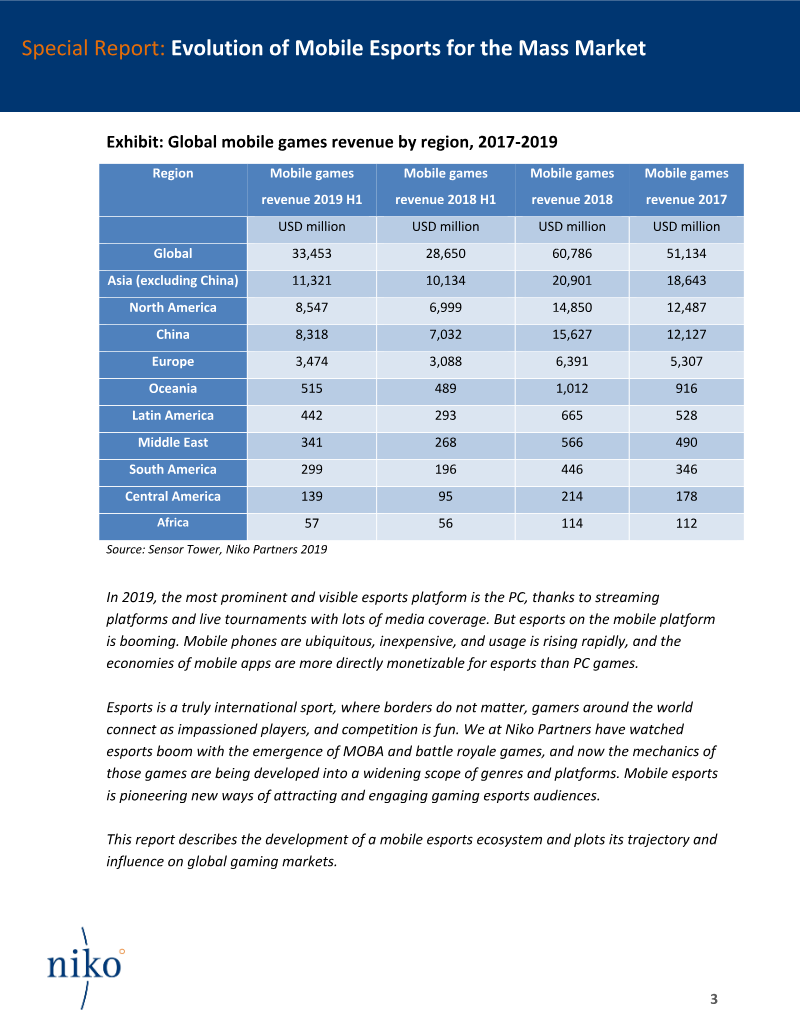
Global mobile games revenue by region, 2017-2019
Showing 1 – 30 of 156