
Report104 pages
Corporate Responsibility Report 2024
Corporate Responsibility Report 2024 Introduction Patients Science Employees Communities Planet Governance Data <td>Corporate Responsibility at Alnylam</td> stol. S7 Catalina, patient (Spain) On the cover, left: Tsuyoshi, patient and his wife Rika (Japan) Corporate Responsibility Report 2024 Introduction Patients Science Employees Communities Planet Governance Data A Pivotal Year at Alnylam Transforming Lives Through Innovat...
- Alnylam's Patient Access Philosophy, established in 2017, was revisited in 2024 to expand its reach and ensure patients benefit from their medicines.
- Alnylam launched a 'Patient Perspectives series' in 2024 to help employees understand the experiences of patients, caregivers, and advocates impacted by the diseases they serve.
- In 2024, Alnylam focused on cardiovascular provider collaboration, engaging global cardiologists and other specialists to understand their needs due to two approved medicines and a robust pipeline in this area.
- Alnylam's modular drug discovery platform utilizes a three-pronged approach: delivery of RNAi therapeutics to new tissues, enhancement of existing platform designs, and investment in human genetics to identify drug targets.
- Alnylam was named to Newsweek’s 'America’s Most Responsible Companies 2025' for the third consecutive year, moving from #422 in 2023 to #153 in 2025.
+1
Alnylam Pharmaceuticals
Report21 pages
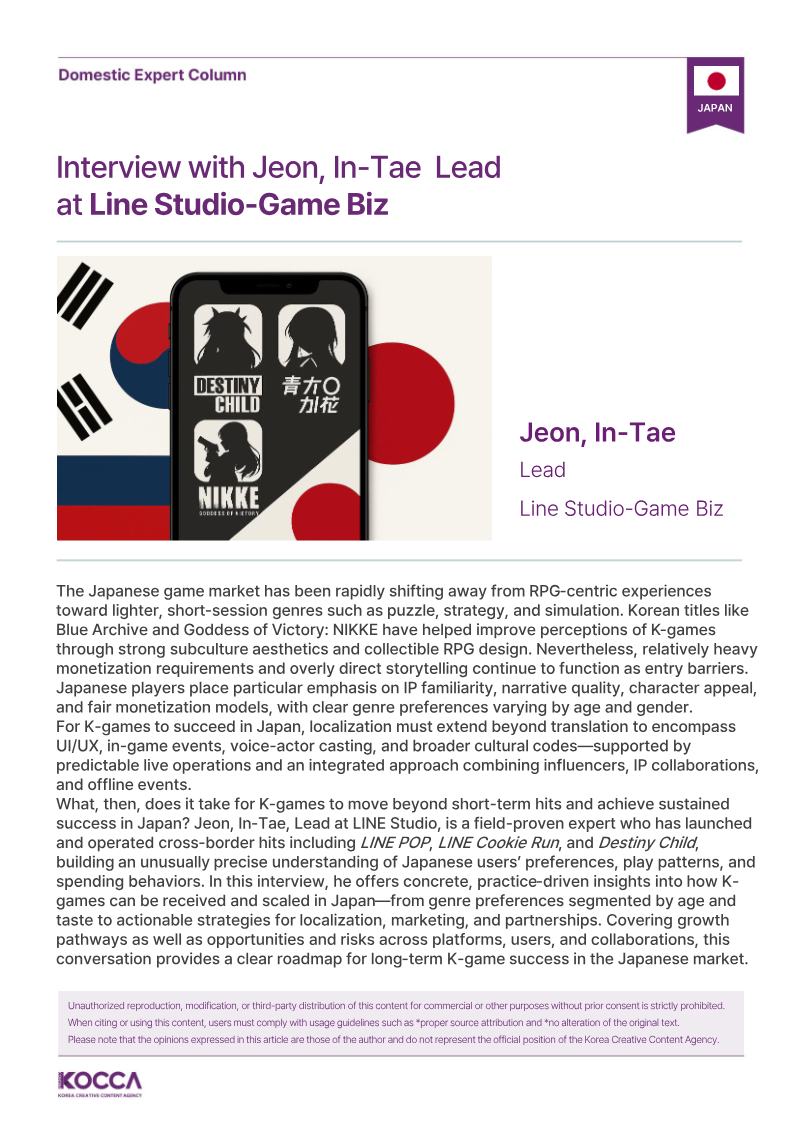
Interview with Game Expert at Line Studio: Japan Market Insights
Market Insights: Japan Prepared for Korean Game Developers & Publishers Date: March 2026
Executive Summary
Japan’s mobile gaming ecosystem is undergoing a rapid shift. While heavyweight, long‑session RPGs once dominated the charts, lighter‑weight genres—puzzle, strategy, and simulation—now account for roughly 30 % of all downloads. At the same time, 39 % of Japanese gamers are already active on two or more platforms (iOS, Android, console, PC), opening fertile ground for cross‑platform titles and ecosystem‑wide monetisation strategies.
Korean “sub‑culture” games have captured a disproportionate share of this evolving market. Collectible RPGs such as Blue Archive and Goddess of Victory: NIKKE, together with the MMORPG Lineage W, resonate because they blend moe‑style character designs, high‑polish visuals, short‑session playability, and tightly localized narratives.
Success in Japan now hinges less on raw production values and more on deep cultural localisation, storytelling that aligns with Japanese sensibilities, softer monetisation cues, and design that respects short‑session habits. Empowering local Japanese partners to co‑create content, operations, and marketing is essential.
The most promising near‑term opportunities are:
AAA‑grade mobile RPGs with cross‑platform integration (mobile ↔ console ↔ PC). Casual or hybrid titles that combine low‑barrier gameplay with collection‑progression loops.
Conversely, sports and Web3 genres face high entry barriers due to entrenched local preferences and regulatory uncertainty.
Sustained growth will require long‑term IP stewardship, fan‑centered brand building, and continuous alignment with Japanese user preferences, rather than relying solely on technical excellence.
1. Market Landscape – From Heavyweight RPGs to Light‑Weight Genres
1.1 Shift in Genre Preference
Download Share (Q4 2025): Puzzle/Strategy/Simulation: ≈ 30 % Traditional heavyweight RPGs (e.g., turn‑based, open‑world): ≈ 22 % Collectible/Idle RPGs: ≈ 18 % Other (social, casual, AR): ≈ 30 %
Drivers of the shift 1. Time‑scarcity: Japanese commuters and office workers increasingly favor games that can be enjoyed in 5‑10‑minute bursts. 2. Platform diversification: With smartphones as the primary device, developers are optimizing for quick load times and low‑memory footprints. 3. Monetisation fatigue: Players are gravitating toward titles that reward skill and collection rather than pure spend‑to‑win mechanics.
1.2 Multi‑Platform Play
Cross‑platform adoption: 39 % of gamers regularly switch between at least two devices (e.g., mobile ↔ console, mobile ↔ PC). Implications: Data continuity (cloud saves, shared progression) is now a baseline expectation. Cross‑play events and seasonal
- Japanese mobile gaming is shifting toward lighter genres, with puzzle, strategy, and simulation titles now accounting for approximately 30% of all downloads.
- Cross-platform functionality is a critical market requirement, as 39% of Japanese gamers now actively play across two or more platforms, including mobile, console, and PC.
- Korean 'sub-culture' titles like Blue Archive, Goddess of Victory: NIKKE, and Lineage W have successfully penetrated the market by combining moe-style character designs with high-polish visuals and short-session playability.
- Success in Japan requires deep cultural localization and storytelling that aligns with local sensibilities, rather than relying solely on high production values.
- The most viable near-term opportunities for developers are AAA-grade mobile RPGs with cross-platform integration and hybrid titles that blend low-barrier gameplay with collection-progression loops.
+1
KOCCA – Korea Creative Content Agency
Report3 pages
職員募集(契約職員・業務委託パートナー):人材育成
The Computer Entertainment Society (CESA) announces a recruitment drive for contract personnel and outsourced partners to support its expanding human‑resource development initiatives within Japan’s video‑game sector. The role centers on planning and operating creator training programs, facilitating the introduction of game‑based curricula in schools in collaboration with government bodies, and acting as a liaison for industry‑wide issues. Additional responsibilities include coordinating with public agencies, conducting research on the gaming industry, managing outreach and publicity, overseeing committee activities, and handling web, event, and social‑media communications tied to commissioned projects.
Candidates are expected to possess at least five years of professional experience, demonstrable negotiation and coordination skills, and a strong interest in gaming. Preferred backgrounds include prior interaction with governmental entities, experience driving contract‑based projects, and familiarity with educational or certification activities related to games. Basic PC proficiency in spreadsheet, word‑processing, and presentation software is required, while prior employment in game companies or teaching roles is advantageous.
Employment is offered either as a full‑time contract employee with a standard 9:00‑17:30 schedule in Shinjuku, Tokyo, or as an outsourced partnership negotiated according to individual expertise. Contract terms are annual, renewable up to three years, with an hourly wage starting at ¥1,800, subject to experience. Benefits encompass health, pension, unemployment, and workers’ compensation insurance, a complete two‑day weekend, and a smoke‑free office environment. Applications are to be submitted via the CESA inquiry form, followed by a two‑stage interview process conducted online and in person.
- The Computer Entertainment Society (CESA) is hiring contract personnel and outsourced partners to lead human-resource development and creator training programs within the Japanese video-game industry.
- Core responsibilities include facilitating game-based curricula in schools, managing government relations, conducting industry research, and overseeing communications for commissioned projects.
- Candidates must have at least five years of professional experience, with preference given to those with backgrounds in government liaison work, project management, or educational certification.
- Contract employees are based in Shinjuku, Tokyo, with a standard 9:00–17:30 schedule and an hourly wage starting at ¥1,800.
- Employment terms are annual and renewable for up to three years, with full benefits including health, pension, unemployment, and workers' compensation insurance.
+2
CESA – Computer Entertainment Supplier's AssociationFeb 2026
Presentation24 pages
Financial Results Briefing FY2025
GungHo Online Entertainment is currently undergoing a fundamental strategic pivot, transitioning from a primary focus on the domestic Japanese mobile market toward a global, multi-platform distribution model. This evolution targets North America and Europe specifically through the development of action-oriented intellectual properties for console and PC. The success of this shift is evidenced by the dramatic rise in the overseas net sales ratio, which is projected to reach 66% in fiscal year 2025, up from just 11.4% in 2016. Key drivers for this international expansion include the upcoming launch of Let It Die: Inferno and the continued global scaling of the Ragnarok and Puzzle & Dragons franchises across more than 150 countries.
Despite this aggressive geographic expansion, the company faces immediate financial headwinds characterized by a contraction in consolidated net sales and operating profit. Quarterly performance data reveals a downward trajectory over a four-year period, with peak values declining from over 16,000 to approximately 7,750 in the most recent quarter. This downturn is largely attributed to softening sales of legacy mobile titles and a reactional decrease in revenue from the subsidiary Gravity. To stabilize these core assets, the company is utilizing high-profile collaborations with major brands such as Sanrio and Digimon to maintain domestic user engagement while simultaneously preparing for the launch of Ragnarok Online 3 in major Asian markets.
The long-term outlook centers on a diversified portfolio that balances established mobile revenue with new, high-scale global releases. While current financial indicators reflect a period of contraction and volatility, the commitment to 100-player raid mechanics in upcoming titles and the expansion of Ragnarok X: Next Generation into EMEA markets signal a move toward more technologically ambitious projects. Ultimately, the transition toward a global-first strategy represents a necessary adaptation to the maturing domestic mobile landscape, aiming to replace declining legacy revenue with sustainable growth from international console and PC audiences.
- GungHo is executing a strategic pivot from the domestic Japanese mobile market to a global, multi-platform model, with overseas net sales projected to reach 66% of total revenue in FY2025, up from 11.4% in 2016.
- Consolidated net sales and operating profit are in a four-year decline, with quarterly performance metrics dropping from a peak of over 16,000 to approximately 7,750.
- The company is addressing the softening sales of legacy mobile titles and decreased revenue from its subsidiary Gravity by leveraging high-profile collaborations with brands like Sanrio and Digimon.
- Future growth is anchored in the expansion of the Ragnarok franchise, including the upcoming launch of Ragnarok Online 3 in Asian markets and the introduction of Ragnarok X: Next Generation to EMEA regions.
- GungHo is shifting its development focus toward action-oriented console and PC intellectual properties, highlighted by the upcoming release of Let It Die: Inferno.
GungHo Online EntertainmentFeb 2026
Presentation53 pages
Q3 for the Fiscal Year Ending March 2026 Results Presentation
Sega Sammy’s performance through the third quarter of the fiscal year ending March 2026 is characterized by a significant divergence between robust domestic gaming machine operations and substantial financial setbacks in the global consumer and mobile segments. While the Pachislot and Pachinko division exceeded expectations—driven by high-volume unit sales of titles like Smart Pachislot Tokyo Revengers—the broader group faces a projected net loss of 13.0 billion yen for the fiscal year. This downturn is primarily the result of 46.3 billion yen in extraordinary impairment losses related to the acquisitions of Rovio and Stakelogic, the latter of which was impacted by regulatory shifts in the Netherlands.
The Entertainment Contents Business struggled with underperforming new full game launches and a deteriorating user acquisition environment for mobile titles, most notably Sonic Rumble. Consequently, management has pivoted from aggressive expansion to a period of consolidation, suspending large-scale M&A activities in favor of a 20.0 billion yen share buyback program. To restore profitability within the mobile sector, the strategy now emphasizes a "regrowth phase" for Rovio, leveraging AI-driven marketing efficiencies and a transmedia approach that includes major theatrical releases for the Angry Birds and Sonic franchises scheduled through 2027.
Despite current headwinds, the medium-term outlook relies on a robust multi-platform pipeline and the expansion of the Gaming Business, which includes record-high performance at Paradise SegaSammy fueled by Japanese VIP demand. Upcoming releases for the Nintendo Switch 2 and the continued rollout of high-profile intellectual properties like Yakuza and Persona are intended to stabilize the consumer area. Geographically, the company remains focused on global markets while maintaining strict compliance with international gaming regulations in jurisdictions such as Nevada, which govern both corporate operations and shareholder requirements.
- Sega Sammy projects a 13.0 billion yen net loss for the fiscal year ending March 2026, driven by 46.3 billion yen in impairment losses from the acquisitions of Rovio and Stakelogic.
- The Pachislot and Pachinko division is the company's primary financial driver, significantly exceeding expectations through high-volume sales of titles like Smart Pachislot Tokyo Revengers.
- Management has shifted from aggressive M&A to a consolidation strategy, marked by the suspension of large-scale acquisitions and the initiation of a 20.0 billion yen share buyback program.
- The Entertainment Contents Business is underperforming due to weak new full game launches and poor user acquisition for mobile titles, specifically Sonic Rumble.
- The company is pivoting to a 'regrowth phase' for Rovio, utilizing AI-driven marketing and transmedia support from Angry Birds and Sonic theatrical releases scheduled through 2027.
Sega Sammy HoldingsFeb 2026
Presentation20 pages
Results Briefing Materials: Fiscal Year Ending March 2026, Third Quarter
Marvelous Inc. reports a significant increase in financial performance for the first nine months of the fiscal year ending March 2026. Net sales reached 29,121 million yen, a 40.5% year-on-year increase, while ordinary profit grew 28.6% to 2,129 million yen. This growth was primarily driven by the Digital Contents and Amusement segments, alongside foreign exchange gains that bolstered the bottom line.
The Digital Contents business saw revenue jump 69.2% following the successful launches of core titles including Rune Factory: Guardians of Azuma, STORY OF SEASONS: Grand Bazaar, and DAEMON X MACHINA TITANIC SCION. While high development costs for these new titles initially pressured margins, strong sales contributed to earnings ahead of schedule, significantly reducing cumulative operating losses in the segment. In the online space, the company launched Browser Sangokushi Ten, though it noted a slow initial start.
The Amusement business remained a consistent profit driver, with revenue increasing 25.1% due to the continued popularity of Pokémon kids’ amusement machines, such as Pokémon FRIENDA and the overseas expansion of Pokémon MEZASTAR. Conversely, the Audio & Visual business experienced a revenue decline of 11.3% following the liquidation of unprofitable businesses, though segment profit rose sharply by 306.1% due to high-performing stage productions and secondary usage revenue from anime titles.
Geographically, the company is focused on the Japanese, North American, European, and Asian markets across Nintendo Switch, PlayStation 5, and PC platforms. Despite exceeding year-to-date targets for certain profit metrics, the full-year forecast remains unchanged at 35,000 million yen in net sales and 2,000 million yen in operating profit, citing potential future uncertainties in the macroeconomic and industry environment.
- Marvelous Inc. reported a 40.5% year-on-year increase in net sales to 29,121 million yen and a 28.6% rise in ordinary profit to 2,129 million yen for the first nine months of the fiscal year ending March 2026.
- The Digital Contents segment saw a 69.2% revenue surge driven by the releases of 'Rune Factory: Guardians of Azuma', 'STORY OF SEASONS: Grand Bazaar', and 'DAEMON X MACHINA TITANIC SCION', which helped offset initial high development costs.
- The Amusement business grew revenue by 25.1%, fueled by the sustained popularity of 'Pokémon FRIENDA' and the international expansion of 'Pokémon MEZASTAR'.
- The Audio & Visual business saw an 11.3% revenue decline due to business liquidations, but segment profit jumped 306.1% thanks to successful stage productions and anime secondary usage revenue.
- Despite exceeding year-to-date profit targets, the company maintained its full-year forecast of 35,000 million yen in net sales and 2,000 million yen in operating profit, citing macroeconomic and industry uncertainties.
MarvelousJan 2026
Report112 pages
Square Enix Next: That Excitement Once Again
Square Enix’s recent performance review exposes a persistent decline in revenue growth and profitability over the past three years, with operating income falling 32 % and ROE dropping 61 %. The downturn is driven primarily by weak margins in both high‑definition (HD) and small‑dungeon (SD) game segments, excessive portfolio fragmentation, sub‑optimal product design and promotion, and escalating development costs. While the MMO licensing arm remains the sole growth driver (+11 %), overall gaming revenue has slipped, with HD and SD titles declining 4 % and 5 % respectively. Operating margins for these segments hover around 35–40 %, noticeably higher than the industry average of 28 % but still lagging behind competitors, indicating inefficiencies that are not being adequately addressed.
The company’s medium‑term “Reboots” plan offers only high‑level directions without concrete key performance indicators or quantitative targets. Critical gaps include a lack of clear business‑portfolio strategy, insufficient disclosure on non‑core business rationales, and no defined mechanisms for monitoring progress or maximizing shareholder value. Capital allocation disclosures are similarly weak: cost‑of‑capital calculations, ROE and ROIC targets, and hurdle rates are absent, while share‑buyback authorization remains unused despite a sharp price decline. SG&A costs exceed peer norms by 5–6 ppt, driven largely by an oversized sales force, further eroding profit margins.
Geographically, SD game revenue is almost entirely domestic; the Japanese market has contracted 2 % annually since 2020, and overseas growth remains only 3 %. The company’s global SD strategy is inert, with a 7 % overseas expansion rate falling short of projected growth and flagship titles such as FFVII Ever Crisis deriving 70 % of revenue from Japan. Non‑core Amusement and Publishing businesses are undervalued, with a significant conglomerate discount relative to peers and declining sales and margins. Limited cross‑synergy between game and publishing arms further hampers value creation.
In summary, Square Enix faces a multifaceted challenge: declining core game performance, weak strategic direction and KPI setting, high SG&A costs, and an underperforming non‑core portfolio. Addressing these issues through tighter cost control, clearer performance metrics, aggressive overseas expansion, and potential portfolio optimization is essential to restore corporate value and achieve sustainable growth.
- Square Enix has experienced a significant financial decline over the past three years, marked by a 32% drop in operating income and a 61% decrease in return on equity (ROE).
- Core gaming segments are underperforming, with HD and SD game revenues falling 4% and 5% respectively, while MMO licensing remains the only growth driver at +11%.
- Operating margins for HD and SD segments remain inefficient at 35–40%, and SG&A costs exceed industry norms by 5–6 percentage points due to an oversized sales force.
- The company's 'Reboots' medium-term plan lacks concrete KPIs, quantitative targets, and clear capital allocation strategies, such as defined hurdle rates or ROIC goals.
- Square Enix’s SD game revenue is heavily reliant on the contracting Japanese market, with flagship titles like 'FFVII Ever Crisis' generating 70% of their revenue domestically.
+2
InvestGameDec 2025

Report104 pages
Integrated Report: Value Creation Story
DeNA entered a transformative "Second Founding" phase in FY2024, marked by a significant financial recovery and a strategic pivot toward company-wide AI integration. Revenue reached 164.0 billion yen with a Non-GAAP operating profit of 32.9 billion yen, driven primarily by the global success of Pokémon Trading Card Game Pocket. While the Game Business remains the core profit engine, the organization is diversifying its portfolio across Live Streaming, Healthcare, and a record-performing Sports segment to mitigate the volatility of hit-driven cycles. The company has established a FY2026 Non-GAAP operating profit target of 15.0 billion yen, emphasizing sustainable, structural growth over short-term gains.
Central to this evolution is the "AI-ALL-IN" strategy, which aims to double productivity and launch approximately 10 AI-native products. This transition is supported by a robust human capital framework, including the DeNA AI Readiness Score (DARS) to track employee literacy and a shift toward market-linked, performance-based compensation. To manage development risks, the Game Business has adopted a "soft launch strategy" focused on iterative testing. Meanwhile, the Sports segment achieved 40 billion yen in revenue, and the Healthcare division is pivoting toward medical digital transformation despite facing recent impairment losses.
Governance and sustainability are integrated into this value creation story through a board composed of 50% independent directors and a rigorous risk management framework. DeNA maintains high standards for data security and has committed to a 58.8% reduction in Scope 1 and 2 emissions by FY2033. By balancing aggressive AI adoption with disciplined capital allocation—including strategic share sales and increased dividends—the organization seeks to harmonize social value with long-term profitability across its diverse digital and physical business ecosystems.
- DeNA achieved 164.0 billion yen in revenue and 32.9 billion yen in Non-GAAP operating profit in FY2024, largely fueled by the global performance of Pokémon Trading Card Game Pocket.
- The company is executing an 'AI-ALL-IN' strategy targeting a 100% increase in productivity and the launch of approximately 10 AI-native products.
- The Sports segment has become a major revenue pillar, generating 40 billion yen in the last fiscal year, helping to diversify the company away from hit-driven game cycles.
- Management has set a conservative FY2026 Non-GAAP operating profit target of 15.0 billion yen, prioritizing structural, sustainable growth over short-term volatility.
- To improve operational efficiency, the company implemented the DeNA AI Readiness Score (DARS) to track employee literacy and transitioned to a market-linked, performance-based compensation model.
+1
DeNA Co.Oct 2025
Presentation21 pages
Results Briefing Materials: Fiscal Year Ending March 2026, First Half (Semi-annual Period)
Marvelous Inc. reported a significant revenue increase for the first half of the fiscal year ending March 2026, covering the period from April to September 2025. Net sales rose 157.5% year-on-year to 20,281 million yen, primarily driven by the launch of three core video games and robust performance in the amusement sector. Despite the revenue surge, operating profit fell 61.8% to 226 million yen due to high development costs for new titles. However, ordinary profit and net income saw modest gains, aided by a shift from foreign exchange losses to gains.
The Digital Contents business experienced nearly doubled sales, reaching 12,414 million yen. Key performers included Rune Factory: Guardians of Azuma and Story of Seasons: Grand Bazaar, both of which surpassed half a million units sold and contributed to profits ahead of schedule. Conversely, the segment recorded a loss of 1,070 million yen, and sales for Daemon X Machina: Titanic Scion were characterized as sluggish. The Amusement business remained a strong profit driver, growing 36.3% in revenue and 41.2% in segment profit, fueled by the domestic and international success of Pokémon-themed kids' amusement machines like Pokémon Frienda and Pokémon Mezastar.
The Audio & Visual business saw a revenue decline of 16% following the liquidation of unprofitable units, yet segment profit nearly tripled to 483 million yen due to high-performing stage productions and secondary usage of past anime titles. Looking ahead, the company maintained its full-year forecast of 35,000 million yen in net sales and 2,000 million yen in operating profit. Management plans to focus on the continued expansion of its core first-half releases and upcoming titles like The Thousand Musketeers: Rhodoknight for the Nintendo Switch.
- Marvelous Inc. reported a 157.5% year-on-year revenue increase to 20,281 million yen for the first half of FY2026, though operating profit dropped 61.8% to 226 million yen due to high development costs.
- The Digital Contents segment saw sales nearly double to 12,414 million yen, driven by 'Rune Factory: Guardians of Azuma' and 'Story of Seasons: Grand Bazaar' each surpassing 500,000 units sold.
- The Amusement business remains the company's primary profit driver, achieving a 36.3% revenue increase and 41.2% profit growth, largely due to the success of 'Pokémon Frienda' and 'Pokémon Mezastar'.
- Despite revenue growth in Digital Contents, the segment recorded a 1,070 million yen loss, with 'Daemon X Machina: Titanic Scion' noted for sluggish sales performance.
- The Audio & Visual business segment profit nearly tripled to 483 million yen despite a 16% revenue decline, following the liquidation of unprofitable units and strong performance from stage productions and back-catalog anime.
MarvelousOct 2025

Report80 pages
Sega Sammy Holdings Integrated Report 2025
Sega Sammy Holdings’ 2025 Integrated Report details a transformative strategic shift aimed at establishing a more balanced and resilient business portfolio. Historically reliant on the volatile Pachislot & Pachinko market, the Group is transitioning to a three-pillar structure: Entertainment Contents, Pachislot & Pachinko, and a newly formed Gaming Business. This "Welcome to the Next Level!" plan focuses on global expansion and transmedia integration to drive long-term growth through 2030.
The Entertainment Contents segment remains the primary revenue driver, contributing ¥321.5 billion of the Group’s ¥428.9 billion in FY2025 net sales. This growth is fueled by a "mille-feuille" revenue model that leverages major intellectual properties like Sonic the Hedgehog, Persona, and Like a Dragon across games, film, and licensing. Meanwhile, the Pachislot & Pachinko segment is being repositioned as a stable cash generator. To combat a shrinking domestic market, the Group is introducing innovative modular cabinet systems to reduce costs for operators and improve player engagement.
The most significant strategic development is the establishment of the Gaming Business as a third pillar, targeting the North American iGaming and B2B casino solutions markets. This expansion is underpinned by the major acquisitions of Rovio, GAN, and Stakelogic, totaling over ¥130 billion, alongside the divestment of non-core assets like the Phoenix Seagaia Resort. Financially, the Group reported a robust FY2025 performance with a profit of ¥45.1 billion and an ROE of 12.2%. Looking ahead, the Group targets a cumulative adjusted EBITDA of over ¥230 billion by FY2027, supported by a commitment to shareholder returns including a 50% total return ratio and a 3% dividend on equity. Sustainability and governance also remain central, with goals for carbon neutrality by 2050 and enhanced diversity within its global workforce.
- Sega Sammy is restructuring into a three-pillar business model comprising Entertainment Contents, Pachislot & Pachinko, and a new Gaming Business to reduce reliance on volatile domestic markets.
- The Entertainment Contents segment generated ¥321.5 billion of the Group's ¥428.9 billion total FY2025 net sales, driven by a transmedia strategy utilizing IPs like Sonic, Persona, and Like a Dragon.
- The company is aggressively entering the North American iGaming and B2B casino markets through over ¥130 billion in acquisitions, including Rovio, GAN, and Stakelogic.
- The Group reported a robust FY2025 financial performance with a profit of ¥45.1 billion and an ROE of 12.2%.
- Management has set a target of over ¥230 billion in cumulative adjusted EBITDA by FY2027, supported by a 50% total return ratio and a 3% dividend on equity.
Sega Sammy HoldingsOct 2025
Report2 pages
Square Enix Special Feature: Erdrick Trilogy Reimagined
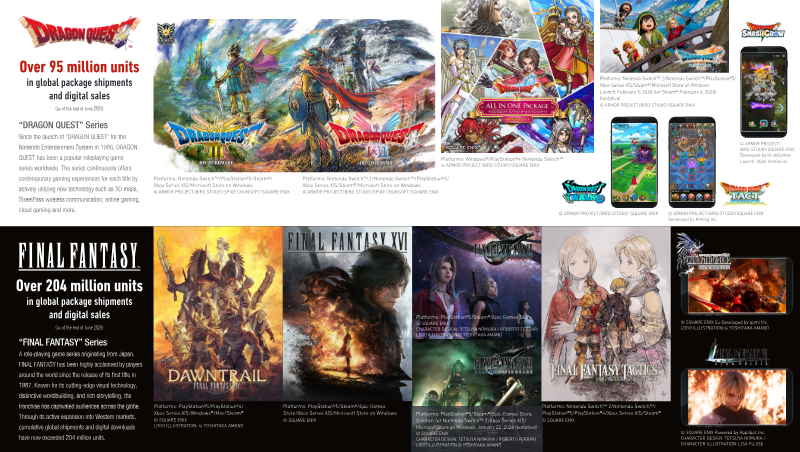
The Dragon Quest franchise continues to expand its global footprint, reaching over 95 million units in total shipments and digital sales as of June 2025. A central focus of the current release strategy is the reimagining of the foundational Erdrick Trilogy through HD-2D remakes. Dragon Quest I & II HD-2D Remake is scheduled for a February 5, 2026, launch on a wide array of platforms, including the Nintendo Switch 2, PlayStation 5, Xbox Series X|S, and PC via Steam and the Microsoft Store. This multi-platform approach reflects a broader commitment to utilizing contemporary technology to modernize classic role-playing experiences for a global audience.
Beyond the core Dragon Quest series, the broader portfolio demonstrates significant market penetration across several flagship intellectual properties. The Final Fantasy franchise has surpassed 204 million units globally as of mid-2025, supported by the ongoing expansion of Final Fantasy XIV: Dawntrail and the continued rollout of Final Fantasy VII Rebirth across various ecosystems. Additionally, the Kingdom Hearts series, a collaborative effort with Disney, has achieved over 38 million units in sales, with new entries currently in development for unspecified launch windows.
The strategic roadmap emphasizes cross-platform accessibility and the revitalization of legacy content. By targeting next-generation hardware like the Nintendo Switch 2 alongside established consoles and PC storefronts, there is a clear intent to maximize reach across diverse geographic markets. This strategy is complemented by a robust pipeline of mobile and niche titles, including Dragon Quest Tact and various entries in the Bravely Default and Octopath Traveler series, ensuring a steady cadence of content across the role-playing game segment through 2026.
- The Dragon Quest I & II HD-2D Remake is scheduled for release on February 5, 2026, across Nintendo Switch 2, PlayStation 5, Xbox Series X|S, and PC.
- The Dragon Quest franchise has reached 95 million units in total shipments and digital sales as of June 2025.
- The Final Fantasy franchise has surpassed 204 million units globally as of mid-2025, driven by Final Fantasy XIV: Dawntrail and Final Fantasy VII Rebirth.
- Square Enix is prioritizing a cross-platform strategy that targets next-generation hardware alongside established consoles and PC storefronts to maximize global market reach.
- The Kingdom Hearts series has achieved over 38 million units in sales, with new entries currently in development.
+3
Square EnixSept 2025
Presentation37 pages
Consolidated Financial Results Briefing Materials: FY3/26 Q1
Akatsuki Inc. experienced a challenging start to the fiscal year ending March 2026, reporting a 44% year-over-year decline in consolidated sales to ¥2,313 million and an operating loss of ¥1,698 million for the first quarter. This downturn was primarily driven by a 52% revenue contraction in the core Games business, resulting from a reactionary fall following a strong prior quarter, strategic title withdrawals, and heightened development costs associated with the upcoming global launch of Kaiju No. 8 The Game. While total operating expenses decreased by 18% due to a 42% reduction in research and development spending and a streamlined portfolio, these savings were insufficient to offset the revenue decline and typical seasonal fluctuations.
Despite the volatility in gaming, the IP Solutions and Comics segments demonstrated robust growth. IP Solutions sales surged 168% to ¥298 million, bolstered by the consolidation of CRAYON, Inc. and the rapid expansion of the Slash Gift online lottery service. Simultaneously, the Comics segment broadened its international footprint through the MANGA MIRAI service in the United States, integrating high-profile titles such as One Piece and Naruto. The company also accelerated its expansion into new business domains through the full acquisition of the creator agency Natee Co., Ltd. and realized ¥1.2 billion in investment proceeds following the IPO of LIFE CREATE Co., Ltd.
The financial position remains liquid with ¥33.2 billion in cash and deposits, providing a stable foundation for ongoing strategic investments despite a slight decrease in total assets to ¥50.9 billion. The current fiscal trajectory reflects a transition period as the company rebalances its portfolio, shifting focus toward high-potential global IP launches and diversified digital entertainment services to mitigate the inherent cyclicality of the mobile gaming market.
- Akatsuki Inc. reported a 44% year-over-year decline in consolidated sales to ¥2,313 million and an operating loss of ¥1,698 million for Q1 FY3/26.
- The core Games business revenue contracted by 52% due to title withdrawals, a reactionary decline from the previous quarter, and high development costs for the upcoming 'Kaiju No. 8 The Game'.
- IP Solutions revenue grew 168% to ¥298 million, driven by the consolidation of CRAYON, Inc. and the expansion of the Slash Gift online lottery service.
- The company maintains a liquid financial position with ¥33.2 billion in cash and deposits, despite total assets decreasing to ¥50.9 billion.
- Operating expenses fell by 18% overall, supported by a 42% reduction in research and development spending and a streamlined game portfolio.
+1
AkatsukiAug 2025
Report1 pages
Video Game Industry Inspection Mission: Canary Islands
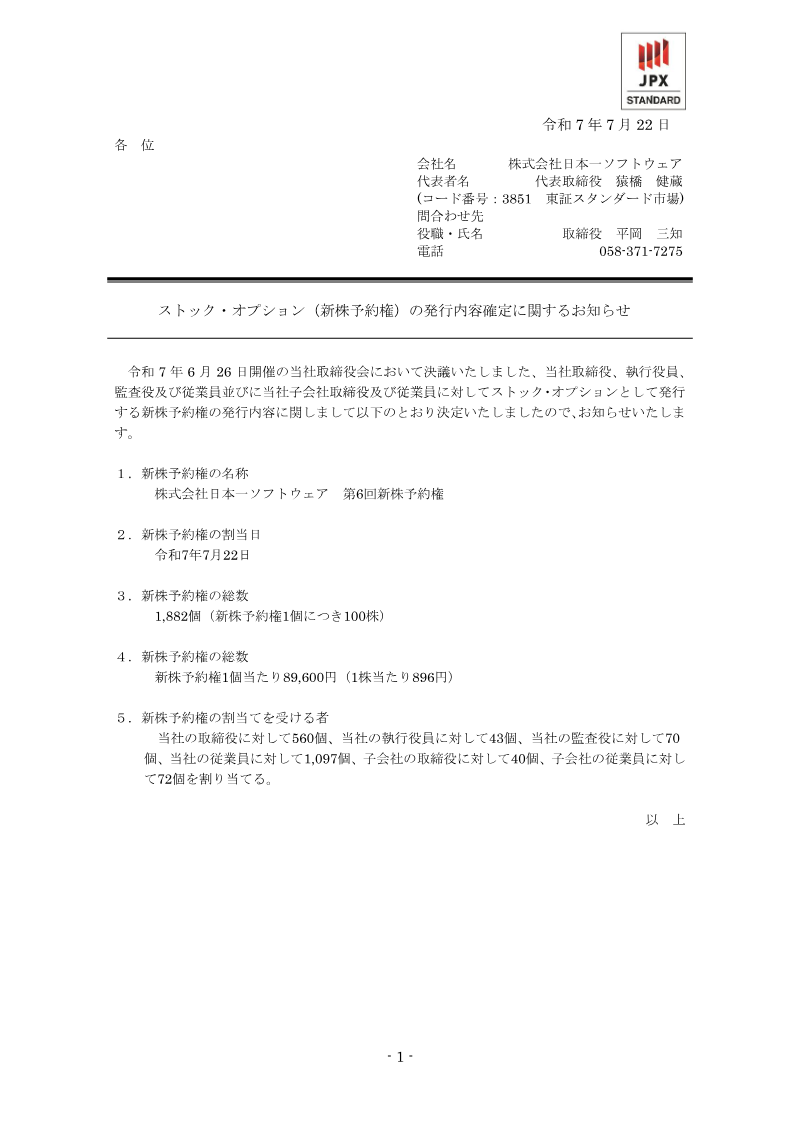
The announcement serves to formalize the issuance of a new series of stock options by Nippon Ichi Software Co., Ltd., a listed entity on the Tokyo Stock Exchange Standard Market. Following a board resolution on 26 June 2025, the company will allocate 1,882 stock options, each representing 100 shares, with an exercise price of ¥89,600 per option (equivalent to ¥896 per share). The allocation date is set for 22 July 2025, and the distribution targets internal stakeholders across the corporate hierarchy and its subsidiaries.
The breakdown of the allocation assigns 560 options to company directors, 43 to executive officers, 70 to auditors, and 1,097 to employees. Within the subsidiary structure, 40 options are designated for subsidiary directors and 72 for subsidiary employees. This distribution reflects a strategic effort to align the interests of management and staff with shareholder value, reinforcing incentive structures within the organization.
Contact details for inquiries are provided, listing Director Hiraka Mitsuchi as the point of reference, with a telephone number for direct communication. The notice underscores compliance with corporate governance standards and aims to ensure transparency regarding equity compensation for all eligible participants.
- Nippon Ichi Software will issue 1,882 stock options on 22 July 2025, with each option representing 100 shares.
- The exercise price for the new stock options is set at ¥89,600 per option, or ¥896 per share.
- The allocation targets a broad range of internal stakeholders, including 560 options for company directors and 1,097 for employees.
- Subsidiary staff and directors will receive a combined total of 112 options as part of the incentive program.
- Executive officers and auditors are allocated 43 and 70 options, respectively, to align internal interests with shareholder value.
PROEXCAJul 2025

Presentation33 pages
FY2025.3 4Q Financial Results Presentation: Round One Corporation
FY2025.3 4Q Financial Results Presentation [Company Name] ROUND ONE Corporation [Company ID] 4680-QCODE [Event Type] Earnings Announcement [Event Name] Financial Results Briefing for the Fiscal Year Ended March 2025 [Fiscal Period] FY2025 4Q [Date] May 12, 2025 [Time] 15:30 – 16:30 (Total: 60 minutes, Presentation: 37 minutes, Q&A: 23 minutes) [Venue] Webcast President and Chief Executive ...
- ROUND ONE Corporation exceeded its FY2025.3 financial plan, achieving ¥27.22 billion in Ordinary Profit (8.6% above plan) and ¥27.00 billion in Operating Profit (5.0% above plan) on total sales of ¥177.05 billion (3.3% above plan).
- The company plans to adopt IFRS from FY2026.3, projecting a consolidated operating profit of ¥31.22 billion (IFRS), up from ¥27.00 billion (JGAAP) in FY2025.3, with the USA segment contributing ¥14.68 billion (IFRS) and Japan ¥18.18 billion (IFRS).
- ROUND ONE is considering price revisions of approximately 3% for Japan (excluding Amusement) and 4-5% for the USA, both starting from Q2 FY2026.3, to mitigate rising costs, including potential impacts from Trump tariffs on amusement prizes.
- The company is expanding its 'Delicious Project' in Japan, having signed contracts with 17 high-end cooperating merchants as of May 1, 2025, to offer Japanese B-grade/C-grade gourmet in a Food Hall format, targeting inbound American tourists.
- Capital allocation for FY2026.3 includes ¥9.6 billion for existing store facility investments (¥7.1 billion in the USA for amusement machines) and ¥33.9 billion for new store facility investments (¥27.9 billion in the USA).
+1
Round One CorporationMay 2025
Report4 pages
Top Game Creators Academy: 入学式/懇親会を開催しました
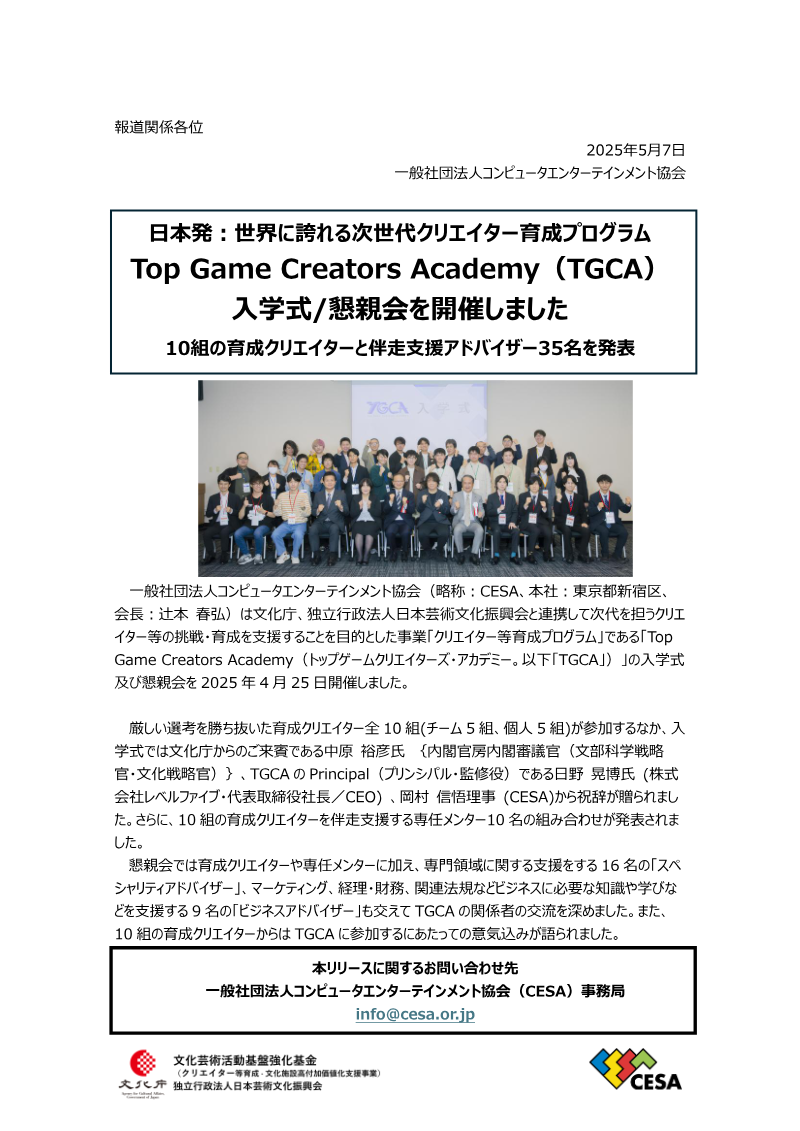
The Top Game Creators Academy (TGCA) was inaugurated on 25 April 2025 as a joint initiative of the Cultural Agency, the Japan Arts and Culture Promotion Agency, and the Computer Entertainment Association (CESA) to cultivate next‑generation game creators capable of delivering original IP that can compete globally. Ten selected teams—five groups and five individual creators—were formally admitted, accompanied by thirty‑five advisors who will provide ongoing mentorship, specialty guidance, and business support throughout a two‑year development cycle.
The program draws on the Cultural Arts Activity Strengthening Fund, allocating public resources to enable intensive, mentor‑driven training. Each creator cohort is paired with a dedicated mentor from leading studios such as Bandai Namco, Capcom, and Square Enix, while sixteen specialty advisors cover visual art, engineering, design, sound, and project management, and nine business advisors address marketing, finance, and legal matters. Progress meetings occur monthly, fostering collaborative feedback within multi‑person groups rather than one‑on‑one pairings.
Participants will showcase their work at major industry events, beginning with an online appearance at CEDEC in July 2025, a debut at Tokyo Game Show in September 2025, and subsequent exhibitions at the Taipei Game Show in January 2026, with potential expansion to international venues such as Gamescom in 2026. The cohort aims to graduate by March 2027, having refined both creative and commercial competencies to launch globally competitive titles.
- The Top Game Creators Academy (TGCA) launched on 25 April 2025 to develop globally competitive original IP through a two-year intensive mentorship program.
- The cohort consists of 10 teams—5 groups and 5 individuals—supported by a network of 35 advisors, including 16 specialty experts and 9 business consultants.
- Mentorship is provided by industry leaders from major studios, specifically Bandai Namco, Capcom, and Square Enix.
- The program is funded by the Cultural Arts Activity Strengthening Fund, a joint initiative involving the Cultural Agency, the Japan Arts and Culture Promotion Agency, and CESA.
- Participants will debut their projects at CEDEC in July 2025 and Tokyo Game Show in September 2025, followed by Taipei Game Show in January 2026.
+2
CESA – Computer Entertainment Supplier's AssociationMay 2025
Presentation46 pages
Consolidated Financial Results Briefing Materials: FY3/25
Akatsuki Inc. demonstrated significant financial resilience in FY3/25, characterized by a 46% year-over-year surge in consolidated operating profit to ¥3,915 million. While total sales experienced a marginal 1% decline, the core Games segment maintained stability through high-performing legacy titles such as Dragon Ball Z Dokkan Battle and Romancing SaGa Re;univerSe. Strong overseas performance and successful large-scale events effectively offset nearly ¥6 billion in development expenses for upcoming projects. This period also marked a strategic turning point as the Comics and IP Solutions segments achieved profitability, driven by the international launch of the MANGA MIRAI service and the rapid expansion of the Slash Gift online lottery platform.
The company’s investment arm further bolstered the balance sheet, realizing ¥2,840 million in proceeds during the fiscal year with additional capital gains anticipated from the IPO of LIFE CREATE Co., Ltd. in early FY3/26. Despite a reduction in total headcount from 803 to 697, primarily within the Games division, permanent staffing levels remained consistent, reflecting a shift toward operational efficiency. This lean organizational structure supports a robust financial position, with ¥33.3 billion in cash reserves earmarked for a ¥35 billion growth investment plan over the next three years, focusing on mergers, acquisitions, and next-generation game development.
Looking toward FY3/26, the group anticipates sustained growth in sales and profit, anchored by the upcoming release of Kaiju No. 8 The Game and the continued scaling of its digital content divisions. To reflect this positive outlook and strong liquidity, the shareholder return policy has been revised upward, increasing the target Dividend on Equity from 3% to 4%. This strategy signals a transition into a new growth phase where diversified IP solutions and global service expansions complement the established mobile gaming portfolio.
- Akatsuki Inc. achieved a 46% year-over-year increase in consolidated operating profit to ¥3,915 million for FY3/25, despite a 1% decline in total sales.
- The company maintains ¥33.3 billion in cash reserves to fund a ¥35 billion growth investment plan over the next three years, targeting M&A and next-generation game development.
- Shareholder returns are increasing as the target Dividend on Equity (DOE) has been raised from 3% to 4% due to strong liquidity and a positive outlook.
- The Comics and IP Solutions segments reached profitability, supported by the international launch of MANGA MIRAI and the expansion of the Slash Gift online lottery platform.
- Investment activities generated ¥2,840 million in proceeds during FY3/25, with further capital gains expected from the upcoming IPO of LIFE CREATE Co., Ltd. in early FY3/26.
AkatsukiMay 2025
Report37 pages
Insights into the Japanese Gaming Market: 2025
The Japanese gaming market stands as a uniquely high-value ecosystem, generating 9.1% of global industry revenue despite accounting for only 2.2% of the worldwide player base. This disparity underscores a high average revenue per user driven by a mature demographic that prioritizes quality, depth, and domestic intellectual property. While Nintendo and established local publishers maintain a firm grip on the console sector, the landscape is undergoing a structural shift as PC gaming emerges as a critical growth engine, representing a substantial $2.5 to $3.0 billion opportunity for international entrants.
Success within this region necessitates a nuanced understanding of local consumer behavior, which diverges significantly from Western trends. Japanese players demonstrate a profound preference for narrative-driven, single-player role-playing games and fantasy-themed experiences, often eschewing the open-world, sports, and multiplayer-centric titles that dominate other major markets. This cultural specificity acts as a barrier to entry for many global publishers, who must tailor their content to align with these distinct aesthetic and gameplay expectations to achieve meaningful penetration.
Beyond cultural alignment, international companies must navigate complex macroeconomic conditions, most notably the volatility of the Japanese Yen. While the market remains a lucrative target, the combination of currency headwinds and the entrenched dominance of domestic franchises requires a strategic, long-term approach. By focusing on high-fidelity, story-rich experiences that resonate with the local appetite for solo play, external publishers can effectively capture a share of this high-margin market, provided they remain adaptable to the evolving preferences of the Japanese gaming audience.
- The Japanese gaming market generates 9.1% of global industry revenue despite representing only 2.2% of the worldwide player base, indicating an exceptionally high average revenue per user.
- PC gaming is a critical growth engine in Japan, representing a $2.5 to $3.0 billion opportunity for international publishers.
- Success in Japan requires prioritizing narrative-driven, single-player role-playing games and fantasy themes, which contrast with the multiplayer and sports-centric preferences of Western markets.
- Domestic publishers and Nintendo maintain a firm grip on the console sector, creating a high barrier to entry for international companies.
- International entrants must navigate macroeconomic challenges, specifically the volatility of the Japanese Yen, when planning market entry.
+2
NewzooJan 2025

Report35 pages
Guide to Growing Chinese Gaming Apps Overseas
Chinese gaming developers are aggressively expanding their global footprint by leveraging sophisticated monetization models and high-volume, AI-driven marketing strategies. The primary objective for these publishers is to balance the high revenue potential of mature markets like the United States, Japan, and South Korea against the rising costs of user acquisition. By prioritizing video advertising, which currently yields the highest Day 7 return on ad spend at 21%, developers are successfully capturing market share in competitive strategy and RPG segments.
Success in these international territories is increasingly predicated on hyper-localization and technological integration. Publishers are utilizing generative AI to streamline the production of localized ad creatives, voice-overs, and performance-tested copy, allowing for rapid iteration and regional customization. Leading titles demonstrate that high-engagement gameplay loops—such as the inclusion of social hangout spaces, customizable home systems, and minigame integrations—are essential for sustaining long-term retention. These efforts are further bolstered by strategic partnerships with local influencers and the implementation of innovative, time-limited gacha mechanics.
To maintain consistent growth, developers are diversifying their engagement tactics through gamified live events, including seasonal collections and interactive board-style challenges. These features, combined with trial character systems, allow publishers to cater to varied player motivations while maintaining a steady revenue stream. By synthesizing competitive intelligence with agile content updates, Chinese gaming apps are effectively navigating the complexities of global expansion, ensuring that both monetization and user interest remain high across diverse geographic regions.
- Video advertising is the most effective monetization channel for Chinese developers in mature markets, currently yielding a 21% Day 7 return on ad spend.
- Generative AI is being deployed at scale to automate the production of localized ad creatives, voice-overs, and performance-tested copy to reduce costs and speed up regional market entry.
- Long-term player retention is increasingly driven by integrating social hangout spaces, customizable home systems, and minigames into core gameplay loops.
- Developers are prioritizing expansion into high-revenue mature markets, specifically the United States, Japan, and South Korea, to offset rising global user acquisition costs.
- Engagement is being sustained through gamified live events, such as seasonal collections and interactive board-style challenges, alongside trial character systems.
+6
EAJan 2025

Report46 pages
Japan Game Market Insights 2025
The analysis demonstrates that Japan’s mobile gaming sector has reached a mature equilibrium, with download volumes stabilising after 2020 while in‑app purchase (IAP) revenue continues to grow, largely driven by high‑spending iOS users. Domestic publishers hold a dominant position in downloads—capturing roughly one‑third of the market—and command more than half of total IAP revenue, underscoring Japan’s robust monetisation models and loyal consumer base. Genre preferences have shifted toward strategy titles such as Pokémon TCG Pocket and SD Gundam G Generation ETERNAL, alongside puzzle games that now lead download charts.
Live‑ops and event‑driven monetisation prove highly effective, as illustrated by Last War: Survival’s H1 2025 performance. Aggressive daily offers and themed events produced a 2.7‑fold increase in downloads and significant revenue spikes during campaigns like Double Joy, confirming that adaptive event strategies resonate with Japanese players. Anime‑style IPs maintain a commanding presence, accounting for 42 % of in‑app purchase revenue from January to July 2025. Legacy franchises—Monster Strike, Fate/Grand Order, Umamusume—continue to perform strongly, while new titles such as Shadowverse: Worlds Beyond and Honkai: Star Rail expand the ecosystem, illustrating the enduring commercial relevance of anime IP.
Digital advertising remains tightly coupled with gaming, with mobile action/strategy titles consuming 63 % of ad spend in H1 2025. LINE dominates the channel landscape, delivering approximately 40 billion impressions and over 80 % of mobile ad exposure. Cross‑IP collaborations and event‑driven campaigns sustain long‑term monetisation, reinforcing gaming’s role as a core growth driver for digital advertising in Japan. Overall, Japanese publishers retain global leadership through strong IP‑driven franchises across PC, console, and mobile platforms, with culturally resonant engagement and targeted advertising underpinning sustained revenue growth. Sensor Tower’s comprehensive analytics platform provides the critical insights that enable stakeholders to navigate this mature yet dynamic market.
- Domestic publishers maintain a dominant market position, capturing roughly one-third of total downloads and over 50% of all in-app purchase (IAP) revenue in Japan.
- Anime-style intellectual property remains the primary revenue driver, accounting for 42% of total IAP revenue between January and July 2025.
- Mobile action and strategy titles accounted for 63% of total digital advertising spend during the first half of 2025.
- The LINE platform is the primary advertising channel in Japan, generating approximately 40 billion impressions and accounting for over 80% of mobile ad exposure.
- Live-ops and event-driven strategies are highly effective, evidenced by 'Last War: Survival' achieving a 2.7-fold increase in downloads during H1 2025 through aggressive daily offers and themed campaigns.
+1
Sensor TowerJan 2025
Report37 pages
UK Interactive Entertainment Japan Market Report 2025
The report examines Japan’s interactive entertainment market for 2025, aiming to guide UK game developers and publishers in entering or expanding within a culturally distinct yet lucrative region. Japan accounts for only 2.2 % of the global player base but generates 9.1 % of worldwide game revenue, underscoring high per‑player spend—$223 in Japan versus $145 in the UK. The PC and console segment, excluding mobile and Nintendo platforms, represents a $2.5–3.0 billion opportunity.
Key market dynamics include an older player demographic than the US and Europe, a strong preference for single‑player role‑playing games with deep narratives, and a dominance of domestic publishers—70 % of console hardware sales are controlled by Japanese firms. Nintendo’s presence is particularly pronounced, while sports titles remain marginal. Revenue growth has been robust, with PC revenue rising 16.2 % YoY in 2024 versus a global 4.4 % increase, though the pace is expected to decelerate as the Japanese yen weakens against the dollar.
Methodologically, insights derive from Newzoo’s flagship global gamer study and proprietary market intelligence tools, sampling 73 000 gamers across PC and console platforms. The analysis covers player overlap, retention, and engagement metrics (DAU/MAU), and includes forecasted growth through 2027. The report concludes that strategic localization—emphasizing narrative depth, fantasy and science‑fiction themes, and solo play experiences—will be critical for success in Japan’s competitive landscape.
- Japan generates 9.1% of global game revenue from only 2.2% of the global player base, with an average per-player spend of $223 compared to $145 in the UK.
- The PC and console segment, excluding mobile and Nintendo platforms, represents a $2.5–3.0 billion market opportunity for developers.
- PC gaming revenue in Japan grew 16.2% year-over-year in 2024, significantly outpacing the 4.4% global growth rate, though this momentum faces headwinds from a weakening yen.
- Domestic firms dominate the market, controlling 70% of console hardware sales, with Nintendo maintaining a particularly strong presence.
- Successful market entry requires prioritizing single-player role-playing games featuring deep narratives, fantasy, or science-fiction themes.
+1
UK Interactive EntertainmentJan 2025