
Report28 pages
Essential Facts About the Video Game Industry 2022
The 2022 Essential Facts About the Video Game Industry provides a comprehensive analysis of the American gaming landscape, asserting that video games have become a vital tool for social connection, skill-building, and mental well-being. The central thesis posits that the high levels of engagement sparked during the pandemic have become permanent fixtures of American life, with 90% of players maintaining or increasing their playtime since the pandemic's peak.
The findings are based on a February 2022 study conducted by The NPD Group, which surveyed approximately 4,000 Americans. The data reveals that 66% of Americans—roughly 215.5 million people—play video games at least weekly. The player base is diverse and aging, with an average age of 33; 48% of players identify as female and 52% as male. While smartphones remain the most popular device (70%), the majority of players utilize multiple platforms. Puzzle and arcade games lead in popularity, though preferences shift by generation, with older adults specifically valuing games for cognitive stimulation.
Social connectivity is a primary driver of modern gaming habits. The research shows that 83% of players engage with others, and 46% have met a significant other or close friend through gaming. Beyond entertainment, 97% of Americans see games as beneficial, citing stress relief and the development of cognitive and teamwork skills. Parents also view the medium favorably, with 77% playing games with their children weekly and 84% expressing awareness of ESRB ratings to manage household gaming habits.
Economically, the industry reached $60.4 billion in total U.S. sales in 2021, driven largely by content spending. Purchase decisions are primarily influenced by game quality and price, with 67% of players engaging in in-game purchases. The scope of the report covers the 2021-2022 period, focusing on U.S. demographics, market trends, and the evolving social role of interactive entertainment.
- The U.S. gaming industry generated $60.4 billion in total sales in 2021, with 67% of players participating in in-game purchases.
- Approximately 215.5 million Americans, or 66% of the population, play video games at least weekly.
- Pandemic-era engagement levels have stabilized, with 90% of players maintaining or increasing their playtime since the peak of the pandemic.
- The player base is gender-balanced at 48% female and 52% male, with an average age of 33 years old.
- Smartphones are the primary gaming device for 70% of players, though most users engage with multiple platforms.
+1
Entertainment Software AssociationJun 2022
Report31 pages
Motivations and Demographics Snapshot Report: The Motivations Driving Top Mobile Games, February 2022
The mobile gaming landscape in the United States is defined by a complex interplay between player demographics and a diverse set of motivational drivers. Analysis of the top 200 grossing titles as of early 2022 reveals that while certain motivations like excitement and thrill are universal, their execution is highly demographic-specific. Younger male audiences gravitate toward high-sensomotoric challenges such as Battle Royales, whereas players aged 45 and older seek similar thrills through low-sensomotoric experiences like Slots. A significant shift in the casual market is also evident, as every top-grossing casual game released between 2020 and 2022 has integrated renovation and customization elements to broaden appeal and foster player expression.
Gender and age remain primary indicators of genre preference and monetization behavior. Thinking and solving motivations, prevalent in Match3 and Hidden Object games, attract a 63% female audience that frequently monetizes through level retries. Conversely, strategic planning and mastery drivers are dominated by male players, who make up 76% to 84% of the audience in 4X strategy and synchronous PvP titles. However, these gender lines blur in specific sub-genres; for instance, while men dominate resource optimization in strategy games, women represent 61% of the audience for similar mechanics within the Tycoon and Crafting categories.
The integration of secondary motivational drivers has become a standard industry practice to enhance retention and engagement. Collection mechanics have permeated nearly all genres, with Slots and character-driven RPGs leading the trend. Social drivers are increasingly facilitated through non-competitive co-op and guild systems, particularly among men aged 25 to 44, while exploration is driven by live events and sandbox elements. Ultimately, the most successful mobile titles are those that layer multiple drivers—such as milestone completion, skill improvement, and social interaction—to appeal to the nuanced psychological profiles of their target demographics.
- Gender and age are primary indicators of genre preference, with women comprising 63% of the audience for Match3 and Hidden Object games, while men make up 76% to 84% of the audience in 4X strategy and synchronous PvP titles.
- Every top-grossing casual game released between 2020 and 2022 has integrated renovation and customization elements to increase player expression and broaden market appeal.
- Motivational drivers are demographic-specific; younger males prefer high-sensomotoric challenges like Battle Royales, while players aged 45 and older seek similar thrills through low-sensomotoric experiences like Slots.
- Gender-based genre preferences are not absolute, as evidenced by women representing 61% of the audience for resource optimization mechanics within Tycoon and Crafting categories.
- Secondary engagement drivers such as collection mechanics have become industry-standard, with Slots and character-driven RPGs leading the trend to improve retention.
+2
GameRefineryFeb 2022
Report18 pages
Consumer Insights: Games and Esports 2022
The Consumer Insights: Games and Esports 2022 report provides a comprehensive analysis of global gaming behaviors, motivations, and market engagement. The primary purpose of the research is to equip game developers, publishers, and industry stakeholders with actionable data to benchmark titles, understand player demographics, and identify growth opportunities across 36 diverse international markets. By examining over 100 key performance indicators, the analysis offers a granular view of how players interact with PC, console, and mobile platforms.
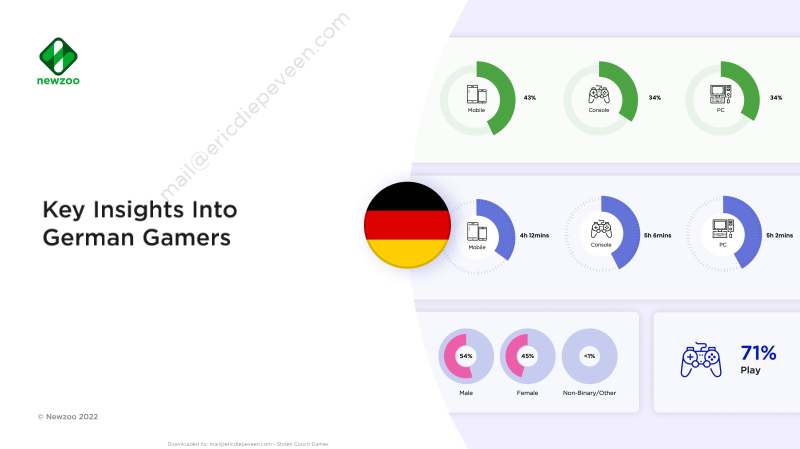
The research is underpinned by a robust methodology, drawing on survey data from over 75,000 consumers worldwide. The findings highlight distinct engagement patterns, such as the prevalence of specific gaming personas—notably Time Fillers and Mainstream Gamers—and the interplay between playing and viewing habits. For instance, data from the German market indicates that while playing remains the dominant activity, a significant portion of the population also engages with gaming video content and esports. Furthermore, the report identifies key drivers for consumer spending, noting that price sensitivity, the desire for exclusive content, and social connectivity are primary motivators for financial investment in games.
Covering a broad geographic scope that includes North America, Europe, Latin America, the Middle East, and the Asia-Pacific region, the report serves as a strategic tool for navigating the complex global gaming landscape. By synthesizing metrics such as monthly active users, daily active users, and lifetime player value, the analysis facilitates a deeper understanding of the motivations driving player behavior. Ultimately, the findings emphasize that a nuanced approach to audience segmentation and platform-specific engagement is essential for companies seeking to reach and retain diverse gaming populations in an increasingly competitive entertainment market.
- The research is based on a global dataset of over 75,000 consumers across 36 international markets, covering North America, Europe, Latin America, the Middle East, and the Asia-Pacific region.
- Consumer spending is primarily driven by three factors: price sensitivity, the desire for exclusive content, and the need for social connectivity.
- Gaming engagement is categorized into distinct personas, with 'Time Fillers' and 'Mainstream Gamers' identified as the most prevalent segments.
- Player behavior analysis utilizes over 100 key performance indicators, including monthly active users (MAU), daily active users (DAU), and lifetime player value (LPV).
- Engagement patterns in markets like Germany demonstrate that gaming video content and esports are significant activities that complement traditional gameplay.
+5
NewzooJan 2022
Report62 pages
State of Mobile India 2022
India’s mobile ecosystem in 2021 experienced a surge of activity, with total app downloads reaching 26.7 billion—a 41 % increase from the previous year—and Android users spending an average of 4.7 hours per day on apps, up 27 % from 2019. Consumer spend hit $417 million, positioning India as a dominant force in global downloads (10 % of worldwide figures) and driving significant growth in finance (+27 %) and medical (+38 %) categories. The country’s high usage time and spend levels make it a key growth engine for advertisers and developers.
Gaming shifted sharply toward hyper‑casual titles, which now dominate worldwide downloads. In 2021, hyper‑casual action and puzzle games generated over $5 billion in consumer spend, while strategy‑based “4× March‑battle” games captured nearly $10 billion in revenue. These trends highlight a pivot toward low‑friction, highly engaging experiences that accelerate user acquisition and monetization.
Food & drink apps saw explosive growth, with user sessions rising 33 % YoY to 12.1 billion in Q4 2021 after a pandemic dip. Rapid‑delivery services such as Zepto, Getir, Gorillas and Flink experienced double‑digit download surges, driven by international expansion and hyper‑fast grocery models. Brand‑centric searches dominate India’s market, while generic terms (“food”, “delivery”, “coffee”) rise in emerging regions, indicating a blend of branded and discovery‑driven usage.
Travel and rideshare apps rebounded strongly in H2 2021. India alone accounted for 259.5 million travel‑app downloads, up 15 million from H2 2020, while global downloads approached pre‑pandemic levels at 1.95 billion versus 2.08 billion in H2 2019. Rideshare demand recovered sharply, with rider sessions outnumbering driver sessions by roughly 3:1 in key markets such as the US, UK, and India. Travel apps and on‑demand transport services are regaining traction, with India playing a pivotal role in the global rebound.
In 2021, the most downloaded and highest‑spending apps in India included Google Pay, Instagram, Flipkart, Jio MyJio and Hotstar. In gaming, Free Fire (Tencent), Call of Duty: Mobile (Activision Blizzard) and Gardenscapes – New Acres (Playrix) led downloads, with Free Fire and Call of Duty: Mobile also topping spend charts. These figures underscore India’s status as a leading mobile market across diverse verticals and user segments.
- India’s mobile market saw 26.7 billion app downloads in 2021, a 41% year-over-year increase, with Android users spending an average of 4.7 hours per day on apps.
- Gaming revenue is driven by two distinct models: hyper-casual action and puzzle games generated over $5 billion globally, while strategy-based '4× March-battle' games captured nearly $10 billion.
- Food and drink app engagement in India surged 33% year-over-year to 12.1 billion sessions in Q4 2021, fueled by the rapid adoption of hyper-fast grocery delivery models.
- Travel and rideshare sectors are recovering toward pre-pandemic levels, with India recording 259.5 million travel app downloads in H2 2021 and a 3:1 ratio of rider-to-driver sessions in key markets.
- India’s consumer spending hit $417 million in 2021, with significant growth in finance (+27%) and medical (+38%) categories.
+1
IntelJan 2022
Report34 pages
2022 Casual Gaming Report
The 2022 Casual Gaming Report demonstrates that mobile gaming dominates the global market, accounting for more than sixty percent of total industry revenue. Despite this dominance, overall user spend declined in the first quarter of 2022 after reaching a pandemic‑era peak of $22.6 billion, indicating a shift in consumer behavior and heightened competition for monetization.
Key performance metrics reveal that the average cost per install (CPI) rose to $1.10, with iOS users costing $2.27 and Android users $0.75. Return on ad spend (ROAS) remained stable, with 7‑day and 30‑day figures at 7.31 % and 17.81 %, respectively; lifestyle titles delivered the highest 30‑day ROAS at 22.56 %. Regional analysis shows that Asia-Pacific and Latin America offer the most cost‑effective acquisition opportunities, each maintaining CPIs below $1 while delivering ROAS comparable to other markets. Conversely, North America remains the most expensive segment with a CPI of $3.32.
The report underscores that creative content is the pivotal factor in successful user acquisition, as it effectively communicates value and propels users through the funnel. Liftoff’s GameRefinery platform, backed by a dataset of 76.1 billion impressions, 3.4 billion clicks, and 58.5 million installs from May 2021 to May 2022, provides developers and publishers with granular insights into pre‑production and LiveOps performance drivers. These findings collectively inform strategic decisions across acquisition, creative development, and regional targeting for casual game stakeholders worldwide.
- Mobile gaming accounts for over 60% of total industry revenue, though Q1 2022 saw a decline in user spend following a pandemic-era peak of $22.6 billion.
- The average cost per install (CPI) is $1.10, with a significant disparity between iOS ($2.27) and Android ($0.75).
- North America is the most expensive market for user acquisition with a CPI of $3.32, while Asia-Pacific and Latin America offer more cost-effective opportunities with CPIs below $1.
- Return on ad spend (ROAS) remains stable at 7.31% for 7-day and 17.81% for 30-day periods, with lifestyle titles peaking at 22.56% for 30-day ROAS.
- Creative content is identified as the primary driver for successful user acquisition and funnel progression.
GameRefineryJan 2022
Report12 pages
Modern Mobile Consumer 2022: App Monetization Report
The report examines how modern mobile consumers interact with app monetization, revealing that rewarded ads and in‑app purchases (IAP) coexist without cannibalizing revenue. Surveying 30,457 participants—18,894 from gaming apps and 11,563 from non‑gaming apps on the ironSource network, plus a 500‑person control group outside MobileVoice®—the study covers North America and global markets from April to May 2022. Respondents were verified as adults and opted in for virtual rewards, ensuring engagement accuracy.
Key findings show an almost even split between IAP and ad‑supported preferences across both gaming and non‑gaming audiences. Generation X favors occasional or frequent IAP yet prefers ad support overall, while 24% of Gen Z would pay a one‑time fee to remove ads. Approximately one third of users make occasional IAPs, a significant rise from the 2‑3% noted five years earlier. Free apps with IAP dominate downloads (52% of gaming users), and 15‑17% of consumers now spend more on IAPs than five years ago.
Methodologically, the study combined custom MobileVoice® surveys with third‑party polling (Pollfish) to mitigate bias. Data were analyzed using ironSource’s Offerwall and native survey offers, with age verification and global reach.
The report concludes that diversified monetization strategies—balancing ads, IAPs, and optional removal fees—are essential to meet evolving consumer expectations. It recommends audience‑specific research, price optimization, and value bundle offerings to maximize revenue while preserving user experience.
- Rewarded ads and in-app purchases (IAP) do not cannibalize each other, allowing for a hybrid monetization strategy that maximizes revenue without sacrificing user experience.
- The percentage of users making occasional IAPs has grown significantly to approximately one-third of the total user base, up from 2-3% five years ago.
- Free apps with IAP are the dominant model, accounting for 52% of all gaming app downloads.
- Consumer spending on IAPs has increased, with 15-17% of users reporting higher expenditure compared to five years ago.
- While preferences are split between IAP and ad-supported models, 24% of Gen Z users are specifically willing to pay a one-time fee to remove advertisements.
+2
ironSourceJan 2022
Report24 pages
Games: India Plays!
The report examines the rapidly expanding Indian mobile gaming market, highlighting a projected 91 % share of online gamers playing on smartphones and an estimated revenue of US$2.2 billion in 2022, with a projected average revenue per user of US$1.5 by 2027. It distinguishes between non‑real‑money gaming (non‑RMG) and real‑money gaming (RMG), focusing on the top five non‑RMG genres—Adventure, Battle Royale, Puzzle, Arcade, and Racing—and key RMG categories such as card‑based games, sports‑fantasy, and casual RMG. Data sourced from Newzoo consumer research and MAAS campaign analytics reveal that 62 % of non‑RMG players are male, while RMG users skew slightly more balanced at 55 % male. Millennials and Gen‑Z (ages 13–41) dominate, with 55 % of adventure and battle royale players in the 13‑27 bracket. Motivations differ: non‑RMG gamers seek entertainment and challenge, whereas RMG players are driven by seasonal events like cricket tournaments or festive card‑game gatherings.
Key performance indicators for advertisers include install‑to‑registration rates of ~50 % for casual games and ~25 % for card‑based RMG, with retention dropping from 30 % on day one to 3 % by day thirty for casual titles. The analysis underscores the importance of vernacular creatives, cross‑interest programmatic targeting, and multi‑channel optimization to reduce audience overlap. It also notes emerging trends—Web3 play‑to‑earn models, esports growth, and super‑app consolidation—that signal continued market maturation. The report concludes that while monetization remains a challenge for non‑RMG segments, strategic acquisition and in‑game advertising innovations can unlock substantial growth across India’s diverse gaming ecosystem.
- The Indian mobile gaming market generated US$2.2 billion in 2022, with smartphones accounting for 91% of the online gaming audience.
- Non-real-money gaming (non-RMG) is dominated by Adventure, Battle Royale, Puzzle, Arcade, and Racing genres, while real-money gaming (RMG) centers on card games and sports-fantasy.
- Demographics skew young, with 55% of Adventure and Battle Royale players falling into the 13–27 age bracket, and 62% of non-RMG gamers being male.
- Advertiser performance metrics show a 50% install-to-registration rate for casual games compared to 25% for card-based RMG, with casual game retention dropping from 30% on day one to 3% by day thirty.
- Average revenue per user is projected to reach US$1.5 by 2027, necessitating a focus on vernacular creatives and in-game advertising to overcome current monetization challenges.
+2
EAJan 2022
Report73 pages
State of Mobile 2022
The global mobile economy experienced unprecedented expansion in 2021, characterized by a 19% year-over-year increase in app store spending to $170 billion and a 23% rise in mobile advertising to $295 billion. This growth was underpinned by a fundamental shift in consumer behavior, as users in leading markets now average 4.8 hours daily on mobile devices. Social, photo, and video applications dominate this engagement, accounting for 70% of time spent. The ecosystem's vitality is further evidenced by the release of 2 million new apps and the emergence of 233 individual titles that each surpassed $100 million in annual consumer spend.
Mobile gaming remains the primary engine of monetization, reaching a record $116 billion in spend. While hypercasual titles drive download volume, core gaming experiences like 4X March-Battle strategy and creative sandboxes drive the highest revenue. Beyond gaming, the finance sector saw a 28% increase in downloads, propelled by the rise of neobanks in emerging markets and a surge in cryptocurrency adoption. Similarly, retail engagement surpassed 100 billion hours, while the food and drink sector reached record sessions through the rapid expansion of ultra-fast delivery services.
The landscape also reflects a recovery in travel and sports, with engagement returning to pre-pandemic levels alongside a 95% increase in dating app spend since 2018. Emerging trends such as live streaming and avatar-based social platforms indicate growing consumer interest in the metaverse, with live streaming engagement outpacing the general market by nine times. Geographically and corporately, the market is led by U.S. giants like Google and Meta in general utility, while Chinese firms like Tencent dominate the gaming sector. This data illustrates a mature yet diversifying mobile industry that has become the central platform for finance, entertainment, and social interaction globally.
- The global mobile economy saw massive growth in 2021, with app store spending rising 19% to $170 billion and mobile advertising increasing 23% to $295 billion.
- Mobile gaming remains the primary revenue driver, reaching a record $116 billion in consumer spend, with 4X March-Battle strategy and creative sandbox titles generating the highest returns.
- Daily mobile usage in leading markets reached 4.8 hours, with social, photo, and video applications capturing 70% of that time.
- The mobile ecosystem demonstrated high-level commercial success with 233 individual titles surpassing $100 million in annual consumer spend.
- Finance app downloads grew by 28% in 2021, fueled by the expansion of neobanks in emerging markets and increased cryptocurrency adoption.
+1
data.aiJan 2022

Report14 pages
Games Can Be Good for the Mind: State of Mobile Games – Cognitive and Psychological Benefits
This empirical report by Skillprint examines the cognitive and psychological benefits of mobile gaming, challenging the narrative that gaming is primarily detrimental to mental health. Based on a large-scale study of nearly 500 U.S. participants and 28 individual game impact studies, the research explores the intersection of the Big 5 personality traits, player motivations, and the emotional shifts experienced after gameplay. The methodology utilizes the Big 5 Inventory to assess traits such as Conscientiousness and Emotionality, while measuring mood changes across categories like focus, creativity, and determination using Cohen’s d effect sizes.
The findings indicate that mobile games can significantly enhance specific mental states, often outperforming traditional psychological interventions like guided meditation or journaling. For instance, rhythm and puzzle games such as Sound Sky and Colorize showed large effect sizes for improving focus and creativity. The data also reveals that personality traits moderate these benefits; more emotional players tend to prefer word and idle games for relaxation, while open-minded individuals seek immersion and inspiration. Younger players are notably more driven by challenge and focus-oriented gameplay.
The report concludes that game developers should prioritize personalization to appeal to diverse personality profiles, such as offering adjustable difficulty levels to satisfy both high-conscientiousness and high-emotionality players. It suggests that health professionals consider mobile games as supplemental tools for treating mood and attention disorders. Ultimately, the research advocates for a nuanced understanding of gaming as a customizable resource for psychological well-being, where specific genres and mechanics—such as timed challenges for focus or sandbox environments for creativity—can be matched to individual user needs.
- Mobile games can significantly enhance specific mental states, with some titles demonstrating larger effect sizes for improving focus and creativity than traditional interventions like guided meditation or journaling.
- Rhythm and puzzle games, specifically Sound Sky and Colorize, produced large effect sizes for improving player focus and creativity.
- The study, based on nearly 500 U.S. participants and 28 individual impact studies, confirms that personality traits—measured via the Big 5 Inventory—directly moderate the psychological benefits a player receives from gaming.
- Player motivations vary by personality and age: more emotional players prefer word and idle games for relaxation, while younger players are primarily driven by challenge and focus-oriented mechanics.
- Developers should implement personalization features, such as adjustable difficulty levels, to cater to the distinct psychological needs of high-conscientiousness and high-emotionality personality profiles.
+1
SkillprintJan 2022
Report21 pages
Newzoo’s Global Gamer Study 2022
Gaming has evolved into a multi-dimensional entertainment ecosystem that extends far beyond traditional play, encompassing viewing, socializing, and content creation. Research conducted between February and April 2022 across 36 global markets reveals that 79% of the online population are game enthusiasts. This engagement is most profound among younger generations; for Gen Alpha, gaming has surpassed social media and streaming as the primary source of entertainment. The study utilized a representative sample of 75,930 respondents aged 10 to 65 to analyze behaviors across five distinct generational cohorts.
Data indicates that gaming is increasingly a platform for social connection, with 75% of players engaging in game worlds for social purposes without playing the primary game. This trend is a significant driver of the emerging metaverse. Financial engagement is also high, with approximately half of Gen Alpha, Gen Z, and Millennials spending money on games. Total consumer spending in the sector was projected to exceed $200 billion in 2023. Furthermore, the rise of blockchain gaming and play-to-earn models shows significant future potential, with 34% of players in the United States expressing interest in these technologies.
The findings emphasize that gamers are a highly attractive demographic for brands, as players generally hold 36% more positive attitudes toward brands compared to non-players. However, the diversity of the audience necessitates a nuanced approach to engagement. Using a proprietary segmentation model, the research identifies various personas ranging from Ultimate Gamers to Time Fillers. For instance, while both Apex Legends and Fortnite are battle royale titles, their player bases differ significantly in age, gender, and brand preferences, illustrating that effective marketing requires deep insights into specific game communities and generational motivations.
- Gaming has become a primary entertainment ecosystem for 79% of the global online population, with Gen Alpha prioritizing gaming over social media and streaming.
- The gaming sector reached a projected consumer spend exceeding $200 billion in 2023, with approximately 50% of Millennials, Gen Z, and Gen Alpha actively spending money on games.
- Gaming is increasingly used as a social platform, as 75% of players engage in game worlds for social interaction rather than playing the primary game mechanics.
- Gamers represent a high-value demographic for advertisers, holding 36% more positive attitudes toward brands than non-players.
- Interest in blockchain and play-to-earn gaming models is significant, with 34% of U.S. players expressing interest in these technologies.
+1
NewzooJan 2022
Report61 pages
State of Mobile 2022 – Indonesia
Indonesia emerged as one of the world’s most mobile-centric markets in 2021, with users averaging 5.4 hours daily on mobile devices, representing a 38% increase since 2019. This engagement translates to roughly one-third of total waking hours, fueling 7.31 billion new app downloads and $532 million in consumer spending. While social, communication, and video applications captured 70% of total time spent, the gaming sector remained the primary economic driver, accounting for 42% of all downloads and 61% of total consumer expenditure. Titles such as Mobile Legends: Bang Bang and Free Fire led the market in both engagement and monetization, while Hypercasual games dominated the download charts.
Beyond entertainment, the Indonesian mobile landscape experienced transformative growth in utility and commerce sectors. Finance app downloads surged by 82% year-over-year, and time spent in shopping applications reached 5.5 billion hours, a 52% increase. The Food and Drink category saw the most explosive growth, with sessions increasing by over 480% due to the rise of quick-service restaurant brands and delivery services. Additionally, the video streaming market nearly doubled its engagement levels since 2019, driven by a shift toward mobile-first content and the continued dominance of platforms like YouTube and TikTok, the latter of which saw 75% year-over-year growth.
Niche sectors also demonstrated significant momentum as the market matured. Consumer spending on dating apps rose 188% since 2018, while Health and Fitness engagement remained 56% higher than pre-pandemic levels. Business and utility apps like BukuWarung and PLN Mobile emerged as breakout leaders, signaling a deeper integration of mobile solutions into daily professional and civic life. As travel restrictions eased in late 2021, the recovery of travel and sports applications further solidified the mobile device as the central hub for the Indonesian consumer's digital and physical interactions.
- Gaming remains the primary economic driver in Indonesia, accounting for 42% of all app downloads and 61% of total consumer expenditure, with titles like Mobile Legends: Bang Bang and Free Fire leading the market.
- Indonesian mobile users averaged 5.4 hours of daily screen time in 2021, a 38% increase since 2019, totaling 7.31 billion downloads and $532 million in consumer spending.
- The Food and Drink category experienced the most explosive growth, with session counts increasing by over 480% due to the rise of delivery services and quick-service restaurant brands.
- Finance app downloads surged by 82% year-over-year, while time spent in shopping applications reached 5.5 billion hours, reflecting a 52% increase.
- TikTok saw 75% year-over-year growth in engagement, contributing to a near-doubling of the total video streaming market since 2019.
+1
data.aiJan 2022
Report62 pages
State of Mobile: Brazil 2022
Brazil solidified its position as a global leader in mobile engagement throughout 2021, with users averaging 5.4 hours daily on their devices. This record-breaking activity drove 10.3 billion app downloads and a 22% year-over-year increase in consumer spending, which reached $1.13 billion. While social, communication, and video streaming apps captured 70% of total mobile minutes, the gaming sector emerged as the primary engine for monetization, accounting for more than half of all consumer expenditures. Hypercasual titles led in volume, while 4X Strategy games dominated revenue generation.
The market underwent a profound digital transformation across the finance and retail sectors. Finance app downloads surged by 91% over a two-year period, fueled by a large underbanked population gravitating toward neobanks like Nubank and PicPay. Similarly, shopping app engagement rose 45%, though domestic players faced increasing competition as international publishers secured a 52% share of the local market. This shift toward digital-first services extended to the "rapid delivery" and food sectors, where sessions reached 4.5 billion, and the business category, where users increasingly utilized apps to secure alternative income through gig economy platforms.
Post-pandemic recovery and lifestyle shifts further diversified the mobile landscape. Travel and sports apps saw significant rebounds in downloads and time spent, while the dating sector reached $47 million in consumer spend, marking a 62% increase since 2018. Health and fitness apps also maintained momentum with a 30% growth in downloads compared to pre-pandemic levels. Emerging trends, such as the 45% surge in TikTok usage and the rise of avatar-based social metaverses, indicate a maturing market where short-form video and interactive digital environments are becoming central to the Brazilian mobile experience.
- Brazilian mobile users averaged 5.4 hours of daily device usage in 2021, driving 10.3 billion app downloads and $1.13 billion in consumer spending.
- Gaming is the primary monetization engine in Brazil, accounting for over 50% of total consumer spend, with hypercasual titles leading in volume and 4X Strategy games dominating revenue.
- Finance app downloads surged 91% over two years, driven by a large underbanked population adopting neobanks such as Nubank and PicPay.
- Shopping app engagement grew 45%, though international publishers now control 52% of the local market share.
- The dating sector reached $47 million in consumer spend in 2021, representing a 62% increase since 2018.
+1
data.aiJan 2022
Report62 pages
State of Mobile 2022 India
The Indian mobile ecosystem is undergoing rapid transformation, driven by a convergence of gaming, financial services, and entertainment applications. Hyper‑casual titles, primarily action‑puzzle games, have surpassed five billion downloads worldwide, while 4X march‑battle strategy games commanded the highest consumer spend in 2021, generating roughly ten billion dollars. This surge in gaming activity coincides with a 28 percent year‑over‑year increase in finance‑app usage, pushing total downloads beyond one billion and reaching 1.2 billion installations. Cryptocurrency platforms such as Binance, WazirX and CoinDCX recorded the strongest gains in sessions per user, signalling a growing appetite for digital‑asset services. Retail and video‑streaming applications also expanded markedly, with shopping apps alone accounting for 7.57 billion hours of user engagement.
The market in 2021 was dominated by a blend of global and domestic firms. Google, Meta, Reliance, the Times Group, ShareChat and Bharti Airtel led both download and spend rankings across categories. In the gaming segment, Chinese and U.S. publishers—including Tencent, Jinke Culture (Outfit7), Voodoo, ironSource and Supercell—held top positions, with popular titles such as Carrom Pool and My Talking Tom Friends driving user acquisition. This competitive landscape underscores the importance of cross‑border content while highlighting the rising influence of Indian platforms.
Overall, the data illustrate a diversified mobile market in India where high‑growth sectors—hyper‑casual gaming, strategic spend‑heavy titles, and fintech services—are reshaping user behavior and revenue streams. The coexistence of strong domestic players with leading international publishers suggests a dynamic environment poised for continued expansion throughout the coming years.
- The Indian mobile market is defined by high-growth sectors in gaming, fintech, and retail, with 4X march-battle strategy games generating approximately $10 billion in global consumer spend during 2021.
- Finance application usage in India grew by 28% year-over-year in 2021, resulting in over 1.2 billion total installations.
- Hyper-casual action-puzzle games have achieved significant scale, surpassing five billion downloads worldwide.
- Cryptocurrency platforms including Binance, WazirX, and CoinDCX experienced the strongest growth in sessions per user, reflecting a rising demand for digital-asset services.
- Retail applications saw massive user engagement, with shopping apps accounting for 7.57 billion hours of total usage in 2021.
+1
data.aiJan 2022
Report22 pages
Newzoo Gen Z & Gen Alpha Report 2022
This analysis examines the gaming behaviors and preferences of Gen Alpha (ages 10-12) and Gen Z (ages 13-27), positioning these cohorts as the primary drivers of the industry's future. The central thesis asserts that for these younger generations, gaming has evolved beyond a mere pastime into a ubiquitous "lifestyle" platform that fulfills fundamental needs for socialization, self-expression, and immersion. This shift is characterized by high engagement across multiple dimensions, including playing, viewing content, and participating in virtual social communities.
Key findings indicate that 90% of Gen Alpha and Gen Z are "game enthusiasts," significantly higher than the 79% found in the total online population. These groups invest a substantial portion of their leisure time in gaming; it is the top entertainment source for Gen Alpha and a top-three source for Gen Z, rivaling social networks and streaming. Socialization is a critical driver, with 70% of Gen Z expressing interest in using game worlds for social gatherings beyond active gameplay, such as attending virtual parties or watching movies. This behavior suggests these generations will be the primary catalysts for metaverse adoption.
Economic engagement is also high, with 52% of Gen Alpha and Gen Z spending money on games, compared to 42% of the general population. Mobile is the leading platform for both play and spend, though Gen Alpha shows a unique affinity for consoles driven by franchises like Fortnite and Mario. The primary motivators for spending include unlocking exclusive playable content and personalizing the in-game experience through virtual goods like currencies and gear.
The data is derived from Newzoo’s 2022 Global Gamer Research, utilizing Computer Assisted Web Interviewing (CAWI) conducted between February and April 2022. The study features a representative sample of 75,930 respondents across 36 global markets, covering North America, Europe, MEA, Latin America, and Asia-Pacific.
- 90% of Gen Alpha and Gen Z are game enthusiasts, significantly outpacing the 79% engagement rate found in the total online population.
- Gaming is the primary entertainment source for Gen Alpha and a top-three source for Gen Z, competing directly with social networks and streaming services.
- 70% of Gen Z are interested in using virtual game worlds for social activities beyond gameplay, such as attending parties or watching movies, positioning them as the primary drivers of metaverse adoption.
- Economic engagement is higher among younger cohorts, with 52% of Gen Alpha and Gen Z spending money on games compared to 42% of the general population.
- Mobile is the dominant platform for both play and spending, though Gen Alpha demonstrates a notable preference for consoles, specifically citing franchises like Fortnite and Mario.
+1
NewzooJan 2022
Report26 pages
Multiplayer Report 2022
The 2022 Multiplayer Report examines the evolving preferences, behaviors, and technical expectations of online gamers across major global markets. The primary thesis suggests that while traditional genres like Battle Royale and First-Person Shooters remain dominant, the success of multiplayer titles increasingly depends on social connectivity and technical reliability. The findings indicate that 77% of the global gaming population engages in multiplayer play, with overall engagement across all genres increasing by an average of 3.3% compared to the previous year.
Key data points highlight that genre is the primary factor for game selection (49%), followed closely by social drivers such as the ability to chat in-game (31%) and having friends already active in the title (34%). Technical performance is equally critical, with 35% of players prioritizing quick matchmaking and 33% requiring skill-based pairing. Regarding monetization, the data shows a 5% year-over-year increase in players purchasing downloadable content. While core gamers are 58% more likely to spend over $20 on additional content, casual audiences remain active spenders in lower price brackets.
The scope of the research covers four major gaming markets—the United States, United Kingdom, Japan, and South Korea—representing a significant portion of global gaming revenue. The analysis segments the industry into various categories, including mobile, PC, and console platforms, while distinguishing between casual and core gamer demographics. Internal data from Unity reveals a 150% growth in PC multiplayer development and a 40% increase in mobile multiplayer projects since early 2021.
Methodology for these insights involved a survey of approximately 1,500 multiplayer gamers conducted in Q3 2021 and Q3 2022. The sample was split evenly between casual players, defined by a minimum of 30 minutes of weekly multiplayer play, and core players, who engage for at least four hours weekly in competitive genres. This survey data was supplemented by anonymized, aggregated internal metrics from Unity’s live gaming solutions.
- Multiplayer gaming engagement grew by 3.3% year-over-year, with 77% of the global gaming population now participating in online play.
- Unity internal data shows a 150% surge in PC multiplayer development and a 40% increase in mobile multiplayer projects since early 2021.
- Genre remains the primary driver for game selection at 49%, followed by social connectivity factors including existing friend groups (34%) and in-game chat capabilities (31%).
- Technical performance is a critical retention factor, with 35% of players prioritizing quick matchmaking and 33% requiring skill-based pairing.
- Players purchasing downloadable content increased by 5% year-over-year, with core gamers being 58% more likely to spend over $20 on additional content than casual audiences.
+1
UnityJan 2022
Report11 pages
Key Insights Into American Gamers
The United States represents the second-largest gaming market globally, generating $47.3 billion in revenue from a population of 191 million gamers. Research conducted in 2022 indicates that 72% of the American online population are game enthusiasts, a broad category encompassing those who play, watch, or socially engage with video games. While 71% of the population plays games, there is a significant overlap with viewership, as 44% of the population watches gaming video content and 18% engages with esports.
The demographic profile of American gamers is nearly evenly split by gender, with 52% identifying as male and 47% as female. Engagement spans all age groups, though the 21-35 bracket is the most active at 35%. Player motivations are diverse, led by social interaction (37%), action (37%), and achievement (36%). While mobile is the most popular platform by reach, capturing 48% of players, console gaming commands the highest engagement time, averaging six hours per week.
Economic engagement is high, with 49% of the online population spending money on games. The primary drivers for spending include the desire to play with friends or family, taking advantage of sales, and unlocking exclusive content. Popular titles like Fortnite, Grand Theft Auto V, and Call of Duty dominate the market, with shooters and adventure games ranking as the top genres by monthly active users. This data is derived from a 2022 consumer insights survey of 3,054 online respondents in the U.S., part of a broader global study covering 36 markets.
- The U.S. gaming market generated $47.3 billion in revenue from 191 million gamers, representing 72% of the online population.
- Engagement is driven by a mix of play and viewership, with 71% of the population playing games, 44% watching gaming content, and 18% engaging with esports.
- Mobile is the most popular platform by reach at 48%, while console gaming commands the highest engagement at an average of six hours per week.
- The demographic profile is nearly evenly split, with 52% male and 47% female, and the 21-35 age bracket serving as the most active segment at 35%.
- Nearly half of the online population (49%) spends money on games, primarily motivated by social interaction, sales, and exclusive content.
+1
NewzooJan 2022
Report11 pages
Key Insights Into South Korean Gamers
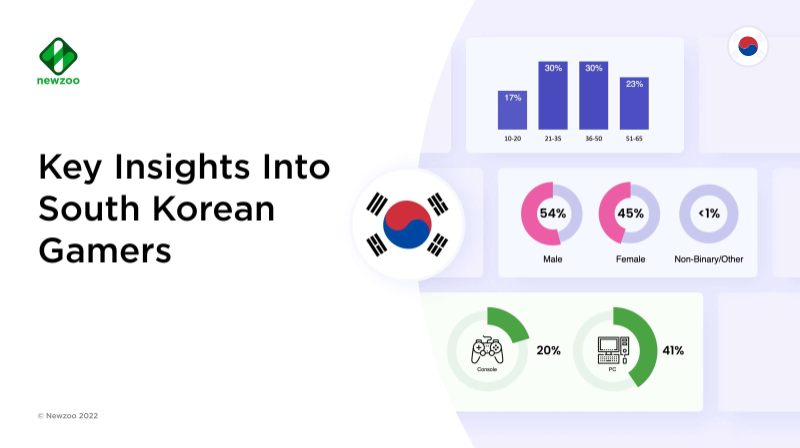
South Korea represents the fourth largest gaming market globally by revenue, valued at $8.3 billion, with a highly engaged population of 33 million gamers. Research conducted in 2022 indicates that 76% of the online population are game enthusiasts who engage with the medium through playing, viewing, or social interaction. While 72% of the population plays games, there is a significant overlap with viewership; 48% of South Koreans both play and watch gaming content, while 22% specifically engage with esports.
The demographic profile of South Korean gamers is diverse, with a nearly even split between males (54%) and females (45%) and broad representation across age groups, particularly those between 21 and 50. Socializing is the primary motivator for play, followed by action and achievement. Despite the high engagement levels, player personas vary; the most common types are Time Fillers, who play casually to pass the time, and Mainstream Gamers, who invest heavily in both playing and viewing.
Mobile is the dominant platform, utilized by 59% of the online population, though PC players record the highest average weekly engagement at five hours. In terms of software, League of Legends and Shooter genres lead in monthly active users. Monetization is also robust, with 38% of the population spending money on games. The primary drivers for spending include the desire to advance more quickly or easily in-game, followed by responding to sales or special offers.
The findings are based on a 2022 consumer insights survey of 2,094 respondents from the South Korean online population. The data highlights a mature market where gaming is a mainstream social activity integrated into daily life across all demographics, supported by a strong esports culture and a high propensity for in-game spending.
- South Korea is the world's fourth-largest gaming market, generating $8.3 billion in annual revenue from a highly engaged base of 33 million gamers.
- Gaming is a deeply integrated social activity, with 76% of the online population participating, 48% both playing and watching content, and 22% specifically following esports.
- Mobile is the primary platform for 59% of the online population, though PC gamers demonstrate higher engagement with an average of five hours of play per week.
- The player base is demographically balanced, with a 54% male and 45% female split and strong representation across the 21–50 age range.
- Monetization is robust, with 38% of the population spending money on games, primarily driven by the desire for faster progression or to capitalize on special offers.
+1
NewzooJan 2022

Report40 pages
India: Mobile Market Spotlight: A Booming Mobile Economy
This analysis examines the rapid expansion of India’s mobile economy, focusing on user behavior, app categories, and market growth between 2019 and mid-2021. Utilizing proprietary intelligence data, the findings characterize India as one of the world’s most mobile-first markets, ranking second globally in total app downloads. In 2020, Indian users downloaded 24 billion apps, a 28% year-over-year increase, and spent a total of 651 billion hours on Android devices. Driven by the COVID-19 pandemic, average daily time spent per user rose from 3.3 hours in 2019 to 4.8 hours by the third quarter of 2021.
Mobile gaming represents a significant pillar of this growth, with India becoming the largest market for game downloads in the first half of 2021, accounting for nearly one-fifth of global installs. While titles like Ludo King and Free Fire dominate active user and spend charts, homegrown publishers represent only 7.6% of the top 1,000 downloaded games, suggesting a major opportunity for local development. Additionally, monetization strategies are evolving, with a 15% increase in top-grossing games adopting hybrid models that combine in-app purchases with advertising.
The financial services sector has also seen a dramatic transformation. Hours spent in investment and trading apps grew by 65% in 2020, led by platforms like Upstox Pro and WazirX. The Unified Payments Interface (UPI) continues to drive the market, with transaction volumes doubling year-over-year by mid-2021. Emerging segments such as "Buy Now Pay Later" and merchant utility apps like Khata Book are gaining significant traction. Beyond finance and gaming, the report highlights surging engagement in digital-first shopping, video streaming services like MX Player and Netflix, and a growing demand for mental health resources through meditation apps.
- India is a global mobile-first leader, ranking second in total app downloads with 24 billion installs in 2020, a 28% year-over-year increase.
- India became the world's largest market for game downloads in the first half of 2021, accounting for nearly 20% of global installs.
- Daily mobile usage per user surged from 3.3 hours in 2019 to 4.8 hours by Q3 2021, fueled by pandemic-driven engagement.
- Homegrown publishers hold only 7.6% of the top 1,000 downloaded games, indicating a significant market opportunity for local developers.
- Monetization in top-grossing games is shifting toward hybrid models, with a 15% increase in titles combining in-app purchases and advertising.
+2
data.aiJun 2021
Report185 pages
Online Nation 2021 Report
Overview............................................................................................................................ 3 What we have found – in brief ........................................................................................................... 3 1. The online consumer ......................................................................................................
- Adults spent significantly more time online in 2020 compared to 2019, with the 18-24 age group showing the largest increase, particularly during lockdown periods.
- Despite a potential decrease, 6% of UK households (approximately 1.5 million) still lacked internet access in March 2021, though direct comparability with previous years is limited due to methodology changes.
- Social video platforms are actively launching new features to maintain and build engagement, exemplified by Snapchat's 'Spotlight' which gained 100 million users by January 2021 and offers creators a share of $1 million daily.
- TikTok removed 104.5 million videos in the first half of 2020 and 89.1 million in the second half, with 'minor safety' and 'adult nudity/sexual activities' consistently being among the top removal reasons.
- The COVID-19 pandemic led to a significant increase in online education for children, with nearly 90% of parents in Britain homeschooling their children in May-June 2020 and January-February 2021.
+1
OfcomJun 2021

Report145 pages
Cultural and Creative Sectors in Post-COVID-19 Europe: Crisis Effects and Policy Recommendations
Requested by the CULT Committee European Parliament Policy Department for Structural and Cohesion Policies Directorate-General for Internal Policies PE 652.242 – February 2021 EN Cultural and creative sectors (CCS) have been hit hard by the consequences of the COVID -19 pandemic. This study analyses the so far effects of the crisis on the CCS, as well as the policy responses that are formulated to support the sectors.
- The Cultural and Creative Sectors (CCS) in the EU-27 were economically fragile before COVID-19, characterized by over 1.1 million enterprises (5% of non-financial businesses) generating EUR 145 billion (2.3% of the non-financial business economy) in 2017, with growth rates slightly above the overall non-financial business economy (1.5% vs 1.4% annually between 2012-2017).
- The COVID-19 pandemic severely impacted the CCS through measures like halting non-essential business, banning public events, and restricting movement, leading to significant income loss for suppliers (e.g., sound/lighting, caterers) and local economies dependent on festivals and events.
- Freelance performing artists, who often rely on multiple income streams and networking at events, were particularly hard hit by movement bans and social distancing, with many unable to access public support.
- While some digital-native CCS sub-sectors (e.g., gaming) and those with large IP portfolios thrived, content creators often did not receive fair remuneration from digital platforms, highlighting a need for equitable compensation models.
- The crisis accelerated the adoption of digital income sources and online distribution for CCS sub-sectors traditionally reliant on physical/live components (e.g., performing arts, live music), demonstrating potential for crisis resistance.
+1
European ParliamentFeb 2021