Report332 pages
Universal Registration Document 2024/25: France
UNIVERSAL REGISTRATION DOCUMENT Including the annual financial report Public limited company with a board of directors with a capital of €108 236 070 Registered office: 396/466, Rue de la Voyette – CRT 2 – 59273 Fretin This universal registration document ("URD") was filed on June 27, 2025 with the French Financial Markets Authority ("AMF"), in its capacity as competent Authority under Regulation (EU) 2017/1129, without prior approval in accordance with ...
- NACON's video game studios benefit significantly from tax incentives like the French Video Game Tax Credit (CIJV), which amounted to €10.5 million as of March 31, 2025, up from €6.1 million in 2024, though challenges to calculation methods or regulatory changes pose a risk.
- The global video game market generated $187.7 billion in revenue in 2023, surpassing the combined film and music markets, with a rapid shift towards digital distribution and anticipated growth in cloud gaming due to 5G.
- NACON is prioritizing a qualitative message on trends for fiscal year 2025/26, with a rich lineup of major game releases planned across adventure, sports, racing, and simulation genres, including "Robocop: Rogue City – Unfinished Business™" (July 17) and "Hell is Us™" (September 4).
- NACON's net profit after tax for fiscal year 2024/25 was -€1,753,929, a decrease from €5,282,060 in 2023/24, with revenue excluding taxes also slightly down to €102,394,315 from €106,723,639.
- NACON is investing in sustainability by building a new 1,000 m² video game accessory manufacturing site in Lauwin-Planque, France, to repatriate production closer to European customers, with completion expected in Q2 2025, aiming to reduce GHG emissions and extend product lifespan through repairability and recycled materials.
+1
Nacon
Report2 pages
Sales for the 2024/25 Financial Year: Nacon
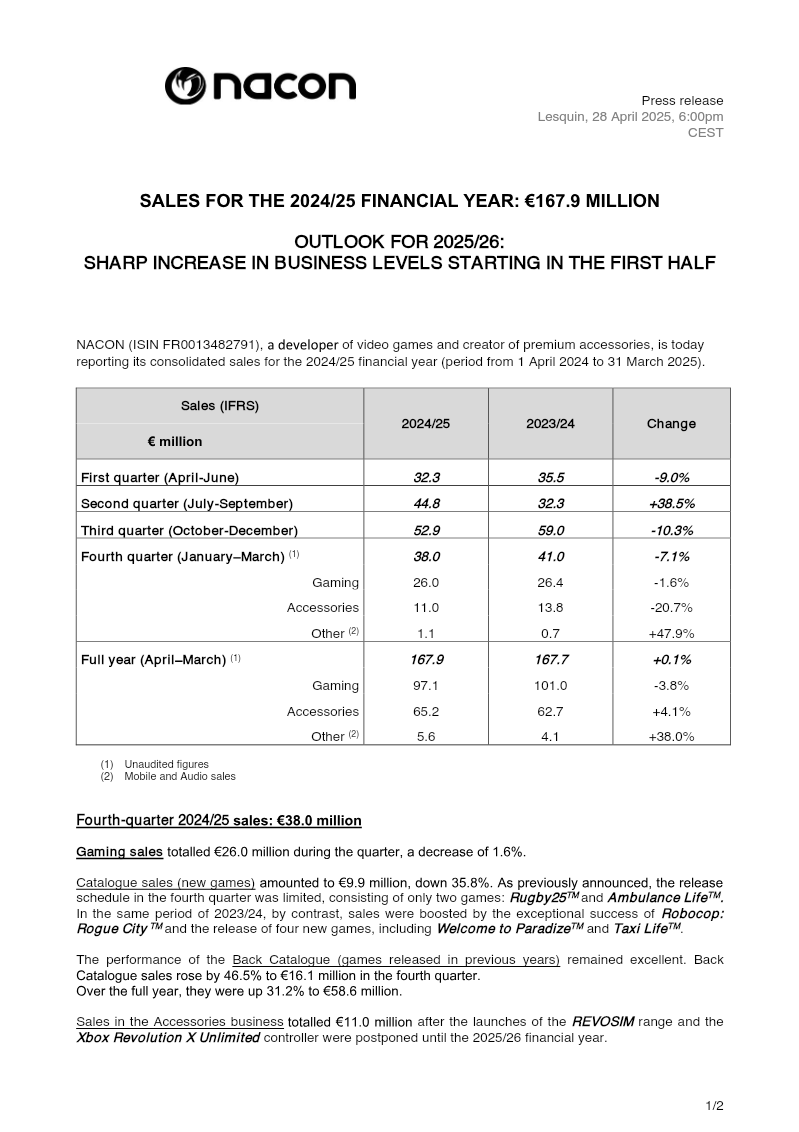
Nacon reported consolidated sales of €167.9 million for the 2024/25 financial year, essentially flat against the €167.7 million recorded in 2023/24. Quarterly performance varied, with a sharp decline in the first quarter (‑9 %) offset by a 38.5 % rise in the second quarter, followed by declines of 10.3 % and 7.1 % in the third and fourth quarters respectively. Gaming revenue fell by 3.8 % to €97.1 million, while accessories grew modestly by 4.1 % to €65.2 million; the “Other” segment, comprising mobile and audio sales, expanded 38 % to €5.6 million.
The fourth‑quarter gaming output was limited to two titles, Rugby25™ and Ambulance Life™, resulting in a 35.8 % drop in new‑game catalogue sales to €9.9 million, compared with four releases and the hit Robocop: Rogue City™ in 2023/24. Back‑catalogue sales, however, surged 46.5 % to €16.1 million in the quarter and 31.2 % for the year, underscoring sustained demand for legacy titles.
Accessories sales were constrained by postponed launches of the REVOSIM range and the Xbox Revolution X Unlimited controller, which will debut in 2025/26. Nacon anticipates a sharper growth trajectory for the next fiscal year, driven by an expanded release calendar of over ten new games across sports, racing, adventure and simulation genres, as well as the launch of high‑profile accessories in the first half of 2025/26. Production expansion at a new French controller plant and continued reliance on Vietnamese manufacturing for U.S. inventory are expected to support this outlook.
- Nacon’s 2024/25 consolidated sales remained stagnant at €167.9 million, showing negligible growth compared to the previous year's €167.7 million.
- Gaming revenue declined 3.8% to €97.1 million, driven by a 35.8% drop in new-game catalogue sales due to a limited release schedule of only two titles in the fourth quarter.
- Back-catalogue performance served as a key stabilizer, with sales surging 31.2% for the full year and 46.5% in the fourth quarter alone.
- Accessories revenue grew 4.1% to €65.2 million, though growth was constrained by the postponement of the REVOSIM range and the Xbox Revolution X Unlimited controller to the 2025/26 fiscal year.
- The company projects a stronger 2025/26 fiscal year, supported by an expanded pipeline of over ten new titles across sports, racing, adventure, and simulation genres.
+1
Nacon
Report2 pages
Consolidated Sales: Second Quarter 2025-26
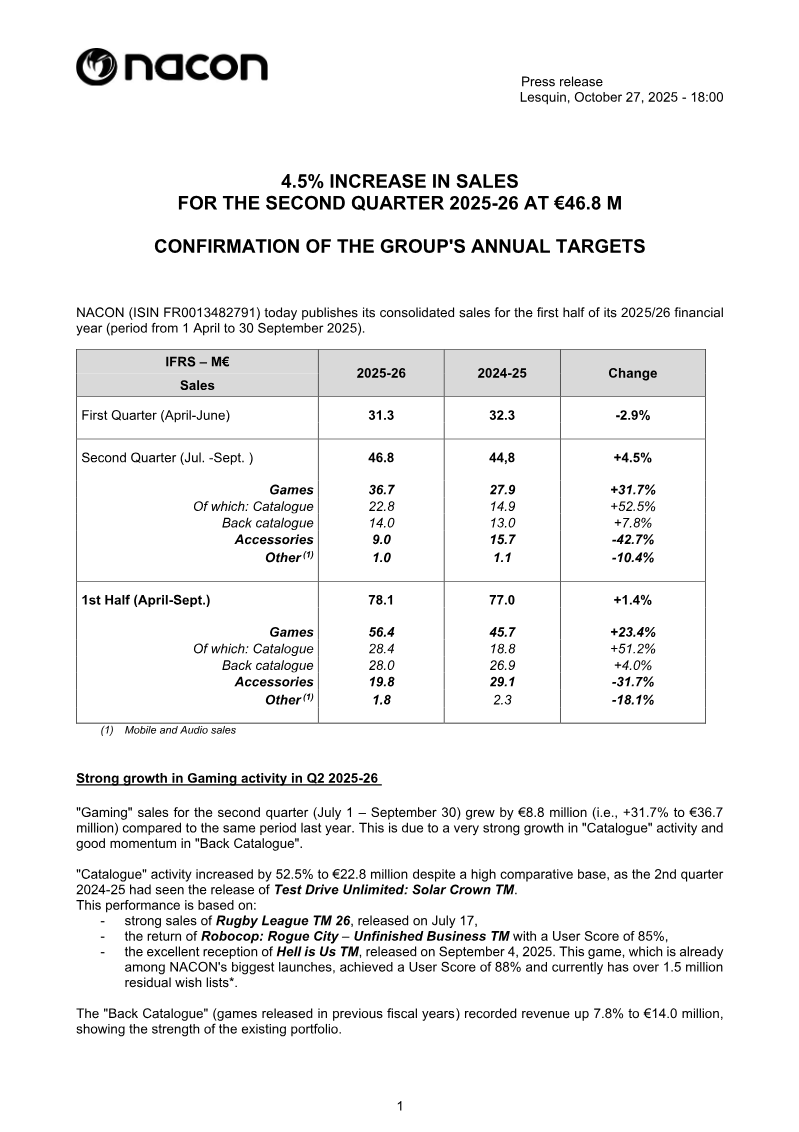
NACON reports a 4.5 % rise in consolidated sales for the second quarter of its 2025/26 fiscal year, reaching €46.8 million compared with €44.8 million in the same period last year. Total first‑half sales for April–September 2025 amount to €78.1 million, up 1.4 % from €77.0 million in the prior year. Gaming sales dominate growth, increasing by €8.8 million (31.7 %) to €36.7 million, driven largely by a 52.5 % jump in catalogue titles and a modest 7.8 % rise in back‑catalogue revenue. Catalogue releases such as Rugby League 26, Robocop: Rogue City – Unfinished Business, and Hell is Us contribute significantly, with the latter achieving an 88 % user score and over 1.5 million residual wish‑lists. Back‑catalogue sales reflect the strength of NACON’s existing portfolio.
The accessories segment, however, contracts sharply by 42.7 % to €9.0 million, largely due to a 66 % decline in U.S. sales caused by higher customs duties. European accessory sales, particularly for Switch 2 and XBOX Revolution X Unlimited controllers, are expected to provide some recovery. NACON anticipates continued catalogue momentum in the second half of the year, with nearly a dozen new titles slated for release, while back‑catalogue activity should remain steady. The company maintains confidence in meeting its 2025/26 annual targets, citing a robust release schedule and new accessory products. The next financial update for the first half of 2025/26 will be issued on November 24, 2025.
- NACON reported a 4.5% increase in Q2 2025/26 sales to €46.8 million, bringing total first-half revenue to €78.1 million, a 1.4% year-over-year growth.
- Gaming segment revenue surged 31.7% to €36.7 million, fueled by a 52.5% increase in catalogue title sales and steady performance from the back-catalogue.
- The accessories segment contracted by 42.7% to €9.0 million, primarily driven by a 66% decline in U.S. sales resulting from increased customs duties.
- Key titles including 'Rugby League 26', 'Robocop: Rogue City – Unfinished Business', and 'Hell is Us' are driving current growth, with 'Hell is Us' recording an 88% user score and 1.5 million wish-lists.
- Management maintains its 2025/26 annual targets, supported by a pipeline of nearly a dozen new game releases and upcoming accessory launches for Switch 2 and XBOX Revolution X.
+2
Nacon
Report2 pages
First-Quarter 2025-26 Sales: Nacon
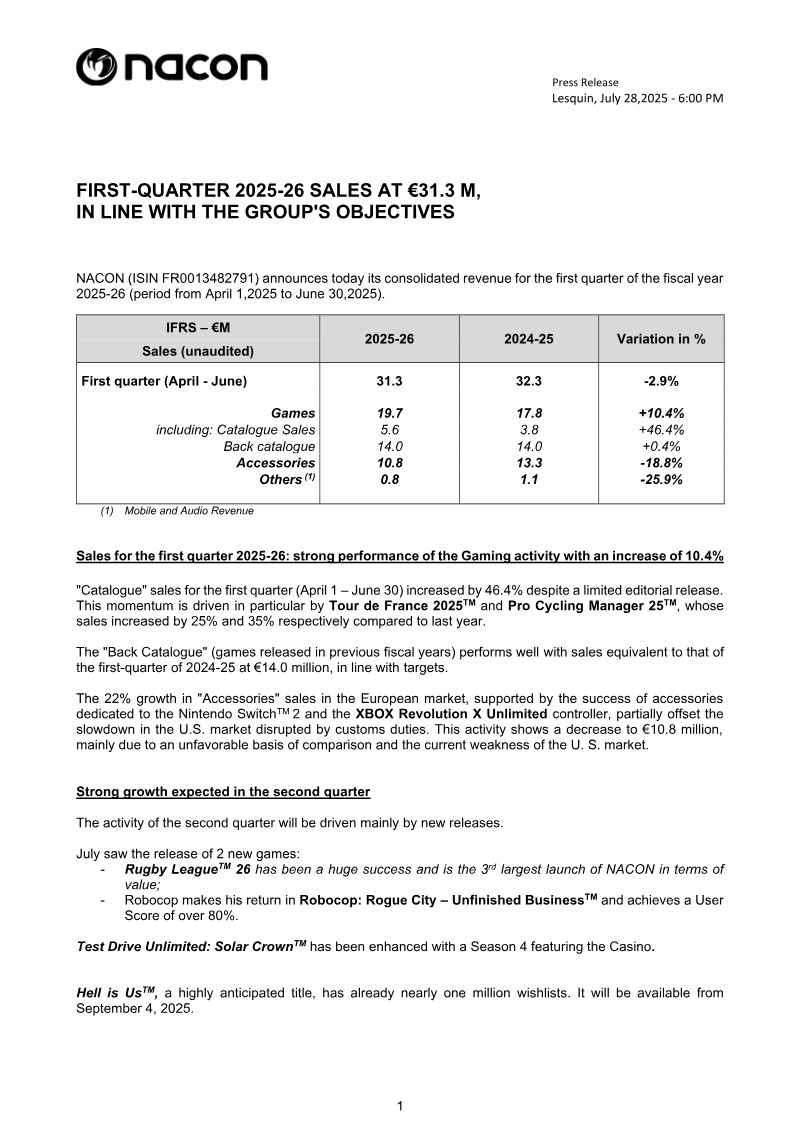
Nacon reported consolidated revenue of €31.3 million for the first quarter of fiscal 2025‑26 (April 1–June 30), a slight decline of 2.9 % compared with the €32.3 million recorded in the same period of 2024‑25. Gaming sales, however, grew by 10.4 % to €19.7 million, driven largely by a 46.4 % jump in catalogue sales to €5.6 million, with key titles such as Tour de France 2025 and Pro Cycling Manager 25 contributing 25 % and 35 % sales increases respectively. Back‑catalogue performance remained flat at €14.0 million, meeting expectations. Accessories revenue fell to €10.8 million, a 18.8 % drop largely attributed to a weaker U.S. market and unfavorable year‑on‑year comparison, though European sales showed 22 % growth thanks to Nintendo Switch 2 and XBOX Revolution X Unlimited controller launches. Other revenue, including mobile and audio, decreased by 25.9 % to €0.8 million.
The company anticipates robust second‑quarter growth, citing new releases such as Rugby League 26 and Robocop: Rogue City – Unfinished Business, with additional titles slated for the second half of the year. Nacon maintains confidence in meeting its 2025‑26 fiscal targets, citing a strong dual‑business model and ongoing accessory innovation. The next quarterly update is scheduled for 27 October 2025.
- Nacon reported Q1 2025-26 consolidated revenue of €31.3 million, representing a 2.9% decline compared to the same period last year.
- Gaming segment revenue grew 10.4% to €19.7 million, bolstered by a 46.4% surge in catalogue sales driven by strong performances from 'Tour de France 2025' and 'Pro Cycling Manager 25'.
- Accessories revenue fell 18.8% to €10.8 million, primarily due to a weaker U.S. market and unfavorable year-on-year comparisons.
- Despite the overall decline in accessories, the European market saw 22% growth in this segment, supported by the launch of Nintendo Switch 2 and XBOX Revolution X Unlimited controllers.
- Back-catalogue sales remained stable at €14.0 million, meeting company expectations for the quarter.
+2
Nacon
Report2 pages
Sales for the First 9 Months of Fiscal Year 2025-26
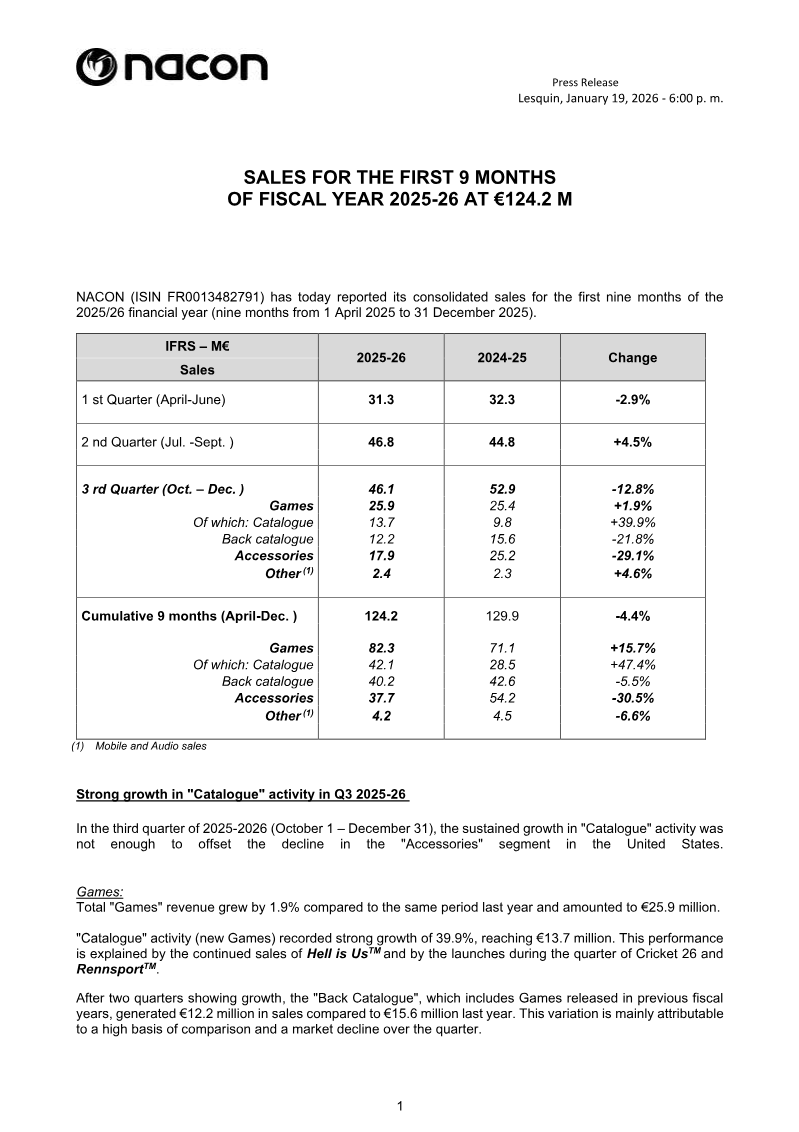
NACON reported consolidated sales of €124.2 million for the first nine months of fiscal year 2025‑26, a decline of 4.4 % compared with €129.9 million in the same period last year. Total game revenue rose 1.9 % to €25.9 million, driven by a 39.9 % increase in catalogue sales (€13.7 million) from new titles such as Hell is Us, Cricket 26 and Rennsport. Back‑catalogue sales fell 21.8 % to €12.2 million, largely due to a high base and market contraction. Accessories revenue dropped 29.1 % to €17.9 million, with the United States market still impacted by customs duties; the decline eased from 66 % in Q2 to 38 % in Q3. Other mobile and audio sales grew modestly by 4.6 %.
Quarterly performance varied: Q1 saw a 2.9 % drop, Q2 grew 4.5 %, while Q3 declined 12.8 %. The company attributes the Q3 downturn to weaker accessories sales, despite strong catalogue momentum. NACON’s outlook for 2025‑26 remains conservative; it now expects activity comparable to the previous year, citing continued catalogue releases (e.g., Styx: Blades of Greed, GreedFall The Dying World) and anticipated accessory sales in Europe, including the Switch 2 and a new RIG R5 PRO HS headset. The company’s 16 studios, AA publishing arm, and peripheral design capabilities underpin its market position across 100 countries through 25 subsidiaries.
- NACON reported consolidated sales of €124.2 million for the first nine months of fiscal year 2025-26, representing a 4.4% decline compared to the same period last year.
- Total game revenue grew 1.9% to €25.9 million, fueled by a 39.9% surge in new catalogue sales from titles like 'Hell is Us', 'Cricket 26', and 'Rennsport'.
- Accessories revenue dropped 29.1% to €17.9 million, primarily due to ongoing impacts from customs duties in the United States market.
- Back-catalogue sales fell 21.8% to €12.2 million, attributed to a high base effect and broader market contraction.
- Quarterly performance was inconsistent, featuring a 2.9% drop in Q1, 4.5% growth in Q2, and a 12.8% decline in Q3.
+2
Nacon
Report2 pages
Nacon Announces Insolvency and Judicial Reorganisation Proceedings
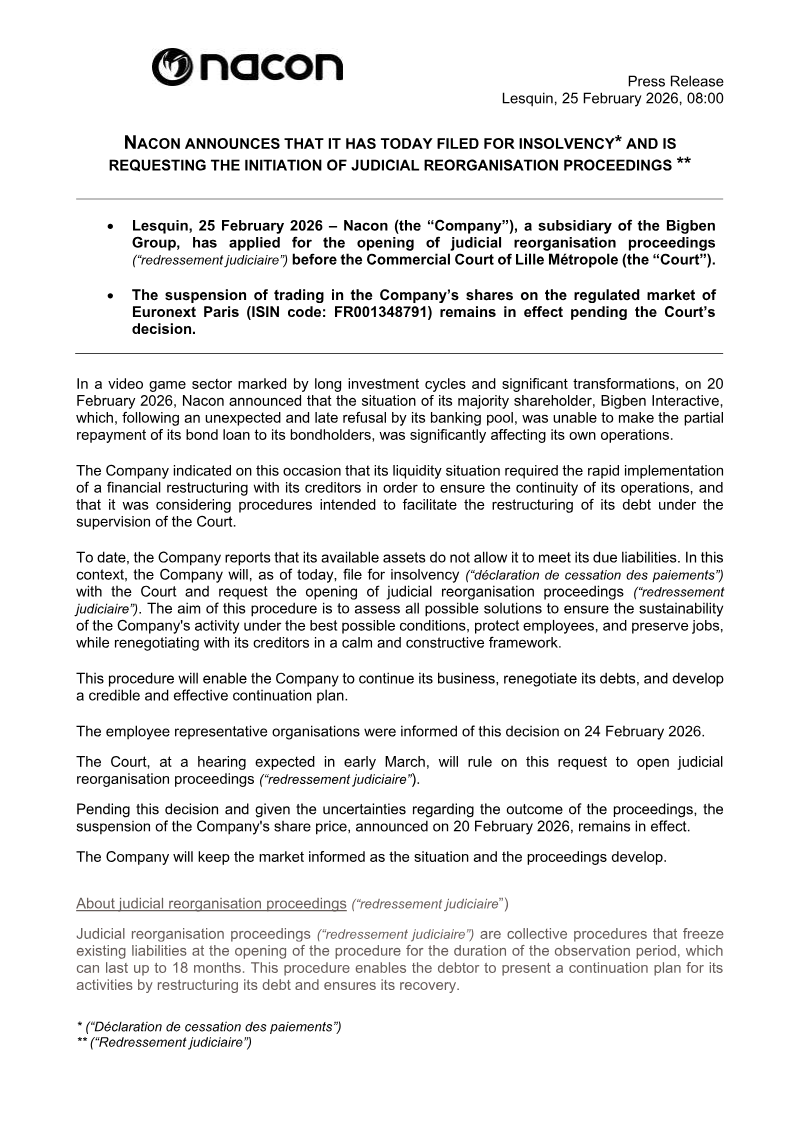
Nacon, a subsidiary of the Bigben Group and listed on Euronext Paris, announced on 25 February 2026 that it has filed for insolvency and requested the initiation of judicial reorganisation proceedings before the Commercial Court of Lille Métropole. The filing follows a liquidity crisis triggered by Bigben Interactive’s failure to repay part of its bond loan after an unexpected refusal from its banking pool. Nacon stated that its available assets are insufficient to meet current liabilities, prompting a rapid financial restructuring with creditors to safeguard operations and preserve jobs.
The court‑initiated procedure, known in France as “redressement judiciaire,” freezes existing debts for up to 18 months, allowing the company to present a viable continuation plan. The hearing is scheduled for early March, and until a decision is made, the company’s shares remain suspended on Euronext Paris. Employee representatives were notified of the insolvency filing on 24 February.
Financially, Nacon reported IFRS revenue of €167.9 million for 2024/25 and an operating profit of €1.1 million, supported by a workforce of over 1,000 employees across 25 subsidiaries and a distribution network covering 100 countries. The company’s portfolio includes 16 development studios, AA publishing, and premium gaming peripherals, positioning it as a unified entity within the video‑game market. The reorganisation aims to renegotiate debt, protect staff, and secure a sustainable operational future under court supervision.
- Nacon has filed for insolvency and initiated judicial reorganisation proceedings with the Commercial Court of Lille Métropole as of 25 February 2026.
- The filing was triggered by a liquidity crisis following parent company Bigben Interactive’s failure to repay a bond loan after being denied support by its banking pool.
- The 'redressement judiciaire' process freezes existing debts for up to 18 months, allowing Nacon to develop a restructuring plan while its shares remain suspended on Euronext Paris.
- Nacon reported 2024/25 IFRS revenue of €167.9 million and an operating profit of €1.1 million prior to the filing.
- The company maintains a significant operational footprint, employing over 1,000 staff across 25 subsidiaries and managing a portfolio of 16 development studios and gaming peripheral lines.
Nacon

Report83 pages
Annual Financial Report: 2019/20
1. FOCUS HOME INTERACTIVE presentation pages 5 to 9 2. Declaration by the person responsible page 11 3. Management Board’s report pages 15 to 33 4. Supervisory Board’s report pages 37 to 41 5.
- Focus Home Interactive's gross profit grew 20% to €36.6M, with a gross margin of 31% (up from 29% last year), and operating profit increased 36% to €19.2M for the year ended March 31, 2020.
- The Group held a net cash position of €18M on March 31, 2020.
- Focus Home Interactive has established new collaborations with Saber (for new projects and porting existing titles to Nintendo Switch and mobile) and Sumo Digital (for a new multiplayer game developed by Sumo Newcastle).
- The company successfully released "World War Z" in April 2019, developed with Saber and based on the Paramount film.
- Focus Home Interactive held 8,295 of its own shares valued at €148,978 as part of a liquidity contract and an additional 151,759 shares under its stock buyback program as of March 31, 2020.
+1
Pullup Entertainment

Report106 pages
Annual Financial and Corporate Social Responsibility Report: 2020/21
ANNUAL FINANCIAL REPORT AT 31 MARCH 2021 1. Introduction pages 5 to 9 2. Declaration by the person responsible page 11 3. Management Board’s report pages 13 to 34 4. Supervisory Board’s report pages 35 to 43 5.
- Focus Home Interactive's revenue increased significantly from €137.8M in 2020 to €166.5M in 2021, with net income totaling €14.7M for the year ended March 31, 2021.
- The company's balance sheet assets grew from €90.9M in March 2020 to €122M in March 2021, and equity increased from €57.7M to €72.4M during the same period.
- Focus Home Interactive bought back 127,753 shares in 2020/21, down from 151,759 shares the previous year, and sold 36,015 shares, with 27,099 used to acquire Deck 13 Interactive.
- The Supervisory Board saw significant changes, with Fabrice Larue appointed Chairman on July 27, 2020, replacing Denis Thébaud, and new members Louise Tingström and Thaima Samman appointed on April 16, 2021.
- Focus Home Interactive faces currency risks, particularly with the US dollar and British pound, and uses hedging strategies to mitigate potential impacts on profitability.
Pullup Entertainment

Report97 pages
Annual Financial Report and CSR Report: 2021/2022
ANNUAL FINANCIAL REPORT AS OF 31 MARCH 2022 1. INTRODUCTION pages 3 to 7 2. DECLARATION BY THE PERSON RESPONSIBLE page 8 3. MANAGEMENT REPORT pages 9 to 24 4. BOARD REPORT ON CORPORATE GOVERNANCE pages 25 to 33 5. AUDITOR’S REPORT ON THE CONSOLIDATED FINANCIAL STATEMENTS FOR YEAR ENDED 31 MARCH 2022 pages 34 to 36 6.
- Focus Entertainment acquired 77.5% of Dotemu for €53.5M on September 30, 2021, resulting in goodwill of €60.7M and significantly increasing the gross value of goodwill from €6.257M to €72.747M.
- The company's commitments to studios and right holders dramatically increased from €39.290M in 2021 to €120.786M in 2022, with €59.183M due within one year.
- Focus Entertainment paid a €2.9M fine to the European Commission on July 12, 2021, related to an investigation into alleged technical and contractual restrictions on PC game circulation in Europe.
- The proportion of sales billed in US dollars was 55% of consolidated revenue as of March 31, 2022, exposing the company to currency risk, though game sales in USD can partially offset USD-denominated costs.
- The company bought back 181,643 shares by March 31, 2022, as part of a program authorizing the buyback of up to 250,000 shares, and held 299,365 of its own shares at that date.
+2
Pullup Entertainment
Report97 pages
Annual Financial Report and CSR Report: 2022/2023
ANNUAL FINANCIAL REPORT AS OF 31 MARCH 2023 1. INTRODUCTION pages 3 to 7 2. DECLARATION BY THE CHIEF EXECUTIVE OFFICER page 8 3. MANAGEMENT REPORT pages 9 to 24 4. REPORT ON CORPORATE GOVERNANCE pages 25 to 34 5. STATUTORY AUDITORS’ REPORT ON THE CONSOLIDATED FINANCIAL STATEMENTS AS OF 31 MARCH 2023 pages 35 to 37 6.
- On June 16, 2022, Dotemu successfully launched Teenage Mutant Ninja Turtles: Shredder’s Revenge, selling over 1 million copies within one week of its release for PC, Nintendo Switch, PlayStation 4, and Xbox One.
- On September 5, 2022, FOCUS ENTERTAINMENT acquired 66.67% of WW1 Game Series B.V. (renamed BlackMill Games B.V.) for €5.5 million, making it the sixth development studio to join the Group.
- The company changed its name from Focus Home Interactive to FOCUS ENTERTAINMENT on April 1, 2022, to better reflect its main business lines and values.
- Goodwill increased by €3,151 from March 31, 2022, to March 31, 2023, reaching €71,826, though Dotemu's goodwill decreased by €8,886 during the same period.
- The average workforce increased from 307 on March 31, 2022, to 398 on March 31, 2023, with significant growth in production roles (201 to 269) and administration (52 to 85).
+2
Pullup Entertainment
Report106 pages
Annual Financial Report and CSR Report: 2023-2024
ANNUAL FINANCIAL REPORT AS OF 31 MARCH 2024 1. INTRODUCTION pages 3 to 6 2. DECLARATION BY THE CHIEF EXECUTIVE OFFICER page 7 3. MANAGEMENT REPORT pages 8 to 26 4. REPORT ON CORPORATE GOVERNANCE pages 27 to 38 ON THE CONSOLIDATED FINANCIAL STATEMENTS AS OF 31 MARCH 2024 pages 39 to 40 6.
- PULLUP Entertainment (formerly FOCUS ENTERTAINMENT) reported a consolidated net loss of €19,244K for the financial year ended March 31, 2024, a significant decrease from the €10,261K net profit in the previous year, representing a 288% decline.
- Revenue decreased by 3% to €187,334K as of March 31, 2024, from €194,104K in the prior year, while game development costs nearly doubled, increasing by 99% to €64,726K from €32,509K.
- The company acquired UK studio Dovetail Games, known for simulation franchises like Train Simulator Classic and Train Sim World, with the acquisition consolidated into PULLUP Entertainment's accounts from April 20, 2023, and expected to have a slightly accretive impact on profit margin.
- PULLUP Entertainment drew an additional €20M on its credit line for the Dovetail Games acquisition and pledged 50.1% of Dotemu shares and 98% of Dovetail Games Holding shares to creditors.
- The company's net debt increased significantly from €27,260K to €132,646K as of March 31, 2024, primarily due to new bank loans totaling €70,500K.
+1
Pullup Entertainment
Report7 pages
Next Day Disclosure Return: XD Inc.
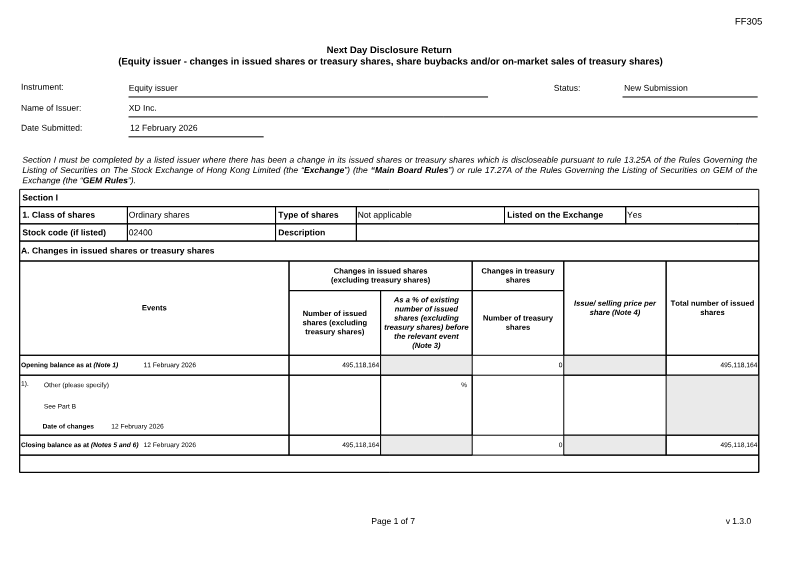
The filing reports a series of share repurchase activities by XD Inc., a Hong Kong-listed company (stock code 02400). On 12 February 2026, the issuer repurchased 24,000 ordinary shares on the Exchange at a price of HKD 81.65 per share, with an aggregate outlay of HKD 1,923,420. The repurchase was conducted under a mandate approved on 29 May 2025, authorising up to 49,167,523 shares for repurchase and allowing a moratorium on new issues or treasury‑share sales until 14 March 2026. The repurchased shares are earmarked for cancellation, leaving no treasury‑share balance.
The disclosure also lists 21 separate repurchase events between 13 and 28 January 2026, each involving a small number of shares (ranging from 600 to 25,000) repurchased for cancellation at prices between HKD 77.8 and HKD 87.39 per share. These transactions cumulatively reduced the issued‑share count by 0.004–0.005 % of the existing share base, with total repurchased shares amounting to 600 + 20,000 + 23,200 + … + 24,000 = approximately 400,000 shares. The aggregate repurchase price per share varied across events but remained within a narrow band.
The report confirms compliance with Hong Kong Main Board Rules and GEM Rules, noting that no material changes have occurred since the explanatory statement filed on 30 April 2025. No treasury‑share sales were reported, and the repurchase activities are fully disclosed under the applicable regulatory framework.
- XD Inc. (02400) repurchased 24,000 ordinary shares on 12 February 2026 at HKD 81.65 per share, totaling an outlay of HKD 1,923,420.
- Between 13 and 28 January 2026, XD Inc. executed 21 separate repurchase events, acquiring approximately 400,000 shares in total.
- All repurchased shares are designated for cancellation rather than treasury holding, resulting in a direct reduction of the company's issued share base.
- The January repurchase activity reduced the total issued-share count by approximately 0.004% to 0.005%.
- Repurchase prices during the January period fluctuated within a narrow range between HKD 77.80 and HKD 87.39 per share.
XD

Report36 pages
Half-Year Financial Report: S1 2025/2026
RAPPORT FINANCIER SEMESTRIEL S1 2025/2026 1. ATTESTATION DE LA PERSONNE RESPONSABLE page 3 2. RAPPORT DE GESTION pages 4 à 10 3. RAPPORT D’EXAMEN LIMITÉ DES COMMISSAIRES AUX COMPTES SUR LES COMPTES CONSOLIDÉS SEMESTRIELS page 11 4.
- PULLUP Entertainment refinanced its senior debt on July 30, 2025, securing €168 million in new bank financing, replacing an existing syndicated credit of €117.5 million that was due in 2028.
- The company's equity (Capitaux propres) decreased from €166,475k on March 31, 2025, to €156,808k on September 30, 2025.
- PULLUP Entertainment expanded its executive committee with the appointment of Geoffroy Sardin as Deputy CEO for operational management (effective April 1, 2025) and Marion Dufour as HR Director.
- The Group's workforce increased from 606 employees on March 31, 2025, to 623 employees on September 30, 2025, with notable growth in Focus Entertainment Publishing (166 to 174), Deck13 (83 to 87), and Dovetail (182 to 186).
- Commitments to studios and rights holders decreased from €111,806k on March 31, 2025, to €86,490k on September 30, 2025, with the majority (€81,077k) owed to studios.
Pullup Entertainment
Report44 pages
Half-Year Report 2021: DONTNOD
Public limited company (Société Anonyme) with share capital of €168,018.74 Registered office: Parc du Pont de Flandre “Le Beauvaisis” 11 rue de Cambrai, 75019 Paris Paris Trade and Companies Register no. 504 161 902 MANAGEMENT REPORT ON THE CONSOLIDATED FINANCIAL STATEMENTS FOR THE SIX MONTHS ENDED JUNE 30, 2021 1.<sub>FIRST </sub>HALF 2021 HIGHLIGHTS In view of the exceptional circumstances surrounding the coronavirus (Covid-19) health crisis and the ensuing government recommendations, DONTNOD ...
- DONTNOD's total operating revenues increased by 19% to €12.8 million in H1 2021, up from €10.8 million in H1 2020, driven by a ramp-up in co-production and self-publishing.
- The company successfully completed a €50 million capital increase on January 28, 2021, with Tencent Holdings Limited contributing €30 million, strengthening DONTNOD's shareholding structure.
- Revenues fell 62% to €2.3 million in H1 2021 from €6.1 million in H1 2020, as the company shifts towards a self-publishing strategy, with only one co-production project currently contributing to publisher revenues.
- Capitalized production doubled from €3.8 million in H1 2020 to €7.8 million in H1 2021, due to increased development under Project 8 with Focus Home Interactive, and other projects including those in Montreal and with PortaPlay.
- DONTNOD allocated 415,554 new ordinary shares, representing 5% of current share capital, through various bonus share and founders' warrant plans, subject to vesting periods and share price targets (e.g., €40 target for some plans).
+1
Don't Nod
Report88 pages
Invitation to Subscribe for Shares in Stillfront Group AB
INBJUDAN TILL TECKNING AV AKTIER I Notera att teckningsrätterna förväntas ha ett ekonomiskt värde. För att inte teckningsrätternas värde ska gå förlorat måste innehavaren antingen: • Utnyttja de erhållna teckningsrätterna och teckna nya aktier senast den 16 mars 2022, eller • Senast den 11 mars 2022 sälja de erhållna teckningsrätterna som inte avses utnyttjas för teckning av nya aktier.
- Stillfront Group AB is inviting subscriptions for shares, with subscription rights expected to have economic value. Holders must either utilize rights to subscribe for new shares by March 16, 2022, or sell them by March 11, 2022.
- Stillfront Group's proforma net sales for January 1 – December 31, 2021, were 6,536 MSEK, with an operating result of 1,008 MSEK and a period result of 374 MSEK, incorporating acquisitions like Super Free Games, Moonfrog Labs, Jawaker, and 6waves.
- The company's proforma total assets as of December 31, 2021, were 23,274 MSEK, with total equity at 11,882 MSEK.
- Stillfront Group's business model focuses on free-to-play online games, generating revenue through in-game purchases and advertising, with a strategy of continuous updates ('live-ops') to extend game lifecycles and retain users.
- Stillfront Group's shares were listed on Nasdaq First North Stockholm in December 2015, moved to First North Premier in June 2017, and have been listed on Nasdaq Stockholm since May 26, 2021.
Stillfront

Report15 pages
Q3 2022 Earnings Call: Stillfront Group AB
Stillfront Group AB<sub>(</sub>SF.SE ) Stillfront Group AB<sub>(</sub>SF.SE) Corrected Transcript Q3 2022 Earnings Call 26-Oct-2022 Chief Executive Officer, Stillfront Group AB ChiefFinancial Officer, Stillfront Group AB ..........................................................................................................................................................................................
- Stillfront Group AB's Q3 2022 earnings show a strong cash flow generation of almost SEK 500 million after net working capital adjustments, enabling continued investment in their portfolio and platform.
- The company's active portfolio consists of 77 games, with mobile games accounting for 77% of the share and ad bookings making up 14% of revenues. Casual & Mash-up games represent 43% of revenues, and Strategy games 35%.
- Stillfront Group AB invested SEK 257 million in new products and their platform, representing 14.4% of their revenues, and settled SEK 290 million in 2021 cash earn-outs this quarter, with no further 2021 earn-outs remaining.
- The company achieved growth with less User Acquisition (UA) spend by leveraging live operations (live ops) and expects increased synergies from live ops across its diversified studio and game teams.
- Stillfront Group AB reported a stable uplift in Daily Active Users (DAU), Monthly Active Users (MAU), and Monthly Paying Users (MPU) year-over-year, driven by acquisitions and strong performance in Strategy games.
+2
Stillfront
Report13 pages
Half-Yearly Report: 2014
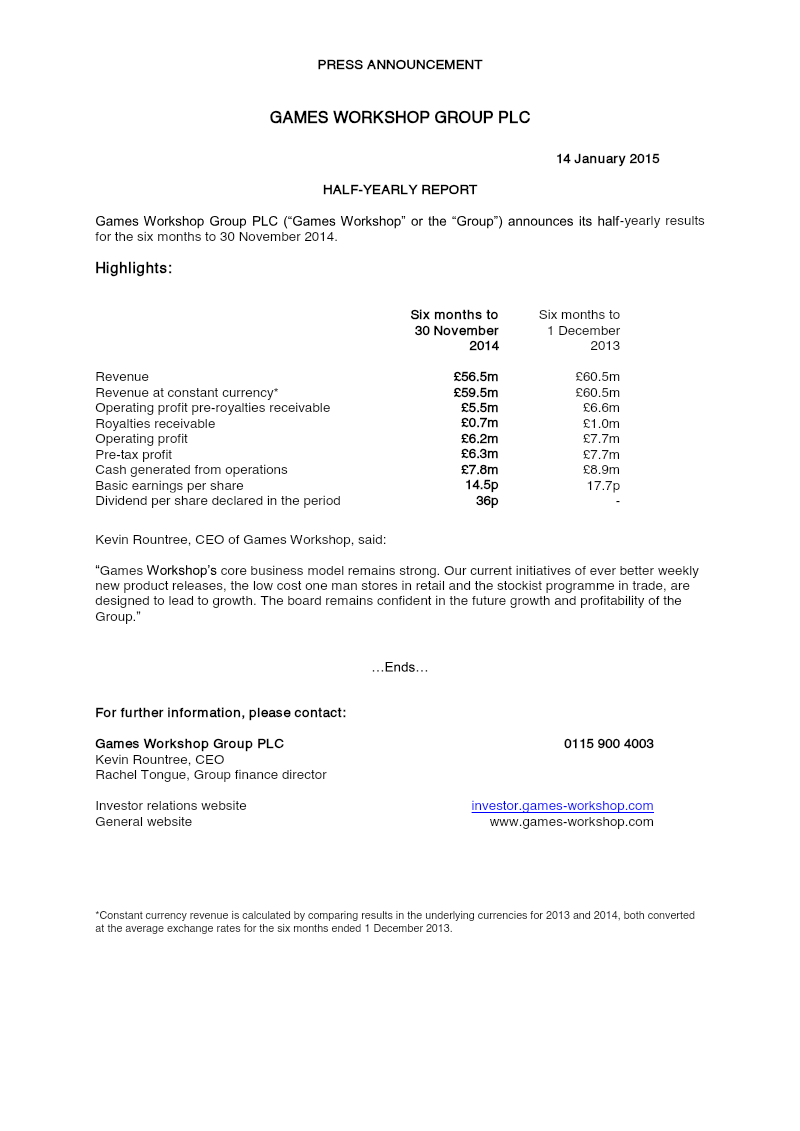
Games Workshop Group PLC (“Games Workshop” or the “Group”) announces its half-yearly results for the six months to 30 November 2014. Six months to Six months to Revenue £56.5m £60.5m Revenue at constant currency £59.5m £60.5m Operating profit pre-royalties receivable £5.5m £6.6m Royalties receivable £0.7m £1.0m Operating profit ...
- Games Workshop Group PLC reported a 6.6% decline in revenue to £56.5 million for the six months to November 30, 2014, compared to £60.5 million in the prior year, with a constant currency decline of 1.7%.
- Operating profit decreased to £6.2 million from £7.7 million in the previous year, and pre-tax profit also fell to £6.3 million from £7.7 million.
- Basic earnings per share dropped to 14.5p from 17.7p, although a dividend of 36p per share was declared in the period, compared to none in the prior period.
- Retail sales declined by 9.7% (£2.4 million) due to restructuring in North America and Continental Europe, and reduced sales from the Nottingham Visitor Centre; Trade sales also fell by 5.1% (£1.2 million).
- Operating expenses were reduced by £3.2 million, including £2.7 million from retail channel costs and £1.0 million from the Continental European reorganization, resulting in a core business operating margin of 9.8% (down from 11.0% in 2013).
+1
Games Workshop Group
Report14 pages
Half-Yearly Report and Trading Update: 2015-2016
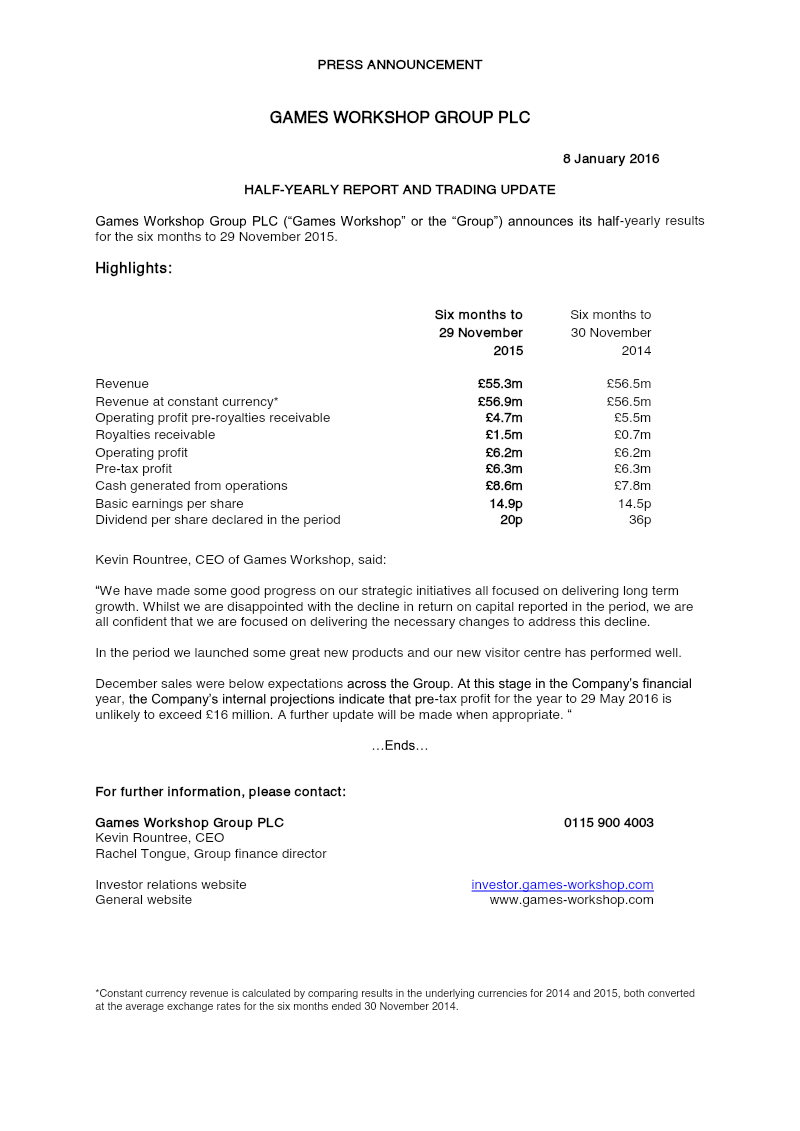
HALF-YEARLY REPORT AND TRADING UPDATE Games Workshop Group PLC (“Games Workshop” or the “Group”) announces its half-yearly results for the six months to 29 November 2015. Six months to Six months to 29 November 30 November 2015 2014 Revenue £55.3m £56.5m Revenue at constant currency £56.9m £56.5m Operating profit pre-royalties receivable ...
- Games Workshop's pre-tax profit for the year to May 29, 2016, is projected to be no more than £16 million, and December sales were below expectations across the Group.
- Revenue for the six months to November 29, 2015, decreased to £55.3 million from £56.5 million in the prior year, though it increased to £56.9 million at constant currency.
- Operating profit remained flat at £6.2 million for the six months to November 29, 2015, compared to the previous year, but core business operating profit (pre-royalties) fell by £0.8 million to £4.7 million.
- Return on capital declined from 38% in November 2014 to 36% in November 2015, attributed to increased average capital employed and a decline in operating profit before royalties.
- Royalties receivable from licensing significantly increased from £0.7 million to £1.5 million in the period.
+1
Games Workshop Group
Report15 pages
Half-Yearly Report: 2016-2017
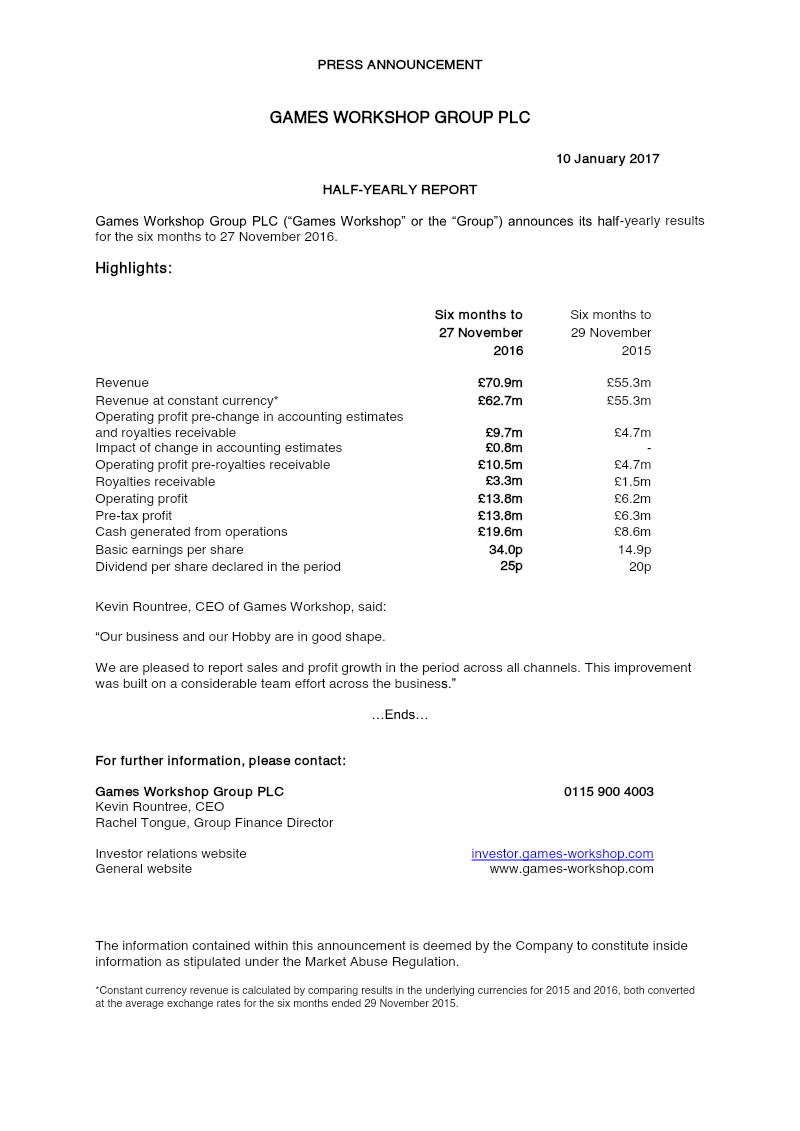
Games Workshop Group PLC (“Games Workshop” or the “Group”) announces its half-yearly results for the six months to 27 November 2016. 27 November 29 November Revenue £70.9m £55.3m Revenue at constant currency £62.7m £55.3m Operating profit pre-change in accounting estimates and royalties receivable £9.7m £4.7m Impact of change in accounting estimates ...
- Games Workshop Group PLC reported significant growth for the six months to November 27, 2016, with total revenue increasing to £70.9m from £55.3m in the prior year, and operating profit more than doubling to £13.8m from £6.2m.
- Profit before tax for the period surged to £13.8m, up from £6.3m in the previous year, while basic earnings per share more than doubled to 34.0p from 14.9p.
- The company experienced sales and profit growth across all channels, with Trade revenue increasing to £29.3m (actual rates) from £22.4m, Retail to £29.2m from £21.5m, and Mail Order to £12.4m from £11.4m.
- A change in accounting estimates for amortisation of development costs and depreciation of moulding tools, effective May 30, 2016, positively impacted operating profit by £0.8m for the six months to November 27, 2016.
- Cash generated from operations saw a substantial increase, rising to £19.6m from £8.6m in the comparable period, and dividends per share declared increased to 25p from 20p.
+2
Games Workshop Group
Report16 pages
Half-Yearly Report: 2017
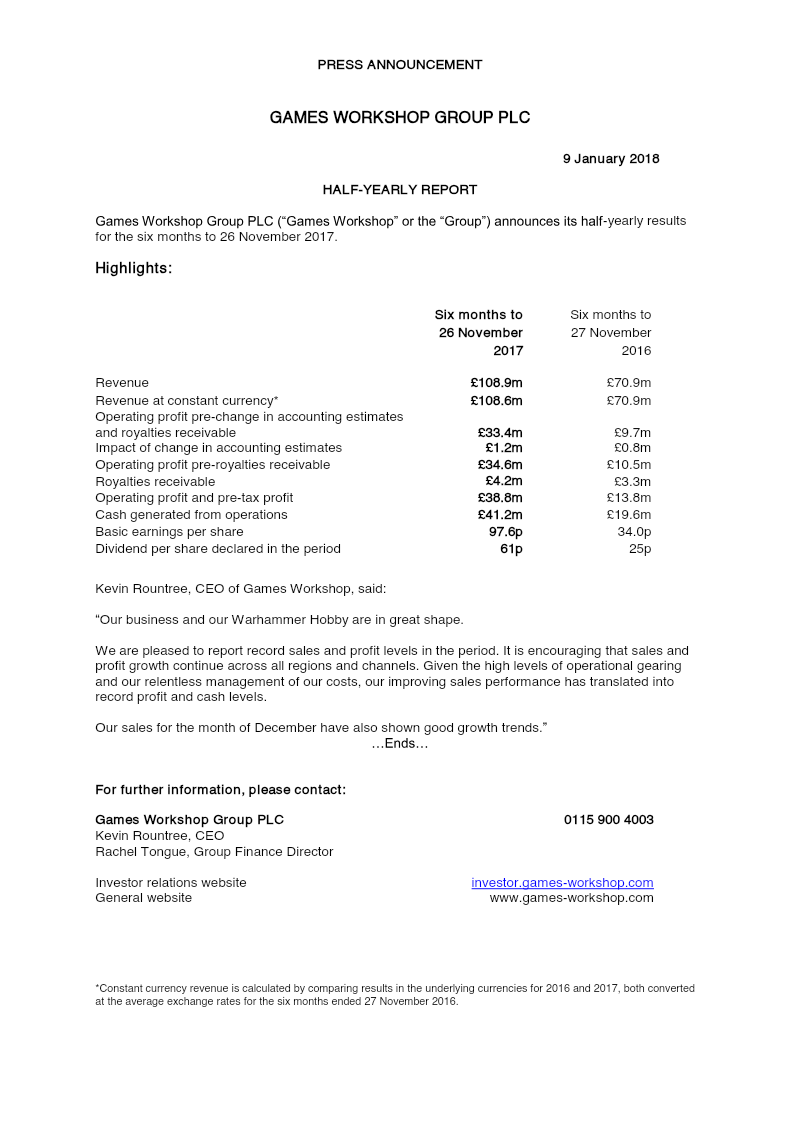
Games Workshop Group PLC (“Games Workshop” or the “Group”) announces its half-yearly results for the six months to 26 November 2017. 26 November 27 November Revenue £108.9m £70.9m Revenue at constant currency £108.6m £70.9m Operating profit pre-change in accounting estimates and royalties receivable £33.4m £9.7m Impact of change in accounting estimates ...
- Games Workshop Group PLC reported record sales and profit for the six months to November 26, 2017, with revenue increasing by 53.6% to £108.9 million (from £70.9 million in 2016) and operating profit soaring by 181.2% to £38.8 million (from £13.8 million in 2016).
- This strong performance translated into significantly higher earnings per share, which rose from 34.0p in 2016 to 97.6p in 2017, and a substantial increase in dividends declared, from 25p to 61p per share.
- Growth was broad-based, with sales and profit increasing across all regions and channels, including a 71% rise in online shop sales and a 22% increase in digital publication sales through Apple, with new distribution channels like Amazon and Audible also launched.
- The company's focus on its 'Warhammer Hobby' and continuous improvement of its miniatures range, combined with effective cost management, contributed to these record financial results and strong cash generation (£41.2 million from operations).
- Games Workshop also saw significant growth in its Trade segment (up 63.5% to £47.96 million) and Mail Order segment (up 71.2% to £21.28 million) in external revenue for the period.
+2
Games Workshop Group