Report2 pages
Return to Growth for Q3 2021-22: Confirmation of 2021/22 & 2022/23 Targets
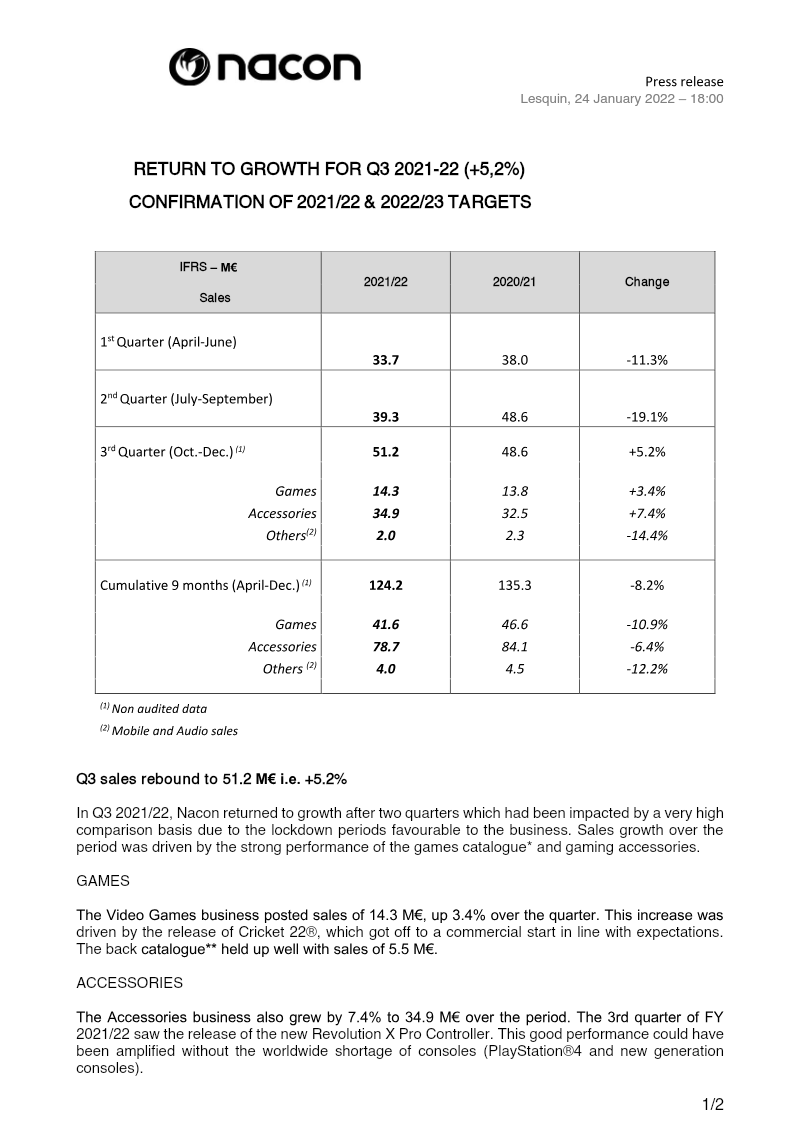
Nacon reported a rebound in Q3 2021/22, with sales rising 5.2 % to €51.2 million after two quarters of decline driven by a high comparison base from lockdown‑related demand spikes. The growth was led by the games catalogue, which generated €14.3 million (+3.4 %) and a strong back‑catalogue contribution of €5.5 million, while accessories grew 7.4 % to €34.9 million thanks to the launch of the Revolution X Pro Controller, though global console shortages limited further upside. Other segments, including mobile and audio sales, contracted by 14.4 % to €2.0 million.
Cumulative sales for the first nine months fell 8.2 % to €124.2 million, with games down 10.9 % and accessories down 6.4 %. Nacon confirmed its FY 2021/22 targets of €150–180 million in sales and an operating income near €20 million. For FY 2022/23, the company projects a robust publishing pipeline of over 15 titles—including high‑profile releases such as Vampire: The Masquerade® – Swansong—and anticipates sales of €250–300 million with an operating margin above 20 %. The strategy includes selective acquisitions to strengthen the catalogue and position Nacon as a leading player in the global video‑game market. The outlook is based on continued demand for both new releases and established titles, with accessories sales expected to benefit from ongoing headset and controller launches across major console platforms.
- Nacon projects significant growth for FY 2022/23, targeting sales of €250–300 million and an operating margin exceeding 20%.
- Q3 2021/22 sales rebounded by 5.2% to €51.2 million, ending two consecutive quarters of decline.
- The company confirmed its FY 2021/22 targets of €150–180 million in sales and an operating income near €20 million, despite a 8.2% decline in cumulative nine-month sales to €124.2 million.
- Accessories growth of 7.4% to €34.9 million was driven by the Revolution X Pro Controller launch, though performance was constrained by global console shortages.
- The games catalogue contributed €14.3 million in Q3, supported by a strong back-catalogue performance of €5.5 million.
+2
Nacon
Report30 pages
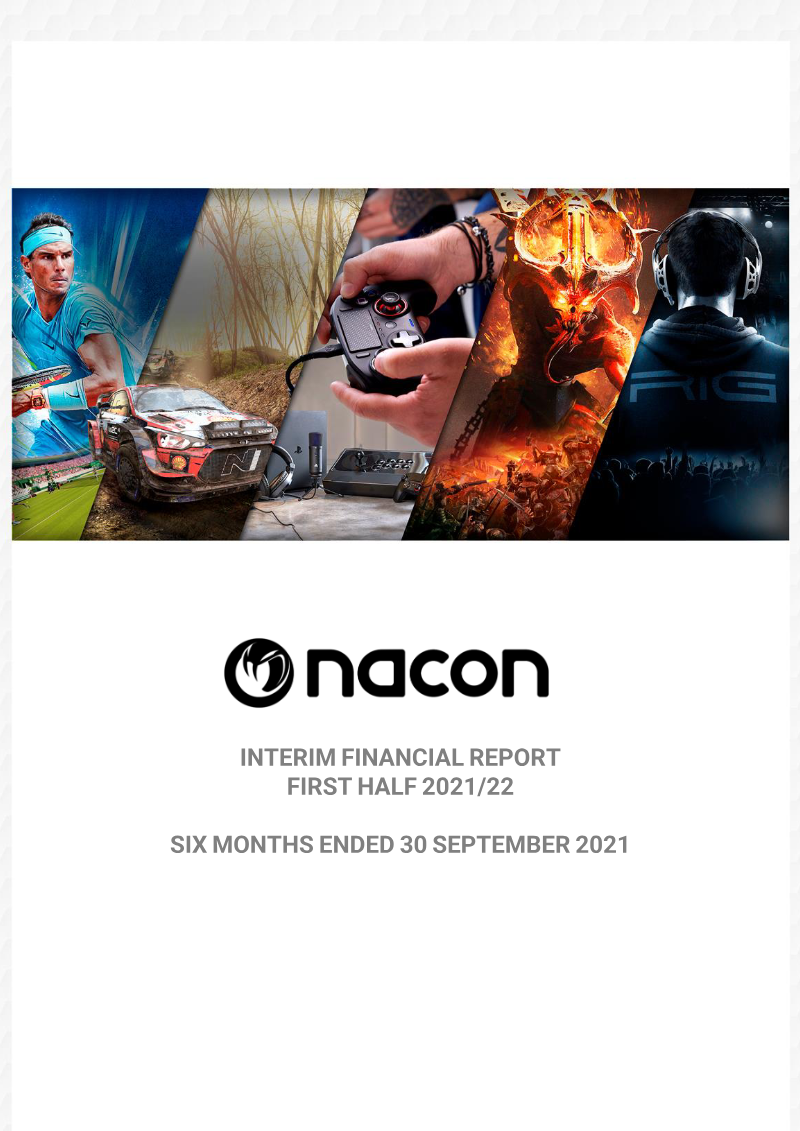
Interim Financial Report: First Half 2021/22
INTERIM FINANCIAL REPORT FOR THE SIX MONTHS ENDED 30 SEPTEMBER 2020 – NACON SIX MONTHS ENDED 30 SEPTEMBER 2021 SIX MONTHS ENDED 30 SEPTEMBER 2021 TABLE OF CONTENTS 2 1> STATEMENT BY THE PERSON RESPONSIBLE .3 2> BUSINESS REPORT 4 2.1 Key events in the first half of 2021/22 ...
- NACON's revenue for the first half of 2021/22 decreased by 15.7% to €73.0 million, down from €86.6 million in the same period last year, primarily due to a decline in accessories sales and fewer new video game releases.
- Net income for the first half of 2021/22 significantly dropped by 60.4% to €3.8 million, compared to €9.6 million in the prior year, while recurring operating income fell by 46.3% to €8.4 million.
- The company acquired two development studios in the first half of 2021/22: Big Ant Holding Pty Ltd (known for sports franchises) in May 2021 for €18 million plus potential earn-outs, and Crea-ture Studios Inc (skateboarding games) in July 2021.
- NACON has adjusted its 2021/22 guidance, reducing expected revenue to €150-180 million and recurring operating income to around €20 million, citing delayed game releases.
- Conversely, guidance for 2022/23 has been increased, with expected revenue of €250-300 million and a recurring operating margin of over 20%.
+2
Nacon
Report3 pages
HY 1 2021/22 Consolidated Results: Impacted by an Unfavourable Basis Comparison
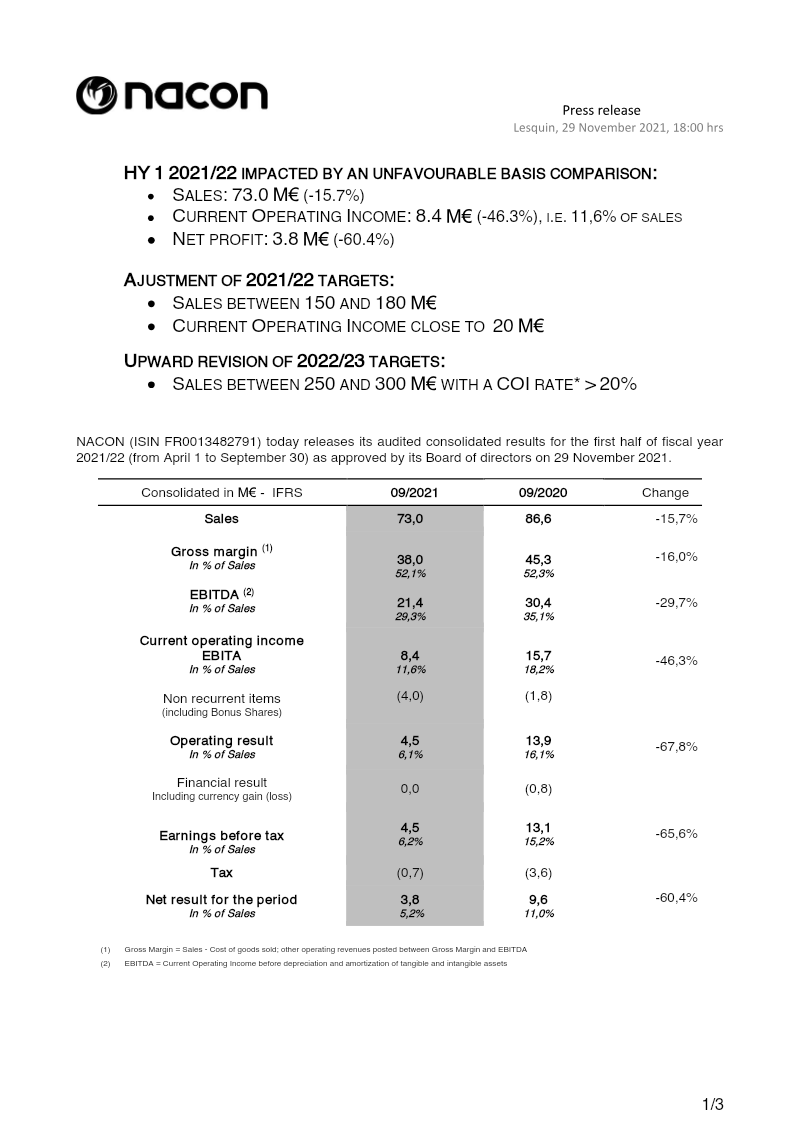
Nacon released audited consolidated results for the first half of fiscal year 2021/22, reporting sales of €73.0 million, a 15.7 % decline from the comparable period in 2020/21. Gross margin fell to €38.0 million (52.1 % of sales) and EBITDA dropped 29.7 % to €21.4 million (29.3 % of sales). Current operating income fell 46.3 % to €8.4 million, representing 11.6 % of sales, while net profit contracted 60.4 % to €3.8 million (5.2 % of sales). The decline is attributed mainly to a weaker editorial portfolio—video‑game sales fell 16.9 % to €27.3 million—and a high comparison basis for accessory sales, which decreased 15.1 % to €43.7 million.
The balance sheet remained solid, with shareholders’ equity at €219.0 million and cash reserves of €62.6 million, reflecting recent studio acquisitions and catalogue development. Working‑capital requirements increased by €2.5 million due to inventory build‑up, while operating cash flow reached €17.7 million and investment outflows rose to €45.6 million.
In response, Nacon revised its 2021/22 targets downward (sales €150–180 million; current operating income near €20 million) and lifted 2022/23 expectations (sales €250–300 million; operating‑income rate >20 %). The company postponed several high‑profile releases to 2022/23, citing a need for additional development time to enhance quality. The acquisition of Ishtar Games was completed on 25 November 2021, expanding Nacon’s studio portfolio. The outlook highlights a strong editorial pipeline for 2022/23, with over fifteen new titles and continued growth of the back‑catalogue.
- Nacon reported a 15.7% decline in HY 2021/22 sales to €73.0 million, with net profit contracting 60.4% to €3.8 million compared to the previous year.
- The company lowered its 2021/22 financial targets, now projecting sales of €150–180 million and current operating income near €20 million.
- Performance was impacted by a 16.9% drop in video-game sales to €27.3 million and a 15.1% decline in accessory sales to €43.7 million.
- Nacon postponed several high-profile titles to fiscal year 2022/23 to prioritize development quality, while simultaneously raising its 2022/23 sales guidance to €250–300 million.
- The balance sheet remains stable with €219.0 million in shareholders’ equity and €62.6 million in cash reserves, despite investment outflows rising to €45.6 million.
+1
Nacon
Report2 pages
1st Half Year 2021/22 Sales
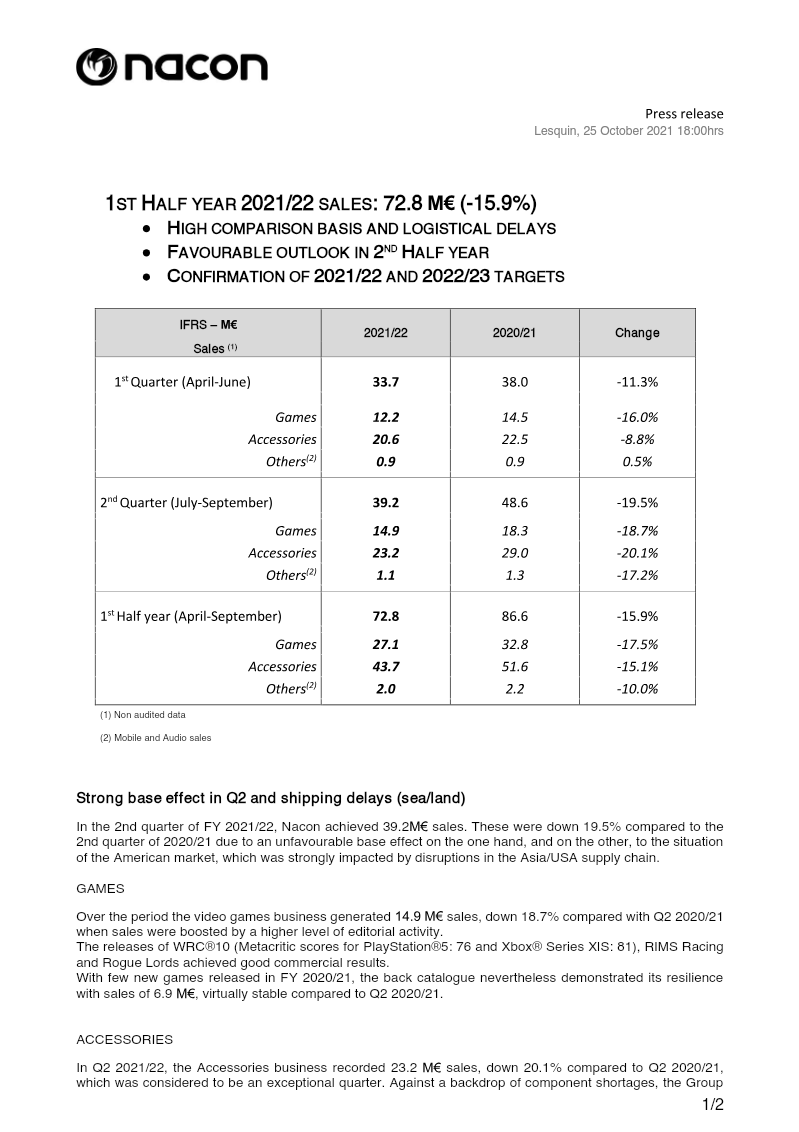
Nacon reported first‑half sales of €72.8 million in FY 2021/22, a decline of 15.9 % versus €86.6 million in the same period of FY 2020/21. The drop reflects a strong comparison base and logistical delays, particularly in the United States where supply‑chain disruptions affected shipments of PlayStation 4 and Xbox consoles. Games sales fell 18.7 % to €14.9 million, while accessories declined 20.1 % to €23.2 million; the “others” segment, comprising mobile and audio sales, saw a 17.2 % reduction to €1.1 million.
Quarterly performance mirrored the overall trend: Q2 sales of €39.2 million were 19.5 % lower than Q2 FY 2020/21, driven by a weaker base and shipping constraints. The company highlighted resilient back‑catalogue performance in games, with €6.9 million in sales that remained stable despite fewer new releases.
Looking ahead, Nacon expects a rebound in the second half of FY 2021/22, citing an expanded game slate—including Cricket 22, Rugby 22, Blood Bowl 3, Train Life, Hotel Life and the narrative RPG Vampire: The Masquerade – Swansong—and new accessories such as the Revolution X Pro controller. Management reaffirmed FY 2021/22 revenue targets of €180–200 million and a 20 % operating margin, while projecting FY 2022/23 sales of €230–260 million with a similar margin.
The company’s methodology relies on non‑audited IFRS data, covering global sales across 100 countries through its 20 subsidiaries and a network of distributors. Nacon’s strategy includes continued acquisitions of development studios, initiated in 2018, to expand its intellectual property portfolio and support future growth.
- Nacon reported first-half sales of €72.8 million for FY 2021/22, representing a 15.9% decline compared to the same period in the previous fiscal year.
- Management reaffirmed full-year revenue targets of €180–200 million with a 20% operating margin, projecting growth to €230–260 million for FY 2022/23.
- Sales performance across all segments declined, with games down 18.7% to €14.9 million, accessories down 20.1% to €23.2 million, and the 'others' segment down 17.2% to €1.1 million.
- The revenue drop was attributed to a strong comparison base from the previous year and supply-chain disruptions in the U.S. that delayed PlayStation 4 and Xbox console shipments.
- Despite fewer new releases, Nacon’s back-catalogue games remained resilient, contributing €6.9 million in stable sales.
+1
Nacon
Report311 pages
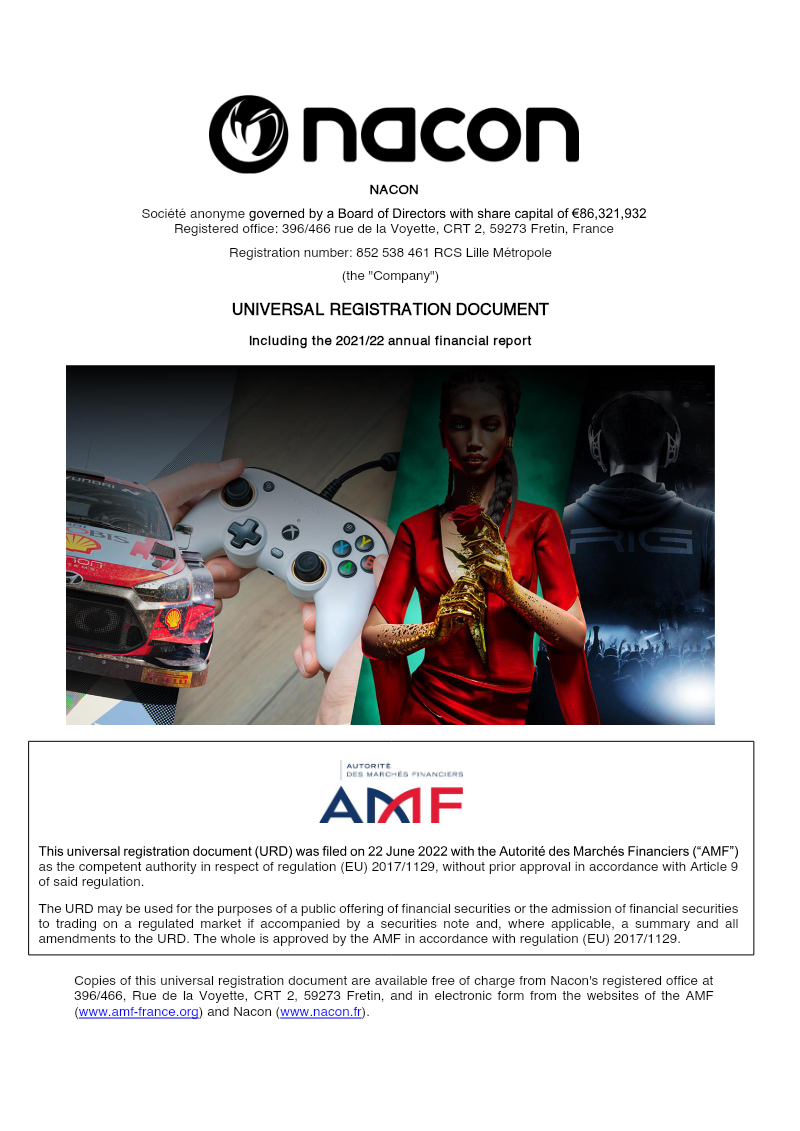
Universal Registration Document: 2021/2022
Société anonyme governed by a Board of Directors with share capital of €86,321,932 Registered office: 396/466 rue de la Voyette, CRT 2, 59273 Fretin, France Registration number: 852 538 461 RCS Lille Métropole UNIVERSAL REGISTRATION DOCUMENT Including the 2021/22 annual financial report This universal registration document (URD) was filed on 22 June 2022 with the Autorité des Marchés Financiers (“AMF”) as the competent authority in respect of regulation (EU) 2017/1129, without prior approval in ...
- Nacon's Video Games sales slowed significantly in 2021/22, down 21.2% to €54.4 million, primarily due to the postponement of four games, including "Vampire: The Masquerade®– Swansong" and "Blood Bowl 3®".
- Nacon has established key partnerships, including a long-standing relationship with Sony for premium and entry-level controllers, and a new major partnership with Microsoft (signed July 2020) for officially licensed Xbox accessories, which is expected to accelerate international Accessories business growth.
- Nacon's Accessories business experienced a slight dip in 2021/22 revenue compared to the previous year, which had a high base due to strong contributions from the first-time consolidation of RIG® premium headsets and lockdowns in the United States.
- Nacon invests heavily in R&D, particularly for its Nacon® brand accessories, leading to 70 registered patents for the Revolution controller alone and a perceived multi-year lead over competitors in technology.
- Nacon faces strong competition in attracting and retaining highly qualified technical personnel in France and abroad, necessitating an active human resources policy focused on recruitment, training, and retention through initiatives like professional databases, internships, and internal/external structures.
+2
Nacon
Report2 pages
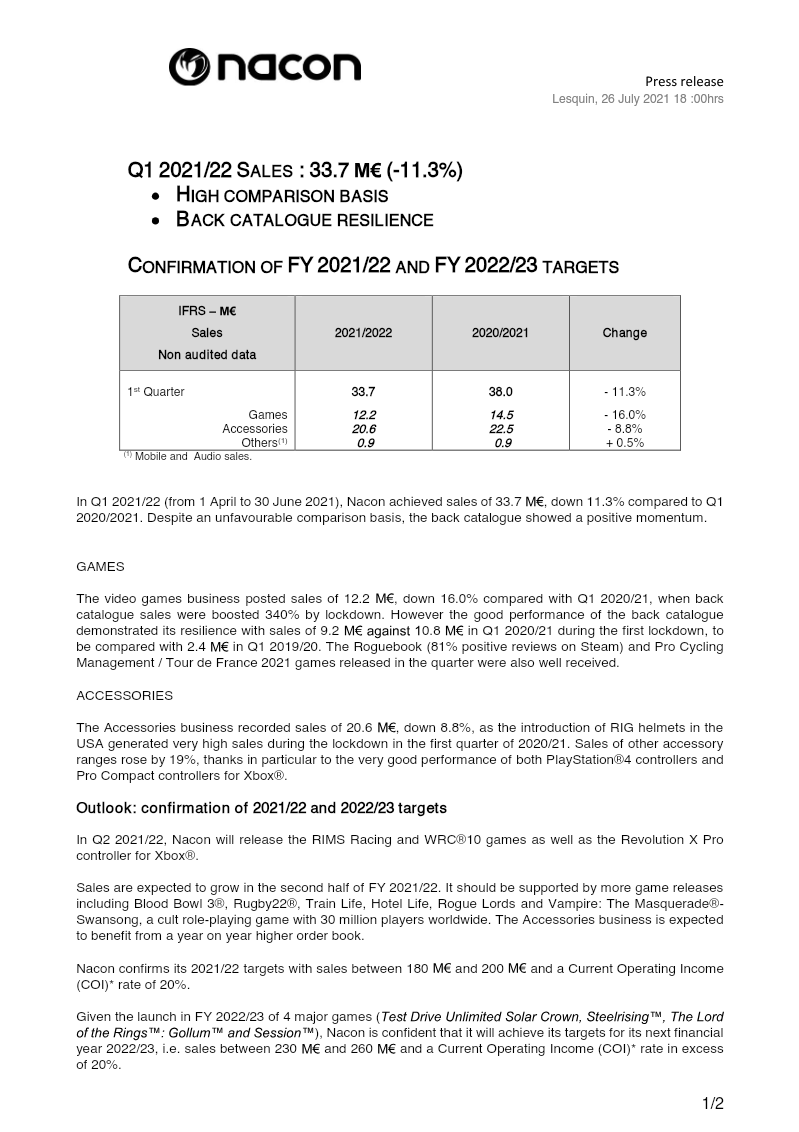
Q1 2021/22 Sales: 33.7 M€
Nacon reported first‑quarter sales of €33.7 million for the period 1 April to 30 June 2021, a decline of 11.3 % versus the same quarter in 2020‑21. The drop reflects an unfavorable comparison basis, yet back‑catalogue performance remained resilient with €9.2 million in sales compared to €10.8 million during the initial lockdown, and a substantial 340 % lift in back‑catalogue revenue that quarter. Game sales fell 16 % to €12.2 million, while accessories declined 8.8 % to €20.6 million; the accessories segment benefited from a 19 % rise in non‑RIG helmet ranges, notably PlayStation 4 and Xbox® controllers. Mobile and audio sales remained flat at €0.9 million.
The company confirmed its 2021‑22 and 2022‑23 targets, projecting total annual sales of €180–200 million with a current operating income (COI) margin of 20 %. For FY 2022‑23, Nacon aims for €230–260 million in sales and a COI margin above 20 %, supported by four major game launches (Test Drive Unlimited Solar Crown, Steelrising™, The Lord of the Rings™: Gollum™, and Session™). Second‑half growth is expected from additional titles such as Blood Bowl 3®, Rugby22®, Train Life, Hotel Life, Rogue Lords, and Vampire: The Masquerade®‑Swansong. Nacon’s integrated structure—comprising 11 development studios, publishing of AA titles, and premium hardware design—underpins its strategy to leverage synergies across a global distribution network covering 100 countries. The company, listed on Euronext Paris, employs over 600 staff and operates through 16 subsidiaries.
- Nacon reported Q1 2021/22 sales of €33.7 million, representing an 11.3% decline compared to the same period in the previous fiscal year.
- The company maintained its financial guidance, targeting €180–200 million in sales for FY 2021-22 and €230–260 million for FY 2022-23, both with a current operating income margin of at least 20%.
- Segment performance saw game sales fall 16% to €12.2 million and accessories decline 8.8% to €20.6 million, though non-RIG helmet ranges and console controllers grew by 19%.
- Back-catalogue sales reached €9.2 million, showing resilience despite a difficult comparison against the previous year's lockdown-driven 340% revenue surge.
- Future growth is anchored by four major upcoming releases: Test Drive Unlimited Solar Crown, Steelrising, The Lord of the Rings: Gollum, and Session.
+3
Nacon
Report2 pages
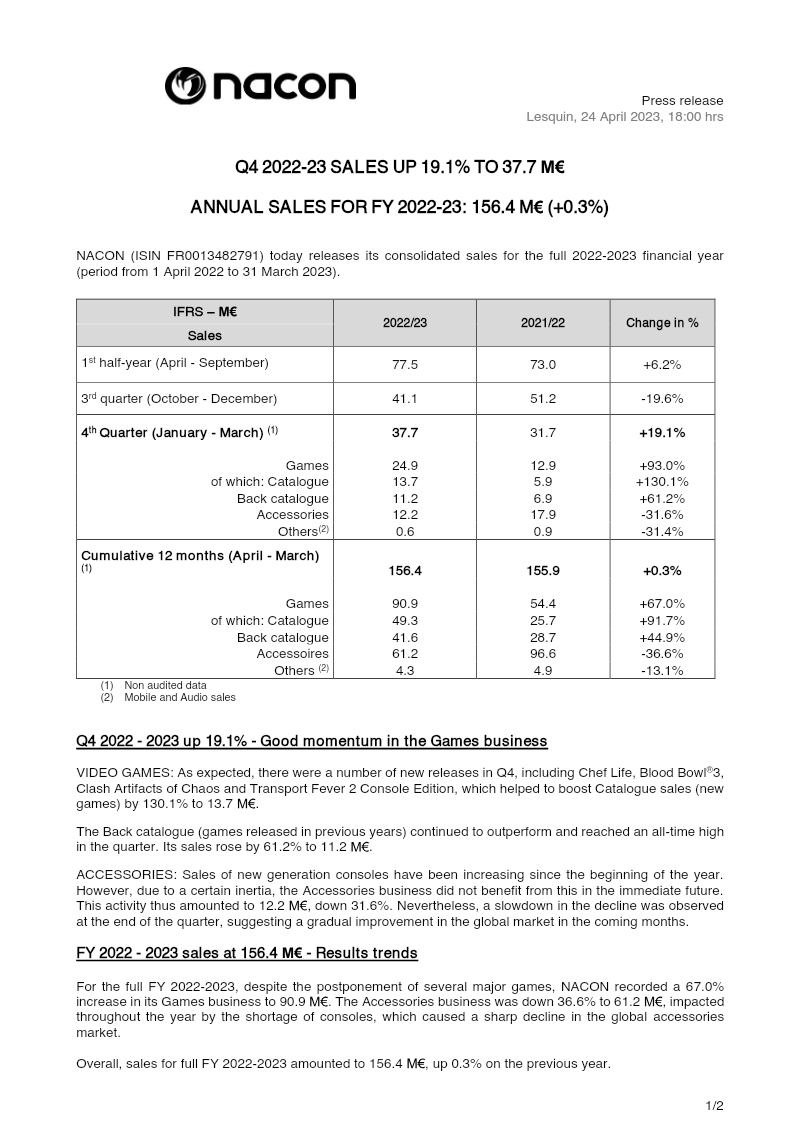
Q4 2022-23 Sales and Annual Sales: FY 2022-23
NACON reported consolidated sales for the fiscal year 1 April 2022 to 31 March 2023, with total revenue of €156.4 million, a marginal increase of 0.3 % over the prior year. Quarterly performance showed a strong rebound in Q4, where sales rose 19.1 % to €37.7 million after a 19.6 % decline in Q3. The Games segment dominated the growth, increasing by 67.0 % to €90.9 million for the full year; new‑catalogue sales surged 93.0 % to €24.9 million, driven by releases such as Chef Life and Transport Fever 2 Console Edition. Back‑catalogue sales also expanded, reaching an all‑time high of €11.2 million in Q4 and growing 61.2 % year‑over‑year. Accessories revenue fell 36.6 % to €61.2 million, largely due to a global console shortage that dampened demand for new‑generation hardware; however, the decline slowed in Q4, suggesting a potential rebound. Other categories, including mobile and audio sales, contracted 13.1 % to €4.3 million.
The company anticipates a decline in operating income before IFRS2 for FY 2023‑24 but expects overall operating and net income to rise. Management projects a robust publishing pipeline with roughly twenty titles slated for release, including high‑profile games such as The Lord of the Rings: Gollum and RoboCop: Rogue City. The back‑catalogue is expected to continue benefiting from the mechanical effect of new releases, while accessories sales should recover as console supply normalizes and new product offerings expand. NACON’s outlook remains positive, underscoring confidence in continued growth across its video‑game and accessories businesses.
- NACON reported total annual revenue of €156.4 million for FY 2022-23, representing a marginal 0.3% increase over the previous fiscal year.
- The Games segment drove growth with a 67.0% annual increase to €90.9 million, bolstered by a 93.0% surge in new-catalogue sales from titles like Chef Life and Transport Fever 2 Console Edition.
- Accessories revenue declined 36.6% to €61.2 million for the year, primarily attributed to global console shortages, though the segment showed signs of a Q4 recovery.
- After a 19.6% decline in Q3, NACON experienced a strong Q4 rebound with total sales rising 19.1% to €37.7 million.
- Back-catalogue sales reached an all-time high of €11.2 million in Q4, contributing to a 61.2% year-over-year growth for that category.
+2
Nacon
Report32 pages
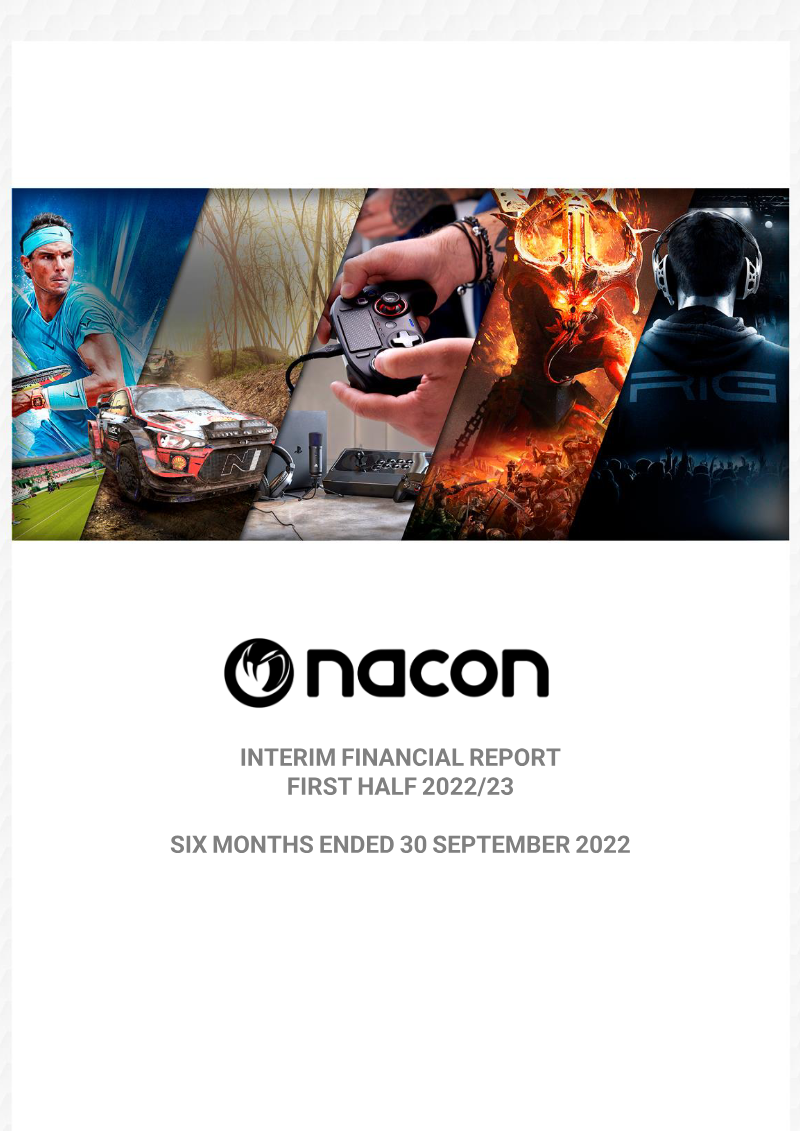
Interim Financial Report: First Half 2022/23
INTERIM FINANCIAL REPORT FOR THE SIX MONTHS ENDED 30 SEPTEMBER 2020 – NACON SIX MONTHS ENDED 30 SEPTEMBER 2022 SIX MONTHS ENDED 30 SEPTEMBER 2022 TABLE OF CONTENTS 2 1. STATEMENT BY THE PERSON RESPONSIBLE .3 2.
- NACON's net income more than doubled, increasing by 123.5% to €8.4 million in the first half of 2022/23, up from €3.8 million in the first half of 2021/22.
- Operating income also saw significant growth, rising by 119.2% to €9.8 million in the first half of 2022/23, compared to €4.5 million in the same period last year.
- Gross profit increased to €47.6 million (61.4% of revenue) in H1 2022/23 from €38.0 million (52.1% of revenue) in H1 2021/22, driven by a higher proportion of Video Games revenue.
- Consolidated revenue grew by 6.2% to €77.5 million in the first half of 2022/23, compared to €73.0 million in the first half of 2021/22.
- Basic earnings per share rose from €0.04 in H1 2021 to €0.10 in H1 2022.
+2
Nacon
Report2 pages
Q3 2022/23 Sales: 9-Month Cumulative Report
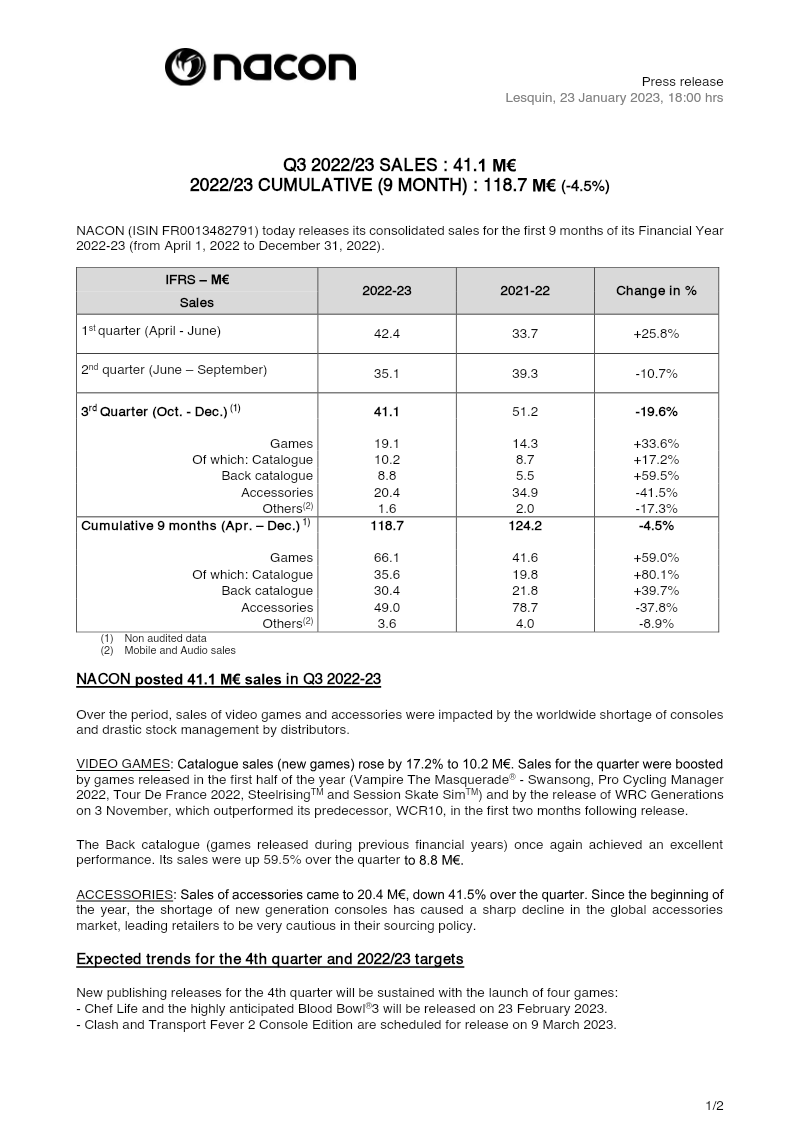
NACON reported Q3 2022‑23 sales of €41.1 million, a 4.5 % decline from the same period in 2021‑22, bringing cumulative nine‑month sales to €118.7 million versus €124.2 million previously. The decline was driven largely by a sharp 41.5 % drop in accessories sales, attributed to global shortages of new‑generation consoles that forced retailers to tighten sourcing. Video game revenue rebounded, with catalogue sales up 17.2 % to €10.2 million and back‑catalogue sales surging 59.5 % to €8.8 million, supported by releases such as Vampire The Masquerade® – Swansong, Pro Cycling Manager 2022, and WRC Generations.
Quarterly performance varied: the first quarter saw a 25.8 % increase to €42.4 million, while the second quarter fell 10.7 % to €35.1 million and the third quarter declined 19.6 % to €41.1 million. Across the nine months, game sales grew 59 %, driven by catalogue and back‑catalogue growth, whereas accessories fell 37.8 % and other categories declined modestly.
Looking ahead, NACON anticipates a recovery in accessories sales as console shortages ease and plans to launch four new titles in Q4 2023, including Chef Life and Blood Bowl III. For FY 2023‑24, the company expects a modest rise in sales and operating income, buoyed by an expanded release calendar of roughly twenty games and a strengthening back‑catalogue pipeline. The outlook remains positive, with confidence in the company’s FY 2023‑24 prospects reaffirmed.
- NACON reported cumulative nine-month sales of €118.7 million for 2022/23, representing a decline from the €124.2 million recorded during the same period in the previous fiscal year.
- Accessories revenue dropped significantly, falling 41.5% in Q3 and 37.8% over the nine-month period, primarily due to global shortages of new-generation consoles.
- Video game revenue demonstrated strong growth, with a 59% increase over nine months driven by a 17.2% rise in catalogue sales and a 59.5% surge in back-catalogue performance.
- Quarterly sales performance was inconsistent, starting with a 25.8% increase in Q1 followed by consecutive declines of 10.7% in Q2 and 19.6% in Q3.
- The company expects a recovery in the accessories segment as console supply constraints ease and plans to release four new titles in Q4 2023, including Chef Life and Blood Bowl III.
+1
Nacon
Report2 pages
2022-23 Half-Year Results
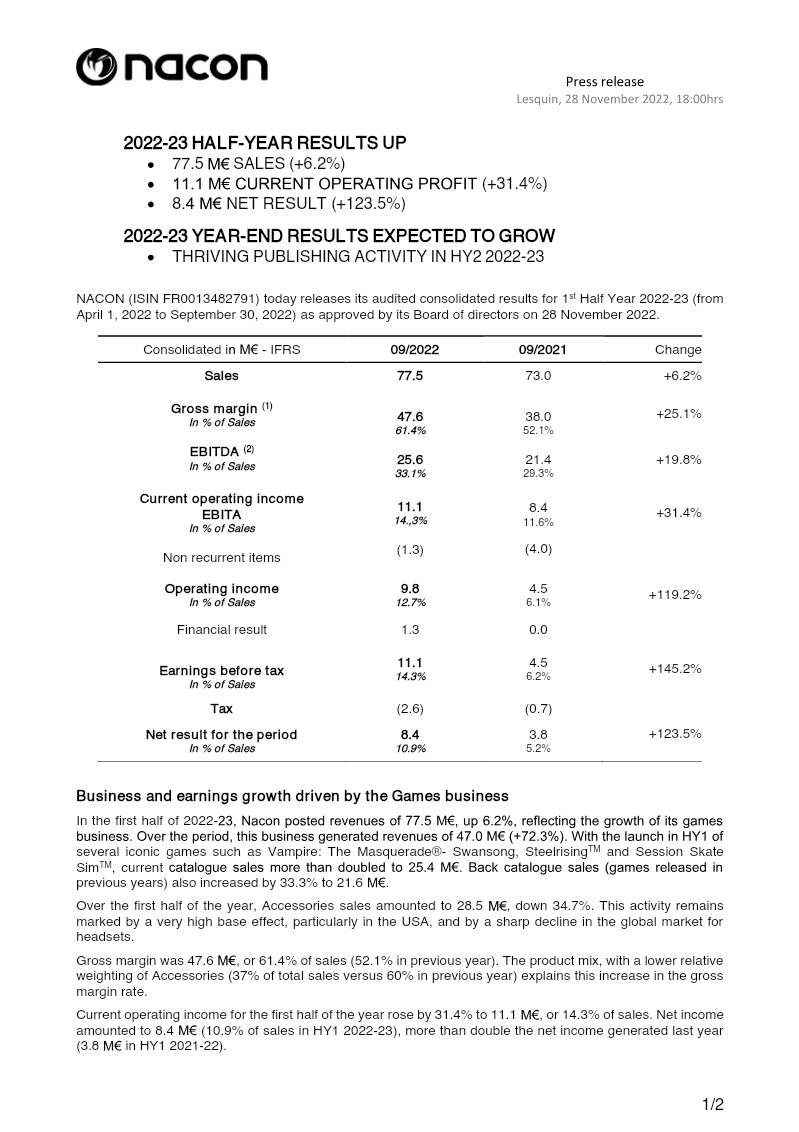
Nacon’s first‑half 2022‑23 financials show a modest revenue increase of €77.5 million, up 6.2% year‑on‑year, driven primarily by its games segment. Game sales rose 72.3% to €47 million, with current‑catalogue titles such as Vampire: The Masquerade®‑Swansong, Steelrising™ and Session Skate Sim™ more than doubling sales to €25.4 million; back‑catalogue revenue grew 33.3% to €21.6 million. Accessories sales fell 34.7% to €28.5 million, reflecting a high base effect in the U.S. and a global headset market decline.
Gross margin improved to €47.6 million (61.4% of sales) from 52.1% the previous year, largely due to a lower proportion of accessory revenue (37% versus 60%). EBITDA climbed 19.8% to €25.6 million, and current operating income surged 31.4% to €11.1 million (14.3% of sales). Net profit for the period rose 123.5% to €8.4 million, more than double the €3.8 million recorded in the same period a year earlier.
Cash and equity positions remain solid, with shareholders’ equity at €241.5 million and cash reserves of €38.1 million, after a strategic reinvestment in development (50 titles, >€30 million CAPEX) and the acquisition of Daedalic (€34.1 million). Net debt increased to €63.6 million due to inventory build‑up amid component shortages.
Management projects a slight uptick in full‑year 2022‑23 sales and operating income, citing delayed releases of major titles such as Blood Bowl III and Chef Life. Strong growth is anticipated for 2023‑24, underpinned by the upcoming Lord of the Rings Gollum™ launch and continued publishing activity.
- Nacon reported a 6.2% year-on-year revenue increase to €77.5 million for the first half of 2022-23, driven by a 72.3% surge in games segment revenue to €47 million.
- Net profit more than doubled to €8.4 million, up 123.5% from the €3.8 million recorded in the same period the previous year.
- Gross margin improved to 61.4% of sales, up from 52.1%, primarily because the lower-margin accessories segment dropped 34.7% to €28.5 million.
- The company invested heavily in future growth, allocating over €30 million in CAPEX for 50 titles and completing the €34.1 million acquisition of Daedalic.
- Current operating income rose 31.4% to €11.1 million, while net debt increased to €63.6 million due to strategic inventory build-ups to mitigate component shortages.
+2
Nacon
Report2 pages
1st Half 2022/23 Sales
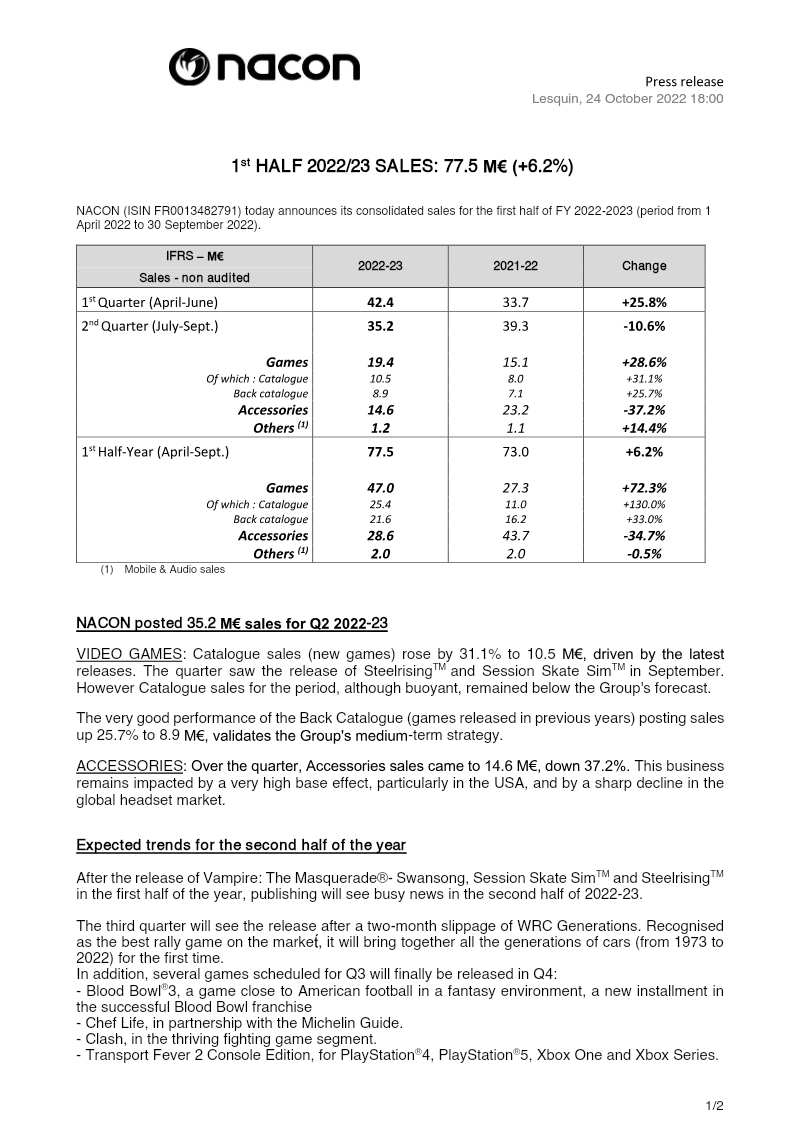
NACON reported first‑half sales of €77.5 million for FY 2022‑23, a 6.2 % increase over the same period in 2021‑22. Quarterly performance showed a strong 25.8 % rise in the first quarter (€42.4 million) followed by a 10.6 % decline in the second quarter (€35.2 million). Game sales dominated revenue, rising 72.3 % to €47.0 million; catalogue (new releases) grew 130 % to €25.4 million, while back‑catalogue sales increased 33 % to €21.6 million. Accessories revenue fell sharply by 34.7 % to €28.6 million, reflecting a high base effect and a global headset market downturn; mobile and audio sales remained flat.
Geographically, the decline in accessories was most pronounced in the United States. The company highlighted upcoming releases—WRC Generations, Blood Bowl 3, Chef Life, Clash, and Transport Fever 2 Console Edition—expected to bolster catalogue sales in the second half. Despite a shortfall against forecasted catalogue targets, NACON anticipates year‑end sales and operating income to rise relative to the prior year due to back‑catalogue strength, though it will miss FY 2022‑23 targets of €250 million in sales and €50 million in operating income.
Looking ahead to FY 2023‑24, NACON expects growth driven by late‑year releases feeding the back catalogue and a diversified publishing slate. The company maintains confidence in its medium‑term prospects, citing synergies from its 16 studios and a global distribution network of 23 subsidiaries.
- NACON will miss its FY 2022-23 targets of €250 million in sales and €50 million in operating income, despite anticipating year-end growth relative to the prior year.
- Total first-half sales reached €77.5 million, a 6.2% increase year-over-year, driven by a 72.3% surge in game revenue to €47.0 million.
- Accessories revenue dropped 34.7% to €28.6 million, primarily due to a global headset market downturn and a high base effect, particularly in the United States.
- New release catalogue sales grew 130% to €25.4 million, while back-catalogue sales increased 33% to €21.6 million.
- Quarterly performance was inconsistent, featuring a 25.8% rise in Q1 (€42.4 million) followed by a 10.6% decline in Q2 (€35.2 million).
+3
Nacon
Report308 pages
Universal Registration Document: 2022/2023
UNIVERSAL REGISTRATION DOCUMENT Including the annual financial report Société anonyme governed by a Board of Directors with share capital of €86,897,407 Registered office: 396/466, rue de la Voyette, CRT 2, 59273 Fretin, France Registration number: 852 538 461 RCS Lille Métropole This universal registration document (URD) was filed on 26 June 2023 with the Autorité des Marchés Financiers (“AMF”) as the competent authority in respect of regulation (EU) 2017/1129, without prior approval...
- Nacon's revenue in 2022/23 totaled €156.0 million, broadly unchanged from the previous year, driven by strong performance in Video Games, which now accounts for 58.0% of revenue (up from 34.9% in 2021/22).
- The shift towards Video Games significantly increased Nacon's gross margin to 59.1% in 2022/23, up from 49.9% in 2021/22, with gross profit rising 15.5% to €92.1 million.
- Nacon faces strong competition in hiring and retaining highly qualified technical personnel, particularly in France and abroad, which could adversely affect its business and development prospects.
- Nacon acquired Midgar Studios SAS on February 7, 2022, a J-RPG development studio, with potential earn-out payments of €10.0 million based on future revenue from Edge-series video games.
- Nacon's bank covenants for loans funding studio acquisitions and publishing development costs (interest cover ratio > 6 and net leverage ratio < 2) were all complied with as of March 31, 2023.
+2
Nacon
Report2 pages
Q1 2022-2023 Sales Results: Confirmation of FY 2022-23 Targets
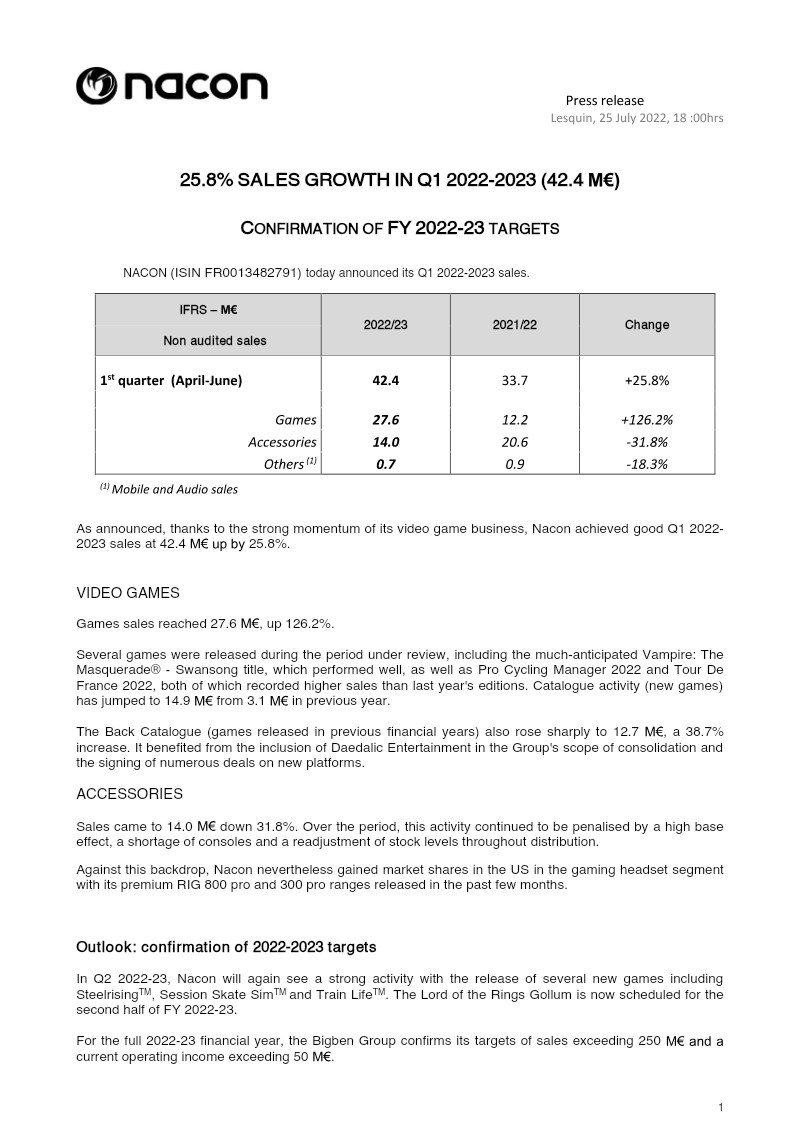
Nacon reported a 25.8 % increase in first‑quarter sales for the fiscal year 2022‑23, reaching €42.4 million compared with €33.7 million in the same period of 2021‑22. Video game sales surged by 126.2 %, totaling €27.6 million, driven largely by the launch of high‑profile titles such as Vampire: The Masquerade® – Swansong, Pro Cycling Manager 2022 and Tour De France 2022. New‑catalogue activity rose to €14.9 million from €3.1 million, while back‑catalogue sales climbed 38.7 % to €12.7 million, aided by the consolidation of Daedalic Entertainment and expanded platform deals.
Accessories sales fell 31.8 % to €14.0 million, impacted by a high base effect, console shortages and inventory readjustments. Despite this decline, Nacon gained U.S. market share in the gaming headset segment with its RIG 800 Pro and 300 Pro ranges.
The company confirmed its full‑year targets of sales exceeding €250 million and operating income above €50 million for FY 2022‑23. Upcoming releases in Q2, including Steelrising, Session Skate Sim and Train Life, are expected to sustain momentum, with The Lord of the Rings: Gollum slated for the second half of the fiscal year. Nacon operates under the Bigben Group umbrella, leveraging a network of 23 subsidiaries and a global distribution presence across 100 countries.
- Nacon reported a 25.8% year-over-year increase in Q1 2022-23 sales, reaching €42.4 million.
- Video game sales grew by 126.2% to €27.6 million, bolstered by new releases like 'Vampire: The Masquerade – Swansong' and the consolidation of Daedalic Entertainment.
- Accessories revenue declined 31.8% to €14.0 million, attributed to console shortages, inventory adjustments, and a difficult year-over-year comparison.
- The company reaffirmed its full-year targets for FY 2022-23, aiming for sales exceeding €250 million and operating income above €50 million.
- Back-catalogue game sales rose 38.7% to €12.7 million, supported by expanded platform distribution deals.
+2
Nacon
Report2 pages
Strong Earnings Growth: 2023/24 Full-Year Results
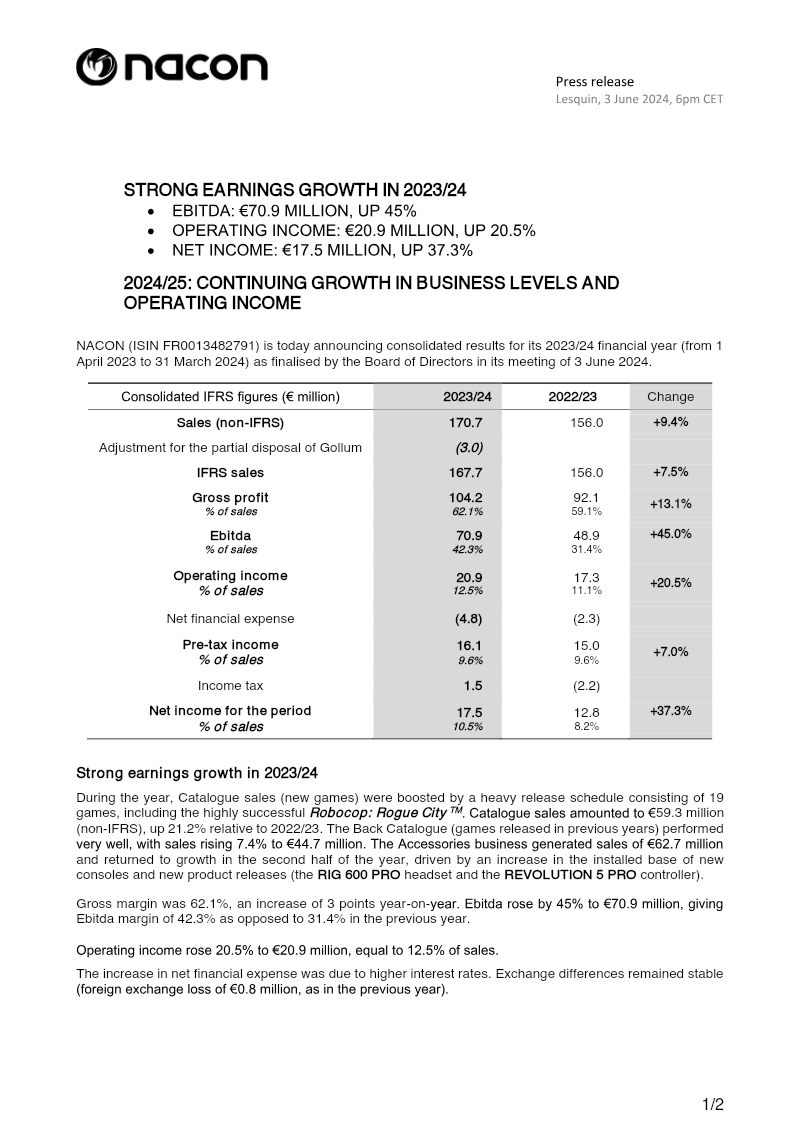
NACON reported a robust financial year for 2023/24, with consolidated IFRS sales rising to €167.7 million from €156.0 million, a 7.5 % increase. Gross profit climbed to €104.2 million, up 13.1 %, pushing the gross margin to 62.1 % of sales. EBITDA surged by 45 % to €70.9 million, translating into a margin of 42.3 %. Operating income grew 20.5 % to €20.9 million, representing 12.5 % of sales, while net income rose 37.3 % to €17.5 million, or 10.5 % of sales. The company’s equity strengthened to €263.6 million, and net debt fell to €85.2 million, reflecting disciplined borrowing and repayment.
Key drivers included a heavy new‑game release schedule of 19 titles, notably the successful Robocop: Rogue City™ which lifted catalogue sales by 21.2 % to €59.3 million. Back‑catalogue sales increased 7.4 % to €44.7 million, and accessories revenue rebounded to €62.7 million, buoyed by new hardware launches such as the RIG 600 PRO headset and REVOLUTION 5 PRO controller. Inventory levels were trimmed by €8.2 million, and operating cash flow rose 54.4 % to €73.1 million.
Looking ahead, NACON plans a busy 2024/25 release calendar of around 15 games and aims to consolidate its racing‑market presence through a dedicated Racing department, the Revosim by Nacon brand, and new premium peripherals. The strategy positions NACON as a unique provider of integrated racing games and accessories worldwide, with expectations of continued sales and operating‑income growth.
- NACON achieved strong 2023/24 financial growth, with sales rising 7.5% to €167.7 million and net income increasing 37.3% to €17.5 million.
- EBITDA surged 45% to €70.9 million, resulting in a 42.3% margin, while operating income grew 20.5% to €20.9 million.
- The release of 19 new titles, led by the success of Robocop: Rogue City, drove a 21.2% increase in new-game catalogue sales to €59.3 million.
- Accessories revenue rebounded to €62.7 million, supported by the launch of new hardware including the RIG 600 PRO headset and REVOLUTION 5 PRO controller.
- The company strengthened its balance sheet by increasing equity to €263.6 million and reducing net debt to €85.2 million.
+1
Nacon
Report2 pages
Fourth-Quarter 2023/24 Sales: Nacon
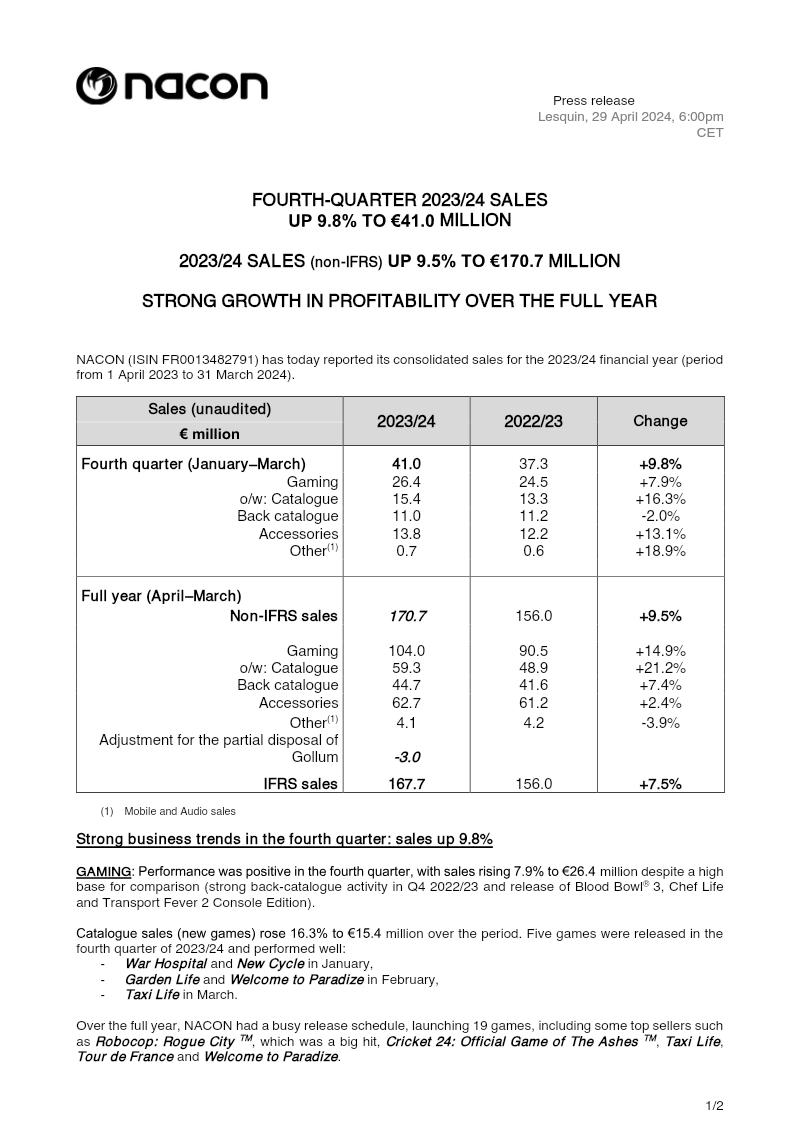
Nacon reported consolidated sales for the 2023/24 financial year, ending 31 March 2024. Fourth‑quarter sales rose 9.8 % to €41.0 million, with gaming revenue up 7.9 % to €26.4 million and catalogue sales of new titles increasing 16.3 % to €15.4 million. Back‑catalogue sales held at €11.0 million, while accessories grew 13.1 % to €13.8 million, driven by strong performance of the RIG 600 PRO headset and REVOLUTION 5 PRO controller. Non‑IFRS full‑year sales reached €170.7 million, up 9.5 % from €156.0 million in 2022/23; gaming contributed €104.0 million (14.9 % growth) and catalogue sales grew 21.2 %. Operating income expanded at a faster rate than revenue, signalling improving profitability.
The company launched 19 games during the year, including high‑profile titles such as Robocop: Rogue City and Cricket 24: Official Game of The Ashes. Five new releases in the fourth quarter—War Hospital, New Cycle, Garden Life, Welcome to Paradize, and Taxi Life—performed well, supporting the catalogue growth. A pipeline of roughly 15 titles is planned for 2024/25, with early‑access successes like Ravenswatch and upcoming releases such as Test Drive Unlimited: Solar Crown.
Nacon, part of the Bigben Group since 2019, operates through 16 development studios and a global distribution network covering 100 countries. The company will announce full‑year results on 3 June 2024 and outline its 2024/25 strategy thereafter.
- Nacon achieved a 9.5% increase in full-year non-IFRS sales, rising to €170.7 million for the 2023/24 fiscal year compared to €156.0 million in 2022/23.
- Gaming revenue grew by 14.9% to €104.0 million for the full year, with catalogue sales of new titles showing particularly strong growth of 21.2%.
- Fourth-quarter sales rose 9.8% to €41.0 million, supported by the release of five new titles including 'War Hospital' and 'Taxi Life'.
- Accessories revenue increased 13.1% to €13.8 million in the fourth quarter, driven by the commercial performance of the RIG 600 PRO headset and REVOLUTION 5 PRO controller.
- Operating income grew at a faster rate than revenue during the 2023/24 period, indicating an improvement in overall company profitability.
+1
Nacon
Report28 pages
Interim Financial Report: First Half 2023/24
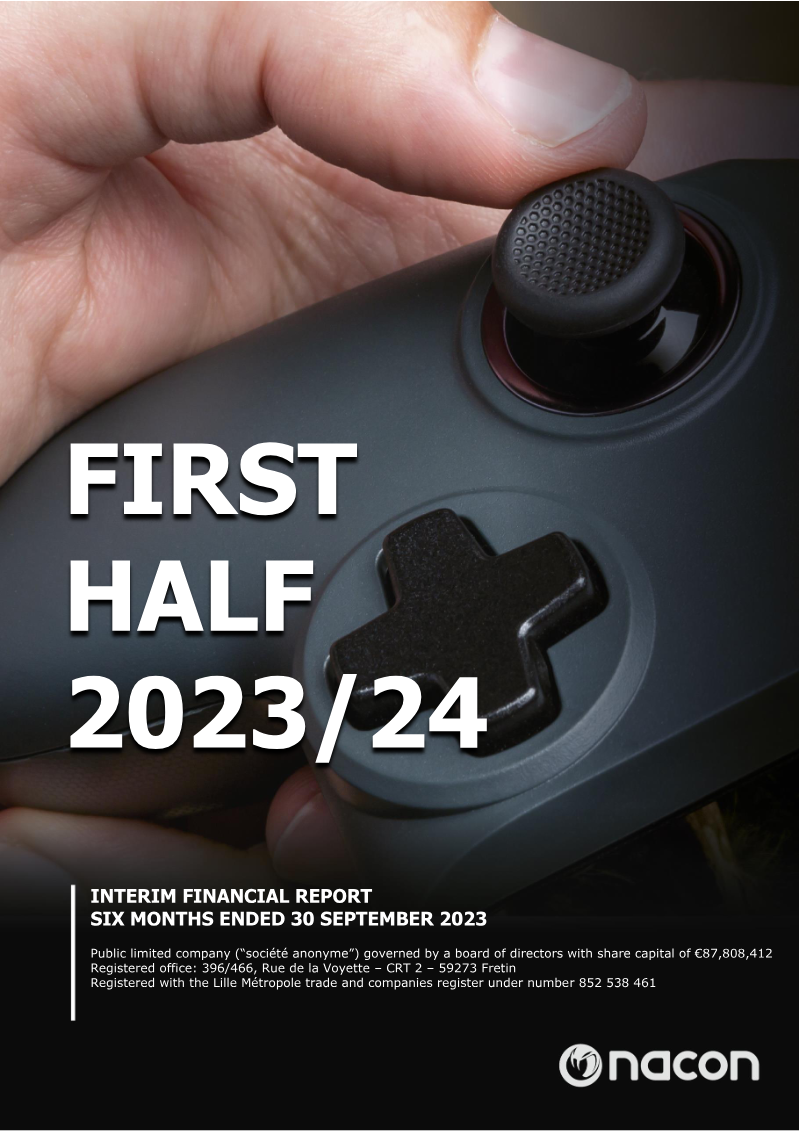
SIX MONTHS ENDED 30 SEPTEMBER 2023 Public limited company (“société anonyme”) governed by a board of directors with share capital of €87,808,412 Registered office: 396/466, Rue de la Voyette – CRT 2 – 59273 Fretin Registered with the Lille Métropole trade and companies register under number 852 538 461 Registered office: 396/466, Rue de la Voyette - CRT 2 - 59273 Fretin Registered with the Lille Métropole trade and companies register under number 852 538 461 1.
- Net income for the first half of 2023/24 significantly decreased to €3.2 million, down from €8.4 million in the first half of 2022/23.
- Revenue for the first half of 2023/24 was €67.765 million, a decrease from €77.509 million in the first half of 2022/23.
- Net financial expense in the first half of 2023/24 was €2.205 million, including a €0.5 million currency loss, contrasting with a €1.261 million net financial income (including a €1.8 million currency gain) in the prior-year period.
- Bonus share awards in September 2023 totaled 2,946,252 shares, following the vesting of 175,157 shares (6,660 from the 2022 plan and 168,497 from studio acquisitions) in September 2023.
- Bigben Interactive SA holds a 60.26% stake in the company's capital and 70.51% of voting rights as of September 30, 2023.
+1
Nacon

Report300 pages
Universal Registration Document 2023/2024
UNIVERSAL REGISTRATION DOCUMENT Including the annual financial report Société anonyme governed by a Board of Directors with share capital of €87,808,412 Registered office: 396/466, Rue de la Voyette, CRT 2, 59273 Fretin Registration number: 852 538 461 RCS Lille Métropole Registered office: 396/466, Rue de la Voyette, CRT 2, 59273 Fretin Registration number: 852 538 461 RCS Lille Métropole This universal registration document (URD) This universal registration document (URD) was filed on 24 June ...
- Nacon's Revolution 5 Pro controller, licensed to PlayStation®, launched in October 2023 to great success, featuring Hall effect technology for precision and a battery life over 10 hours, compatible with PS5, PS4, and PC.
- Nacon's entry-level controllers, including the Compact and Asymmetric Wireless for PlayStation™ 4 and Pro Compact for Xbox Series, have achieved combined sales of several million units and remain bestsellers.
- Nacon's total assets were €478,958 thousand in 2024, a slight decrease from €483,311 thousand in 2023, but an increase from €412,252 thousand in 2022. Total equity has steadily increased from €228,407 thousand in 2022 to €263,552 thousand in 2024.
- Staff turnover at the Nacon Group decreased to 11.6% in 2023/24 from 14.8% in 2022/23, and the company assesses the materiality of net risk as 'average' with a 'low' probability of occurrence.
- Non-current assets are primarily located in France (€243,364 thousand in 2024), followed by Germany (€53,155 thousand) and Australia (€40,681 thousand), with France showing an increase from €210,125 thousand in 2023.
+2
Nacon
Report2 pages
First Quarter 2024/25 Sales: Confirmation of Full-Year 2024/25 Growth Targets
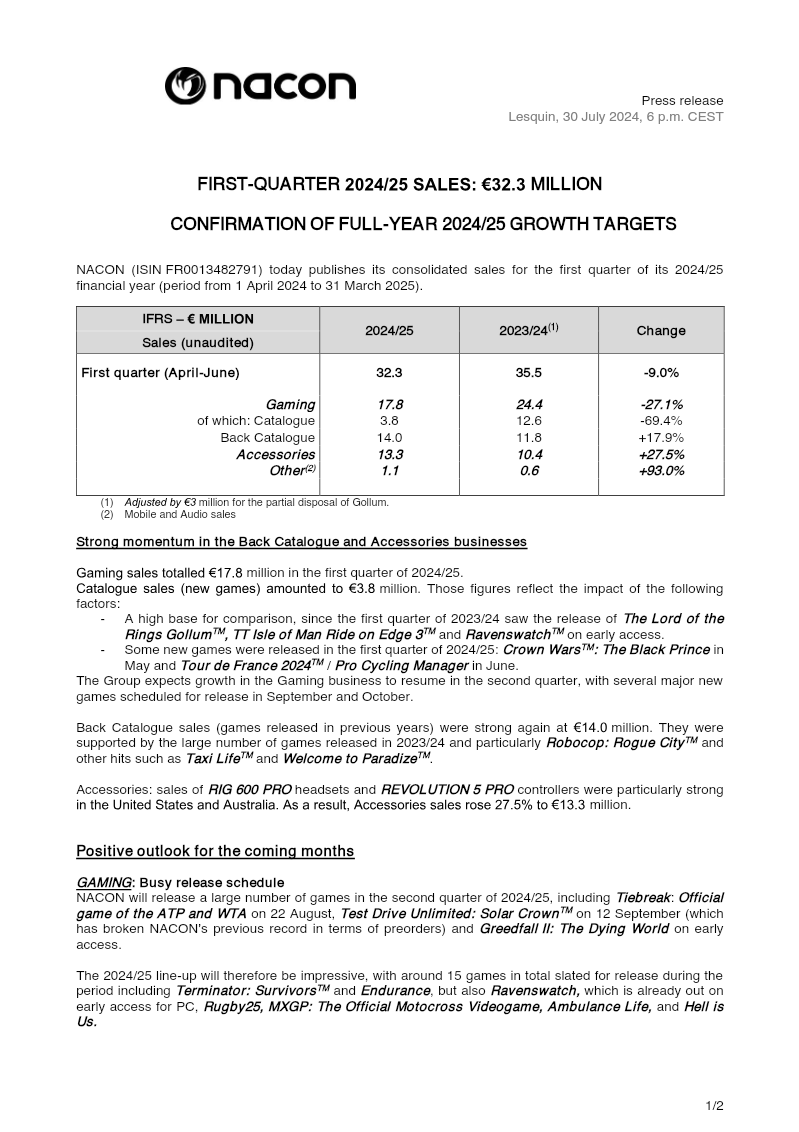
NACON reported first‑quarter sales of €32.3 million for the 2024/25 financial year, a 9.0 % decline from €35.5 million in the same period of 2023/24 after adjusting for a partial disposal of Gollum. Gaming revenue fell sharply to €17.8 million, with new‑game catalogue sales dropping 69.4 % to €3.8 million due to a high base in the prior year, while back‑catalogue sales rose 17.9 % to €14.0 million, buoyed by titles such as Robocop: Rogue City and Taxi Life. Accessories sales increased 27.5 % to €13.3 million, driven by strong demand for RIG 600 PRO headsets and REVOLUTION 5 PRO controllers in the United States and Australia. Other mobile and audio sales grew 93 % to €1.1 million.
The company projects a rebound in gaming revenue in the second quarter, citing an aggressive release schedule that includes Tiebreak: Official Game of the ATP and WTA, Test Drive Unlimited: Solar Crown, and Greedfall II. The accessories division is expected to remain robust, supported by new premium products under the REVOSIM brand and a growing console installed base. NACON’s capital increase in July 2024 has reinforced its financial position, enabling further investment in the gaming pipeline. The next sales update is slated for 28 October 2024.
NACON operates globally with 23 subsidiaries and a distribution network covering 100 countries, employing over 1,000 staff across 16 development studios and a publishing arm that generated €20.9 million in operating income for 2023/24.
- NACON reported Q1 2024/25 sales of €32.3 million, representing a 9.0% year-over-year decline after adjusting for the partial disposal of Gollum.
- Gaming revenue fell to €17.8 million, driven by a 69.4% drop in new-game sales compared to a strong prior-year base, though back-catalogue sales grew 17.9% to €14.0 million.
- The accessories division performed strongly with a 27.5% revenue increase to €13.3 million, fueled by demand for RIG 600 PRO headsets and REVOLUTION 5 PRO controllers in the U.S. and Australia.
- Management projects a Q2 revenue rebound supported by an aggressive release schedule featuring Test Drive Unlimited: Solar Crown, Greedfall II, and Tiebreak: Official Game of the ATP and WTA.
- A July 2024 capital increase has strengthened the company's financial position, allowing for continued investment in its development pipeline across 16 internal studios.
+2
Nacon
Report2 pages
Strong Sales Growth in the Second Quarter of 2024/25: Nacon
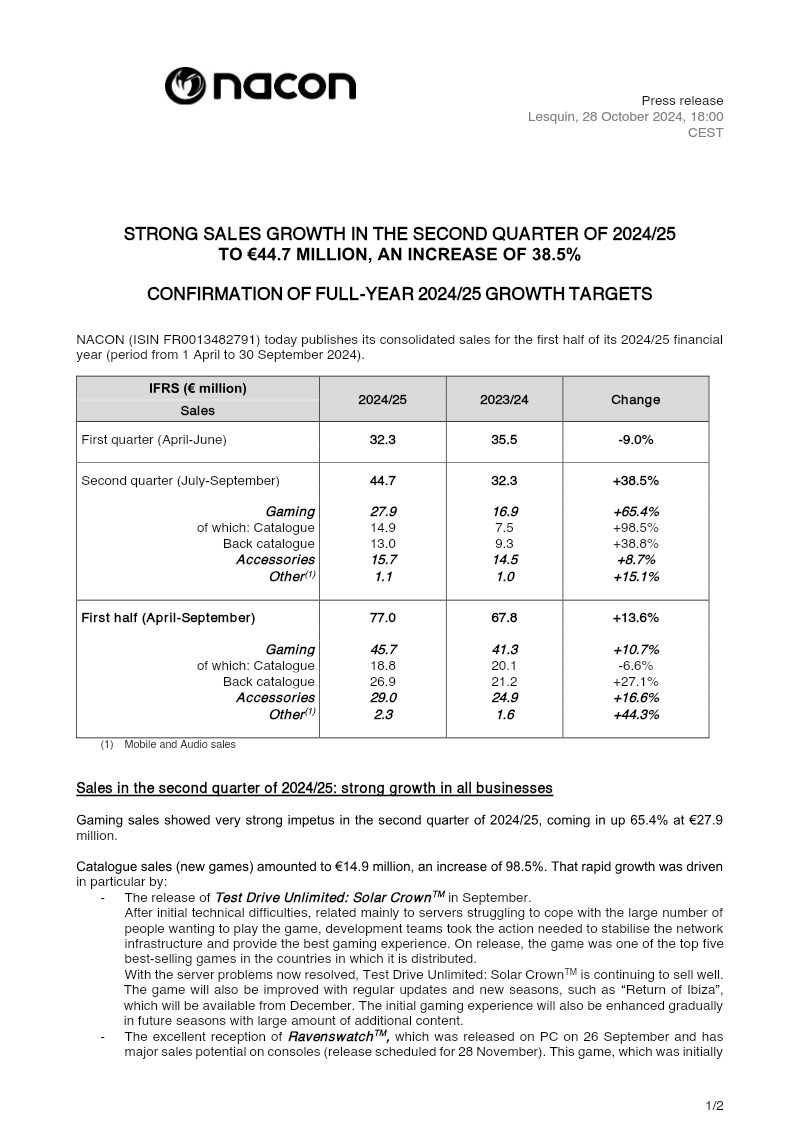
Nacon reported a 38.5 % surge in second‑quarter sales, reaching €44.7 million for the July‑September 2024 period and confirming its full‑year growth targets. Total first‑half sales for the fiscal year rose 13.6 % to €77.0 million, driven largely by a 65.4 % increase in gaming revenue (€27.9 million). Within gaming, catalogue sales doubled (+98.5 %) to €14.9 million, propelled by the launch of Test Drive Unlimited: Solar Crown™ and the strong reception of Ravenswatch™, while back‑catalogue sales grew 38.8 % to €13.0 million thanks to recent titles such as Robocop: Rogue City™ and Taxi Life™. Accessories sales expanded 8.7 % to €15.7 million, with headsets and controllers maintaining momentum in the U.S. and Australia.
The company highlighted a robust release schedule for the second half of 2024/25, including new titles across sport, racing, adventure, and simulation genres, as well as several premium accessories such as a REVOSIM steering wheel and a COBRA chair. Nacon’s integrated publishing and peripherals model is positioned to sustain growth and enhance operating income.
Geographically, Nacon operates through 23 subsidiaries with a distribution network covering 100 countries. The financial data are presented under IFRS, and the company’s workforce exceeds 1,000 employees. The press release was issued on 28 October 2024 and follows the company’s 2023/24 sales of €167.7 million and operating income of €20.9 million.
- Nacon reported a 38.5% surge in second-quarter sales to €44.7 million, bringing total first-half fiscal year sales to €77.0 million, a 13.6% increase.
- Gaming revenue grew by 65.4% to €27.9 million, driven by a 98.5% increase in catalogue sales following the launches of Test Drive Unlimited: Solar Crown and Ravenswatch.
- Back-catalogue performance remained strong, growing 38.8% to €13.0 million, supported by the continued success of titles like Robocop: Rogue City and Taxi Life.
- Accessories revenue rose 8.7% to €15.7 million, with sustained demand for headsets and controllers in the U.S. and Australian markets.
- The company confirmed its full-year growth targets and plans to bolster second-half performance with new software releases and premium hardware, including the REVOSIM steering wheel and COBRA chair.
+2
Nacon
Report2 pages
Third Quarter 2024/25 Sales
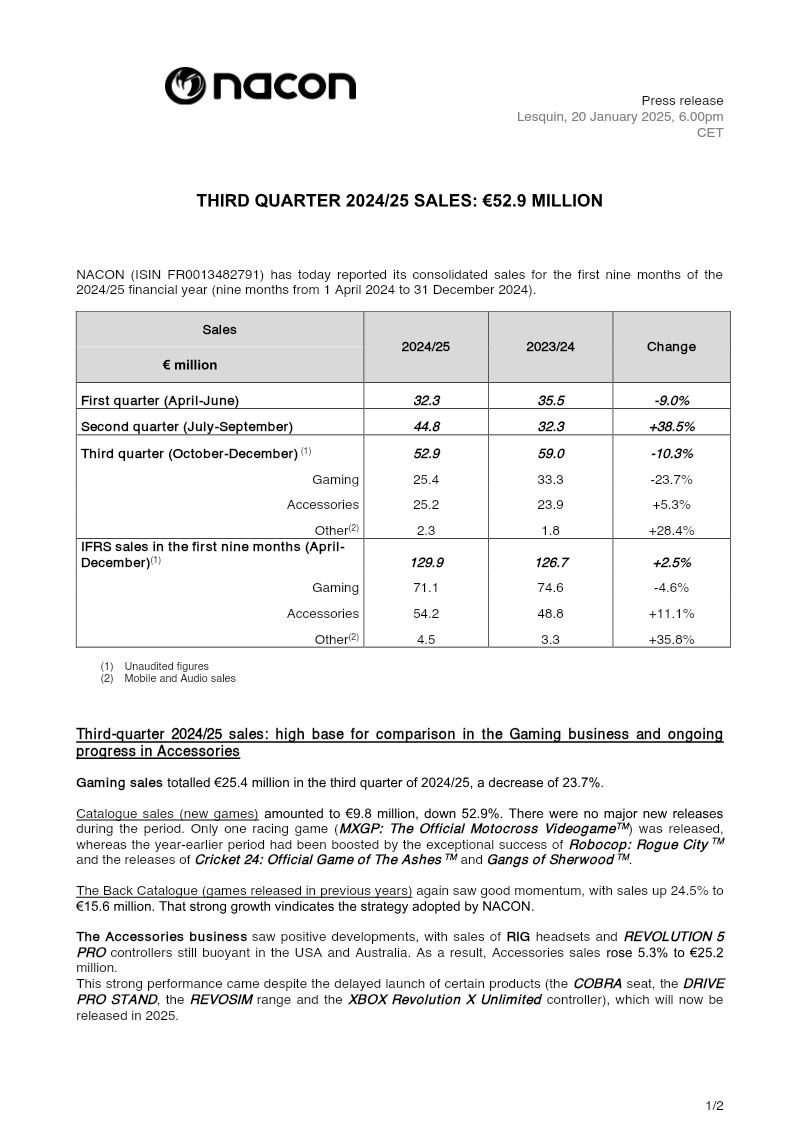
NACON reported consolidated sales of €52.9 million for the third quarter of its 2024/25 financial year, a decline of 10.3 % from the €59.0 million recorded in the same period last year. Gaming sales fell 23.7 % to €25.4 million, driven by a sharp drop in new‑catalogue releases; catalogue sales dropped 52.9 % to €9.8 million after only one new title, MXGP: The Official Motocross Videogame™. Back‑catalogue sales rebounded 24.5 % to €15.6 million, supporting the company’s strategy of leveraging legacy titles. Accessories sales grew modestly 5.3 % to €25.2 million, buoyed by strong performance of RIG headsets and REVOLUTION 5 PRO controllers in the U.S. and Australia, despite delays of several new accessories slated for 2025.
IFRS sales for the first nine months rose 2.5 % to €129.9 million, with gaming down 4.6 % and accessories up 11.1 %. NACON announced a new production plant for gaming accessories in Lauwin‑Planque, France, expected to improve supply chain control and inventory optimisation. The company projects a slight sales increase in the fourth quarter, though operating income may decline due to postponed releases. For 2025/26 first half, NACON anticipates strong growth from new gaming titles, continued back‑catalogue momentum, a busy release schedule, and the launch of Nintendo Switch™ 2 compatible products. The company operates across 100 countries with over 1,000 employees and is part of the Bigben group.
- NACON’s Q3 2024/25 consolidated sales fell 10.3% year-over-year to €52.9 million, primarily driven by a 23.7% decline in gaming revenue.
- Gaming revenue was negatively impacted by a 52.9% drop in new-catalogue sales, as the company released only one new title, MXGP: The Official Motocross Videogame™.
- Back-catalogue gaming sales provided a partial offset, rebounding by 24.5% to reach €15.6 million.
- Accessories sales grew 5.3% to €25.2 million, supported by the performance of RIG headsets and REVOLUTION 5 PRO controllers in the U.S. and Australian markets.
- NACON is establishing a new gaming accessory production plant in Lauwin-Planque, France, to improve supply chain control and inventory management.
+2
Nacon