Report15 pages
Half-Yearly Report: 2018-2019
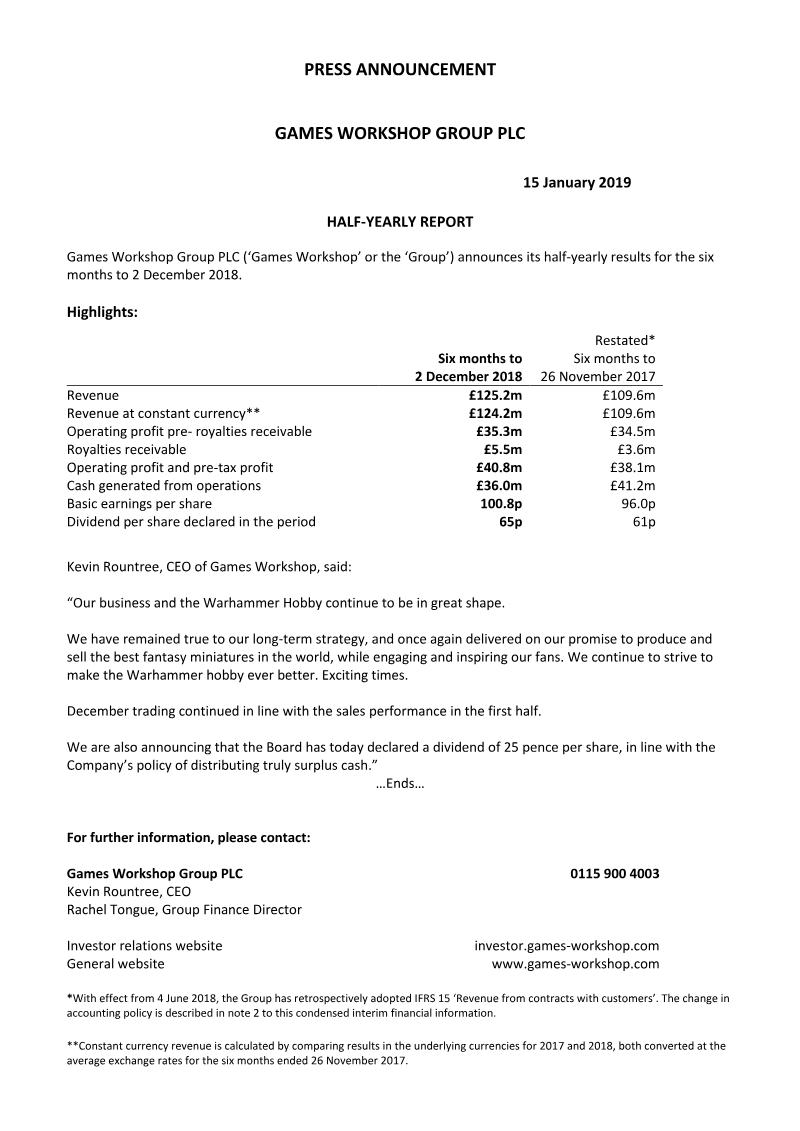
Games Workshop Group PLC (‘Games Workshop’ or the ‘Group’) announces its half-yearly results for the six Six months to Six months to 2 December 2018 26 November 2017 Revenue £125.2m £109.6m Revenue at constant currency £124.2m £109.6m Operating profit pre- royalties receivable £35.3m £34.5m Royalties receivable ...
- Games Workshop Group PLC reported a significant increase in revenue for the six months to December 2, 2018, reaching £125.2 million, up from £109.6 million in the same period last year.
- Operating profit and pre-tax profit also saw growth, rising to £40.8 million for the six months to December 2, 2018, compared to £38.1 million in the prior year.
- Basic earnings per share increased to 100.8p from 96.0p, and the dividend per share declared in the period rose to 65p from 61p.
- Trade segment revenue experienced substantial growth, increasing from £48.0 million to £61.4 million, while Retail revenue grew from £39.6 million to £42.6 million.
- Cash generated from operations decreased to £36.0 million from £41.2 million, primarily due to increased investment in working capital.
+1
Games Workshop Group

Report78 pages
Annual Report 2019
Revenue 256,574 221,304 Revenue at constant currency 255,295 221,304 Operating profit - pre-royalties receivable 69,834 64,702 Royalties receivable 11,365 9,617 Operating profit 81,199 74,319 Profit before taxation 81,296 74,270 Cash generated from operations 88,776 82,332 Earnings per share ...
- Games Workshop Group PLC reported a strong financial performance in 2019, with revenue increasing to £256,574,000 from £221,304,000 in 2018, and operating profit rising to £81,199,000 from £74,319,000.
- The company achieved a third consecutive year of record constant currency sales, profit, cash generation, and returns to shareholders, driven by its core business of producing and selling fantasy miniatures.
- Earnings per share grew to 202.9p in 2019 from 184.3p in 2018, and dividends per share declared in the year increased significantly to 155p from 126p.
- Cash generated from operations also saw a healthy increase, reaching £88,776,000 in 2019 compared to £82,332,000 in 2018.
- Despite the positive financial results, the company's return on capital decreased from 120% in 2018 to 100% in 2019, primarily due to an increase in average capital employed.
+2
Games Workshop Group
Report16 pages
Half-Yearly Report: Six Months to 1 December 2019
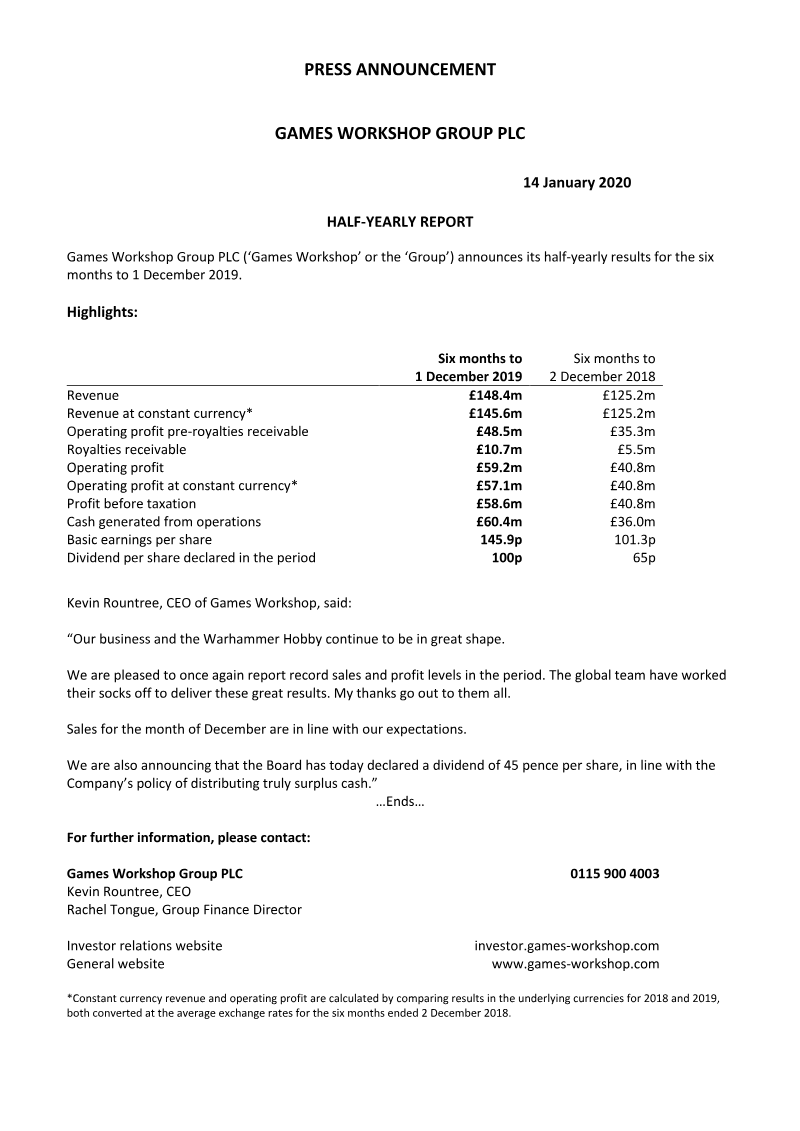
Games Workshop Group PLC (‘Games Workshop’ or the ‘Group’) announces its half-yearly results for the six Six months to Six months to 1 December 2019 2 December 2018 Revenue £148.4m £125.2m Revenue at constant currency £145.6m £125.2m Operating profit pre-royalties receivable £48.5m £35.3m Royalties...
- Games Workshop Group PLC reported record sales and profit for the six months ending December 1, 2019, with revenue increasing by 19% to £148.4 million (16% at constant currency) and operating profit rising to £59.2 million from £40.8 million in the prior year.
- Profit before taxation increased by £17.8 million to £58.6 million, and basic earnings per share grew to 145.9p from 101.3p.
- Licensing income (royalties receivable) significantly increased by £5.2 million to £10.7 million, including £6.2 million from new license contracts, compared to £1.6 million in the previous year.
- Sales growth was observed across all channels: Trade (£76.1 million), Retail (£45.3 million), and Online (£24.2 million).
- The company declared dividends of 100p per share during the period, including a new dividend of 45 pence per share, and invested £5.7 million in capital projects.
+2
Games Workshop Group
Report17 pages
Half-Yearly Report: 29 November 2020
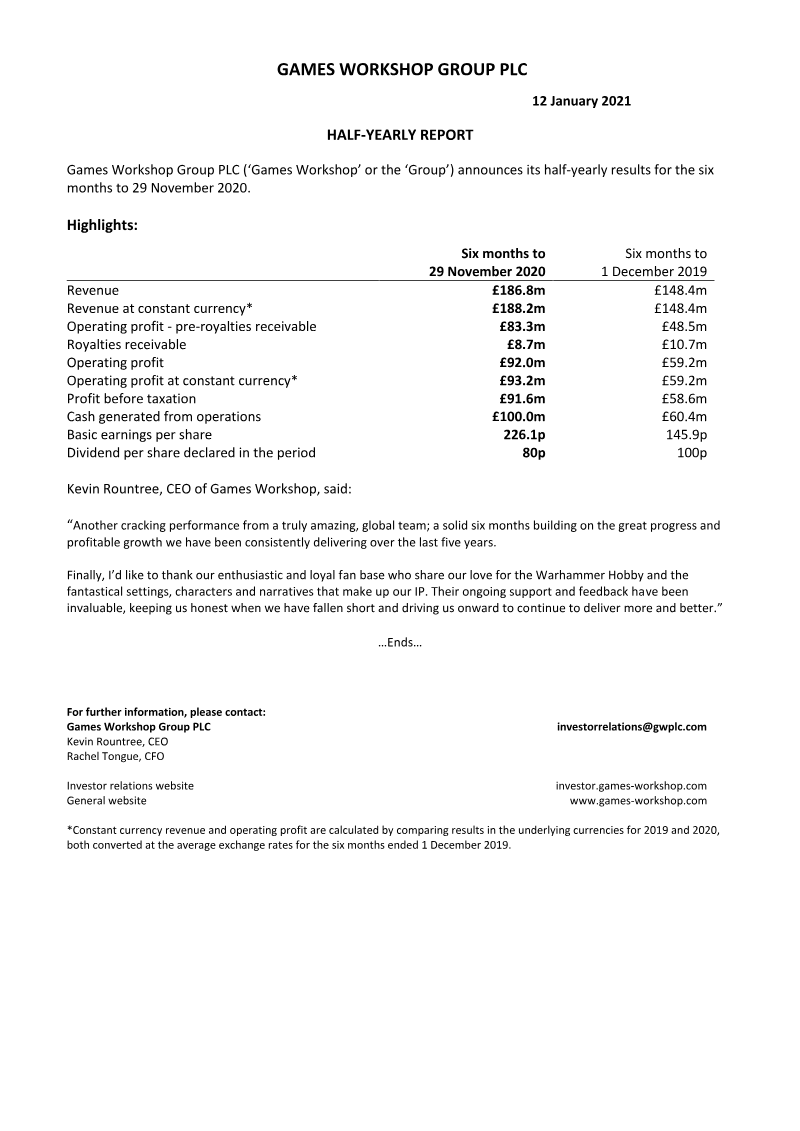
Games Workshop Group PLC (‘Games Workshop’ or the ‘Group’) announces its half-yearly results for the six Six months to Six months to 29 November 2020 1 December 2019 Revenue £186.8m £148.4m Revenue at constant currency £188.2m £148.4m Operating profit - pre-royalties receivable £83.3m ...
- Games Workshop Group PLC reported significant growth for the six months to November 29, 2020, with revenue increasing to £186.8m from £148.4m in the prior year, and operating profit rising to £92.0m from £59.2m.
- Profit before taxation for the period reached £91.6m, up from £58.6m, and basic earnings per share grew to 226.1p compared to 145.9p in the previous year.
- Sales growth was strong across all channels, with trade sales up 33%, online sales up 87%, and retail sales broadly following government lockdown rules, contributing to a 26% overall sales increase.
- The company achieved a 75% gross margin, a 6% increase, driven by higher volumes, and maintained a controlled cost-to-sales ratio of 28% (excluding group profit share and discretionary bonus), down from 36% in 2019.
- Manufacturing output increased by 30% compared to the same period last year, with the new Warhammer 40,000 launch breaking production volume records, and the company is expanding its manufacturing capacity with a new factory nearing completion and securing additional land.
+2
Games Workshop Group
Report20 pages
Half-Yearly Report: 2022-2023
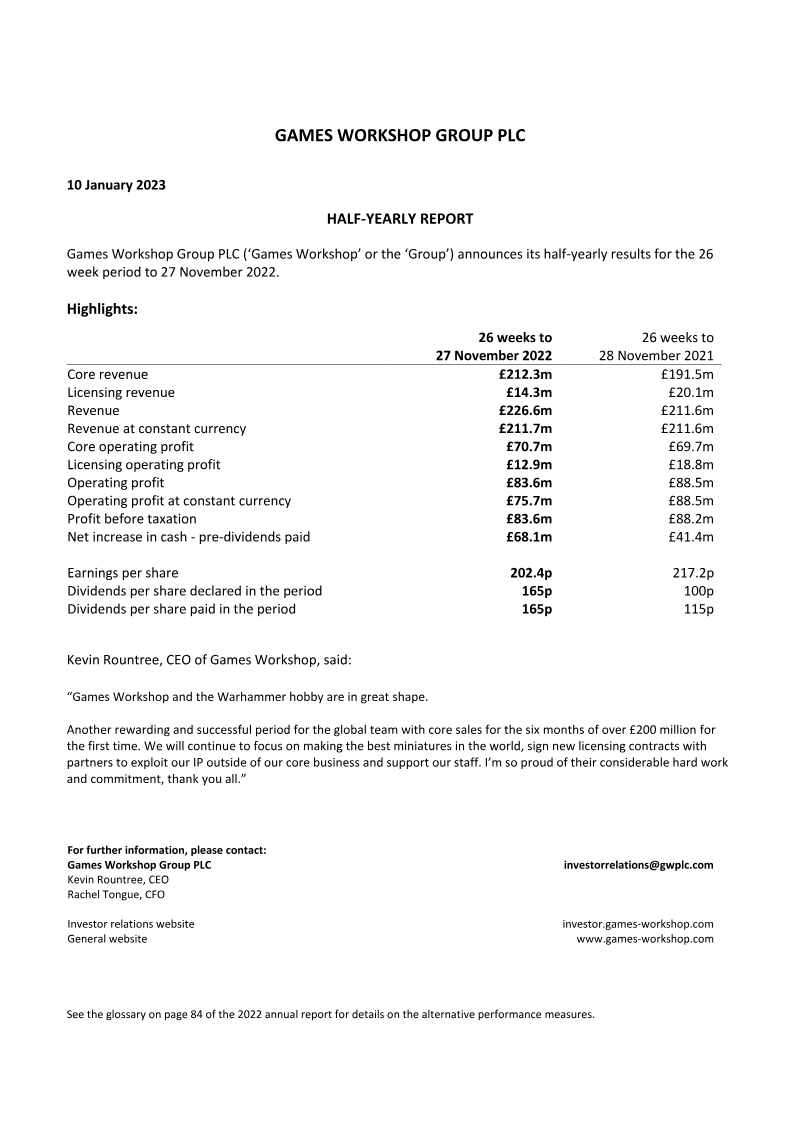
Games Workshop Group PLC (‘Games Workshop’ or the ‘Group’) announces its half-yearly results for the 26 week period to 27 November 2022. 26 weeks to 26 weeks to 27 November 2022 28 November 2021 Core revenue £212.3m £191.5m Licensing revenue £14.3m £20.1m Revenue ...
- Games Workshop Group PLC reported a half-yearly revenue of £226.6m for the 26 weeks to 27 November 2022, an increase from £211.6m in the prior year, with core revenue growing to £212.3m from £191.5m.
- Operating profit decreased to £83.6m from £88.5m in the previous year, and profit before taxation also saw a decline to £83.6m from £88.2m.
- Licensing revenue significantly decreased to £14.3m from £20.1m, largely due to a high level of guarantee income on multi-year contracts recognized in the prior year.
- The company's net increase in cash before dividends paid rose substantially to £68.1m from £41.4m, and dividends per share declared increased to 165p from 100p.
- Core sales growth was observed across Retail (+9.8%) and Trade (+3.4%), with a slight decline in Online sales (-0.5%) on a constant currency basis.
+1
Games Workshop Group
Report20 pages
Half-Yearly Report: 26 Weeks to 26 November 2023
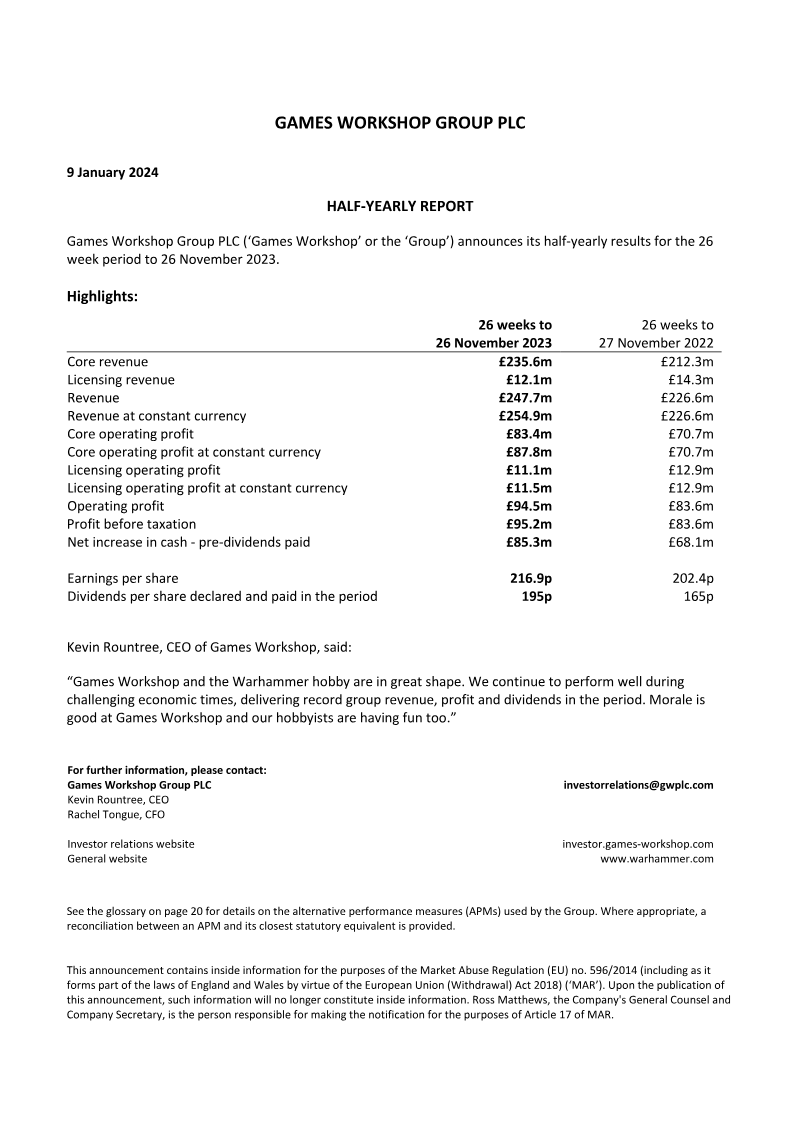
Games Workshop Group PLC (‘Games Workshop’ or the ‘Group’) announces its half-yearly results for the 26 week period to 26 November 2023. 26 weeks to 26 weeks to 26 November 2023 27 November 2022 Core revenue £235.6m £212.3m Licensing revenue £12.1m £14.3m Revenue ...
- Games Workshop Group PLC reported record half-yearly revenue of £247.7m (up from £226.6m in the prior period) and profit before taxation of £95.2m (up from £83.6m) for the 26 weeks to 26 November 2023.
- Core revenue grew by 11.0% to £235.6m, with growth across Retail (+12.3%), Trade (+12.6%), and Online (+4.9%).
- Core gross margin increased significantly from 64.2% to 69.4%, primarily due to reduced inventory provision charges and lower carriage costs.
- Dividends per share declared and paid in the period increased to 195p, up from 165p in the previous comparable period.
- The company's cash and cash equivalents increased to £111.3m as of 26 November 2023, up from £90.2m at 28 May 2023.
Games Workshop Group
Report21 pages
Half-Yearly Report: 2024–2025
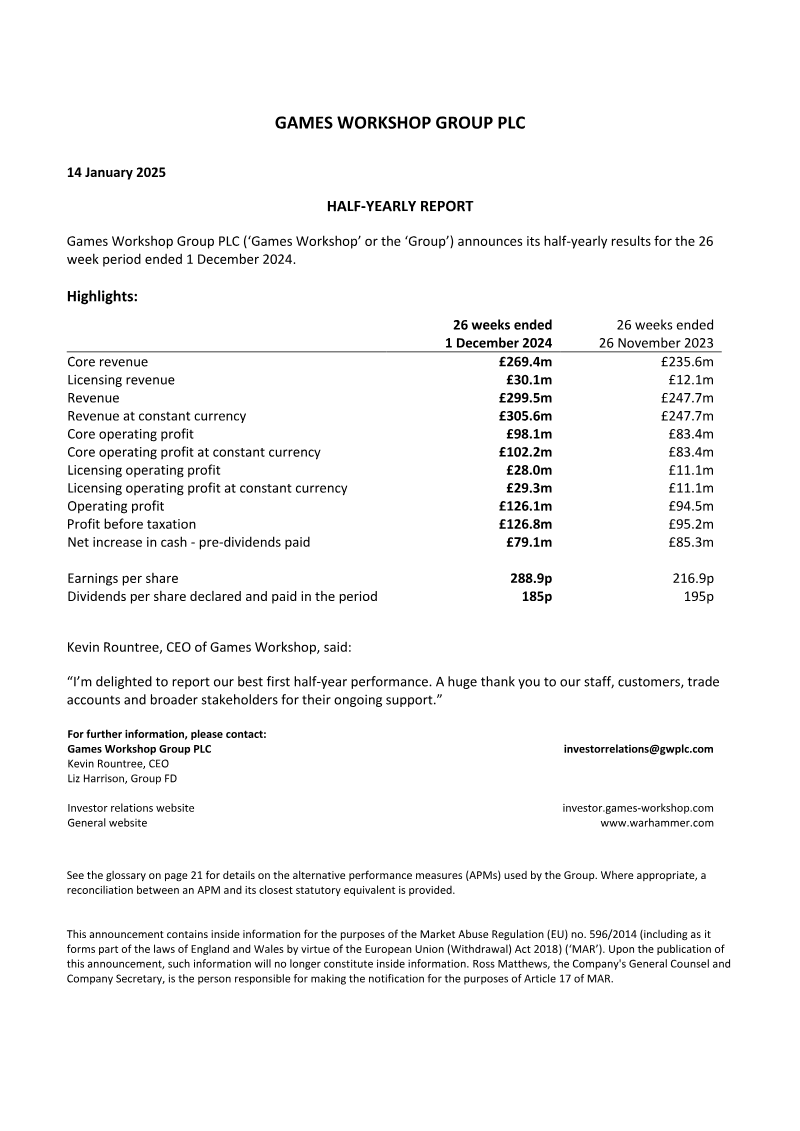
Games Workshop Group PLC (‘Games Workshop’ or the ‘Group’) announces its half-yearly results for the 26 week period ended 1 December 2024. 26 weeks ended 26 weeks ended 1 December 2024 26 November 2023 Core revenue £269.4m £235.6m Licensing revenue £30.1m £12.1m Revenue £299.5m £247.7m Revenue at cons...
- Games Workshop Group PLC reported its best first half-year performance for the 26 weeks ended December 1, 2024, with total revenue reaching £299.5m, up from £247.7m in the prior year.
- Operating profit significantly increased to £126.1m for the 26 weeks ended December 1, 2024, compared to £94.5m in the same period last year, with profit before taxation at £126.8m.
- Core revenue grew by 14.3%, driven by strong performance in Trade (+21.7%) and Retail (+11.2%), although Online revenue decreased by 4.2%.
- Licensing revenue saw substantial growth, increasing from £12.1m to £30.1m, with licensing operating profit rising from £11.1m to £28.0m.
- Earnings per share rose to 288.9p for the 26 weeks ended December 1, 2024, up from 216.9p in the previous year.
+3
Games Workshop Group
Report4 pages
Factbook: Third Quarter of Fiscal Year Ending March 31, 2026
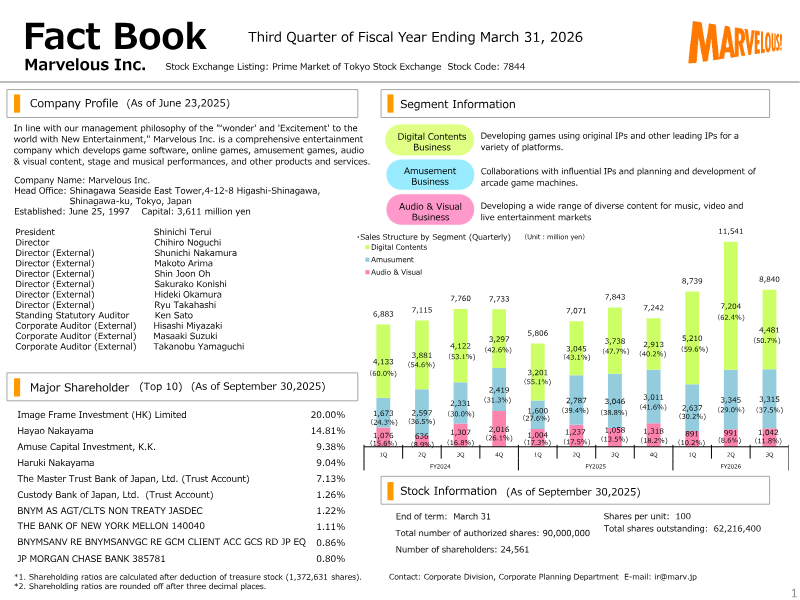
Marvelous Inc., listed on Tokyo’s Prime Market, released its third‑quarter financial results for the fiscal year ending March 31 2026. The company’s core business spans digital content, amusement, audio‑visual production and live entertainment, with a focus on original IPs and collaborations. Revenue rose to ¥29.1 billion in Q3, up 4.5% from the prior quarter and 10.6% year‑on‑year, driven primarily by digital content sales of ¥7.2 billion and amusement revenue of ¥3.0 billion. Gross operating profit reached ¥10.4 billion, a 12% increase over Q2 and a 9% rise versus the same period last year, reflecting improved cost control in production and marketing.
Operating profit fell to ¥1.8 billion, a 12% decline from Q2, largely due to higher selling‑general‑administrative expenses of ¥8.6 billion compared with ¥7.9 billion in Q2. Net income attributable to shareholders was ¥1.5 billion, down 18% from Q2, with a net profit margin of 5.3%. The company’s cash‑flow position remained solid, with operating cash flow of ¥2.8 billion and a cash‑equivalent balance of ¥16.4 billion at quarter end.
Geographically, the report covers Japan and overseas markets where Marvelous operates. The data derive from consolidated financial statements prepared under Japanese GAAP, covering all subsidiaries and affiliates. Key metrics such as return on equity (13.7%) and asset turnover (0.82) indicate healthy profitability, while dividend payout remained at 52% of net income. Overall, the quarter shows revenue growth but margin pressure from higher operating costs, prompting management to focus on cost efficiency and portfolio diversification.
- Marvelous Inc. reported Q3 revenue of ¥29.1 billion, representing a 10.6% year-on-year increase driven by digital content sales of ¥7.2 billion and amusement revenue of ¥3.0 billion.
- Operating profit declined 12% quarter-on-quarter to ¥1.8 billion, primarily due to an increase in selling, general, and administrative expenses from ¥7.9 billion in Q2 to ¥8.6 billion.
- Gross operating profit rose 9% year-on-year to ¥10.4 billion, reflecting improved cost control in production and marketing despite the overall pressure on net margins.
- Net income attributable to shareholders fell 18% from the previous quarter to ¥1.5 billion, resulting in a net profit margin of 5.3%.
- The company maintains a solid financial position with ¥16.4 billion in cash equivalents, an operating cash flow of ¥2.8 billion, and a return on equity of 13.7%.
+3
Marvelous
Report24 pages
Half-Yearly Report: 2025
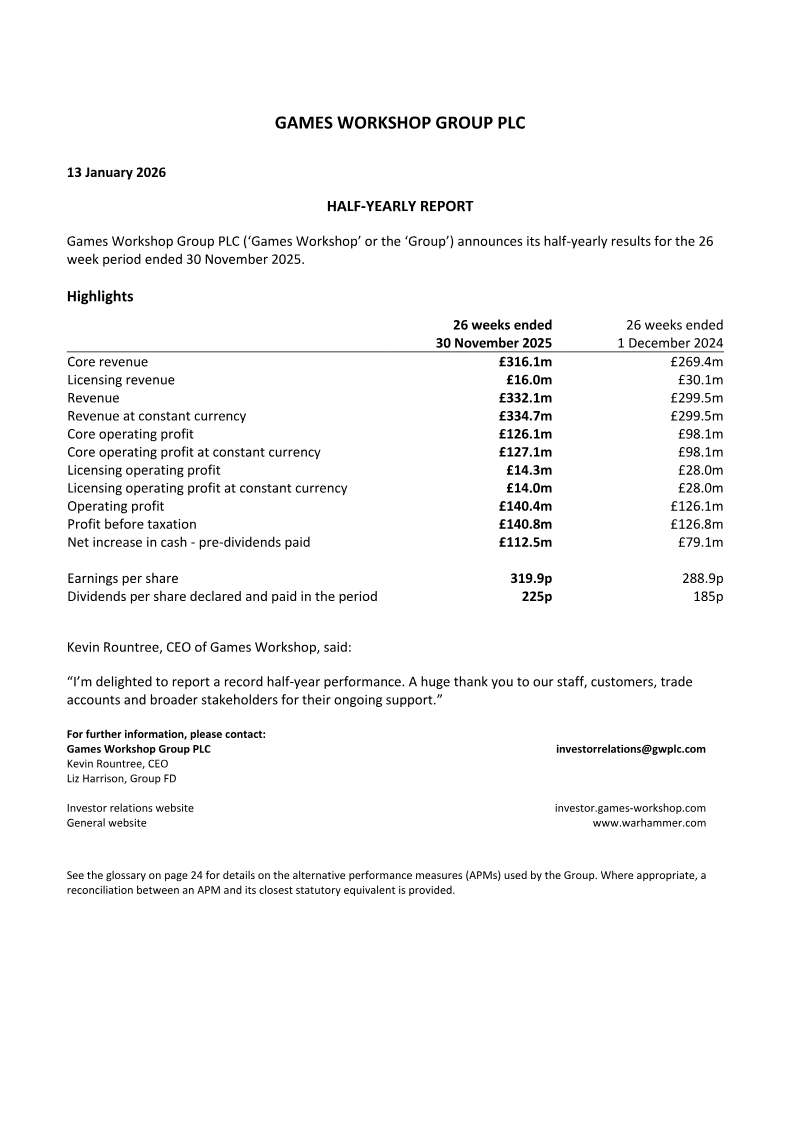
Games Workshop Group PLC (‘Games Workshop’ or the ‘Group’) announces its half-yearly results for the 26 week period ended 30 November 2025. 26 weeks ended 26 weeks ended 30 November 2025 1 December 2024 Core revenue £316.1m £269.4m Licensing revenue £16.0m £30.1m Revenue ...
- Games Workshop Group PLC reported a record half-year performance for the 26 weeks ended November 30, 2025, with total revenue reaching £332.1 million, up from £299.5 million in the prior year.
- Core revenue increased significantly to £316.1 million (from £269.4 million), while licensing revenue decreased to £16.0 million (from £30.1 million).
- Operating profit grew to £140.4 million (from £126.1 million), and profit before taxation increased to £140.8 million (from £126.8 million).
- Earnings per share rose to 319.9p (from 288.9p), and dividends per share declared and paid in the period were 225p (from 185p).
- The company is expanding its infrastructure with a new UK warehousing facility opening in 2027 and a new Warhammer World format location in North America also planned for 2027.
+1
Games Workshop Group

Report96 pages
Annual Report and Accounts 2023
FRONTIER REALMS ANNUAL REPORT AND ACCOUNTS 2023 GROWING AND EVOLVING ANNUAL REPORT HEADLINES CONTENTS Frontier is a leading independent developer and publisher of video games See a summary of our progress in FY23 including 01 Headlines founded in 1994 by David Braben, co-author of the iconic Elite game.
- Frontier Developments PLC acquired Complex Games, developers of Warhammer 40,000: Chaos Gate – Daemonhunters, in November 2022, gaining expertise in turn-based strategy games.
- The company's gross research and development spend increased to £52.9 million in FY23, up from £47.5 million in FY22.
- Planet Zoo, released in 2019, is on its 15th PDLC pack (Oceania Pack, due September 2023) and supports animal conservation initiatives with partners like Edinburgh Zoo and San Diego Wildlife Alliance.
- Adjusted EBITDA (loss)/profit for FY23 was (£4,595k), a decrease from (£6,677k) in FY22.
- From FY24, the company will amortize other intangible assets more rapidly in the first 12 months post-release, which may negatively impact reported operating profit short-term but not Adjusted EBITDA.
+2
Frontier Developments

Report80 pages
Integrated Report 2025
SEGA SAMMY HOLDINGS INTEGRATED REPORT 2025 SEGA SAMMY HOLDINGS INTEGRATED REPORT 2025 Key Visual from Sonic the Hedgehog 3 movie Group Value Introduction Strengthening of Non-Financial Capital Creativity is Mindset and DNA SEGA SAMMY Group Core Businesses 02 Materiality 56 Creativity is Alway...
- SEGA SAMMY Holdings aims for Adjusted EBITDA over ¥230.0 billion and ROE over 10% cumulatively for the three-year period from FY2025/3 to FY2027/3.
- The company is expanding its Gaming Business through the acquisition of Stakelogic B.V. by its subsidiary SEGA SAMMY CREATION INC., completed on April 28, 2025.
- The Entertainment Contents Business expects revenue to increase compared to FY2025/3, with strong sales of new and repeat full games in the Consumer area and continued growth in licensing income, despite an anticipated reactionary decline in Animation areas.
- The Pachislot & Pachinko Machines Business aims to reclaim the No. 1 total utilization share, having fallen one position in the fiscal year ended March 2024 due to differences between product specifications and market needs.
- SEGA SAMMY Holdings is reinforcing "culturally diverse human resources" aligned with its global business expansion strategy and has increased external directors to four to enhance transparency and governance.
+2
Sega Sammy Holdings
Report14 pages
FY24 Interim Results: Frontier Developments
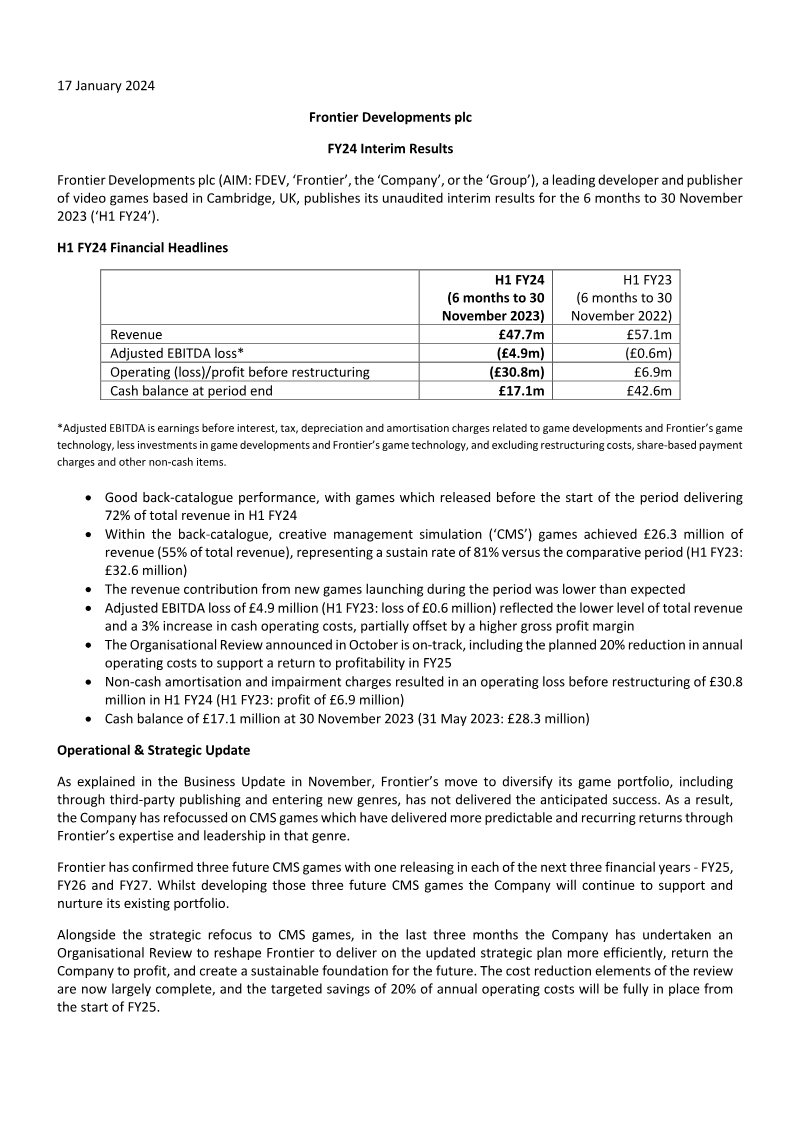
Frontier Developments plc (AIM: FDEV, ‘Frontier’, the ‘Company’, or the ‘Group’), a leading developer and publisher of video games based in Cambridge, UK, publishes its unaudited interim results for the 6 months to 30 November (6 months to 30 (6 months to 30 November 2023) November 2022) Revenue £47.7m £57.1m Adjusted EBITDA loss (£4.9m) (£0.6m) Operating (...
- Frontier Developments experienced a significant financial downturn in H1 FY24 (6 months to 30 November 2023), reporting a £33.1 million loss after tax compared to a £6.7 million profit in H1 FY23, and an operating loss of £30.8 million versus a £6.9 million profit in H1 FY23.
- Revenue decreased to £47.7 million in H1 FY24 from £57.1 million in H1 FY23, primarily due to lower-than-expected contributions from new game launches and a full impairment charge of £16.9 million for 'Realms of Ruin'.
- The company's cash balance significantly reduced to £17.1 million at November 30, 2023, down from £42.6 million in H1 FY23, though it increased to £19.9 million by December 31, 2023, after receiving subscription fees.
- Frontier is strategically refocusing on Creative Management Simulation (CMS) games, with three new CMS titles planned for release in FY25, FY26, and FY27, building on the strong performance of existing CMS games which generated £26.3 million (55% of total revenue) in H1 FY24.
- An organizational review led to cost reduction efforts, targeting 20% savings in annual operating costs by the start of FY25, with a £2.5 million restructuring charge recorded in H1 FY24.
+2
Frontier Developments

Report94 pages
Annual Report and Accounts 2024
ANNUAL REPORT AND ACCOUNTS 2024 30 YEARS OF HEADLINES CONTENTS CREATIVITY, STRATEGIC REPORT See a summary of the headlines for FY24, 01 Headlines INNOVATION AND ...
- Frontier plans to release three self-published CMS (Creative Management Simulation) games in the next three consecutive financial years: Planet Coaster 2 in autumn 2024 (FY25), a new Jurassic World game in FY26, and a third unannounced CMS game in FY27.
- Frontier reported a loss before taxation of £28.425 million for the 12 months ending May 31, 2024, an increase from £26.509 million in the previous year.
- Net cashflows from operating activities decreased to £31.625 million in FY24 from £47.875 million in FY23, while net cashflows used in investing activities improved to (£27.868 million) from (£52.310 million).
- The company incurred £1.4 million in costs from an Organizational Review in FY24, primarily due to redundancy costs, compared to £nil in FY23.
- Frontier's total unrecognised tax losses increased to £109.5 million at May 31, 2024, from £80.2 million at May 31, 2023, with these losses having no expiry date.
+3
Frontier Developments
Report14 pages
FY25 Trading Update
FOR THE FINANCIAL YEAR 1 JUNE 2024 TO 31 MAY 2025 PRIVATE AND CONFIDENTIAL RESERVED STRONG RESULTS AND INCREASED MOMENTUM 2 FINANCIALS the account or benefit of, U.S.
- Frontier Developments PLC's revenue increased by 1% to £90.6 million in FY25, with gross profit up 3% to approximately £63 million.
- Planet Coaster 2 sold over 500,000 base game units in FY25 (approximately 7 months) and has received 5 free major updates since launch, with a 6th scheduled for later this month.
- Jurassic World Evolution 3 is announced for release on October 21, 2025 (in FY26) on PC, PlayStation 5, and Xbox Series X|S, featuring breeding, juvenile dinosaurs, and Jeff Goldblum.
- Elite Dangerous saw a nearly 150% growth in PDLC revenue due to monetisation improvements, including early access ship sales, and PDLC accounted for 36% of total revenue in FY25 (up from 35% in FY24).
- Subscription revenue decreased significantly from 13% in FY24 to 5% in FY25, though underlying revenue, excluding subscription deals, grew by 11%.
+2
Frontier Developments
Report13 pages
FY25 H1 Results: A Strong Turnaround
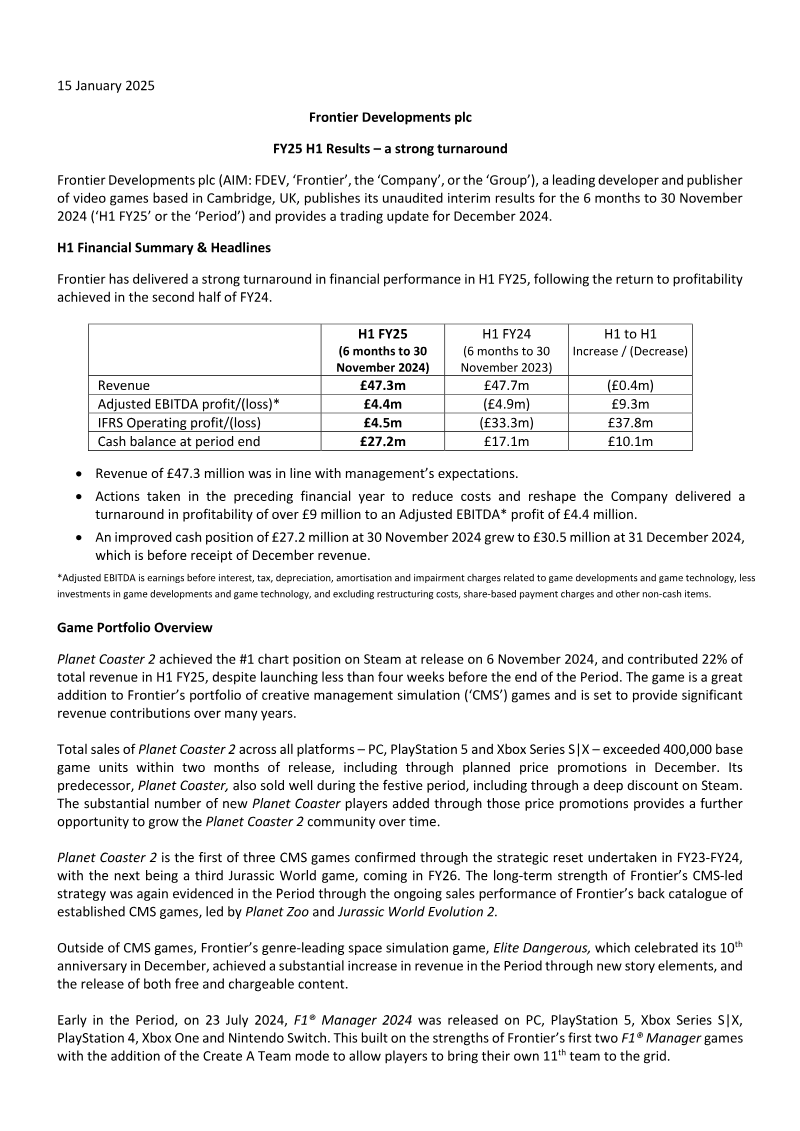
Frontier Developments plc reported a robust turnaround in its first half of FY25, with revenue of £47.3 million nearly matching the prior year’s £47.7 million and an adjusted EBITDA profit of £4.4 million, a swing from a £4.9 million loss in H1 FY24. Operating profit rose to £4.5 million from a £33.3 million loss, driven by significant cost reductions following an organisational review and the closure of Frontier Foundry. Cash reserves strengthened to £27.2 million at 30 November, rising to £30.5 million by 31 December after the November launch of Planet Coaster 2.
Planet Coaster 2, released on 6 November, dominated the period by contributing 22% of total revenue and selling over 400,000 base‑game units across PC, PS5, and Xbox Series platforms within two months. The game’s launch reinforced the company’s CMS strategy, supported by strong sales of existing titles such as Planet Zoo and Jurassic World Evolution 2. Elite Dangerous also saw revenue growth through new story content, while F1® Manager 2024 added a fresh title to the portfolio.
Cost efficiencies were evident: adjusted operating costs fell 25% to £28.5 million, R&D expenses dropped 21% to £19.5 million, and marketing and administrative costs declined 32%. Gross profit margin improved to 70% from 69%, reflecting a favourable revenue mix.
The company maintains a positive outlook for FY25, citing continued momentum from the CMS lineup and upcoming releases. Management expressed confidence in sustaining profitability and capitalising on planned content updates, while acknowledging subscription deal timing as a variable factor. Overall, the interim results demonstrate that Frontier’s strategic reset and disciplined cost management have restored profitability and positioned the firm for continued growth in the competitive video‑game market.
- Frontier Developments achieved a significant financial turnaround in H1 FY25, swinging from a £4.9 million EBITDA loss in the prior year to a £4.4 million profit.
- Operating profit reached £4.5 million, a substantial recovery from the £33.3 million loss reported in H1 FY24, driven by aggressive cost-cutting measures and the closure of the Frontier Foundry division.
- The November 6 launch of Planet Coaster 2 generated 22% of total H1 revenue, selling over 400,000 units across PC, PS5, and Xbox Series platforms within two months.
- Disciplined cost management reduced adjusted operating costs by 25% to £28.5 million, with R&D expenses falling 21% and administrative/marketing costs dropping 32%.
- Cash reserves strengthened to £30.5 million by December 31, 2024, up from £27.2 million at the end of November.
+1
Frontier Developments
Report3 pages
FY25 Trading Update: Strong Results and Increased Momentum
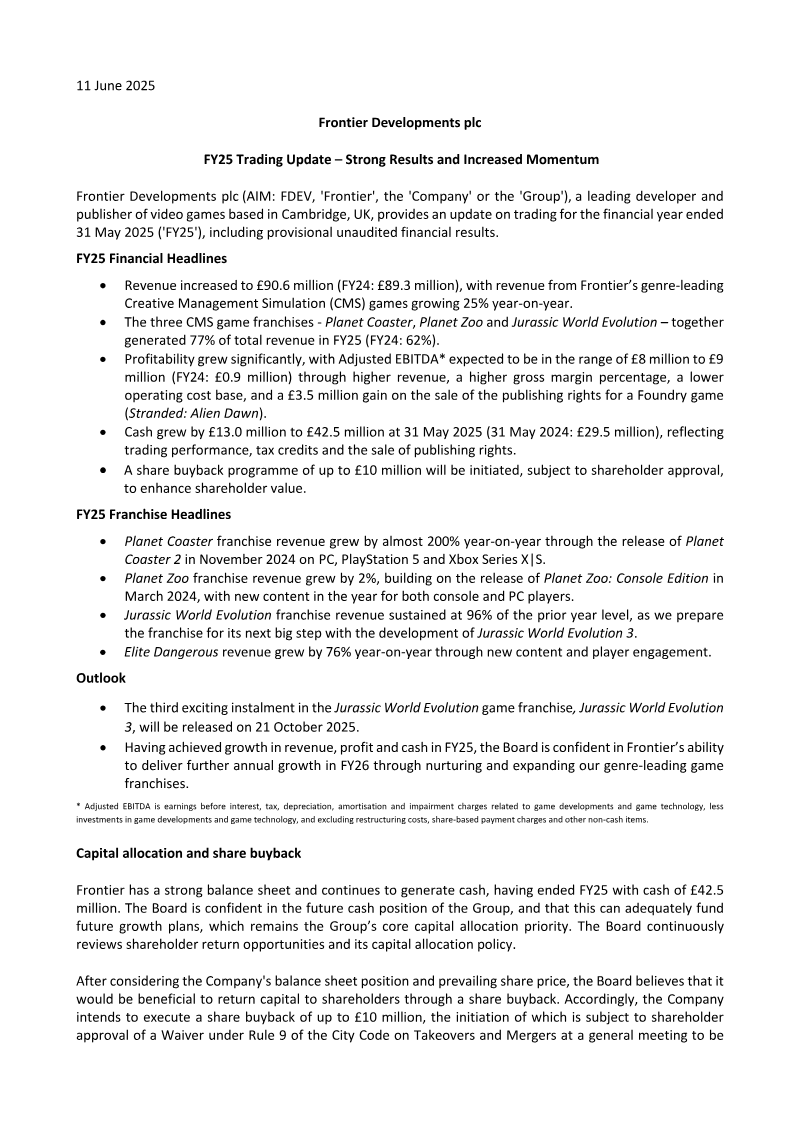
Frontier Developments plc reports a modest revenue rise to £90.6 million for FY25, up from £89.3 million in FY24, driven by a 25 % year‑on‑year increase in its Creative Management Simulation (CMS) titles. The three flagship CMS franchises—Planet Coaster, Planet Zoo and Jurassic World Evolution—accounted for 77 % of total revenue in FY25, a jump from 62 % the previous year. Planet Coaster alone grew almost 200 % following the launch of Planet Coaster 2, while Planet Zoo and Jurassic World Evolution maintained near‑stable sales levels.
Profitability improved sharply; Adjusted EBITDA is projected between £8 million and £9 million, compared with a £0.9 million profit in FY24, thanks to higher gross margins, reduced operating costs and a £3.5 million gain from selling publishing rights to Stranded: Alien Dawn. Adjusted Operating Profit, a new metric effective FY26 that incorporates tax credits and reliefs, is expected to reach £11 million‑£12 million in FY25.
Cash position strengthened, with cash on hand rising to £42.5 million from £29.5 million at the end of FY24, supporting a planned share buyback up to £10 million pending shareholder approval. The board also announced the creation of an Executive Board to streamline decision‑making and highlighted the upcoming release of Jurassic World Evolution 3 on 21 October 2025 as a key growth driver.
- Frontier Developments achieved a significant increase in profitability, with projected Adjusted EBITDA rising to £8–£9 million from £0.9 million in FY24.
- Revenue grew to £90.6 million, driven by a 25% year-on-year increase in Creative Management Simulation (CMS) titles, which now account for 77% of total revenue.
- The launch of Planet Coaster 2 catalyzed a nearly 200% revenue increase for the Planet Coaster franchise.
- The company’s cash position strengthened to £42.5 million, up from £29.5 million, enabling a proposed £10 million share buyback.
- Profitability was bolstered by a £3.5 million gain from the sale of publishing rights to Stranded: Alien Dawn, alongside reduced operating costs.
+4
Frontier Developments

Report92 pages
Annual Report and Accounts 2025
ANNUAL REPORT AND ACCOUNTS 2025 ANNUAL REPORT AND ACCOUNTS 2025 Frontier is a leading independent developer and CONTENTS publisher of video games for PC and consoles, HEADLINES STRATEGIC REPORT creating immersive and fun gameplay with high See a summary of the headlines for FY25, 01 Headlines production values.
- Frontier Developments PLC achieved significant profitability and cash generation uplift in FY25, driven by a sharpened focus on CMS (Content Management System) games and a sustainable cost base.
- Revenue increased year-on-year in FY25, and gross profit rose to £63.3 million (up from £61.3 million in FY24), with an improved gross margin of 70% (up from 69% in FY24) due to a greater share of own-IP game revenue.
- Elite Dangerous, a long-standing space exploration title outside the CMS portfolio, saw 76% year-on-year revenue growth in FY25, supported by new content and increased player engagement.
- Cash expenditure on CMS games represented 72% in FY25, a significant increase from 58% (£26.5 million) in FY24, reflecting a strategic refocus and reallocation of employees to capitalisable projects.
- Frontier will adopt Adjusted Operating Profit as its primary financial performance measure from FY26, replacing Adjusted EBITDA, to provide a more accurate reflection of Group performance.
+2
Frontier Developments
Report17 pages
FY26 H1 Results Presentation
The information contained in this confidential the account or benefit of, U.S. Persons (as defined in or advisers take any responsibility for, or will accept any shareholders, directors, officers, agents, employees or document ("Presentation") has been prepared liability whether direct or indirect, express or implied, advisers.
- Frontier Developments plc's H1 FY26 financial results show an Adjusted Operating Profit of approximately £11 million.
- CMS (Content Management System) games grew 52% in H1 FY26, contributing 90% of the total revenue.
- Jurassic World Evolution 3 (JWE3) has been a significant success.
- The company's FY27 CMS title will be a sequel to Planet Zoo, their most successful individual game.
- A new game is being developed by Frontier's Canada team for release in FY27.
+1
Frontier Developments
Report53 pages
Results Presentation: Q3 for the Fiscal Year Ending March 2026
Q3 for the Fiscal Year Ending March 2026 The market forecasts, performance outlooks, plans, strategies, and other forward-looking statements contained in this document are based on information available to the Company and the judgment of its management at the time this material was created. They do not constitute a guarantee of future performance.
- The company recognized impairment losses of approximately 229 million euros (31.3 billion yen) on Rovio's goodwill and other intangible assets, primarily due to reduced sales forecasts for existing and new game titles.
- Q3 FY2026/3 operating income was 19.8 billion yen, a significant decrease from 43.7 billion yen in Q3 FY2025/3. The full-year operating income forecast for FY2026/3 was revised down to 40.0 billion yen from 53.0 billion yen.
- Rovio's performance significantly underperformed initial forecasts, with existing key titles declining more than expected and new titles failing to meet target KPIs or experiencing development delays/cancellations.
- The Entertainment Contents segment's operating income for Q3 FY2026/3 was 23.7 billion yen, down from 34.6 billion yen in Q3 FY2025/3, and its full-year forecast was revised down to 30.5 billion yen from 39.5 billion yen.
- The company plans to improve Rovio's profit margins by actively increasing external payment usage to 30% for Rovio titles within five years, and by optimizing UA costs through marketing strategy updates and AI in development.
+1
Sega Sammy Holdings
Report12 pages
Interim Results: H1 FY26
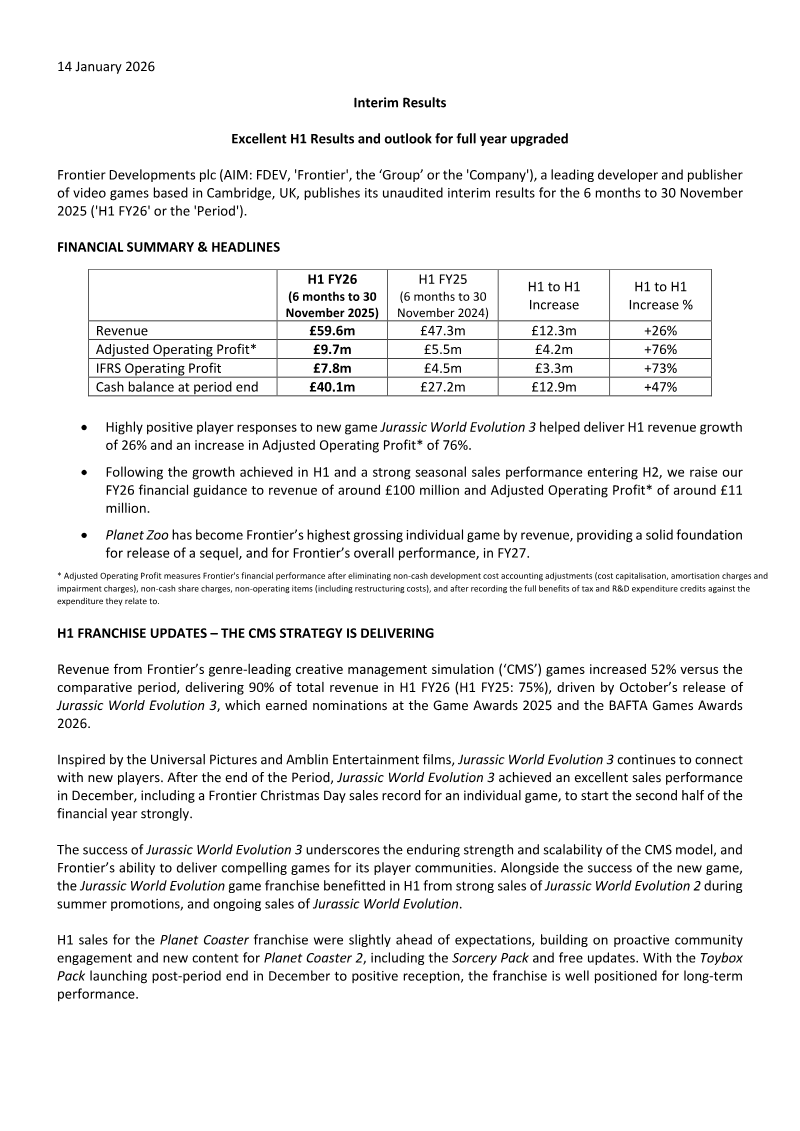
Frontier Developments plc reported unaudited interim results for the six months to 30 November 2025, showing a 26 % increase in revenue to £59.6 million and a 76 % rise in adjusted operating profit to £9.7 million compared with the same period in 2024. The growth was driven primarily by the launch of Jurassic World Evolution 3, which contributed 90 % of total revenue in H1 FY26 and earned nominations at the Game Awards 2025 and BAFTA Games Awards 2026. Other titles such as Planet Zoo, Planet Coaster 2 and Elite Dangerous also performed strongly, with Planet Zoo becoming the Group’s highest‑grossing individual game.
Cash profitability improved markedly; adjusted operating profit, which excludes non‑cash development capitalisation and includes tax and R&D credits, grew to £9.7 million from £5.5 million year‑on‑year. IFRS operating profit rose 73 % to £7.8 million. Gross margin fell to 64 % from 70 %, reflecting higher royalty‑bearing IP revenue. The Group’s cash balance increased to £40.1 million, up 47 % from the prior year, after a £10 million share buy‑back that raised earnings per share to 21.4 p.
The Board upgraded FY26 guidance, now targeting revenue of approximately £100 million and adjusted operating profit of around £11 million, citing strong seasonal sales momentum. CEO Jonny Watts stepped down on 1 January 2026, succeeded by Jo Cooke, with Watts remaining as Executive Director until 31 May 2026 to ensure a smooth transition. The Group remains debt‑free, with no significant liabilities beyond lease obligations, and maintains a robust pipeline of CMS titles slated for release in FY27–FY28.
- Frontier Developments reported a 26% revenue increase to £59.6 million and a 76% rise in adjusted operating profit to £9.7 million for H1 FY26, driven primarily by the launch of Jurassic World Evolution 3.
- Jurassic World Evolution 3 accounted for 90% of total revenue in H1 FY26, while Planet Zoo became the company's highest-grossing individual title.
- The Board upgraded full-year FY26 guidance to approximately £100 million in revenue and £11 million in adjusted operating profit, supported by strong seasonal sales momentum.
- Cash reserves grew 47% year-on-year to £40.1 million, even after executing a £10 million share buy-back that increased earnings per share to 21.4p.
- Gross margin declined from 70% to 64% due to a higher proportion of revenue generated from royalty-bearing intellectual property.
+4
Frontier Developments