Report1 pages
Zawiadomienie w trybie art. 19 ust. 1 rozporządzenia MAR: RB 22/2024
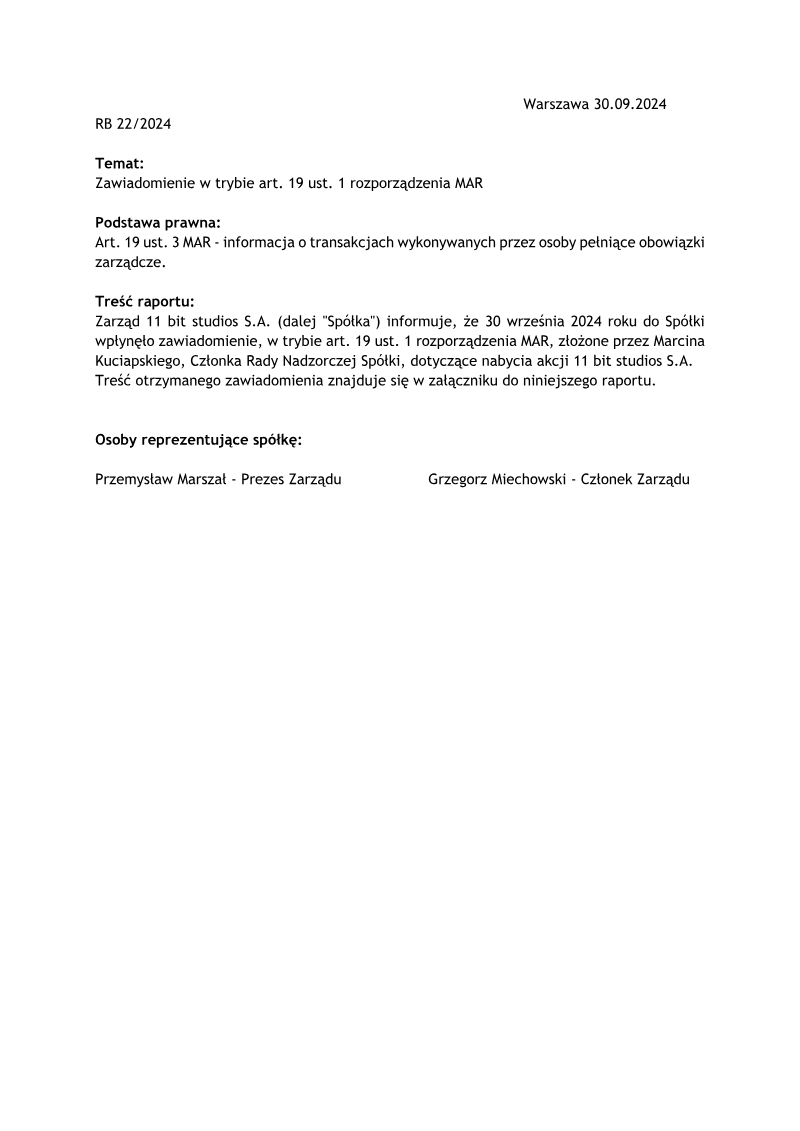
The notice, filed under Article 19(1) of the MAR regulation, reports that on 30 September 2024 a supervisory board member, Marcin Kuciapski, submitted information to 11 bit studios S.A. regarding the acquisition of shares in the company. The notification is attached to the report, and the board confirms receipt of the filing. 11 bit studios S.A.’s management, led by President Przemysław Marszał and board member Grzegorz Miechowski, acknowledges the submission. The communication serves to inform shareholders and regulators of a transaction involving an insider, in compliance with MAR’s disclosure requirements for transactions by persons exercising managerial duties. No further details on the transaction size, price, or number of shares are provided in the excerpt; only that the notice was received and recorded. The scope is limited to a single transaction by a supervisory board member within the Polish jurisdiction, covering the period up to 30 September 2024. The methodology is straightforward: a formal MAR‑19 notification filed by the insider, with the company’s board acknowledging receipt. The report fulfills regulatory obligations without offering additional analytical commentary or market impact assessment.
- Marcin Kuciapski, a member of the supervisory board at 11 bit studios S.A., acquired company shares on 30 September 2024.
- The transaction was formally disclosed to 11 bit studios S.A. in compliance with Article 19(1) of the Market Abuse Regulation (MAR).
- The company's management, including President Przemysław Marszał and board member Grzegorz Miechowski, officially acknowledged receipt of the insider transaction notice.
- The notification serves as a mandatory regulatory filing for persons exercising managerial duties within the Polish jurisdiction.
- The provided disclosure does not specify the volume, price, or total number of shares involved in the acquisition.
11 bit studios
Report1 pages
Zmiana udziału w ogólnej liczbie głosów 11 bit studios S.A.: Zmniejszenie stanu posiadania
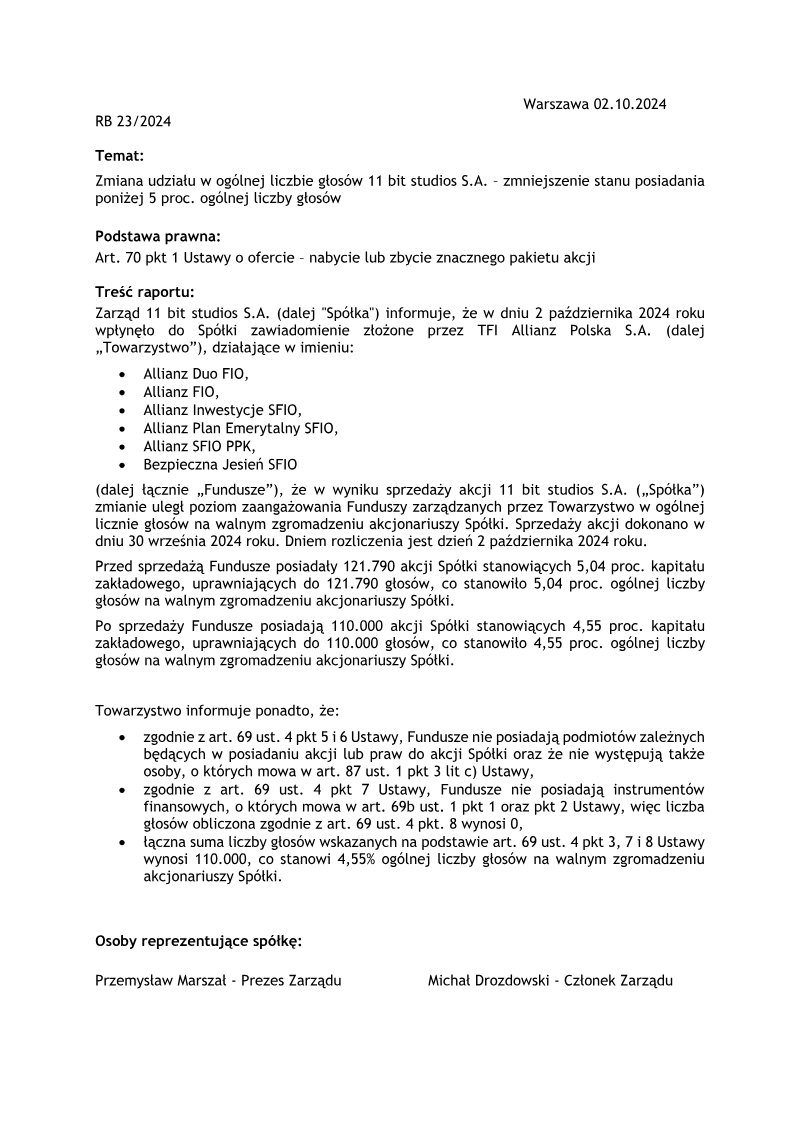
The notice, dated 2 October 2024, informs shareholders that TFI Allianz Polska S.A., acting on behalf of several Allianz‑managed funds, has reduced its stake in 11 bit studios S.A. through a sale of shares executed on 30 September 2024. Prior to the transaction, the funds held 121 790 shares, representing 5.04 % of the company’s share capital and an equal proportion of voting rights at the shareholders’ meeting. After the sale, their holding decreased to 110 000 shares, amounting to 4.55 % of the share capital and voting power.
The filing confirms compliance with Polish securities law, noting that the funds possess no affiliated entities holding shares in 11 bit studios and hold no restricted financial instruments that would affect voting calculations. Consequently, the total number of votes attributable to the funds is 110 000, corresponding precisely to 4.55 % of all votes at the meeting.
The announcement is issued by the board of 11 bit studios, with Przemysław Marszał as Chairman and Michał Drozdowski as board member. The communication serves to satisfy regulatory disclosure requirements under Article 70(1) of the Polish Offer Act, ensuring transparency regarding significant shareholdings that fall below the 5 % threshold following the sale.
- TFI Allianz Polska S.A. reduced its stake in 11 bit studios S.A. to 4.55% following a share sale executed on 30 September 2024.
- The transaction involved the sale of 11,790 shares, decreasing the funds' total holding from 121,790 to 110,000 shares.
- The reduction in shareholding caused the funds' voting power in 11 bit studios S.A. to drop from 5.04% to 4.55%.
- The funds currently hold no affiliated entities with shares in the company and possess no restricted financial instruments that would impact voting rights.
- The disclosure was issued to comply with Article 70(1) of the Polish Offer Act, as the stake fell below the 5% reporting threshold.
11 bit studios
Report1 pages
Current Report No. 24/2024: Analysis of the Situation on One of the Game Projects
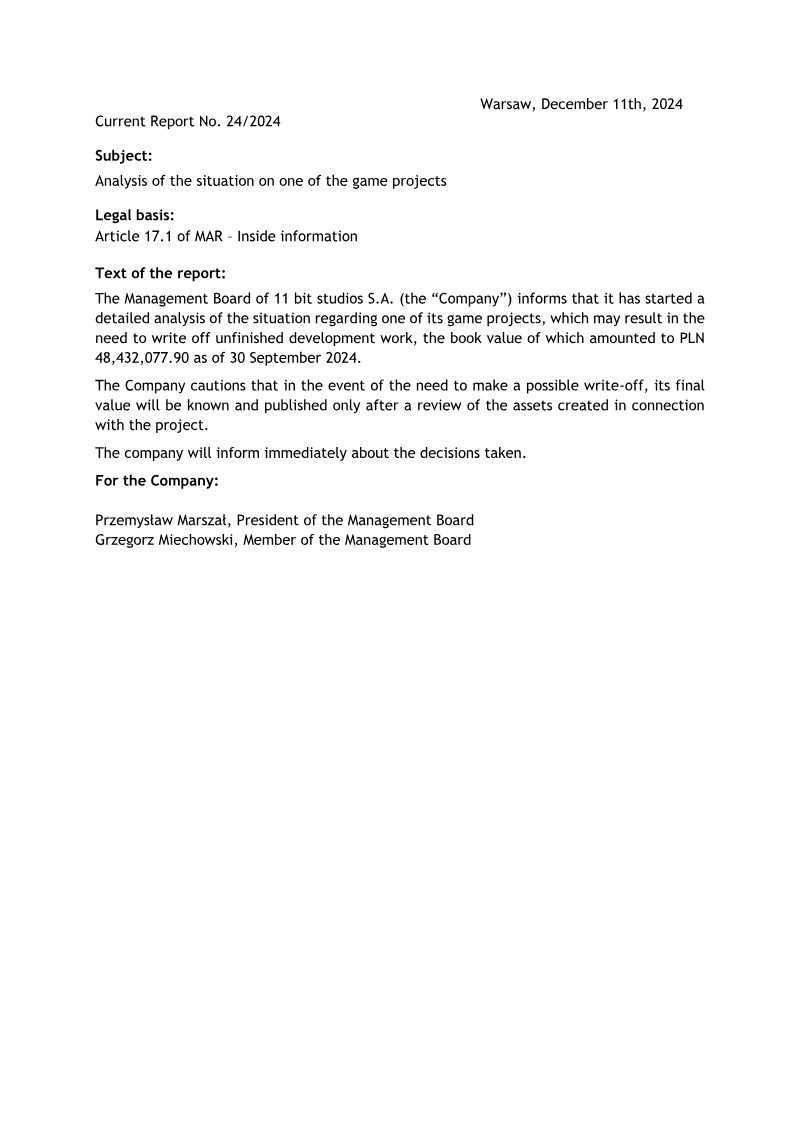
The report announces that the Management Board of 11 bit studios S.A. has initiated a comprehensive assessment of one of its game development projects, which may ultimately require the write‑off of unfinished work. The project’s current book value stands at PLN 48,432,077.90 as of 30 September 2024. The Board cautions that the final write‑off amount will be determined only after a detailed review of all assets associated with the project, and that any decision will be communicated promptly. The notice is issued under Article 17.1 of the MAR – Inside information regulation, indicating that the information is material and must be disclosed to market participants. The scope of the analysis covers a single internal project within the company’s portfolio, with no geographic or sectoral expansion beyond the studio’s existing operations. No specific methodology is disclosed beyond a “detailed analysis” of project assets, and no survey or external data sources are referenced. The communication is signed by Przemysław Marszał, President of the Management Board, and Grzegorz Miechowski, a board member, underscoring executive responsibility for the forthcoming decision.
- 11 bit studios S.A. is conducting a comprehensive assessment of an internal game project that may result in a significant write-off of unfinished work.
- The project in question carries a book value of PLN 48,432,077.90 as of September 30, 2024.
- The final amount of the potential write-off remains undetermined and is subject to a detailed review of all associated project assets.
- This disclosure was issued under Article 17.1 of the MAR regulation, confirming the information is considered material for market participants.
- The assessment is limited to a single internal project and does not involve any broader geographic or sectoral changes to the studio's operations.
11 bit studios
Report1 pages
RB 25/2024: Zamknięcie Projektu 8
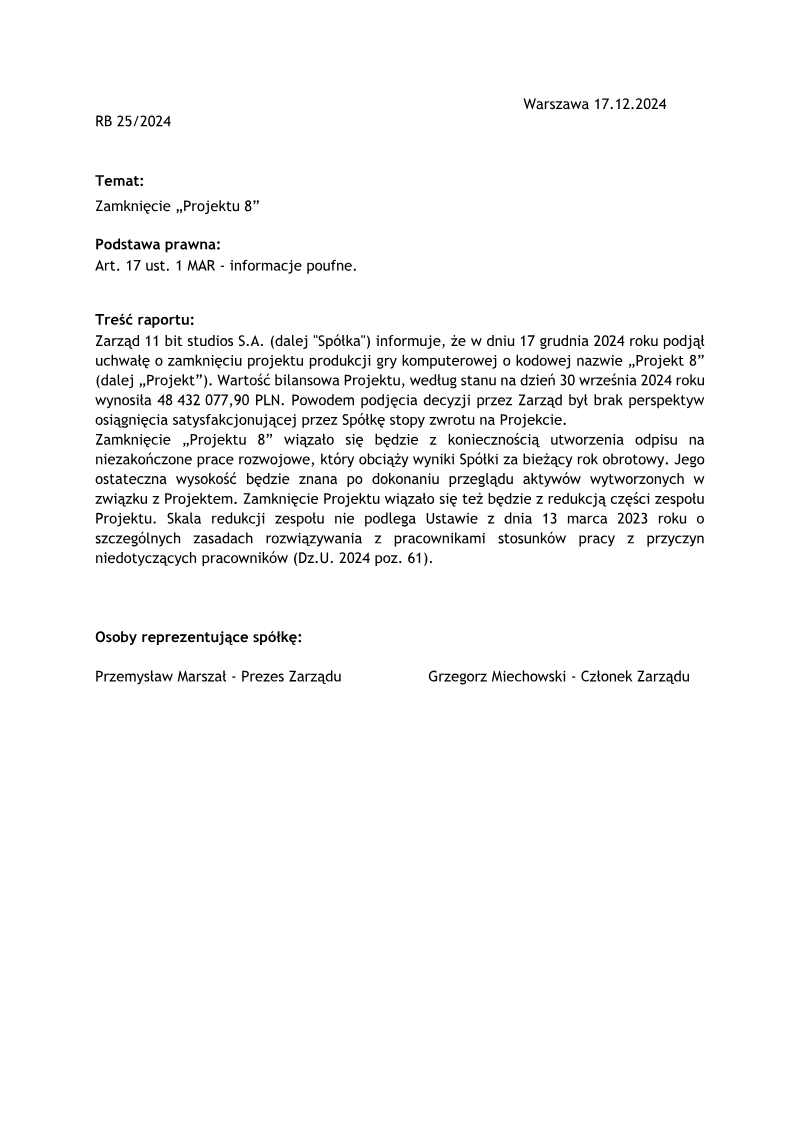
The executive board of 11 bit studios S.A. announced on 17 December 2024 the termination of its internal game‑development venture, code‑named “Projekt 8.” The decision follows an assessment that the project lacks viable prospects for delivering a satisfactory return on investment. As of 30 September 2024, the project’s book value stood at PLN 48,432,077.90; closing it will necessitate a write‑down of unfinished development work, which will impact the company’s financial results for the current fiscal year. The precise amount of the write‑down will be determined after a comprehensive review of assets generated during the project’s lifecycle.
The shutdown also triggers workforce reductions within the Projekt 8 team, though the scale of these layoffs is not governed by the 2023 Act on Special Rules for Terminating Employment Contracts. The board’s resolution reflects a strategic shift away from projects that no longer align with the company’s profitability targets. The announcement was made by President Przemysław Marszał and Board Member Grzegorz Miechowski, underscoring the board’s commitment to fiscal discipline and resource reallocation. The communication serves as a formal disclosure of the project’s closure, its financial implications, and the associated human‑resource adjustments.
- 11 bit studios S.A. officially terminated its internal game development venture, 'Projekt 8,' on 17 December 2024 due to insufficient return on investment prospects.
- The project carried a book value of PLN 48,432,077.90 as of 30 September 2024, which will now be subject to a write-down of unfinished development work.
- The write-down of Projekt 8 assets will negatively impact the company’s financial results for the 2024 fiscal year, with the final amount pending a comprehensive asset review.
- The cancellation of the project has triggered workforce reductions within the Projekt 8 team.
- The layoffs associated with the project closure are not subject to the 2023 Act on Special Rules for Terminating Employment Contracts.
11 bit studios
Report1 pages
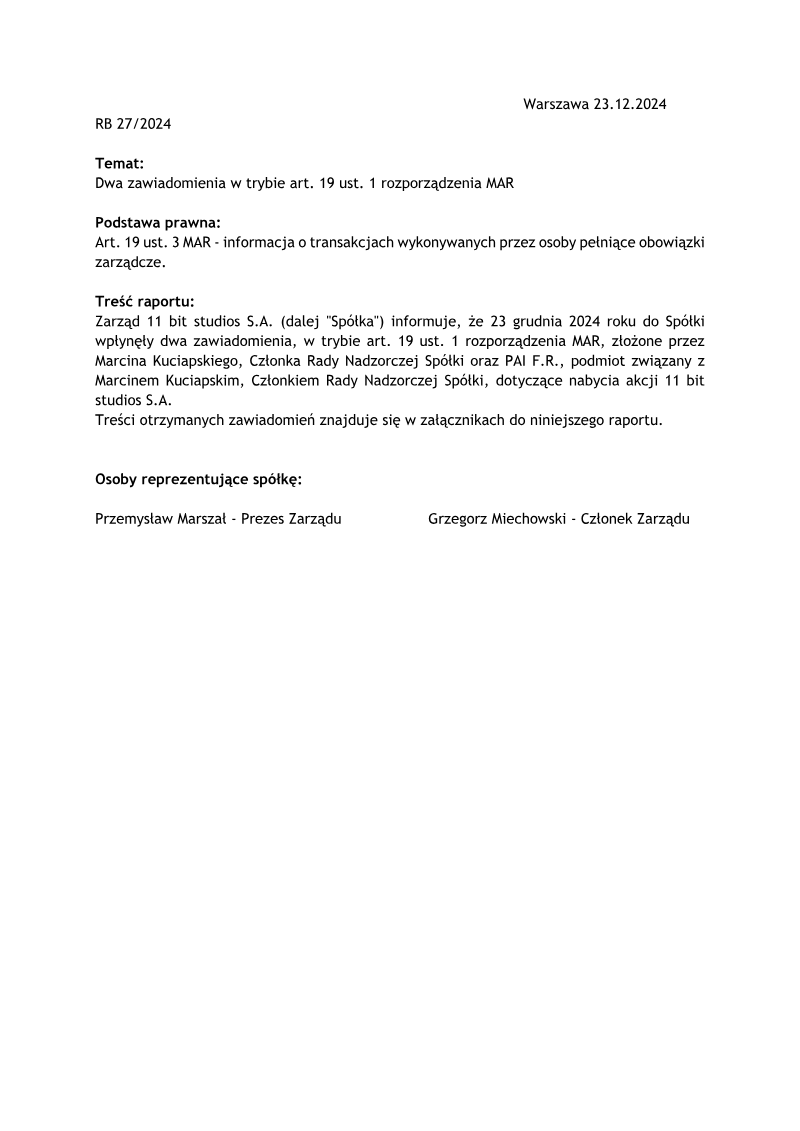
RB 27/2024: Notification of Transactions by Persons Discharging Managerial Responsibilities
The notification, dated 23 December 2024, informs shareholders that two disclosures were received under Article 19(1) of the Market Abuse Regulation (MAR). Both notifications were submitted by Marcin Kuciapski, a member of the supervisory board, and PAI F.R., an entity linked to Kuciapski. The disclosures concern the acquisition of shares in 11 bit studios S.A., the company reporting the notifications. The report confirms receipt of these filings and indicates that their contents are attached to the notification.
The purpose of the communication is to comply with MAR’s requirement that individuals exercising managerial responsibilities disclose transactions involving the company’s securities. The report identifies the relevant parties: Przemysław Marszał, CEO of the board, and Grzegorz Miechowski, a board member. No additional data on transaction amounts, dates of purchase, or share quantities are provided in the text; such details are presumably contained within the attached documents.
The scope is limited to a single Polish entity, 11 bit studios S.A., and pertains specifically to transactions reported on the date of notification. The methodology is straightforward regulatory reporting, with no survey or statistical analysis involved. The communication serves to inform stakeholders of compliance with MAR and to maintain transparency regarding insider trading activities within the company.
- 11 bit studios S.A. received formal notifications on 23 December 2024 regarding share acquisitions by company insiders.
- The transactions were disclosed by Marcin Kuciapski, a member of the supervisory board, and PAI F.R., an entity linked to him.
- The regulatory filings were submitted in compliance with Article 19(1) of the Market Abuse Regulation (MAR) regarding transactions by persons discharging managerial responsibilities.
- The report identifies CEO Przemysław Marszał and board member Grzegorz Miechowski as key individuals associated with the disclosure requirements.
- While the notification confirms the receipt of transaction filings for 11 bit studios S.A., the specific share quantities and purchase dates are contained only in the attached supplementary documents.
11 bit studios
Report1 pages
Release Dates for Periodic Reports: 2025
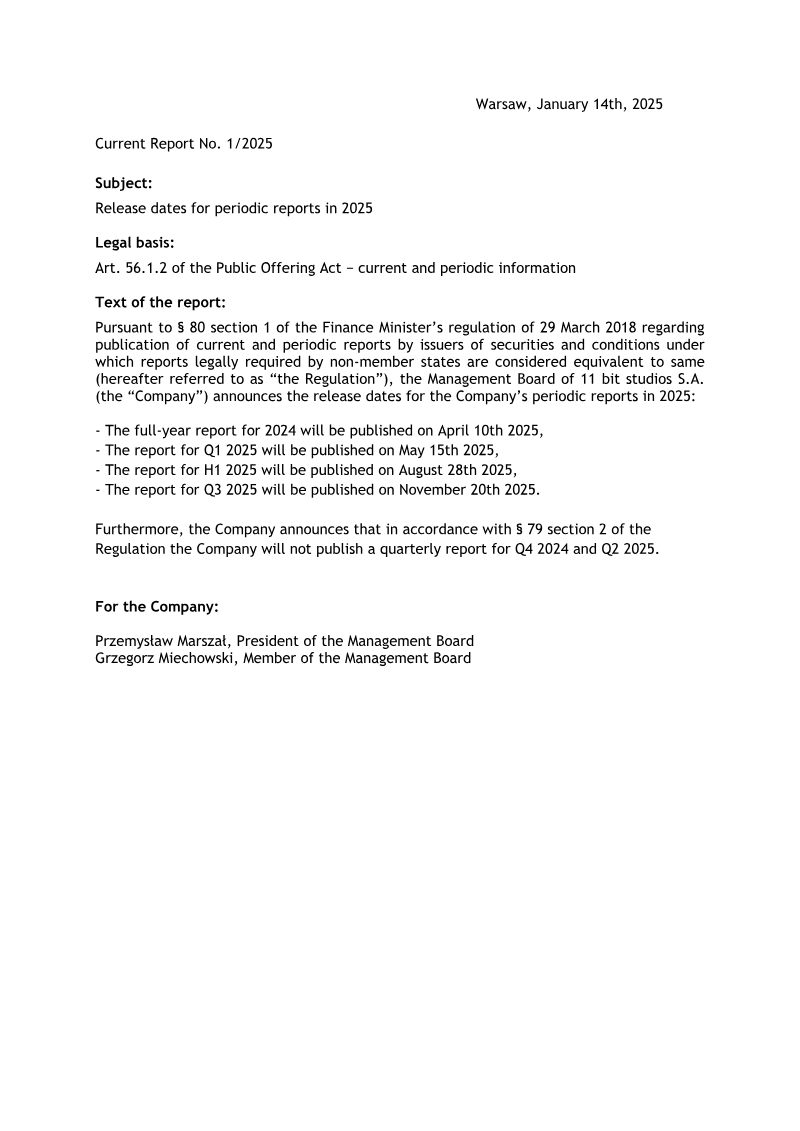
The announcement from Warsaw, dated January 14 2025, outlines the 11 bit studios S.A. schedule for releasing its periodic financial reports in 2025, pursuant to the Finance Minister’s regulation of March 2018 and Article 56.1.2 of the Public Offering Act. The company will publish its full‑year report for 2024 on April 10 2025, followed by quarterly and semiannual reports: Q1 2025 on May 15 2025, H1 2025 on August 28 2025, and Q3 2025 on November 20 2025. In line with § 79(2) of the Regulation, no reports will be issued for Q4 2024 or Q2 2025. The release dates are set by the Management Board, chaired by President Przemysław Marszał and Member Grzegorz Miechowski. The communication serves to inform shareholders, regulators, and market participants of the company’s compliance timetable for statutory disclosures within Poland’s public offering framework. No additional data, statistics, or methodological details are provided beyond the scheduled dates and regulatory references.
- 11 bit studios S.A. will release its 2024 full-year financial report on April 10, 2025.
- The 2025 quarterly and semiannual reporting schedule is set for May 15 (Q1), August 28 (H1), and November 20 (Q3).
- In accordance with regulatory requirements, the company will not issue separate reports for Q4 2024 or Q2 2025.
- The disclosure schedule is mandated by the Polish Finance Minister’s regulation of March 2018 and Article 56.1.2 of the Public Offering Act.
- The reporting calendar was formally established by the company's Management Board, led by President Przemysław Marszał and Member Grzegorz Miechowski.
+1
11 bit studios
Report1 pages
Publishing Agreement Signed with The Outer Zone
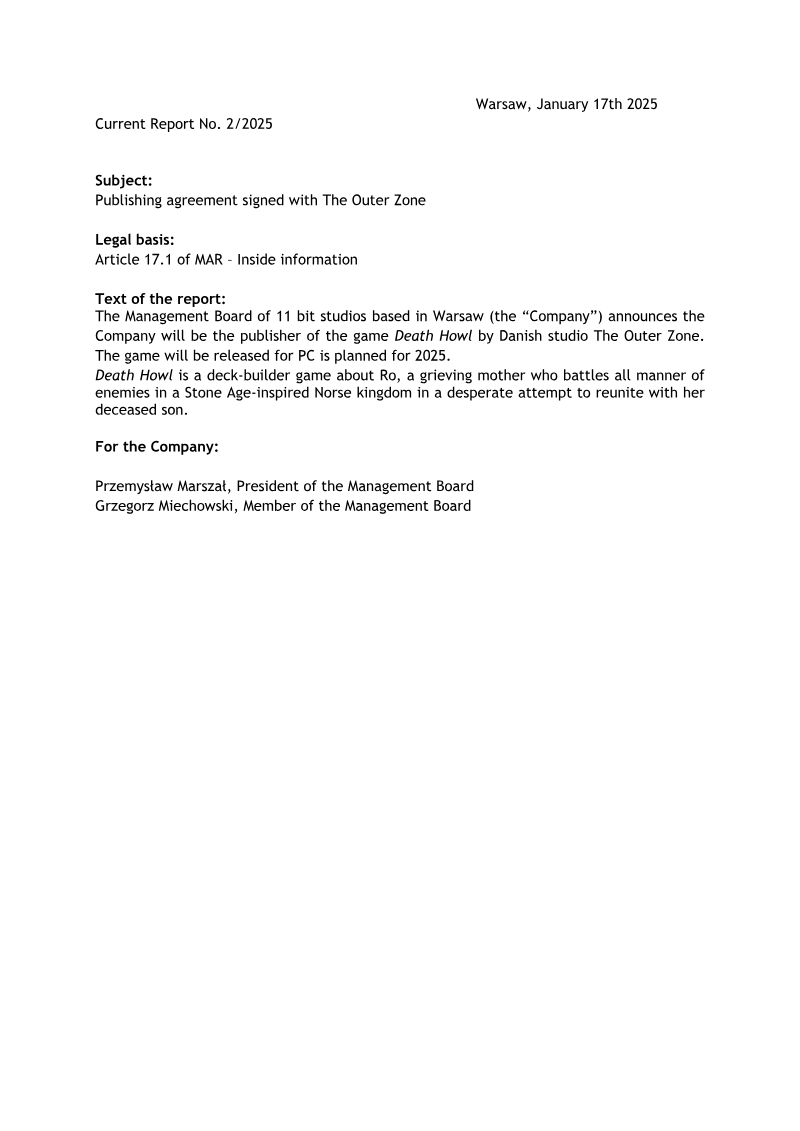
The announcement confirms that 11 bit studios will publish the upcoming deck‑builder title “Death Howl,” developed by Danish studio The Outer Zone. The game centers on Ro, a grieving mother who confronts enemies in a Stone Age‑inspired Norse kingdom to reunite with her deceased son. The release is scheduled for 2025 on PC platforms.
This publishing partnership expands 11 bit studios’ portfolio into the narrative‑driven deck‑builder genre, complementing its existing action and adventure titles. The collaboration leverages The Outer Zone’s creative vision while providing 11 bit studios with a new IP that aligns with its focus on immersive storytelling and unique gameplay mechanics.
The announcement is issued by the Management Board of 11 bit studios, with Przemysław Marszał and Grzegorz Miechowski listed as the President and a Board member, respectively. The release date and platform details are specified, but no further financial terms or distribution arrangements are disclosed.
Geographically, the agreement targets the global PC market, with no regional restrictions noted. The time frame is limited to a 2025 launch window, indicating an upcoming development cycle that will likely involve marketing and localization efforts in the months leading up to release.
Overall, the report serves as a formal disclosure of a new publishing contract, highlighting 11 bit studios’ strategic move to broaden its genre offerings and strengthen ties with international developers.
- 11 bit studios has signed a publishing agreement for the upcoming deck-builder title 'Death Howl,' developed by the Danish studio The Outer Zone.
- The game is scheduled for a global release on PC platforms in 2025.
- The title features a narrative-driven premise centered on a mother navigating a Stone Age-inspired Norse kingdom.
- This partnership marks a strategic expansion for 11 bit studios into the narrative-driven deck-builder genre.
- The agreement leverages 11 bit studios' focus on immersive storytelling while adding a new IP to its existing portfolio of action and adventure titles.
+1
11 bit studios
Report1 pages
Current Report No. 4/2025: Change in Depreciation Method for Frostpunk 2
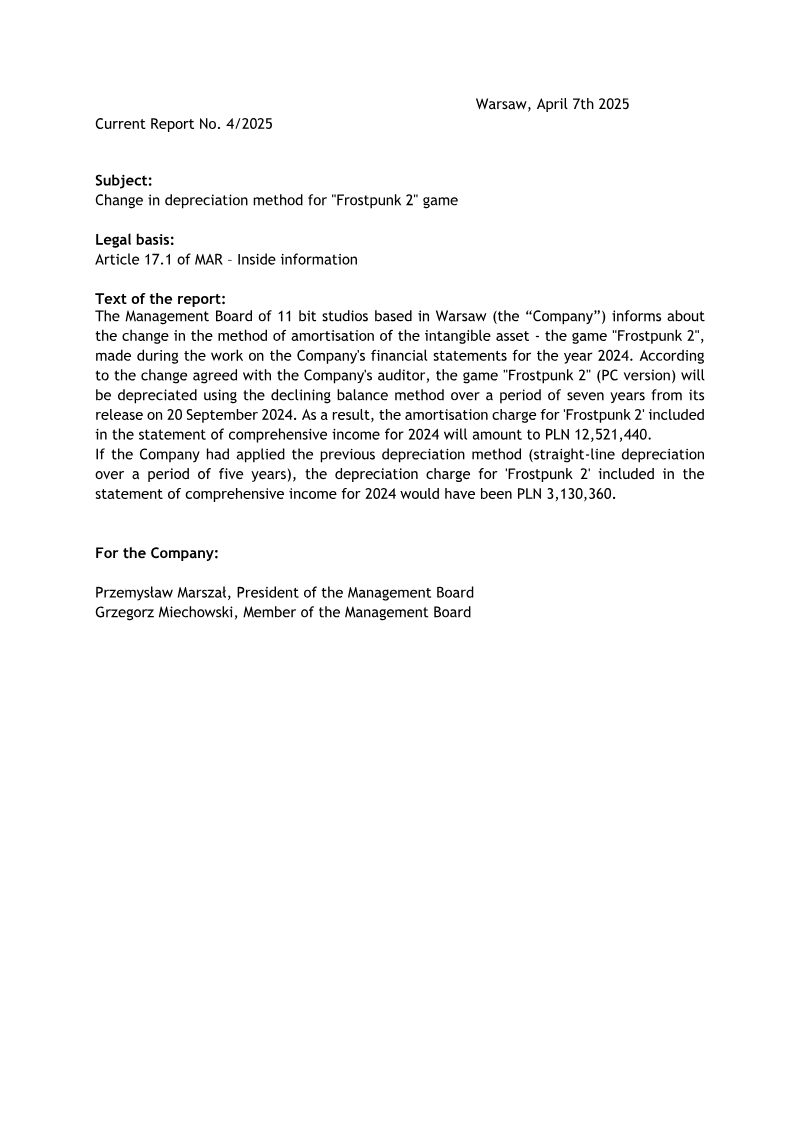
The report announces a change in the depreciation method applied to the intangible asset “Frostpunk 2” by 11 bit studios. The company’s Management Board, following an agreement with its auditor, has decided to switch from a straight‑line depreciation over five years to a declining balance method spanning seven years, effective from the game’s release on 20 September 2024. This adjustment was made during the preparation of the 2024 financial statements.
Under the new method, the amortisation expense recorded in the 2024 statement of comprehensive income is PLN 12,521,440. Had the previous straight‑line approach been retained, the expense would have been PLN 3,130,360. The change therefore increases the annual depreciation charge by approximately PLN 9.4 million, reflecting a more accelerated recognition of the asset’s consumption.
The scope of the adjustment is limited to the PC version of “Frostpunk 2” and pertains solely to the 2024 financial period. No other assets or segments are affected, and the report does not provide additional data on broader industry trends or comparative benchmarks. The methodology is straightforward: a recalculation of depreciation based on the agreed accounting policy, with no mention of external data sources or survey samples. The notice serves to inform stakeholders of the revised accounting treatment and its impact on reported earnings for the year.
- 11 bit studios has transitioned the depreciation method for the intangible asset 'Frostpunk 2' from a five-year straight-line model to a seven-year declining balance method.
- The accounting change, effective from the game's 20 September 2024 release, resulted in a 2024 amortization expense of PLN 12,521,440.
- The new method increased the 2024 depreciation charge by approximately PLN 9.4 million compared to the PLN 3,130,360 that would have been recorded under the previous straight-line approach.
- The revised accounting treatment reflects an accelerated recognition of the asset's consumption for the 2024 financial period.
- This adjustment is strictly limited to the PC version of 'Frostpunk 2' and does not impact any other company assets or business segments.
+1
11 bit studios
Report1 pages
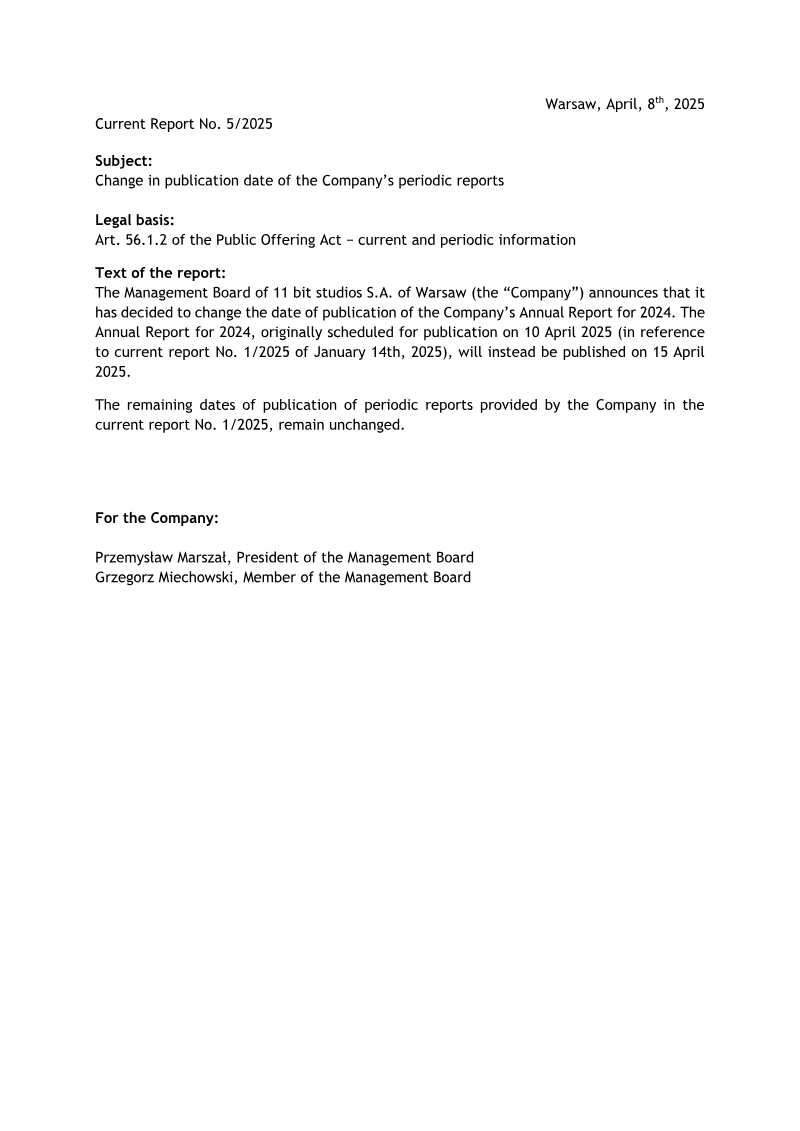
Current Report No. 5/2025: Change in Publication Date of Periodic Reports
The announcement from the Management Board of 11 bit studios S.A. confirms a modification to the release schedule for its annual financial disclosures. Specifically, the Annual Report covering fiscal year 2024 will now be issued on April 15, 2025, rather than the originally planned April 10, 2025. This adjustment is made under Article 56.1.2 of the Public Offering Act, which governs current and periodic information obligations for listed companies.
All other publication dates for the Company’s periodic reports, as outlined in the earlier Current Report No. 1/2025 dated January 14, 2025, remain unchanged. The change applies solely to the 2024 Annual Report and does not affect quarterly or other interim statements.
The notice is signed by Przemysław Marszał, President of the Management Board, and Grzegorz Miechowski, a board member, indicating executive approval. No additional data or statistical details are provided in the communication; it serves purely as a procedural update to inform shareholders and market participants of the revised release timetable.
- 11 bit studios S.A. has rescheduled the release of its 2024 Annual Report from April 10, 2025, to April 15, 2025.
- The modification is a procedural update executed under Article 56.1.2 of the Public Offering Act regarding periodic information obligations.
- All other periodic report publication dates previously announced on January 14, 2025, remain unchanged.
- The adjustment applies exclusively to the 2024 Annual Report and does not impact the company's quarterly or interim financial statements.
- The change was formally approved and signed by President Przemysław Marszał and board member Grzegorz Miechowski.
11 bit studios
Report1 pages
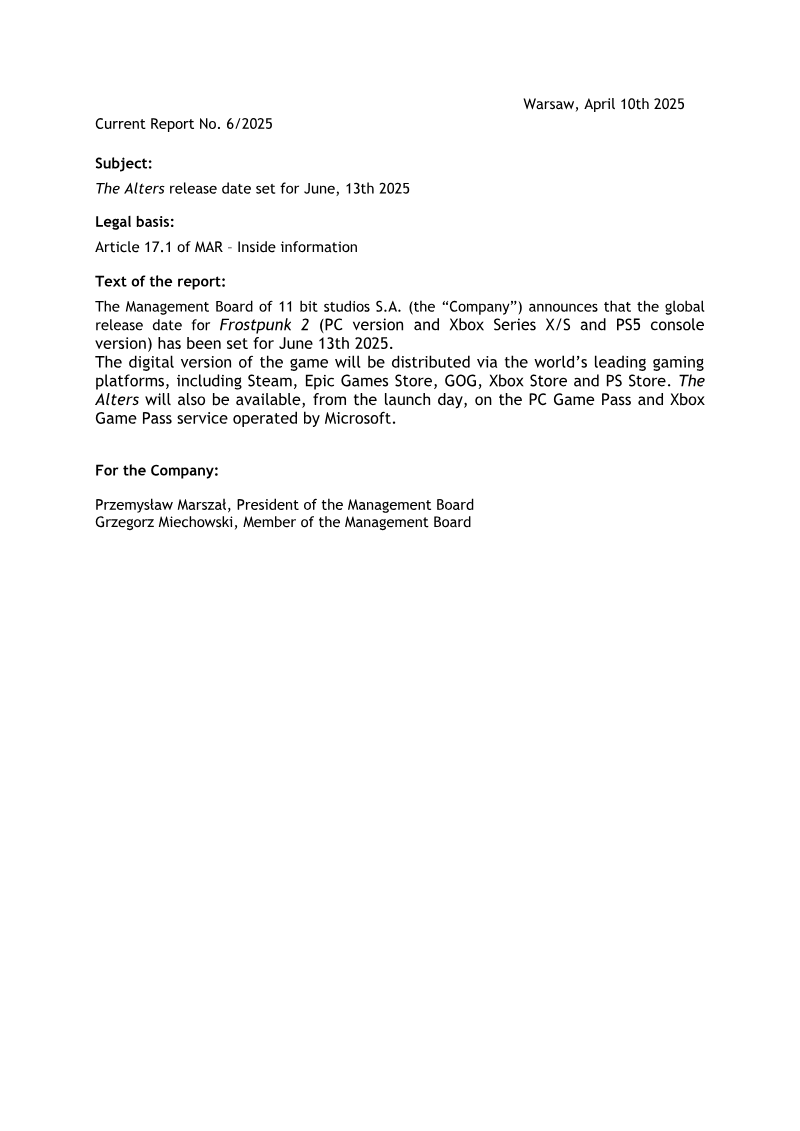
Current Report No. 6/2025: The Alters Release Date
The release of Frostpunk 2, the highly anticipated sequel to the critically acclaimed survival‑city builder, has been officially scheduled for June 13 2025. The announcement comes from the Management Board of 11 bit studios S.A., a Warsaw‑based developer known for its narrative‑driven titles. The global launch will encompass the PC edition and next‑generation console versions for Xbox Series X/S and PlayStation 5, ensuring simultaneous availability across major platforms.
Digital distribution will be handled by the industry’s leading storefronts: Steam, Epic Games Store, GOG, Xbox Store and PlayStation Store. In addition, the game will be added to Microsoft’s subscription services—PC Game Pass and Xbox Game Pass—from day one, broadening accessibility for subscribers. The release date was disclosed under Article 17.1 of the Market Abuse Regulation, classifying it as inside information that must be communicated promptly to avoid market manipulation.
The announcement is concise, focusing solely on the release logistics and distribution channels. No sales projections, marketing strategies, or financial implications are provided in this communication. The scope is strictly global, covering all major digital marketplaces and subscription services at launch. Methodologically, the information originates from an official board statement, with no external data or survey references included.
- 11 bit studios has scheduled the global release of Frostpunk 2 for June 13, 2025.
- The game will launch simultaneously on PC, Xbox Series X/S, and PlayStation 5.
- Frostpunk 2 will be available on day one through PC Game Pass and Xbox Game Pass subscription services.
- Digital distribution will be supported across Steam, Epic Games Store, GOG, the Xbox Store, and the PlayStation Store.
- The release date announcement was issued by the 11 bit studios Management Board as regulated inside information.
+2
11 bit studios
Report1 pages
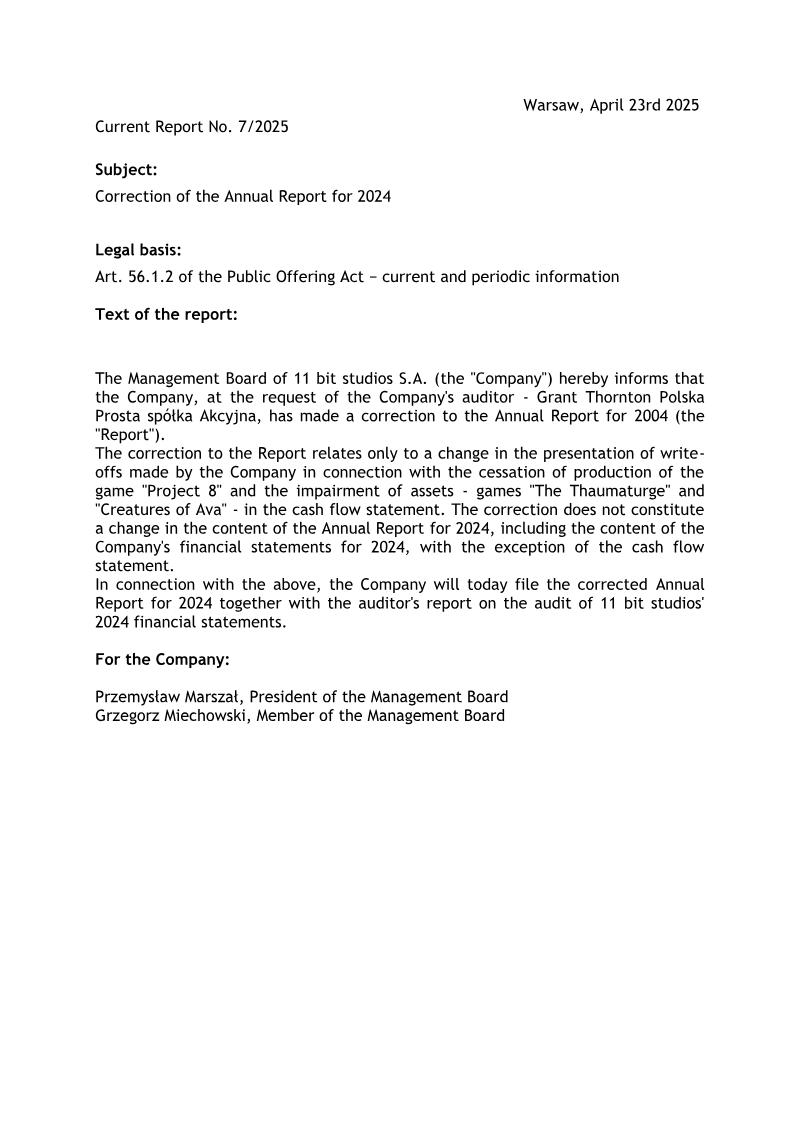
Correction of the Annual Report for 2024
The notice issued by the Management Board of 11 bit studios S.A. announces a correction to its 2024 Annual Report, filed on April 23 2025 in Warsaw. The amendment concerns only the presentation of write‑offs related to the discontinued game “Project 8” and the impairment of assets for “The Thaumaturge” and “Creatures of Ava” within the cash‑flow statement. No other financial figures or statements are affected, and the correction does not alter the overall content of the 2024 Annual Report. The company has acted at the request of its auditor, Grant Thornton Polska Prosta spółka akcyjna, and will submit the revised report along with the auditor’s opinion on the 2024 financial statements. The correction is governed by Article 56.1.2 of the Public Offering Act, which mandates current and periodic disclosure. The communication is signed by Przemysław Marszał, President of the Management Board, and Grzegorz Miechowski, a board member. The notice serves to maintain transparency for shareholders and regulators by ensuring that the cash‑flow presentation accurately reflects asset write‑offs, while confirming that all other financial data for 2024 remain unchanged.
- 11 bit studios S.A. has issued a correction to its 2024 Annual Report, originally filed on April 23, 2025.
- The amendment exclusively updates the presentation of write-offs and asset impairments within the cash-flow statement.
- Affected titles include the discontinued 'Project 8' and asset impairments for 'The Thaumaturge' and 'Creatures of Ava'.
- The company confirmed that no other financial figures or statements from the 2024 Annual Report have been altered.
- The correction was initiated at the request of the company's auditor, Grant Thornton Polska Prosta spółka akcyjna.
11 bit studios
Report3 pages
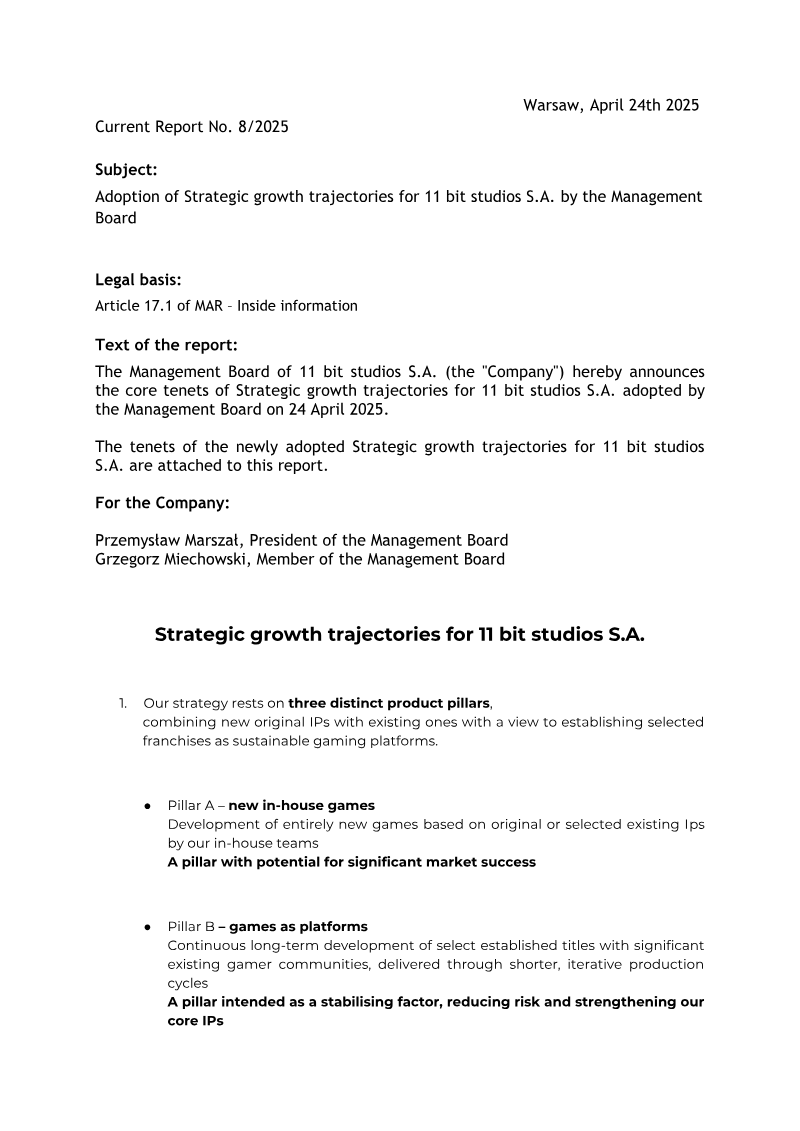
Strategic Growth Trajectories: 11 bit studios
The announcement outlines 11 bit studios’ strategic growth plan, structured around three product pillars that blend new IP development with the expansion of existing franchises and a publishing arm. Pillar A focuses on in‑house creation of original titles, aiming for high market impact; Pillar B targets long‑term evolution of established games with active communities, using shorter iterative cycles to stabilize revenue; Pillar C establishes an X‑DEV publishing division that will bring external, gameplay‑driven titles to market with budgets of USD 1–2 million per project.
The strategy shifts the studio’s creative emphasis from “meaningful games” to “relatable games,” prioritising emotional authenticity while maintaining core gameplay quality. High‑quality single‑player experiences will be the default, with selective multiplayer or social layers added where appropriate. Development teams are optimised at 30–60 developers, targeting four‑year production cycles for in‑house titles.
Organisationally, the plan stresses experienced creative leadership, disciplined budgeting, and independent decision‑making. It also commits to professional development for senior staff and the formalisation of proprietary know‑how, supporting sustainable growth.
Overall, 11 bit studios intends to launch multiple projects across all three pillars simultaneously, preserving operational efficiency and agility. The vision is to remain an independent studio that consistently delivers proprietary, relatable games with strong commercial potential, underpinned by innovative teams and a stable business model.
- 11 bit studios is pivoting its creative focus from 'meaningful games' to 'relatable games' while maintaining a core commitment to high-quality single-player experiences.
- The company’s growth strategy is built on three pillars: in-house original IP development, long-term iterative expansion of established franchises, and an external publishing division.
- The new X-DEV publishing division will focus on gameplay-driven titles with production budgets ranging from USD 1–2 million per project.
- In-house development teams are being optimized at a size of 30–60 developers to support a target production cycle of four years per title.
- The studio aims to launch multiple projects across all three strategic pillars simultaneously to maintain operational agility and revenue stability.
11 bit studios
Report1 pages
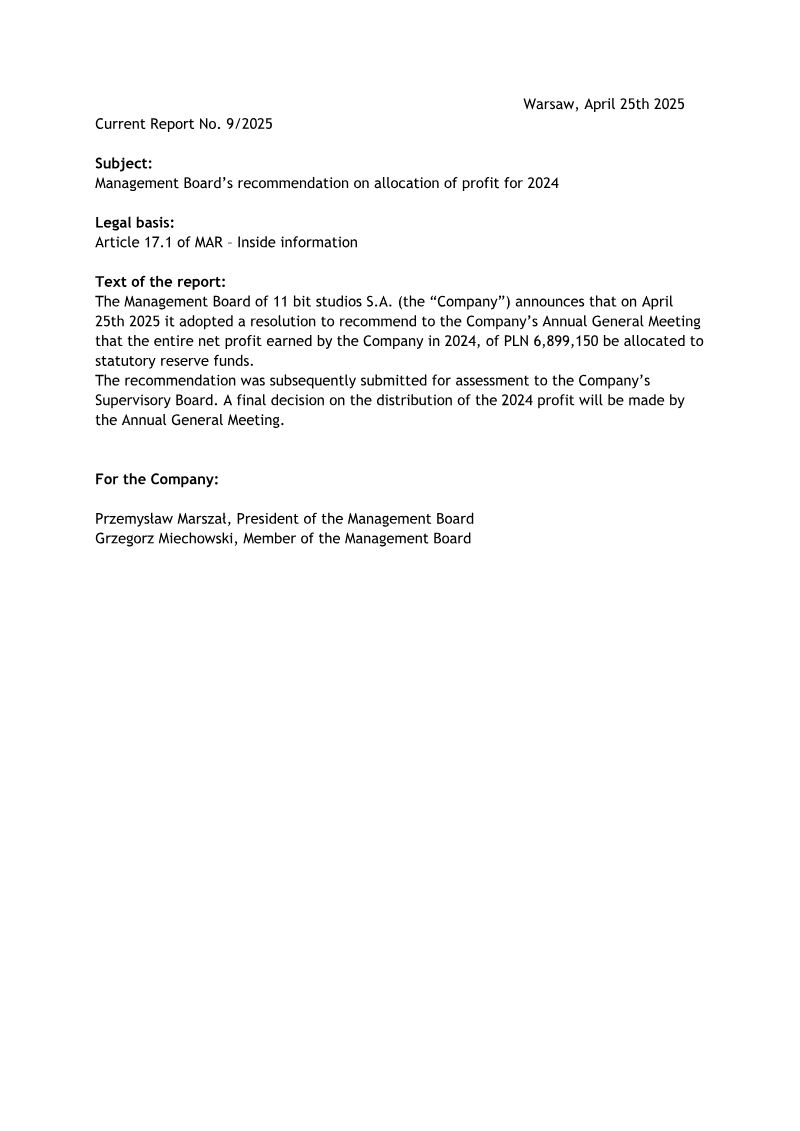
Management Board’s Recommendation on Allocation of Profit for 2024: 11 bit studios
The Management Board of 11 bit studios S.A. has resolved to allocate the entire net profit earned in 2024, amounting to PLN 6,899,150, to statutory reserve funds. This recommendation was adopted on 25 April 2025 and subsequently forwarded to the Supervisory Board for assessment. The final decision on profit distribution will be made at the forthcoming Annual General Meeting.
The recommendation reflects a conservative approach to capital preservation, ensuring that all available earnings are retained within the company’s statutory reserves rather than distributed as dividends or used for other purposes. By directing the full profit into reserve funds, the Board aims to strengthen financial stability and support future investment or risk mitigation strategies.
The decision is grounded in Article 17.1 of the Market Abuse Regulation (MAR), which governs the disclosure of inside information. The resolution is presented as part of the company’s routine annual reporting cycle, with no additional financial data or projections disclosed beyond the stated profit figure.
No further methodological details are provided, as the recommendation pertains solely to the allocation of already realized earnings. The focus remains on reinforcing the company’s balance sheet and preparing for potential future capital needs, with the final approval deferred to shareholders at the Annual General Meeting.
- The Management Board of 11 bit studios S.A. has recommended allocating the entire 2024 net profit of PLN 6,899,150 to statutory reserve funds.
- The proposal mandates that no dividends will be distributed from the 2024 earnings, with all profits retained to strengthen the company’s balance sheet.
- The board’s strategy focuses on capital preservation to support future investment opportunities and enhance risk mitigation capabilities.
- The recommendation was formally adopted by the Management Board on 25 April 2025.
- The proposal has been submitted to the Supervisory Board for assessment and awaits final approval by shareholders at the upcoming Annual General Meeting.
11 bit studios
Report1 pages
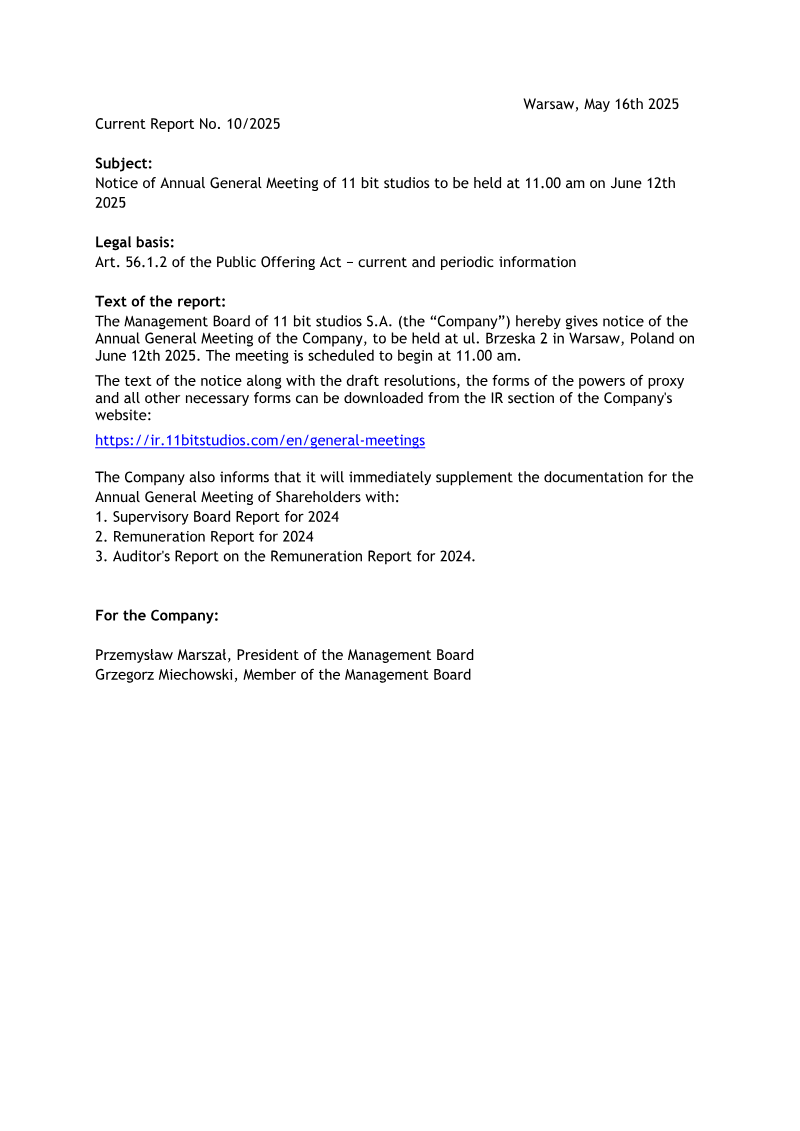
Notice of Annual General Meeting: 2025
The notice announces the Annual General Meeting of 11 bit studios S.A., scheduled for June 12, 2025 at 11:00 am in Warsaw. The meeting will be held at ul. Brzeska 2, and all related documents—including draft resolutions, proxy forms, and additional materials—are available on the company’s Investor Relations website. The Management Board informs shareholders that supplementary documentation will be provided immediately before the meeting, comprising the Supervisory Board Report for 2024, the Remuneration Report for 2024, and an Auditor’s Report on that remuneration report. The notice is issued under Article 56.1.2 of the Public Offering Act, fulfilling legal requirements for periodic disclosure to shareholders. The communication is signed by Przemysław Marszał, President of the Management Board, and Grzegorz Miechowski, a board member. The announcement serves to inform shareholders of the meeting’s date, time, location, and agenda items, ensuring compliance with regulatory disclosure obligations.
- 11 bit studios S.A. will hold its Annual General Meeting on June 12, 2025, at 11:00 am.
- The meeting will take place at ul. Brzeska 2 in Warsaw.
- Shareholders can access draft resolutions, proxy forms, and meeting materials via the company’s Investor Relations website.
- Supplementary documentation to be provided at the meeting includes the 2024 Supervisory Board Report, the 2024 Remuneration Report, and the corresponding Auditor’s Report.
- The notice is issued by President Przemysław Marszał and board member Grzegorz Miechowski to satisfy regulatory requirements under Article 56.1.2 of the Public Offering Act.
11 bit studios
Report1 pages
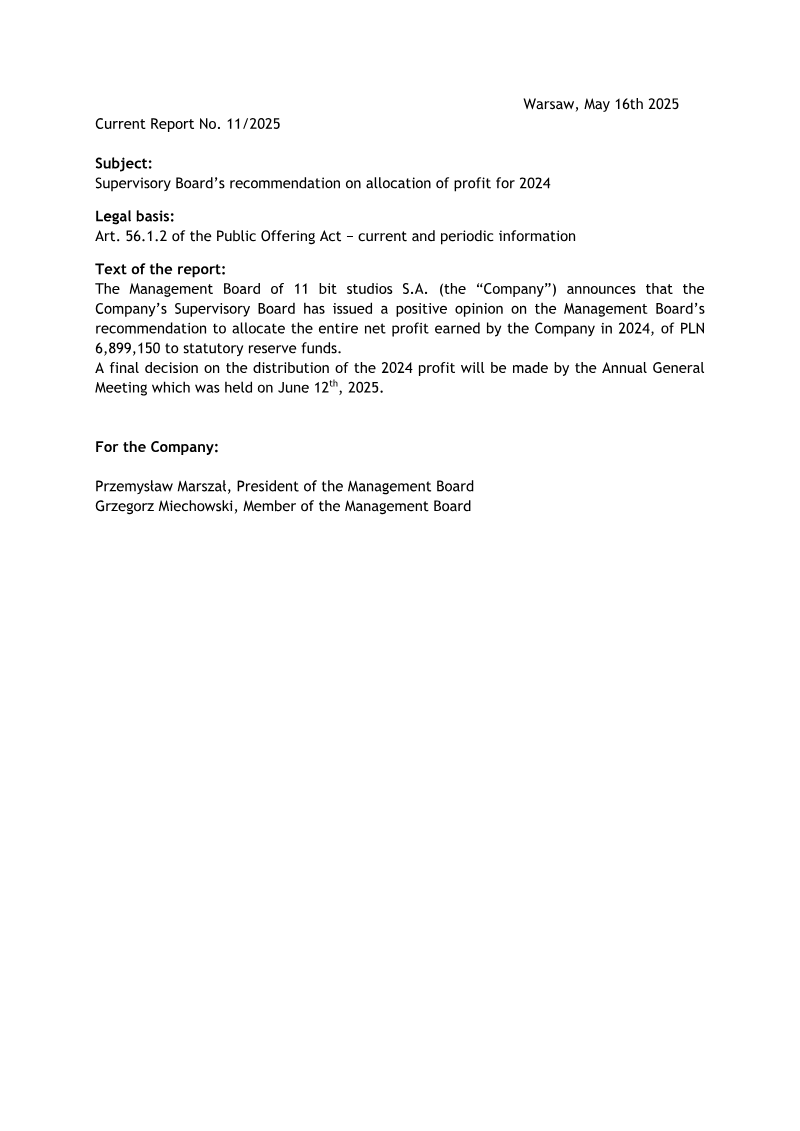
Supervisory Board’s Recommendation on Allocation of Profit for 2024: Poland
The supervisory board of 11 bit studios S.A. has endorsed the management’s proposal to allocate the entire net profit of PLN 6,899,150 earned in 2024 to statutory reserve funds. This recommendation follows the legal requirement under Article 56.1.2 of the Public Offering Act, which mandates periodic disclosure of profit allocation plans. The final decision on how the 2024 profit will be distributed rests with the annual general meeting, which convened on June 12 2025. The report is issued from Warsaw on May 16 2025 and represents the current, official stance of the supervisory board. The recommendation reflects a conservative approach to capital preservation and compliance with statutory reserve obligations, ensuring that the company’s retained earnings are fully directed toward strengthening its financial base. No further distribution to shareholders or other stakeholders is proposed at this stage, pending the AGM’s resolution. The communication underscores the board’s commitment to prudent financial governance and adherence to regulatory frameworks governing public companies in Poland.
- 11 bit studios S.A. has proposed allocating its entire 2024 net profit of PLN 6,899,150 to statutory reserve funds.
- The supervisory board’s recommendation prioritizes capital preservation and strengthening the company’s financial base over shareholder distributions.
- No dividends or other profit distributions are currently proposed for the 2024 fiscal year.
- The final decision regarding the allocation of the PLN 6,899,150 profit was subject to a vote at the annual general meeting held on June 12, 2025.
- The proposal aligns with the regulatory requirements of Article 56.1.2 of the Polish Public Offering Act regarding periodic disclosure of profit allocation plans.
11 bit studios
Report1 pages
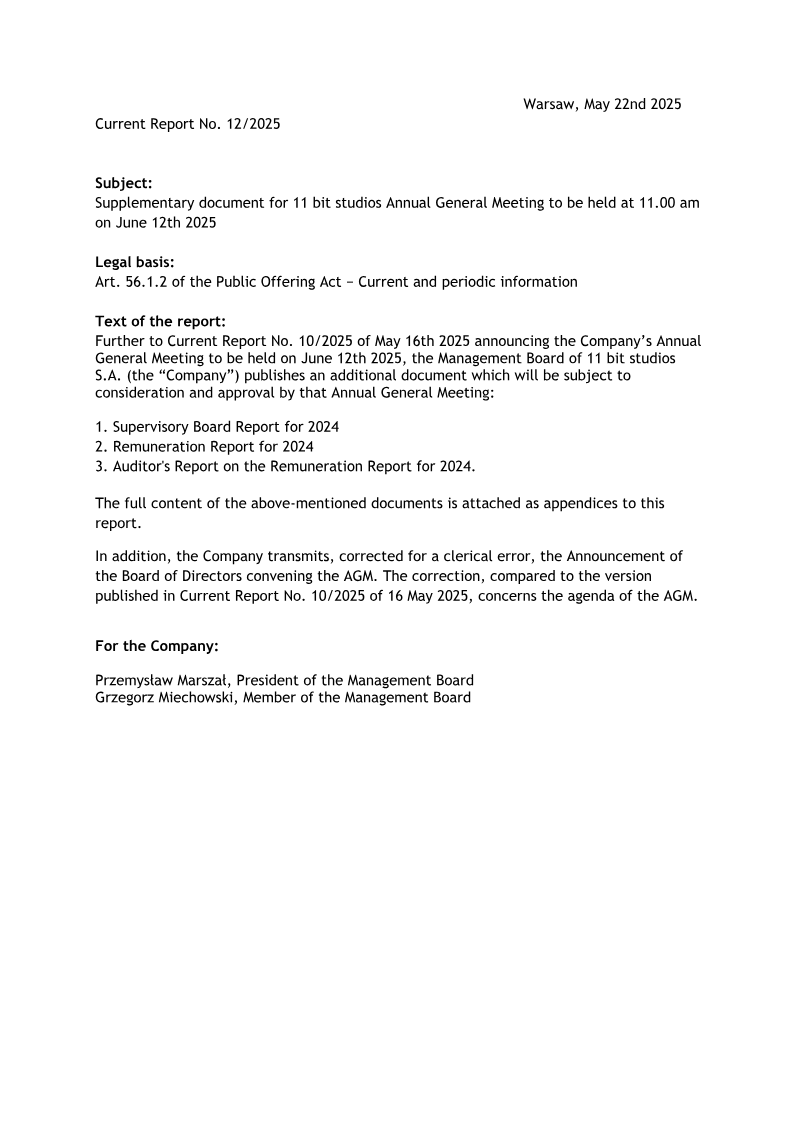
Current Report No. 12/2025: Supplementary Document for Annual General Meeting
The supplementary document, issued on May 22 2025, serves to provide additional material for the 11 bit studios Annual General Meeting scheduled for June 12 2025. It supplements an earlier notice (Current Report No. 10/2025) by attaching three key reports: the Supervisory Board Report for 2024, the Remuneration Report for 2024, and the Auditor’s Report on that remuneration report. These documents are appended in full to the current release, ensuring shareholders receive comprehensive governance and compensation information before the meeting.
The notice also corrects a clerical error from the prior announcement regarding the AGM agenda, clarifying the items to be discussed. The correction is communicated through an updated Board of Directors announcement included in this release.
The scope of the supplementary material covers the company’s 2024 financial and governance performance, with a focus on supervisory oversight and executive remuneration. No specific geographic or industry segmentation is addressed beyond the company’s operations in the video game sector.
Methodologically, the reports rely on internal audit and external auditor verification for remuneration data, while supervisory board activities are documented through standard corporate governance practices. The document concludes with signatures from the President of the Management Board, Przemysław Marszał, and a board member, Grzegorz Miechowski, underscoring the authenticity of the information provided.
- 11 bit studios will hold its Annual General Meeting on June 12, 2025.
- The supplementary document provides the 2024 Supervisory Board Report, the 2024 Remuneration Report, and the corresponding Auditor’s Report for shareholder review.
- The release serves to correct a clerical error regarding the agenda items previously announced in Current Report No. 10/2025.
- The provided materials focus on the company’s 2024 financial performance, corporate governance, and executive compensation structures.
- The document is officially authorized by President of the Management Board Przemysław Marszał and board member Grzegorz Miechowski.
11 bit studios
Report1 pages
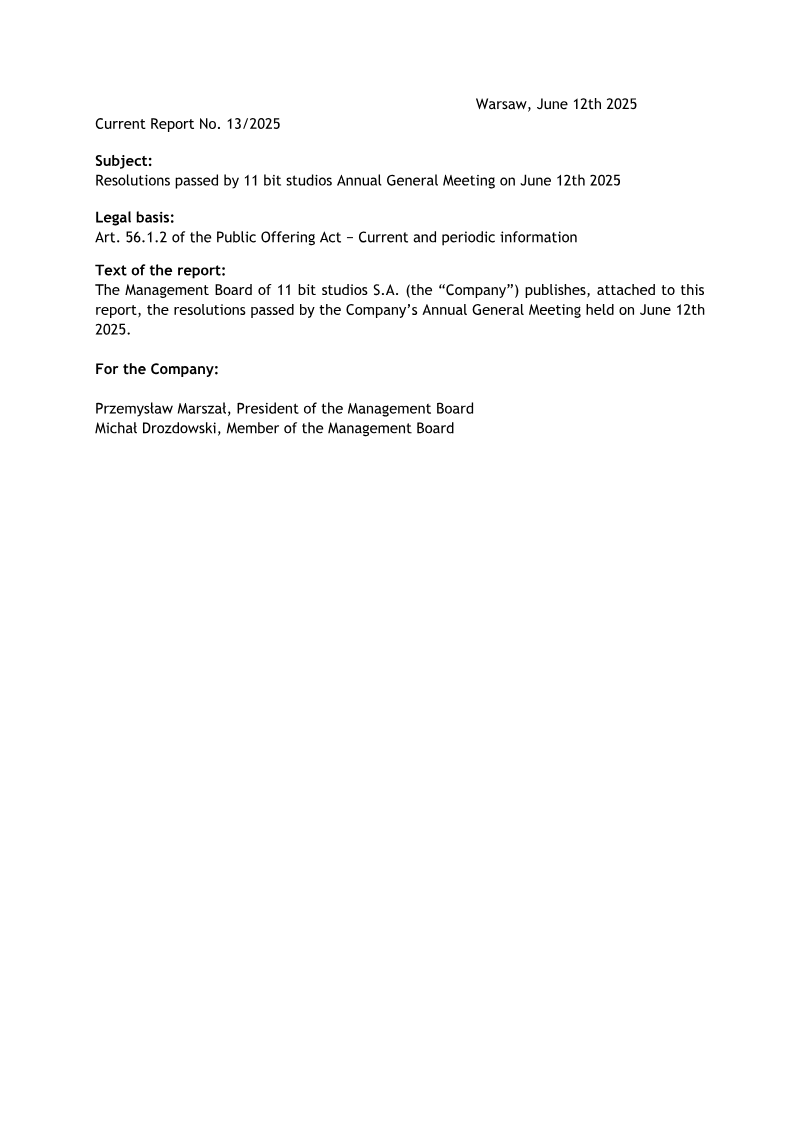
Resolutions Passed by 11 bit studios Annual General Meeting: June 12th 2025
The report announces the adoption of resolutions by 11 bit studios S.A.’s Annual General Meeting held on June 12, 2025. The meeting’s outcomes are recorded under the legal framework of Article 56.1.2 of the Public Offering Act, which governs current and periodic disclosures for listed companies. The document confirms that the Management Board, chaired by President Przemysław Marszał and including Member Michał Drozdowski, has formally adopted the resolutions. No further detail on the specific content of those resolutions is provided within this brief notice, and no additional data or statistical findings are included. The scope of the disclosure is limited to Warsaw‑based 11 bit studios S.A., covering its corporate governance decisions for the fiscal year ending in 2025. The methodology is implicit: resolutions are passed by a duly convened Annual General Meeting, following statutory procedures for shareholder approval. The report serves as an official record of the company’s governance actions, fulfilling regulatory requirements for transparency and shareholder communication.
- 11 bit studios S.A. held its Annual General Meeting on June 12, 2025, to formally adopt corporate governance resolutions.
- The meeting was conducted under the regulatory framework of Article 56.1.2 of the Public Offering Act, which mandates disclosure requirements for listed companies.
- The resolutions were adopted under the leadership of the Management Board, chaired by President Przemysław Marszał and including Board Member Michał Drozdowski.
- The scope of these governance actions is limited to the Warsaw-based entity 11 bit studios S.A. for the fiscal year ending in 2025.
- The disclosure serves as an official record of shareholder-approved governance decisions to ensure regulatory compliance and transparency.
11 bit studios
Report1 pages
Shareholders Holding 5% or More of Total Voting Rights: June 2025
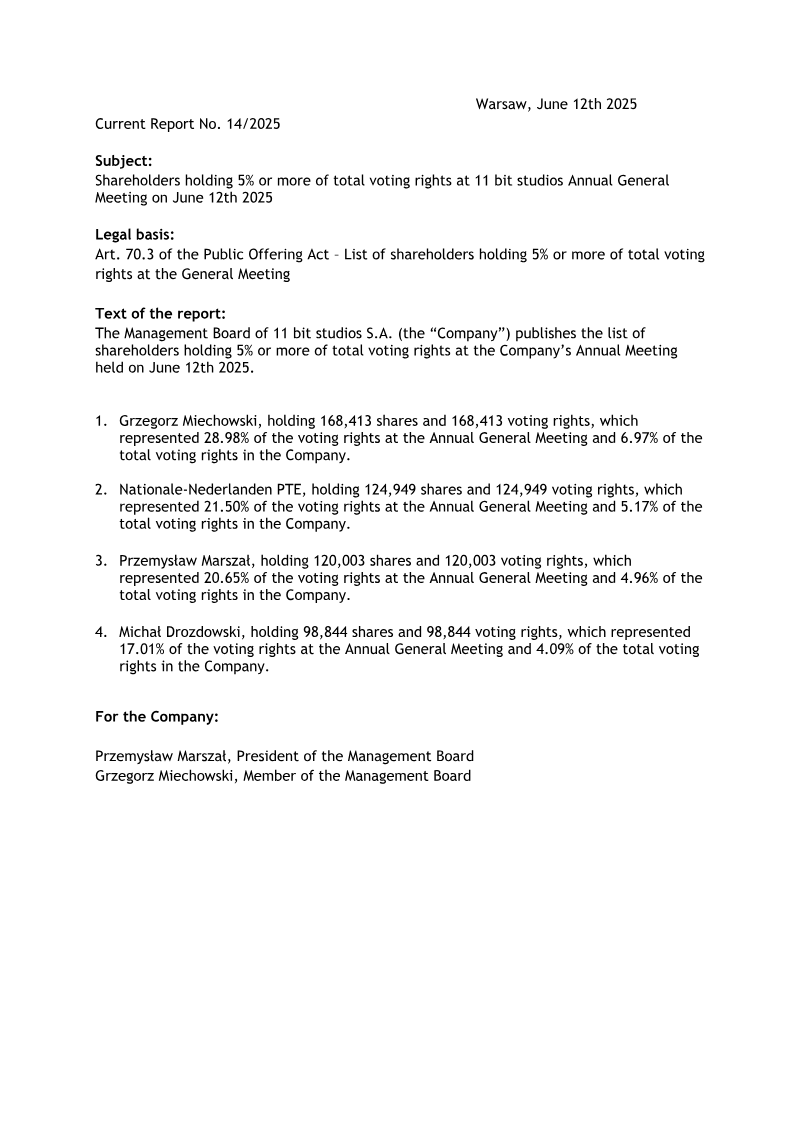
The report lists shareholders who held at least five percent of the total voting rights in 11 bit studios S.A. during its Annual General Meeting on June 12, 2025. The disclosure follows Article 70.3 of the Public Offering Act and identifies four major shareholders, detailing their share counts, voting rights, and proportional representation both at the meeting and across the company’s total voting base.
Grzegorz Miechowski leads with 168,413 shares and an equal number of voting rights, accounting for 28.98 % of the meeting’s votes and 6.97 % of all voting rights issued by the company. Nationale‑Nederlanden PTE follows with 124,949 shares, representing 21.50 % of the meeting’s votes and 5.17 % of total rights. Przemysław Marszał holds 120,003 shares, contributing 20.65 % of the meeting’s votes and 4.96 % of total rights, while Michał Drozdowski owns 98,844 shares, equating to 17.01 % of the meeting’s votes and 4.09 % of total rights.
The report confirms that these four individuals collectively control a significant portion of the company’s voting power, with Miechowski and Marszał also serving on the Management Board. The disclosure provides a clear snapshot of shareholder influence at the 2025 annual meeting, illustrating how concentrated ownership can shape corporate governance decisions.
- As of June 12, 2025, four major shareholders held at least 5% of the total voting rights in 11 bit studios S.A.
- Grzegorz Miechowski is the largest shareholder, controlling 168,413 shares which represent 6.97% of the company's total voting rights.
- Nationale-Nederlanden PTE holds 124,949 shares, accounting for 5.17% of the total voting rights issued by the company.
- Przemysław Marszał holds 120,003 shares, representing 4.96% of total voting rights, while Michał Drozdowski holds 98,844 shares, representing 4.09%.
- At the 2025 Annual General Meeting, Grzegorz Miechowski, Nationale-Nederlanden PTE, Przemysław Marszał, and Michał Drozdowski collectively accounted for 88.14% of the votes cast.
11 bit studios
Report1 pages
Sales Report: The Alters
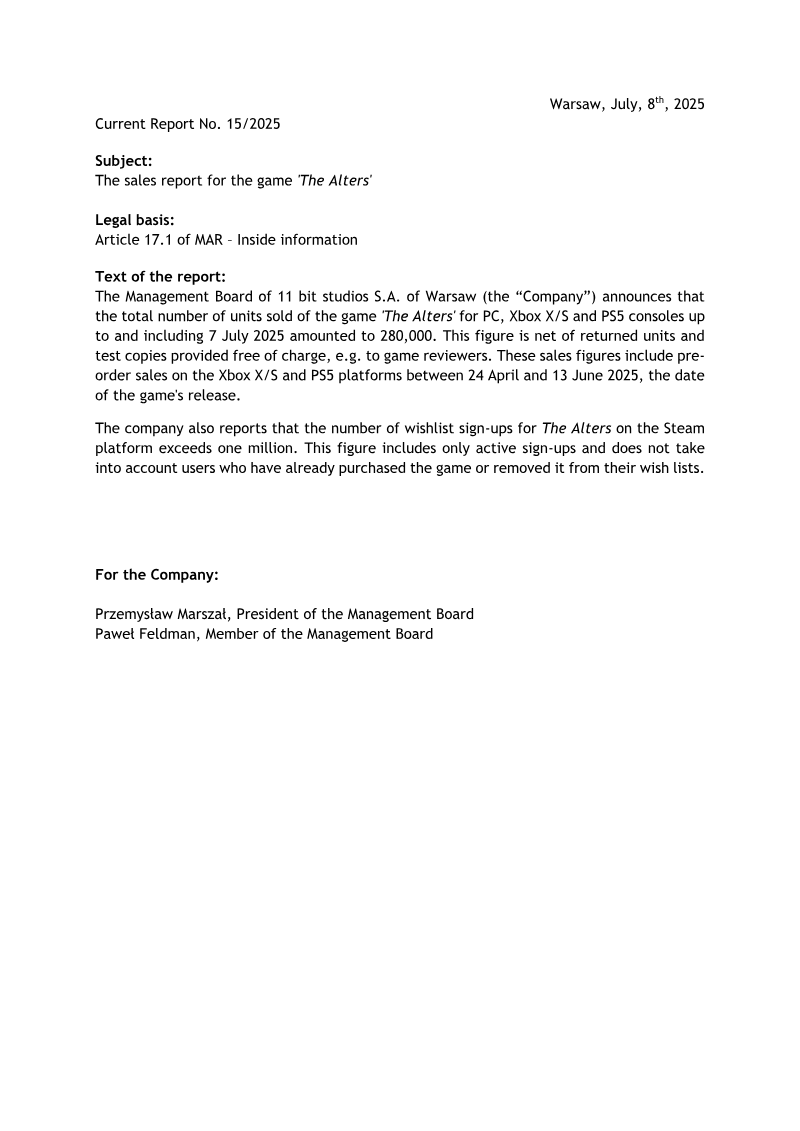
The report announces that the title “The Alters” has sold 280,000 units across PC, Xbox X/S and PS5 platforms through 7 July 2025, after deducting returns and complimentary copies. Pre‑order sales on Xbox X/S and PS5, recorded between 24 April and 13 June 2025, are included in this total. The company also highlights that more than one million users have added the game to their wish lists on Steam, a metric that excludes prior purchasers or those who later removed the title. The data covers sales up to mid‑July 2025 and focuses on three major platforms: PC, Xbox X/S, and PS5. No additional market segments or geographic breakdowns are provided beyond the platform‑level aggregation. The methodology is implicit: sales figures are reported by the company’s Management Board, presumably sourced from internal distribution and retail tracking systems. The report serves to inform stakeholders of the game’s commercial performance, emphasizing both actual sales and pre‑launch interest as measured by wish list activity. The information is presented under Article 17.1 of MAR, indicating it constitutes inside information for regulatory purposes.
- The Alters achieved 280,000 net unit sales across PC, Xbox Series X/S, and PS5 platforms as of 7 July 2025.
- Steam wish list activity for the title has surpassed one million users, excluding those who have already purchased or removed the game.
- The reported sales figures include pre-order data collected for Xbox Series X/S and PS5 between 24 April and 13 June 2025.
- The sales data reflects net performance after accounting for all returns and complimentary copies.
- This commercial performance data is classified as inside information under Article 17.1 of the Market Abuse Regulation (MAR).
+3
11 bit studios
Report1 pages
Current Report No. 16: Setting Release Date for Moonlighter 2: The Endless Vault
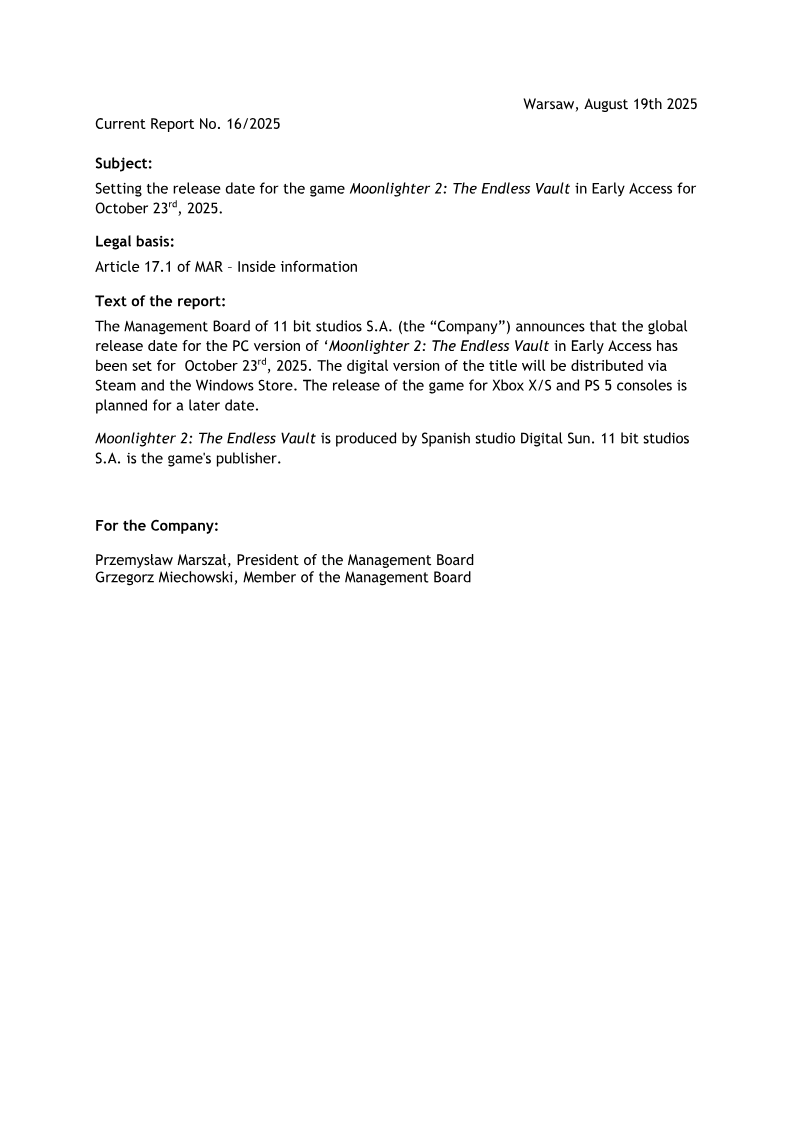
The announcement establishes the global early‑access release date for Moonlighter 2: The Endless Vault on PC as October 23, 2025. Distribution will occur through Steam and the Windows Store, while console releases for Xbox X/S and PlayStation 5 are deferred to a later date. The title is developed by Spanish studio Digital Sun, with 11 bit Studios S.A. acting as publisher.
The release schedule reflects a strategic focus on the PC market, leveraging major digital storefronts to maximize initial reach. By postponing console launches, the publisher can concentrate resources on polishing the PC experience and gathering player feedback during early access. The decision aligns with industry trends where developers use early‑access periods to iterate on gameplay, balance mechanics, and build community engagement before broader platform releases.
The communication is issued by the Management Board of 11 bit Studios, underscoring corporate governance and regulatory compliance. The statement cites Article 17.1 of MAR – Inside information as the legal basis, indicating that the release date is considered material information for investors. The brief does not provide additional data on sales projections, market analysis, or development milestones, focusing solely on the release timeline and distribution channels.
- Moonlighter 2: The Endless Vault will launch in early access on PC via Steam and the Windows Store on October 23, 2025.
- Console versions for PlayStation 5 and Xbox Series X/S are deferred to a later date to allow for a focused PC-first release strategy.
- The development is led by the Spanish studio Digital Sun, with 11 bit Studios S.A. serving as the publisher.
- The early-access period is intended to facilitate gameplay iteration, mechanical balancing, and community engagement prior to a wider platform rollout.
- 11 bit Studios issued this announcement as material information under Article 17.1 of the Market Abuse Regulation (MAR) to ensure regulatory compliance.
+2
11 bit studios