
Report50 pages
Mobile App Trends 2023: Japan Edition
Japan’s mobile app market is undergoing a significant recovery following a downturn in 2022, characterized by a 12% surge in consumer spending to $4.65 billion in the first quarter of 2023. This resurgence is primarily anchored by the gaming sector, which generated $3.14 billion during the same period. Role-playing games and simulation titles remain the dominant forces in the region, leading in both installation volume and user retention. While iOS remains the preferred platform for the majority of Japanese mobile users, accounting for over 60% of gaming and fintech engagement, the market is defined by a unique tension between high engagement and strict data privacy preferences, as evidenced by opt-in rates that consistently trail global averages.
Beyond gaming, the e-commerce and fintech sectors are experiencing robust expansion. Marketplace apps currently command nearly half of all e-commerce installs, contributing to a projected annual revenue of $156.3 billion. Simultaneously, fintech adoption is accelerating, with crypto-related applications seeing a 134% quarterly increase in installs. Despite these growth metrics, developers face persistent challenges regarding user loyalty, as evidenced by declining retention rates and shorter session durations in the e-commerce vertical. This necessitates a shift toward more sophisticated user acquisition strategies that balance personalization with privacy-compliant data aggregation.
The advertising landscape is also evolving rapidly with the rise of Connected TV (CTV) as a critical growth channel. With household ownership of internet-connected televisions reaching 30 million, the CTV ad market is projected to hit 169.5 billion yen by 2025. This medium offers higher audience receptivity and superior ad quality compared to traditional mobile formats. To maintain momentum through 2023 and beyond, marketers must diversify their channel mix and leverage cross-device measurement tools to optimize return on investment across both mobile and television platforms.
- Japan's mobile market recovered in Q1 2023 with a 12% surge in consumer spending to $4.65 billion, driven largely by the gaming sector's $3.14 billion contribution.
- The Japanese advertising landscape is shifting toward Connected TV (CTV), with the market projected to reach 169.5 billion yen by 2025 as household ownership hits 30 million.
- Fintech adoption is accelerating rapidly in Japan, highlighted by a 134% quarterly increase in installations for crypto-related applications.
- Role-playing and simulation games remain the dominant categories for both installation volume and user retention in the Japanese mobile market.
- iOS maintains a dominant position in Japan, accounting for over 60% of gaming and fintech engagement, despite a market-wide trend of low opt-in rates for data tracking.
+1
AdjustJan 2023

Report84 pages
DeNA Integrated Report 2022
DeNA is undergoing a strategic evolution to diversify its portfolio into two primary pillars: "Entertain," comprising Games and Live Streaming, and "Serve," focusing on Healthcare and Sports. This transition is supported by core competencies in artificial intelligence, agile in-house development, and a regional "Home Base" strategy centered in Yokohama. By leveraging high-potential technologies such as Web3 and health big data, the organization aims to balance stable cash flow from established entertainment properties with high-growth opportunities in medical data and global streaming markets.
Financial performance in fiscal year 2021 reflects this transition, with profit attributable to owners reaching 30.5 billion yen and a return on equity of 13.2%. While the Game Business experienced a revenue decline to 74.7 billion yen due to a lack of new hits, the Live Streaming segment saw a 1.4x revenue increase, and the Healthcare segment achieved its first quarterly profit. Strategic capital moves, including the sale of approximately half of the company's Nintendo shareholdings and the acquisition of subsidiaries like IRIAM and DATA HORIZON, have been implemented to increase asset efficiency and expand the medical database to over 15 million insured individuals.
Operational and governance structures have been modernized to support this multi-sector growth. The January 2022 establishment of a cross-departmental Product Development Department and a new Group Executive System aims to accelerate business execution and talent cultivation. Personnel strategies now emphasize specialized technical rankings to attract top-tier engineers, while executive compensation is increasingly linked to mid-to-long-term growth indicators. Looking ahead, the strategy focuses on releasing three to five global game titles annually, expanding the Pococha streaming service into the United States and India, and deepening the long-term strategic partnership with Nintendo to secure a robust global presence.
- DeNA is pivoting toward a dual-pillar strategy of 'Entertain' (Games and Live Streaming) and 'Serve' (Healthcare and Sports) to balance stable cash flow with high-growth sectors.
- Fiscal year 2021 financial results included 30.5 billion yen in profit attributable to owners and a 13.2% return on equity.
- The Game Business revenue declined to 74.7 billion yen due to a lack of new hits, while the Live Streaming segment grew 1.4x and the Healthcare segment achieved its first quarterly profit.
- Strategic capital reallocation included selling approximately half of the company's Nintendo shareholdings and acquiring subsidiaries like IRIAM and DATA HORIZON to expand its medical database to over 15 million insured individuals.
- The company is targeting an annual release cadence of three to five global game titles and is expanding the Pococha streaming service into the United States and India.
+1
DeNA Co.Sept 2022

Report34 pages
Japan Mobile App Trends 2022: Essential App Performance Benchmarks and Insights
The Japanese mobile app market underwent a period of significant expansion between 2020 and mid-2022, characterized by a 19% increase in total installs and a 12% rise in user sessions. Gaming remains the primary driver of this growth, with installs surging 52% year-over-year. Within this vertical, Hyper Casual and RPG titles command the largest market shares, accounting for 15% and 13% of installs respectively. While gaming leads in volume, the Fintech and E-commerce sectors have reached record engagement levels, with E-commerce sessions growing 29% over 2020 benchmarks and Fintech sessions rising 13% annually.
User acquisition dynamics in Japan reveal a complex landscape of costs and returns across different platforms and genres. Dating apps face particularly high acquisition hurdles, with costs per install peaking at $6.60, while puzzle games average a $5.48 cost per install. Data indicates that Android users frequently outperform iOS users in terms of conversion efficiency and return on ad spend, particularly within the gaming and dating verticals. These performance metrics suggest that while the market is maturing, strategic platform selection remains critical for optimizing marketing budgets.
Looking toward future growth, the Japanese digital landscape is shifting toward multi-channel engagement, with Connected TV emerging as a vital marketing frontier. Projections suggest that ad spend in the Japanese Connected TV sector will reach ¥58.8 billion by 2024. This evolution, supported by data from the top 2,000 performing apps, underscores a resilient mobile economy where traditional gaming dominance is being supplemented by rapid digital transformation in financial services and retail. The transition from 2020 through the first half of 2022 highlights a market that is both expanding in scale and diversifying in its technological reach.
- The Japanese mobile market saw a 19% increase in total installs and a 12% rise in user sessions between 2020 and mid-2022, driven primarily by a 52% year-over-year surge in gaming installs.
- Hyper Casual and RPG titles dominate the gaming sector, accounting for 15% and 13% of total installs respectively.
- E-commerce and Fintech are experiencing significant engagement growth, with sessions rising 29% and 13% respectively compared to 2020 benchmarks.
- User acquisition costs are high, with Dating apps peaking at $6.60 per install and Puzzle games averaging $5.48 per install.
- Android users demonstrate superior conversion efficiency and return on ad spend compared to iOS users, particularly within the gaming and dating verticals.
+1
AdjustAug 2022

Presentation43 pages
1Q FY2022 Presentation Material: October to December 2021
CyberAgent demonstrated significant financial growth during the first quarter of fiscal year 2022, with consolidated sales reaching 171 billion yen and operating profit increasing nearly threefold to 19.8 billion yen. This performance was primarily catalyzed by the Game business, where sales nearly doubled to 58.3 billion yen. The massive success of Uma Musume Pretty Derby, which surpassed 12 million downloads, drove a 15.1-fold year-over-year increase in operating profit for the segment. Despite this momentum, the inherent volatility of the gaming market led to a cautious approach regarding full-year forecasts.
The Media segment, led by the streaming platform ABEMA, achieved 24.9 billion yen in sales but reported an operating loss of 3.8 billion yen. This deficit reflects aggressive reinvestment into the online betting platform WINTICKET and content expansion, including the acquisition of Babel Label and integration with the Nintendo Switch. ABEMA continues to scale its reach, recording over 76 million downloads and 18 million weekly active users. Meanwhile, the Internet Advertisement business achieved record sales, supported by the launch of three new subsidiaries focused on digital transformation.
The long-term strategic framework involves utilizing high-margin profits from the Advertising and Game segments to fund the evolution of Media into a primary growth pillar and essential social infrastructure. This vision is underpinned by a corporate purpose focused on overcoming economic stagnation through digital innovation and global expansion. Future growth in the gaming sector is anticipated through a robust pipeline of high-profile intellectual properties, including titles based on Final Fantasy VII and Jujutsu Kaisen, while broader corporate sustainability is managed through integrated ESG initiatives.
- CyberAgent’s consolidated sales reached 171 billion yen in 1Q FY2022, with operating profit nearly tripling to 19.8 billion yen.
- The Game business segment saw sales nearly double to 58.3 billion yen, driven by the success of 'Uma Musume Pretty Derby' which exceeded 12 million downloads.
- Operating profit for the Game segment grew 15.1-fold year-over-year, though management remains cautious about full-year forecasts due to gaming market volatility.
- The Media segment, anchored by ABEMA, recorded 24.9 billion yen in sales but incurred an operating loss of 3.8 billion yen due to heavy reinvestment in WINTICKET and content expansion.
- ABEMA reached 76 million total downloads and 18 million weekly active users as of the end of 2021.
+1
CyberAgentJan 2022

Report34 pages
Japan Mobile App Trends 2022
The Japanese mobile app market experienced a period of significant expansion between 2020 and 2022, characterized by a 19% surge in total installs and a dominant 52% growth rate within the gaming sector. While the pandemic-driven peak of 2021 led to a stabilization of gaming sessions in 2022, the market remains robust across multiple verticals. Hyper-casual and RPG titles continue to lead in volume, though simulation games have emerged as highly efficient options for developers, offering lower acquisition costs and superior return on ad spend compared to puzzle games.
Beyond gaming, the fintech and e-commerce sectors have demonstrated remarkable resilience and growth. Fintech sessions increased by 13% year-over-year in the first half of 2022, while e-commerce activity reached record highs during the same period. The dating app category also saw a 13% uptick in engagement, with notable discrepancies in user acquisition costs between platforms; Android registrations proved more cost-effective at $8.47 compared to $10.20 for iOS. These trends indicate a maturing digital economy where user engagement is diversifying across utility and lifestyle applications.
A pivotal shift in the Japanese advertising landscape is the rapid rise of Connected TV (CTV), which is projected to reach 23.2% user penetration and ¥58.8 billion in ad spend by 2024. This emerging frontier is reshaping user acquisition strategies, necessitating sophisticated cross-device measurement and multi-touch attribution to link large-screen impressions to mobile conversions. As local broadcasters and analytics platforms form deeper integrations, CTV is transitioning from an experimental channel to a permanent, data-driven fixture of the Japanese mobile marketing ecosystem.
- The Japanese mobile market saw a 19% surge in total installs between 2020 and 2022, with the gaming sector experiencing a dominant 52% growth rate.
- Connected TV (CTV) is a critical emerging channel in Japan, projected to reach 23.2% user penetration and ¥58.8 billion in ad spend by 2024.
- Simulation games have become highly efficient for developers, offering lower acquisition costs and superior return on ad spend compared to traditional puzzle games.
- Fintech sessions grew by 13% year-over-year in the first half of 2022, while e-commerce activity reached record highs during the same period.
- Dating app engagement increased by 13%, with Android user acquisition costs ($8.47) proving more cost-effective than iOS ($10.20).
AdjustJan 2022
Presentation55 pages
FY2021 Presentation Material
CyberAgent achieved record-breaking financial performance in fiscal year 2021, characterized by consolidated sales of 666.4 billion yen and a more than threefold increase in operating profit to 104.3 billion yen. This surge was primarily catalyzed by the Game business, which experienced 68.6% year-over-year growth following the massive commercial success of Uma Musume Pretty Derby. While the Game segment provided the most significant profit contribution, the Internet Advertisement business maintained steady double-digit growth, and the Media segment narrowed its operating losses through the expansion of ABEMA and the WINTICKET betting platform.
The strategic focus for the period centered on leveraging high-performing assets to fund long-term growth initiatives. WINTICKET emerged as a critical driver within the Media segment, capturing 25% of the Keirin online betting market and tripling its transaction volume. Simultaneously, the company utilized profits from its established advertising and gaming pillars to invest in ABEMA’s digital transformation and content offerings, including pay-per-view services. This diversification strategy aims to stabilize the inherent volatility of the gaming industry, which led to the omission of specific earnings forecasts for the upcoming fiscal year.
Future growth is predicated on a robust pipeline of high-profile intellectual properties and strategic partnerships with industry leaders such as Nintendo, SEGA, and Bandai Namco. Upcoming releases, including titles based on the Final Fantasy VII and Jujutsu Kaisen franchises, are expected to sustain the momentum established in 2021. By aligning its corporate purpose with digital innovation and cross-media expansion, the organization seeks to transition from a gaming-heavy profit structure toward a more balanced ecosystem where media and advertising provide consistent, long-term value.
- CyberAgent achieved record-breaking FY2021 performance with 666.4 billion yen in consolidated sales and a 104.3 billion yen operating profit, representing a more than threefold increase.
- The Game business was the primary profit driver, recording 68.6% year-over-year growth fueled by the commercial success of Uma Musume Pretty Derby.
- WINTICKET captured 25% of the Keirin online betting market and tripled its transaction volume, significantly contributing to reduced operating losses in the Media segment.
- The Internet Advertisement business maintained steady double-digit growth, serving as a stable financial pillar alongside the high-volatility gaming segment.
- Management opted not to provide earnings forecasts for the upcoming fiscal year due to the inherent revenue volatility associated with the gaming industry.
+1
CyberAgentOct 2021

Presentation50 pages
3Q FY2021 Presentation Material: April to June 2021
CyberAgent experienced exceptional financial growth during the third quarter of fiscal year 2021, covering the period from April to June. Consolidated sales reached 192.2 billion yen, representing a 70.3% year-over-year increase, while operating profit surged more than fivefold to 44.5 billion yen. This performance was primarily catalyzed by the Game business, specifically the massive commercial success of Uma Musume Pretty Derby. The title surpassed nine million downloads within five months of its launch, driving segment sales up by 151.7% and operating profit by over 480%. The success of this intellectual property has further expanded into a multi-media franchise encompassing anime, music, and live events, prompting an upward revision of full-year forecasts to 650 billion yen in sales and 100 billion yen in operating profit.
The media segment, led by the streaming platform ABEMA, also demonstrated significant momentum with quarterly sales more than doubling to 10.5 billion yen. Weekly Active Users reached a peak of 14.9 million, supported by high-profile sports broadcasting and original content. A critical component of this segment's monetization strategy is the WINTICKET online betting service, which saw transaction volumes grow 5.5 times year-over-year to 39.3 billion yen through strategic integration with ABEMA’s programming.
Beyond current hits, the strategic focus remains on technological innovation and pipeline development. The advertising business reported high adoption rates for AI-driven creative tools, while the gaming division is preparing for future growth with high-profile upcoming titles based on the Final Fantasy VII and Jujutsu Kaisen franchises. These results indicate a robust diversification strategy where high-performing gaming assets and integrated media services drive record-breaking financial outcomes across the Japanese market.
- CyberAgent’s consolidated sales grew 70.3% year-over-year to 192.2 billion yen in 3Q FY2021, with operating profit increasing more than fivefold to 44.5 billion yen.
- The 'Uma Musume Pretty Derby' game drove a 151.7% increase in gaming segment sales and a 480% surge in operating profit, reaching nine million downloads within five months of launch.
- Driven by the success of 'Uma Musume', CyberAgent revised its full-year forecasts upward to 650 billion yen in sales and 100 billion yen in operating profit.
- The ABEMA streaming platform saw quarterly sales more than double to 10.5 billion yen, supported by a peak of 14.9 million Weekly Active Users.
- The WINTICKET online betting service, integrated with ABEMA, achieved a 5.5-fold year-over-year increase in transaction volume to 39.3 billion yen.
+1
CyberAgentJul 2021

Report21 pages
Market Snapshot: Q1 2021 US, China & Japan
The mobile gaming market in the first quarter of 2021 demonstrated regional divergence in genre performance, with the United States remaining relatively stable while China and Japan experienced notable shifts in market share. In the US, simulation games continued to grow, and Roblox Corporation solidified its position as the top-grossing publisher. Conversely, Japan saw a decline in RPG market share alongside a significant rise in sports titles, driven by the breakout success of Cygames’ Uma Musume Pretty Derby. China’s market moved away from traditional RPG and strategy dominance, favoring a surge in shooter games.
Data analysis reveals distinct trends in monetization and feature implementation across these regions. Collectible albums have become a staple in the US, utilized by over 70% of top-grossing games. In Japan, battle pass mechanics are gaining traction, appearing in over 25% of top-grossing titles. Meanwhile, Chinese developers have doubled the year-over-year utilization of special gacha mechanics, which now appear in 30% of top-grossing games. Social features, particularly guild mechanics and co-op modes, remain essential for retention across puzzle, RPG, and strategy genres.
The analysis utilizes a proprietary genre taxonomy and a motivation framework to categorize player archetypes. In the US market, the top 200 grossing games primarily appeal to five distinct archetypes, with a rising trend toward the Skill Master archetype, indicating an increased consumer appetite for competitive gameplay that rewards reflexes and skill. These findings are based on iOS market performance data, publisher share metrics, and an evaluation of soft-launch titles, providing a comprehensive view of the mobile landscape during the transition from late 2020 to early 2021.
- In Q1 2021, mobile gaming genre preferences diverged globally: US markets favored simulation games, Japan saw a shift from RPGs to sports titles led by Cygames’ Uma Musume Pretty Derby, and China moved toward shooter games.
- Roblox Corporation established itself as the top-grossing publisher in the US market during Q1 2021.
- Monetization strategies varied by region, with collectible albums appearing in over 70% of top-grossing US games, battle passes in over 25% of top-grossing Japanese titles, and special gacha mechanics in 30% of top-grossing Chinese games.
- Chinese developers doubled their year-over-year utilization of special gacha mechanics in top-grossing titles.
- US mobile gaming trends indicate a rising consumer appetite for the 'Skill Master' archetype, reflecting a growing preference for competitive gameplay that rewards reflexes and skill.
+2
GameRefineryApr 2021

Presentation52 pages
2Q FY2021 Presentation Material: January to March 2021
CyberAgent experienced exceptional financial growth during the second quarter of fiscal year 2021, characterized by a 26.6% year-over-year increase in consolidated sales to 163.4 billion yen and a doubling of operating profit to 25.8 billion yen. This performance was primarily catalyzed by the Game business, which achieved record-high quarterly sales of 63.9 billion yen. The massive success of Uma Musume Pretty Derby, which secured over five million downloads within its first 45 days, served as the primary engine for this expansion. Coupled with the strong performance of titles like NieR Re[in]carnation and a robust pipeline including Final Fantasy VII Ever Crisis, the company significantly upgraded its full-year forecasts, raising sales targets to 600 billion yen and nearly doubling its projected operating profit range.
The media segment, centered on the ABEMA platform, demonstrated significant scale despite ongoing operating losses of 3.4 billion yen. Sales for the segment grew 1.4 times year-over-year, reaching 19.8 billion yen, bolstered by the rapid expansion of the online betting service WINTICKET. Transaction volumes for WINTICKET surged 9.1 times annually to 31.9 billion yen, highlighting a successful diversification of revenue streams beyond traditional advertising. Weekly active users remained stable at approximately 12 million, supported by a strategic mix of original dramas, variety content, and anime.
To sustain this momentum, the organization is prioritizing digital transformation and cross-media strategies. The Internet Advertisement business reached record-high performance levels, while ABEMA is undergoing a comprehensive user interface redesign to better integrate linear and on-demand viewing. These initiatives, combined with AI-driven operational efficiencies, aim to transition the media segment toward long-term monetization while maintaining the high-growth trajectory established by the gaming and advertising divisions within the Japanese market.
- CyberAgent’s consolidated sales grew 26.6% year-over-year to 163.4 billion yen in 2Q FY2021, with operating profit doubling to 25.8 billion yen.
- The Game business reached record quarterly sales of 63.9 billion yen, driven primarily by the launch of 'Uma Musume Pretty Derby,' which surpassed five million downloads in 45 days.
- Due to strong gaming performance, CyberAgent raised its full-year sales forecast to 600 billion yen and nearly doubled its projected operating profit range.
- The media segment, anchored by ABEMA, saw sales grow 1.4 times year-over-year to 19.8 billion yen, despite recording an operating loss of 3.4 billion yen.
- WINTICKET online betting transaction volume surged 9.1 times year-over-year to 31.9 billion yen, providing a critical revenue stream outside of traditional advertising.
CyberAgentApr 2021

Report20 pages
Market Snapshot: Q2 2021 US, China & Japan
The mobile gaming market in the second quarter of 2021 experienced notable shifts in genre performance and publisher dominance across the United States, China, and Japan. The primary objective is to provide a comparative analysis of these regional markets, highlighting evolving trends in genre market share, publisher success, and the increasing importance of live-service feature updates. The analysis utilizes a proprietary taxonomy and motivation framework, supported by a survey of over 7,000 mobile gamers in English-speaking western countries, to categorize games and identify player archetypes.
Key findings indicate that the United States saw a decline in the Puzzle genre’s market share, while the Strategy genre experienced significant growth. In Japan, the Sports genre continued to gain momentum, largely driven by the success of titles like Umamusume Pretty Derby, while RPGs faced a decline. China exhibited a trend reversal from the previous quarter, with RPG and Strategy genres regaining market share at the expense of Shooters. Publisher performance was marked by strong results from Supercell in the US and Cygames in Japan, while Leiting Games nearly doubled its market share in China.
A critical trend identified is the 37% year-over-year increase in feature updates, with Strategy games leading this surge at 208%. Developers are increasingly prioritizing engagement through non-recurring live events and limited in-app purchase offers, which saw frequency increases of 143% and 122%, respectively. These features are becoming essential for retention and monetization across major genres. Furthermore, player motivation data reveals that games appealing to fast-paced action and competitive play continue to dominate the top-grossing charts in the US, with specific archetypes like King of the Hill and Skill Master remaining highly relevant.
- Live-service feature updates increased by 37% year-over-year, with Strategy games leading the surge at 208% growth.
- Engagement tactics are shifting toward non-recurring live events and limited-time in-app purchase offers, which saw frequency increases of 143% and 122% respectively.
- In the US, the Strategy genre grew while the Puzzle genre declined, with Supercell emerging as a top-performing publisher.
- China experienced a market reversal in Q2 2021 as RPG and Strategy genres regained share from Shooters, while Leiting Games nearly doubled its market share.
- Japan’s market saw the Sports genre gain momentum behind the success of Umamusume Pretty Derby, while RPGs faced a decline and Cygames maintained strong publisher performance.
+3
GameRefineryJan 2021
Report30 pages
Mobile Game Genre Report: Role-Playing Games 2021
Role-playing games represent the most lucrative segment of the global mobile gaming market, generating $18.5 billion in 2020 and accounting for nearly a quarter of all mobile gaming revenue. This market is geographically concentrated in East Asia, where China, Japan, and South Korea collectively generate over 70% of the genre's global earnings. The landscape is characterized by the dominance of domestic publishers and a heavy reliance on established intellectual properties from movies, literature, and PC ports, which account for approximately half of the top-performing titles. The Marvel franchise serves as a primary example of this trend, exerting a pervasive influence on player acquisition and revenue generation through its immense brand saturation.
While IP-based titles leverage organic recognition, original properties must utilize aggressive influencer marketing and high-quality creative advertisements to compete. Long-term sustainability in the genre is driven by consistent content updates, social competitive mechanics, and time-limited gacha systems. Although in-app purchases remain the primary revenue driver—particularly among high-income male audiences—there is a significant shift toward hybrid monetization. Approximately 83% of players now accept non-disruptive rewarded video ads as a means to progress without direct spending.
To navigate evolving privacy regulations and tracking challenges, developers are increasingly prioritizing high-value user signals within the first 24 hours of gameplay. Interactive playable ads have emerged as a highly effective acquisition tool, occasionally increasing eCPMs by over 200%. By combining traditional spending triggers like battle passes and limited-time events with sophisticated ad integration, publishers are successfully monetizing both high-spending "whales" and non-paying users to maintain growth in an increasingly competitive global market.
- Mobile RPGs generated $18.5 billion in 2020, representing nearly 25% of total mobile gaming revenue.
- The market is heavily concentrated in East Asia, with China, Japan, and South Korea accounting for over 70% of global RPG earnings.
- Approximately 50% of top-performing RPG titles rely on established intellectual properties, such as the Marvel franchise, to drive player acquisition and revenue.
- Hybrid monetization is becoming standard, with 83% of players accepting non-disruptive rewarded video ads as an alternative to direct in-app purchases.
- Interactive playable ads have become a critical acquisition tool, capable of increasing eCPMs by more than 200%.
+5
PangleJan 2021

Presentation44 pages
1Q FY2021 Presentation Material: October to December 2020
CyberAgent achieved record-high consolidated sales of 131 billion yen during the first quarter of fiscal year 2021, representing a 13.3% year-over-year increase. This growth was primarily propelled by the Media and Advertising segments, offsetting a temporary downturn in the Game business. While the Game segment saw revenue decline 15% to 29.9 billion yen and operating profit drop 77.8% due to seasonal factors and elevated marketing expenditures, the company maintained a strong financial foundation with 252 billion yen in total assets. This performance establishes a solid trajectory toward meeting full-year targets despite the mixed results across different business units.
The Media segment emerged as a significant growth engine, with ABEMA driving a 67% surge in revenue to 20.4 billion yen. This expansion was supported by a premium subscriber base exceeding 921,000 users and an elevenfold increase in transaction volume for the WINTICKET platform. To capitalize on this momentum, the company restructured ABEMA into distinct Free and Premium business units. Simultaneously, the Game business prepared for a recovery through the high-profile launches of titles such as Uma Musume Pretty Derby and NieR Re[in]carnation, signaling a strategic focus on high-quality content to stabilize future earnings.
Corporate strategy remains centered on governance and technological adaptation within the Japanese market. The organizational structure utilizes a clear distinction between supervision and execution, supported by a board of eight directors that includes significant outside representation. By emphasizing environmental data disclosure and the integration of artificial intelligence within advertising and media functionality, the company aims to align with modern ESG standards. These initiatives, framed within the context of the New Normal, reflect a commitment to long-term sustainability and operational agility in a rapidly evolving digital landscape.
- CyberAgent achieved record-high consolidated sales of 131 billion yen in 1Q FY2021, a 13.3% year-over-year increase driven by strong performance in the Media and Advertising segments.
- The Media segment grew revenue by 67% to 20.4 billion yen, bolstered by ABEMA’s premium subscriber base exceeding 921,000 users and an elevenfold increase in WINTICKET transaction volume.
- The Game business experienced a 15% revenue decline to 29.9 billion yen and a 77.8% drop in operating profit, attributed to seasonal factors and increased marketing spend.
- To drive future earnings recovery, the company is focusing on high-quality content launches, specifically Uma Musume Pretty Derby and NieR Re[in]carnation.
- Management restructured ABEMA into separate Free and Premium business units to better capitalize on current growth momentum.
+1
CyberAgentJan 2021
Report1 pages
Survey on Games and Daily Life: Japan
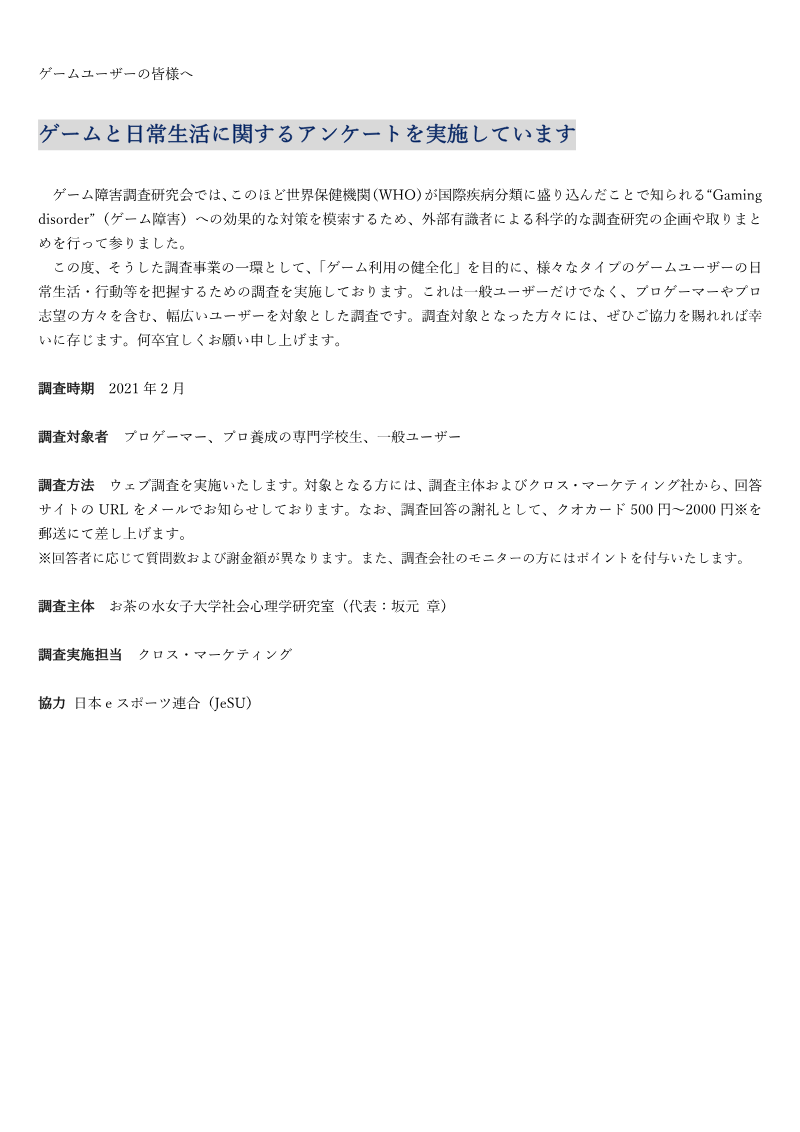
The survey was launched to deepen understanding of how gaming activities intersect with everyday life in Japan and to inform strategies for mitigating “gaming disorder,” a condition recently classified by the World Health Organization. Its overarching aim is to promote healthier gaming habits across a broad spectrum of participants, ranging from casual players to professional gamers and students enrolled in specialized esports training programs.
Fieldwork took place in February 2021 and targeted three distinct groups: active professional gamers, individuals attending dedicated esports academies, and the general gaming public. Data were collected through an online questionnaire distributed via email by the research team and Cross‑Marketing, with respondents directed to a secure response site. To encourage participation, incentives varied from ¥500 to ¥2,000 Quo‑card vouchers, supplemented by point awards for panel members of the survey firm.
The investigation was coordinated by the Social Psychology Laboratory at Ochanomizu University, under the leadership of Professor Akira Sakamoto, with operational support from Cross‑Marketing and endorsement from the Japan eSports Union (JeSU). Although specific results are not disclosed in the excerpt, the study’s design reflects a comprehensive, mixed‑audience approach intended to generate actionable insights for policy makers, health professionals, and the esports industry regarding responsible gaming practices in Japan.
- The study, conducted in February 2021, aimed to analyze the intersection of gaming and daily life to inform strategies for mitigating gaming disorder.
- Research was led by Professor Akira Sakamoto of the Social Psychology Laboratory at Ochanomizu University with endorsement from the Japan eSports Union (JeSU).
- The survey targeted three distinct demographics: active professional gamers, students in specialized esports academies, and the general gaming public.
- Data collection was facilitated through an online questionnaire managed in partnership with the research firm Cross-Marketing.
- Participation was incentivized through a combination of point awards and Quo-card vouchers ranging in value from ¥500 to ¥2,000.
+1
CESA – Computer Entertainment Supplier's AssociationJan 2021

Presentation54 pages
FY2020 Presentation Material
CyberAgent achieved record-high financial performance in fiscal year 2020, reporting consolidated sales of 478.5 billion yen and an operating profit of 33.8 billion yen. These results represent year-over-year increases of 5.5% and 9.9% respectively, surpassing initial forecasts despite the operational challenges posed by the global pandemic. Growth was primarily catalyzed by the Game business, which generated 155.8 billion yen in sales. This segment benefited from the sustained performance of legacy titles and the successful launch of Project SEKAI, which acquired over two million users within its first three weeks.
The Media business, centered on the ABEMA streaming platform, remains a critical pillar for long-term expansion. ABEMA experienced a 22.6% increase in annual sales to 57 billion yen, supported by a cumulative download base exceeding 59 million. While the segment continues to operate at a loss of 18.5 billion yen due to aggressive up-front investments, these losses are narrowing as new monetization streams mature. Specifically, the rapid adoption of Pay-Per-View services and a seventeen-fold increase in transaction volume for the WINTICKET cycling betting service have diversified the platform's revenue model beyond traditional advertising.
Looking toward fiscal year 2021, the strategic focus shifts toward scaling consolidated sales to 500 billion yen while maintaining a robust financial position. To manage this growth, a new governance structure has been implemented to separate management oversight from execution. Although increased selling, general, and administrative expenses led to a quarterly dip in operating profit during the final months of 2020, the overall trajectory remains positive. The combination of a highly profitable gaming portfolio and the accelerating monetization of digital media assets positions the organization for sustained domestic leadership in the Japanese internet services market.
- CyberAgent achieved record FY2020 performance with 478.5 billion yen in sales and 33.8 billion yen in operating profit, marking year-over-year growth of 5.5% and 9.9% respectively.
- The Game business served as the primary growth engine, generating 155.8 billion yen in sales driven by legacy titles and the successful launch of Project SEKAI, which reached two million users in three weeks.
- The Media segment, anchored by ABEMA, grew annual sales by 22.6% to 57 billion yen, supported by a cumulative base of over 59 million downloads.
- Despite an 18.5 billion yen operating loss in the Media segment due to aggressive investment, monetization is diversifying through Pay-Per-View services and a seventeen-fold increase in transaction volume for the WINTICKET cycling betting service.
- CyberAgent has set a consolidated sales target of 500 billion yen for FY2021 and implemented a new governance structure to separate management oversight from operational execution.
+1
CyberAgentOct 2020

Presentation40 pages
3Q FY2020 Presentation Material
CyberAgent’s performance during the third quarter of fiscal year 2020 remained resilient despite the economic disruptions caused by the COVID-19 pandemic. Consolidated sales reached 112.8 billion yen, a marginal year-over-year decrease of 0.7%, while operating profit stood at 8.2 billion yen. By the end of this period, the company had already achieved between 89% and 102% of its full-year operating profit forecasts. This stability was largely driven by the Internet Advertisement segment, which successfully offset declining demand in certain sectors by pivoting toward advertisers benefiting from stay-at-home trends, and the Game business, which generated 36.7 billion yen in quarterly revenue following major title anniversaries.
The media segment, centered on the streaming platform ABEMA, demonstrated significant growth with a 19.2% year-over-year increase in sales to 13.3 billion yen. This expansion was supported by a record 56 million downloads and a surge in the WINTICKET gambling transaction business, which doubled its volume to 7.2 billion yen. Strategic priorities for this segment include reaching one million ABEMA Premium subscribers by late 2020 and leveraging new virtual production technologies, such as Pay-Per-View systems, to enhance monetization.
Looking forward, the corporate strategy focuses on establishing ABEMA as a long-term financial pillar while maintaining market share in the advertising sector through AI-driven efficiency. In the gaming division, the emphasis remains on the dual approach of developing new intellectual properties and extending the lifecycle of existing titles through robust operational management. These efforts are underpinned by a broader commitment to ESG initiatives and information security, ensuring sustainable value creation across the company’s diverse digital portfolio.
- CyberAgent reported 112.8 billion yen in consolidated sales for 3Q FY2020, achieving 89% to 102% of its full-year operating profit forecast despite a marginal 0.7% year-over-year revenue decline.
- The Game business generated 36.7 billion yen in quarterly revenue, bolstered by major title anniversaries and a strategy focused on both new IP development and lifecycle extension for existing games.
- The media segment, anchored by the ABEMA streaming platform, grew sales by 19.2% year-over-year to 13.3 billion yen, supported by 56 million total downloads.
- WINTICKET gambling transactions doubled in volume to 7.2 billion yen, contributing significantly to the media segment's growth.
- The Internet Advertisement segment maintained stability by pivoting toward advertisers benefiting from stay-at-home trends to offset sector-specific demand declines.
+1
CyberAgentJul 2020

Presentation43 pages
2Q FY2020 Presentation Material: January to March 2020
CyberAgent achieved record-high financial performance during the second quarter of fiscal year 2020, with consolidated sales reaching 129.1 billion yen and operating profit surging 45.3% year-over-year to 12.4 billion yen. This growth was primarily anchored by the Game Business, which generated 44.8 billion yen in revenue. Success in this segment was driven by high-profile anniversary events for established titles like Granblue Fantasy and the strong market debut of KonoSuba: Fantastic Days. By the end of the first half, the company had already secured between 63% and 72% of its full-year profit targets, though projections for the remainder of the year remain cautious due to anticipated declines in advertising demand stemming from the COVID-19 pandemic.
The media segment, centered on the ABEMA streaming platform, demonstrated significant momentum as stay-at-home orders accelerated user adoption. ABEMA reached 52 million downloads and grew its premium subscriber base to 676,000, with a clear trajectory toward one million subscribers by the end of the calendar year. While the segment still operates at a loss, these losses narrowed to 4.2 billion yen as sales rose nearly 19%. Monetization efforts are diversifying beyond traditional advertising into subscriptions and related services, such as the WinTicket betting platform, which saw transaction volumes double quarter-on-quarter to 3.5 billion yen.
Strategic priorities for the future focus on balancing short-term gains with long-term operational stability. In the gaming sector, the emphasis remains on high-quality development and extending the lifecycle of existing intellectual properties. Simultaneously, the media division is pivoting toward a multi-faceted revenue model to ensure the sustainability of its expanding digital ecosystem. Despite the broader economic uncertainty introduced by global health trends, the current fiscal trajectory suggests a robust foundation built on digital entertainment and diversified media services.
- CyberAgent achieved record-high Q2 FY2020 consolidated sales of 129.1 billion yen and a 45.3% year-over-year increase in operating profit to 12.4 billion yen.
- The Game Business drove performance with 44.8 billion yen in revenue, bolstered by anniversary events for Granblue Fantasy and the successful launch of KonoSuba: Fantastic Days.
- By the end of the first half of FY2020, CyberAgent had already achieved 63% to 72% of its full-year profit targets.
- The ABEMA streaming platform reached 52 million downloads and 676,000 premium subscribers, with management targeting one million subscribers by the end of the calendar year.
- The media segment narrowed its operating loss to 4.2 billion yen as sales grew nearly 19%, supported by a doubling of WinTicket betting transaction volumes to 3.5 billion yen.
+1
CyberAgentApr 2020

Presentation26 pages
1Q FY2020 Presentation Material: October to December 2019
Financial performance for the first quarter of fiscal year 2020, covering October to December 2019, reflects a period of strategic investment and steady growth across core digital segments. Net sales reached 115.6 billion yen, representing approximately 25% of the full-year forecast of 465 billion yen. Operating income and ordinary income both stood at 7.7 billion yen, tracking toward an annual target range of 28 billion to 32 billion yen. Profit attributable to owners of the parent was 1.4 billion yen, fulfilling roughly 15% to 18% of the projected 8 billion to 10 billion yen annual goal.
The gaming segment maintained momentum through the performance of established titles and new releases. Key contributors included the third anniversary of Princess Connect! Re:Dive and the ongoing success of Granblue Fantasy and BanG Dream! Girls Band Party. New market entries such as Kick-Flight and the global expansion of Monster Strike further diversified the portfolio. In the media sector, the Abema platform demonstrated significant scaling, reaching 48 million downloads by the end of the quarter. Weekly active users showed consistent upward trends, supported by diverse programming including news, sports, and original reality content like Weekend Homestay.
Strategic focus remains on the medium- and long-term monetization of the media business. The revenue model is evolving to balance advertising and subscription income with expanding peripheral businesses, such as the WinTicket betting service. This diversification aims to accelerate the path to profitability for the streaming segment. Geographically centered in Shibuya, Japan, the organizational strategy emphasizes integrated reporting and a unified corporate culture to drive innovation across advertising, gaming, and digital media services.
- The company generated 115.6 billion yen in net sales for 1Q FY2020, meeting approximately 25% of its 465 billion yen full-year revenue target.
- Operating and ordinary income both reached 7.7 billion yen, tracking toward the annual target range of 28 billion to 32 billion yen.
- Profit attributable to owners of the parent was 1.4 billion yen, representing 15% to 18% of the projected 8 billion to 10 billion yen annual goal.
- The Abema media platform reached 48 million total downloads by the end of December 2019, supported by growth in weekly active users across news, sports, and original reality programming.
- Gaming segment momentum was driven by established titles including Granblue Fantasy, BanG Dream! Girls Band Party, and the third anniversary of Princess Connect! Re:Dive.
+1
CyberAgentJan 2020