The Death
Game
7 documents in the library are about The Death, from writers such as Jason Schreier, PocketGamer.biz and Deconstructor of Fun. Each has a summary and key insights with the page they come from.
Connections
The documents about The Death on the inner ring, the other games and companies they name on the outer one. Select a cover to see it up close and open it in a new tab; drag to move, pinch or Ctrl + scroll to zoom.
Documents about The Death

The Death Of Physical Games Is A Sign Of What's Coming
The video game industry has transitioned from a high-growth sector into a mature market, fundamentally altering how major publishers approach revenue and consumer engagement.
- The video game industry has transitioned from a high-growth market to a mature market, meaning companies no longer expect significant expansion in the number of new console users.
- To maintain revenue growth in a stagnant user base, companies like Sony are shifting to digital-only distribution to eliminate retail costs and capture higher margins per sale.
- Sony’s strategy for the PlayStation 5 focuses on maximizing revenue from its existing 125 million monthly active users rather than aggressively pursuing new hardware adoption.

The Death Of PlayStation Discs Was Decades In The Making
The transition toward an all-digital gaming ecosystem, culminating in Sony’s 2028 decision to discontinue PlayStation discs, represents the final stage of a decades-long industry effort to eliminate the used game market.
- Sony’s decision to phase out PlayStation discs by January 2028 marks the final stage of a decades-long industry effort to eliminate the used game market and transition to fully digital distribution.
- In the late 2000s, major publishers like EA implemented 'Project $10' and online passes to capture revenue from used game sales, requiring secondary buyers to pay a $10 fee to unlock online features.
- The industry's attempt to enforce digital rights management (DRM) on physical consoles peaked in 2013, when Microsoft faced significant backlash for plans to restrict used games on the Xbox One, leading to a public reversal.

Micro-Horror Games in Vietnam (Part 2): User Acquisition, Localization, and Expansion
The analysis argues that micro-horror is a high-impact category for performance advertising in Vietnam, offering a “cheat code” advantage through ultra-fast hooks that trigger curiosity within three seconds.
- Micro-horror games serve as a high-impact performance advertising category in Vietnam, utilizing ultra-fast three-second hooks to trigger curiosity and optimize ad delivery through content-signal targeting.
- Publishers like Funtap Games can capitalize on the 2026–2027 market window by integrating micro-horror elements into casual mobile genres such as room defense, idle, and merge games.
- Environmental storytelling using familiar Vietnamese settings—specifically dormitories, aging apartments, and public restrooms—is a primary driver for localization and user engagement.

Shooter Monthly #5: The Marathon Revelation, Overwatch Reborn & The Death of Highguard
The modern shooter landscape is currently defined by a tension between the volatility of community-driven spectacle and the necessity of sustainable, systems-based design.
- The collapse of Highguard demonstrates that relying on negative community sentiment and 'hate-playing' is an unsustainable strategy that fails to generate long-term player engagement.
- Bungie is positioning Marathon to disrupt the extraction shooter genre by combining high-stakes tactical gameplay with the accessibility and streamlined objectives typical of battle royale titles.
- Overwatch has successfully reclaimed market share by pivoting back to its core identity and implementing fundamental gameplay updates, validating the effectiveness of nostalgia-driven re-launch strategies.

Speed Panel: The Death of IDFA & Cookies - Your Monetisation is at Risk
The deprecation of IDFA and third-party cookies necessitates a fundamental shift in mobile gaming monetization, moving away from intrusive, data-heavy targeting toward privacy-compliant, authentic advertising models.
- The deprecation of IDFA and third-party cookies requires a shift from intrusive, data-heavy targeting toward privacy-compliant, game-centric advertising models.
- Intrinsic advertising, such as placing ads on in-game billboards, allows developers to monetize the entire player base rather than relying solely on a small cohort of spenders.
- Successful intrinsic advertising depends on contextual alignment, where ad content must resonate with the game's setting and audience to maintain brand value.

The Death of the IDFA | PocketGamer.biz RoundTables
The deprecation of the Identifier for Advertisers (IDFA) on iOS marks a fundamental transition in the mobile gaming industry, moving away from deterministic, granular user tracking toward a privacy-centric, probabilistic measurement landscape.
- The deprecation of IDFA has forced a permanent shift from deterministic, granular user tracking to a probabilistic measurement landscape, significantly reducing the precision of campaign attribution.
- Publishers must now rely on machine learning and predictive analytics to identify high-value users within the first 48 hours of gameplay to compensate for the loss of individual-level tracking data.
- The industry is pivoting toward the development of robust first-party data sets, such as email addresses and phone numbers, to maintain control over audience targeting without relying on third-party identifiers.
The Death of Performance Marketing: The Secret Interview
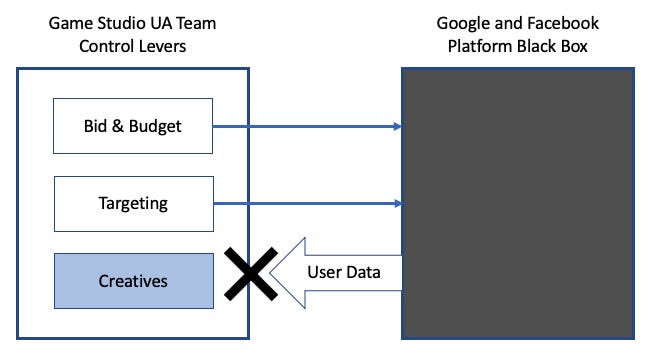
The mobile gaming industry is undergoing a fundamental shift in user acquisition (UA) strategy, driven by restrictive updates to Facebook’s Advanced Mobile App Measurement terms of service.
- Facebook’s updated terms of service for Advanced Mobile App Measurement prohibit advertisers from accessing device-level data, effectively ending traditional granular user acquisition tracking.
- The restriction of device-level data, retargeting, and fingerprinting forces mobile game studios to rely entirely on the 'black box' algorithms of Facebook and Google for campaign optimization.
- User acquisition teams are expected to shrink significantly as platforms automate bidding, budgeting, and targeting, shifting the primary focus of marketing roles toward creative asset production and data analysis.