Transcript
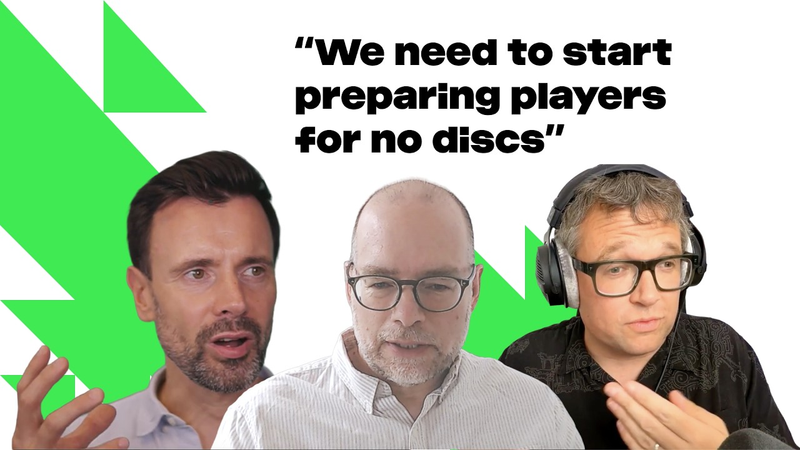
Hello, OneTakeShrier here. Sony's recent decision to kill PlayStation discs starting in January of 2028 has led to a whole lot of controversy for very good reasons. It's also the natural endpoint of a battle that the video game industry has been fighting since the early 2000s. This decision in many ways has been almost three decades in the making. So, let's go back in time, shall we? It's story time. Let's say it's, I don't know, 2005. The Xbox 360 and PlayStation 3 and Wii are all about to come out. Now, back then, video games were sold physically. There was no such thing as digital game sales unless you were playing games on PC when occasionally at this point you would be able to gain get games on um
Steam was just kind of kicking off and it was kind of like in the early days of digital game sales. But, for the most part, you would buy your games and especially your console games at your local store, your local Best Buy, your local Target, your local GameStop. And what these stores did, particularly GameStop, was that they, in addition to selling new games, they would offer you the opportunity to trade in your games and then they would go around turn around and and sell them as used. And a lot of people took advantage of this for a number of reasons. One is that a ton of people were playing the annual sports games every year and there were and and one way to get that price down a little bit for the newest Madden, for Madden 06, was to bring in your copy of Madden 05 and maybe get, I don't know, 15 bucks back for it and therefore contribute that that to buying the latest one. Um but also people kind of used GameStop as almost as a rental service where you
would buy a game and you would play through it and then you would trade it back in. Maybe you'd get um, way less than what you actually paid for it, but still it helped knock the price off and helped make $60 games more affordable. This was a problem for game publishers because if you were EA or Ubisoft or Activision or Take-Two, you would look at this and see a game that you made, that you funded, that you put money into getting sold once for $60 and you only benefit from that one sale and then circulating in the market over and over again, potentially being sold dozens more times that same game as it gets traded in and back and in and back um, without you seeing anything from it. GameStop is the biggest the biggest uh, uh, profit generation generator from those sales. So, the companies all started thinking, "Hey, how can we put an end to this practice?" Now, remember, this was a point when kind of it
around this era, around the late 2000s, there was this kind of rise of the Xbox Live Arcade and we were starting to see the beginnings of downloadable games and downloadable indie games in particular, but this was not an era where you could just buy a digital copy of I don't know, Arkham Asylum or the new Madden or Dragon Age: Origins. You had to go buy physically and therefore these companies had this kind of this frenemy in GameStop where GameStop was both uh, there they relied upon GameStop to actually get their games, distribute their games to customers, but at the same time they hated this used game market. Something that EA did was uh, this kind of ridiculously titled plan, this service that they called Project $10 that was speared by see CEO of EA at the time, John Riccitiello. And the idea of Project $10 was that um, they would couple their new games with some sort of add-on in the form of a download code,
whether it was an online pass or DLC or something like that. I'll get into some specific examples in a second. But if you didn't have the code, you had to pay $10.00 for it. In other words, if you went to the store and you bought a new copy of the game, you would get a code with it, no problem. You download your thing, you connect to the internet and you get you're all set. But if you buy the game from the store and it's used, chances are someone's already used that online code and so you have to go on EA's store and pay $10.00 for it, which will help juice up the profits for EA and make it so they actually benefit from at least a subset of the people who are buying used games rather than new ones. Because remember, EA doesn't see any profit when GameStop, if I traded my game at GameStop and then GameStop resells it, they don't have to pay a dime to EA. That is pure profit for them. If they paid me $20.00 for a game and then they turn around and sell it for $50.00, that is that is a $30.00 margin. That is a ridiculous profit for them and that's how GameStop was able to stay in business and become so
ubiquitous back in the 2000s and early 2010s or so. Before the meme stock era. Just a whole different story. So EA did this Dragon Age Origins is a good example. That was 2009 and that had a DLC called the Stone Prisoner that you could go and recruit this character named Shale. Had an entire new character and quest with it. That was free DLC. If you bought a new copy of the game, otherwise you had to pay $10.00 for it. There are other examples too. I mean, EA did it a lot. They did it for online passes. I'm just pulling up a couple of examples here, but there was like Battlefield 3 had what was called an online pass and in order to play any sort of multiplayer, you had to connect to the internet using one of of codes. Other other companies too. Arkham City, Batman Arkham City, which came out in 2011, had codes for what they called uh, an online VIP pass, which uh, gave you access to Catwoman as a playable character in the game. And in order to
to have access to Catwoman, you had to use this online code um, or go and pay $10 for it. This is also a time by the way when we started to see the rise of it all started with the kind of infamous horse armor where um, Bethesda uh, decided to start selling uh, cosmetic armor for your horse uh, in uh, The Elder Scrolls uh, Oblivion. And that became this kind of like this this uh, quintessential example of how ridiculous downloadable content was and a lot of other companies started following suit, selling you all sorts of um, what the games industry calls skins, which are essentially costumes or new outfits or new aesthetics and cosmetics for your characters. And so, you could log into the Xbox Live store or the PlayStation store and just download and and buy um, a lot of these different cosmetics at the time. Um, so yeah, it wasn't just EA. Um, uh, Ubisoft was was uh, well known for doing it as well. Um, Sony did it. There were games like SOCOM and um, bunch of EA Sports games were doing it.
Ubisoft uh, did it with Assassin's Creed games. It was it was pretty much pretty much all the major publishers. Um, Rock Band had like various songs that were attached to online codes. So, the idea was like, "Hey, we are going to um, get something out of this used game system." But of course, that led to some pressure from the retailers, from GameStop and others, and eventually uh, these companies were kind of forced to abandon that practice. But in the early 2010s, something else happened, which is that uh, these game companies started talking about what would become their next generation of video game consoles. Now, this was a time when maybe this online pass, maybe this project $10 initiative wasn't working so well, wasn't really it was obviously it was pissing off a lot of customers. A lot of people wind up complaining to customer support when they bought a new game and like the code didn't work or slash they bought a new game and the code didn't work. It was it was a whole big controversial thing and made headlines
constantly back then and led to a lot of complaints including from the retailers. So, so that initiative I think was not super successful for these companies. So, here's what's happening. So, cut to 2011-2012. PlayStation and Xbox are both preparing for the launch of their new consoles. The Wii and the Wii U are kind of on a different cycle at this point. Wii U comes out in 2012. That's the the flop of that console is a whole 'nother story, but let's focus on PlayStation and Xbox cuz those those were kind of the the two direct competitors and the two that were working more closely I would say with the big AAA third-party games and publishers. So, PlayStation and Xbox say, "Hey, this used game thing is a problem. What are we going to do about this?" And both of them in various capacities begin exploring this idea of some sort of DRM, some sort of protection to make used games less of a thing on their consoles. PlayStation
winds up abandoning that and Xbox winds up moving forward with it in some capacity or another. And what happens is in May of 2013, Microsoft announces the Xbox One. Don Mattrick, who's running Xbox at the time, does this whole big presentation. It is one of the most tone-deaf video game company events that has ever been held. It mostly focuses on the entertainment aspects of the Xbox One. They talk about how it's going to be this this living room entertainment box that lets you watch Netflix and do all these other things, multitask using what's called Xbox, I think it was called Xbox Snap, um to like allow your your thing to you you could it came with a built-in connect, uh which was their motion their full body motion control device, and you could kind of you could gesture to like snap things on on the interface. It was actually kind of cool, but um but yeah, the the focus was entertainment, and it even came with two HDMI ports, not just
one. There was an HDMI in and an HDMI out ports, because the idea was that you would be watching passing your your um other kind of uh cables so your your other entertainment devices through this thing and using the Xbox as your they called it all-in-one. The real one of the reasons it was called Xbox One was cuz it was an all-in-one entertainment device was the idea. Um that conference they like barely even mentioned video games. It was it got a lot of flak. But more importantly, at the time, it was very confusing, and they had a lot of mixed messaging about how it would actually handle being connected to the internet, checking your games, seeing if you could actually use used games on the thing or if it had to have some sort of digital license or handshake with the servers in order to actually get your games working. And um uh the executives of the time gave these interviews that were incredibly confusing. At one point, Phil Harrison, who was another top executive at Xbox at the time, he gave an interview where he said that you would have to connect to
the internet once every 24 hours on the device. Then, Xbox had to send over a statement to another gaming website being like, "That was actually just one potential example, and the decisions have not yet been finalized." It was a debacle. It was a mess, but it became very clear in those days and weeks that followed that there was going to be some sort of protection on the system that would prevent you from playing used games or using used games in some way. PlayStation at the time, it was heavily rumored that they were considering something similar. So, it was a bit of a surprise and a big shot against their biggest competitor when at E3 2013, they did their big press conference for the PlayStation 4 and they showed a video of two executives at the time, Shuhei Yoshida and Adam Boyes, and one of them said, "This is how you share games on PlayStation." and simply handed one a disc between themselves, just handed a disc one guy to the other. Um this, of course, became a flashpoint and brought
up quite a bit recently because it is no longer relevant now that PlayStation is killing discs, but at the time, it was seen as Sony being customer first and making something that people really wanted and uh people called it one of the the the craziest, one of the most mic drop moments in E3's history and just a few weeks after E3, Don Mattrick, the CEO of Xbox, stepped down and Xbox announced that it was backtracking and the Xbox One, instead of being this weird online connected device that had some sort of used game protection, would not let you use used games, now it would be now it would be a traditional console. But, of course, these companies were still trying to figure out how to solve this problem. And one of the ways that it I mean, the way that it they solved it was essentially through no kind of
It wasn't a tactic. It wasn't a strategy. It wasn't something they actively did. It was almost an accident. It was just the industry shifting because what began to happen throughout that generation and especially into this current generation is people started buying games digitally. Um everybody's internet got better. It became much easier to just go on the store. The stores really got improved quite a bit. If you ever look at UIs for the PlayStation store or the Xbox store in the 2000s versus what they became in the 2010s. It's leaps and bounds different. They added all sorts of features. They started putting big discounts on their digital stores to try to draw people in digitally. They started making bigger hard drives and these consoles came with bigger built-in hard drives, especially later on with the PlayStation 5 and the Xbox Series era. And we got to this point where customer habits really changed and people just found it more convenient and um people preferred buying games digitally. They didn't have to go to the stores. Of course, some people still wanted to save money and
buy games for cheaper by uh doing the whole trading in thing. But it became less and less relevant and at the same time GameStop became a disastrous company um that just made so many of its own sorts of boneheaded moves um and wound up now now the guy in charge, Ryan Cohen, he has his own just kind of delusions of grandeur and visions of himself running eBay. He recently said uh and in an interview with Bloomberg that I'll link in the show notes here, he recently said that um that the play that PlayStation's decision to kill discs is {quote} irrelevant to his business, which I suppose is his business is is trying to buy eBay and selling Funko collectibles or something like that. I don't know. But what happened was the world the gaming world gaming customers, they moved to digital. And I've discussed in a previous video why the margins for these companies are so much higher on digital. It it's a little bit complicated. Of course, there's bandwidth costs and payment
processor costs and all sorts of other things that are kind of factors there to consider. But for the most part, companies are making more money digitally than they are by by going physically. And now we are just seeing the culmination of this. So what happened essentially was the story here is essentially that these companies tried to kill used games, failed, tried again, failed, and then it just kind of accidentally happened um because people just found that buying digitally was actually kind of convenient for them. And now we're in this world where the majority of games that are sold are done so digitally. I want to share a stat from um one of the uh most informative analysts out there, a guy named Matt Piscatella, who um works for the firm Circana. And he shared the stat just recently, which is that um which is the number of physical units. So, okay. So, I'm going to read this from Matt Piscatella. He writes, "Two PlayStation video games sold more
than 10,000 physical units in the US during the week ending July 11th, 2026. Two. Two PlayStation video games sold more than 10,000 physical discs. Seven total have sold more than 100,000 physical units year to date. Seven games this year have sold more than 100,000 discs. Millions and millions of games sold, and seven of them have sold more than 100,000 physical units, which I think speaks to what's happened here, which is that the market has shifted. So, as I've said before, I am personally I'm a big fan of libraries. Go support your local library. It bumps me out that they will not be able to carry PlayStation discs moving forward. Um I think that it's really a shame that um that people won't be able to trade in used games anymore in this this kind of new digital future. I think it's going to hurt some people. Obviously, preservation and collection, there are a lot of issues that are associated with this with this
transition, but it is something that was made based on pure math and pure numbers and the logic of seeing that the market has really shifted. Um it is there is a little bit of irony here, and of course uh I think the customer the consumer backlash to PlayStation's decision to sell discs I think is much louder even than the backlash to online passes was back in the day which is also pretty crazy to see. Um I've said this before but I still think it's wild if you look at PlayStation's Twitter account every single thing they've tweeted over the last however many weeks since they made that decision and made that announcement has been met by thousands and thousands of angry replies talking about this single issue to the point where I wonder like if I was marketing a game with PlayStation and I had made some sort of arrangement with that or paid them for a marketing spot on the PlayStation blog and some social media promotion is it kind of backfiring now because your your
big promotion for Blood of Dawn Walker or Wolverine or whatever else is now just going to be met by backlash from customers about the discs thing. So that's a whole another that's a whole another problem that you have to worry about these days. But regardless we are seeing the humongous customer backlash to it. Is it going to change anything? I don't know. I it's it's beyond me to speculate about that sort of thing but the market has undoubtedly shifted. So the video game industry they tried to kill used games couldn't pull it off but now have actually done it. This has been in the works for a very long time and this is kind of the end point of that particular saga. All right, that is that for this week's No, I keep saying that. God. Man triple click habits have trained me into saying certain things. That is that for today's episode of One Take Schrier and I'll see you all on Friday with a fun little story about an escapee from Amazon games.
Auto-generated captions from YouTube — names and numbers may be misheard.
Key insights
6 takeaways · ~2 min read- 01Sony’s decision to phase out PlayStation discs by January 2028 marks the final stage of a decades-long industry effort to eliminate the used game market and transition to fully digital distribution.
- 02In the late 2000s, major publishers like EA implemented 'Project $10' and online passes to capture revenue from used game sales, requiring secondary buyers to pay a $10 fee to unlock online features.
- 03The industry's attempt to enforce digital rights management (DRM) on physical consoles peaked in 2013, when Microsoft faced significant backlash for plans to restrict used games on the Xbox One, leading to a public reversal.
- 04Sony initially gained a competitive advantage at E3 2013 by demonstrating that the PlayStation 4 would support physical disc sharing, a stance that has now been abandoned in favor of digital-only models.
- 05The shift toward digital distribution is driven by higher profit margins for publishers compared to physical retail, which relies on intermediaries like GameStop that generate no revenue for the original game creators.
- 06Consumer behavior has naturally migrated toward digital convenience, rendering the physical resale market increasingly irrelevant despite significant ongoing backlash from the gaming community.
Ask AI about this video
Cite this video
Citation
Generating citation…



















Comments