Saints Row
Game
Documents about Saints Row

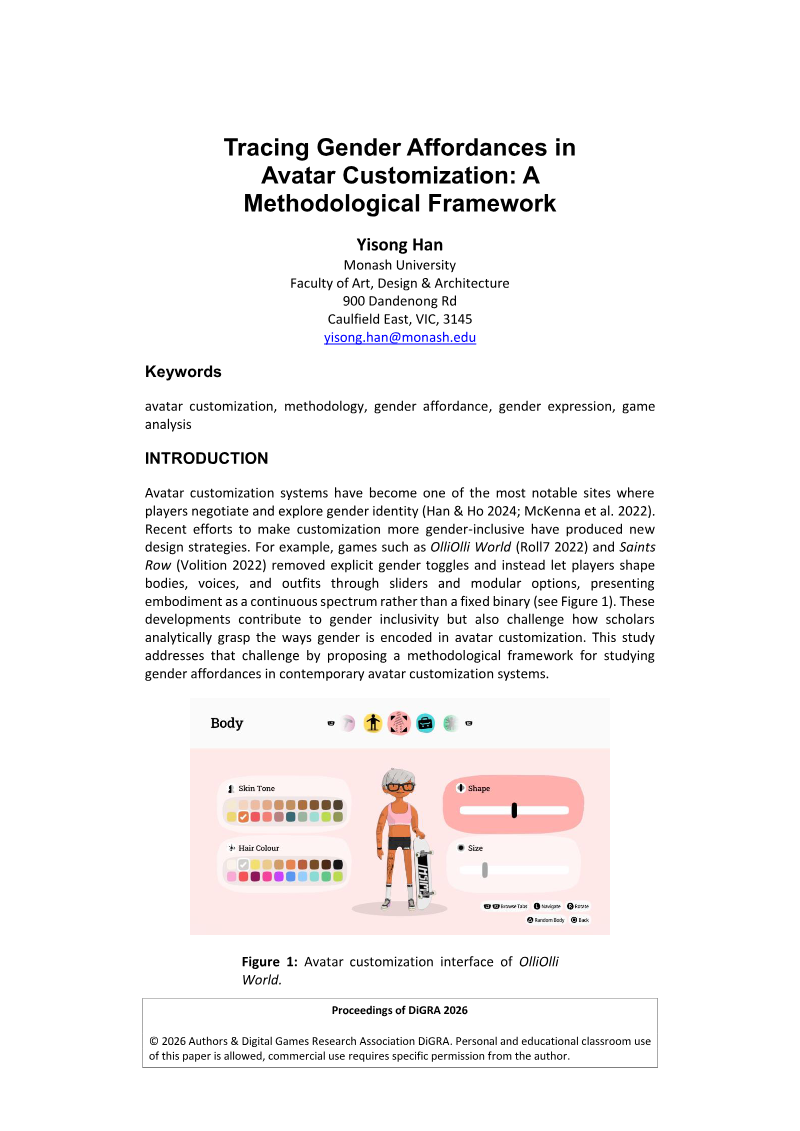
Tracing Gender Affordances in Avatar Customization: A Methodological Framework
Han's paper proposes a methodological framework for analyzing gender affordances in avatar customization systems, arguing that gender is not encoded in a single toggle but is distributed across interacting options, boundaries, and defaults.
- Gender in avatar customization systems is not encoded in a single toggle but is distributed across interacting options, boundaries, and defaults, so analysis focused on visible gender widgets misses how gender is actually constituted.
- Han critiques McArthur et al.'s Avatar Affordance Framework for focusing too narrowly on visible widgets, and builds on Butler's notion of performatively constituted gender and Iantorno and Consalvo's work on intersecting class, race, and gender in CRPG character creators.
- The proposed framework rests on four analytical lenses: Gender-Related Options, Option Interactions and Navigational Distance, Boundaries of Gender Expression, and Defaults and Invisible Rules.

Challenging the User-Avatar Dichotomy in Avatar Customization Research
Victoria McArthur's 2018 Eludamos article challenges the dominant "user-avatar dichotomy" in avatar customization research, which treats avatars as objects shaped primarily by users' identity motivations.
- Avatars should be understood as emerging from heterogeneous actor-networks that include interface affordances, game-world aesthetics, co-situated players, and socio-cultural ideologies, not merely as tools of user identity expression.
- Interfaces are active co-constructors of identity rather than neutral tools, so self-representation research must move beyond anthropocentric frameworks.
- Designers now control the range of customization options available to players, and default avatars (such as The Sims' white male character) carry social stigma while reinforcing dominant cultural assumptions.
Ethical Recognition of Marginalized Groups in Digital Games Culture
This paper argues that moral agents within digital games culture, including publishers, developers, critics, researchers, and players, bear an ethical obligation to promote equal treatment, opportunities, and justice for marginalized groups.
- The paper argues that everyone in games culture, including publishers, developers, critics, researchers, and players, has an ethical obligation to promote equal treatment and justice for marginalized groups, with recognition extending beyond representation to visibility, participation, platform access, and power redistribution.
- Industry data from the IGDA Diversity Report 2014 indicate the Western games workforce is roughly 79% White and 86% heterosexual, while character studies find White characters make up about 70–74% of those reviewed.
- Female characters account for only about 10–15% of characters across major studies, and non-heterosexual characters are rare.
Understanding Videogame Cities
"Understanding Videogame Cities" argues that fictional game cities can be analyzed with the same rigor applied to physical cities, using Saints Row: The Third's Steelport as its central case.
- The report argues that fictional videogame cities can be analyzed with the same rigor as physical cities, using a three-part framework of constitutional, representational, and experiential orders that blends Lefebvre's spatial triad with Douglas Allen's criteria.
- Its central thesis is that a city's character emerges from the interplay between its built structure, its visual and symbolic representation, and the embodied experience of moving through it.
- Using Saints Row: The Third's Steelport (2011) as the central case, the analysis finds that territory control and monuments, such as the Magarac Island statue destroyed late in the game, visibly express the city's power dynamics.
Companies behind it
As the documents state it.