Fire Emblem: Three Houses
Game
7 documents in the library are about Fire Emblem: Three Houses, from writers such as Breda University of Applied Sciences, Nintendo and DiGRA. Each has a summary and key insights with the page they come from.
Connections
Each row is a game or company named alongside Fire Emblem: Three Houses, each column a document, oldest first. A mark means that document names it. Select a row to see those documents.
Documents about Fire Emblem: Three Houses
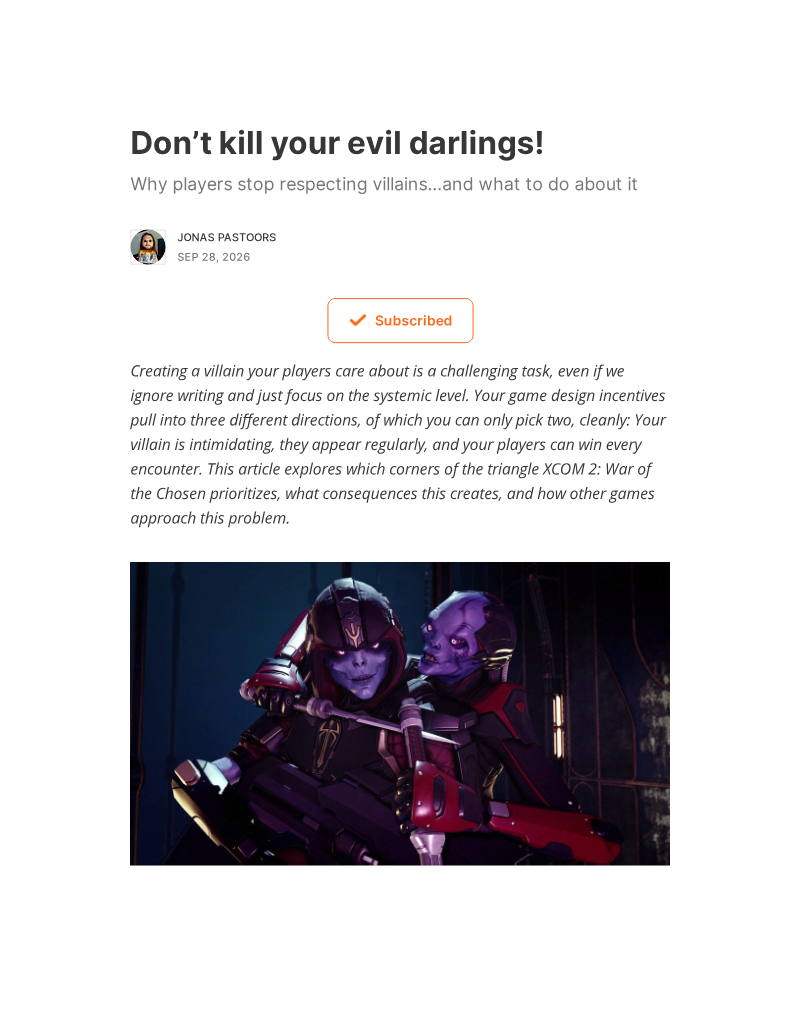
Don't Kill Your Evil Darlings! Why Players Stop Respecting Villains...and What to Do About It
This essay is an opinion-driven design analysis rather than an empirical study, so it presents no survey data, sample sizes, or statistics.
- Game villains face a "design triangle" in which recurrence, intimidating aura, and player beatability can be achieved together only by compromising one of the three.
- Villain decay, the loss of menace over repeated appearances, is the central problem the essay examines, framed through the established villain decay trope.
- XCOM 2: War of the Chosen is praised for keeping its recurring Chosen antagonists threatening by letting players temporarily kill them while the narrative explains their respawns.
A Class on Narrative Frames (and Advanced Murder): What 'Fire Emblem: Three Houses' Knows About Casting the Player's Role
This article examines how the player's narrative role relative to the characters on their team shapes the emotional bonds that develop between them.
- Narrative framing of the player's role strongly shapes emotional bonds with team characters: games that cast the player as a responsible figure, like the professor in Fire Emblem: Three Houses, align the player's incentives with nurturing those characters.
- The article's central thesis is that pairing great power over a crew with a strong sense of responsibility can pre-load the emotional experience a designer intends, with incentive alignment between player and characters as the key variable.
- Games are contrasted by player position: RimWorld casts the player as an external force with supernatural influence but no social identity, while XCOM 2 and Darkest Dungeon create commander responsibilities, with Darkest Dungeon deliberately undermining them through an employer-employee dynamic built on disposability.
Lifting the Fog of War: Militarism, Colonialism and Encyclopedic Pleasures in Digital Play
This paper examines the design concept of fog of war (FOW), the limiting of visible information in strategy and exploration games, and argues that its meaning has shifted from a representation of military risk and uncertainty to a source of exploratory pleasure in entertainment gaming.
- The paper argues that the 'fog of war' mechanic has shifted meaning from representing military risk and uncertainty to a source of exploratory pleasure, with the obscured map reframed as 'unfinished business' inviting players to uncover the game world.
- Its central thesis is that 'lifting the fog' in contemporary games enacts a colonial fantasy in which unexplored terrain is cast as terra incognita, a space of untapped potential to be mapped and possessed, obscuring the violence of colonial cartography.
- The authors contend that fog-as-fun parallels the goal of military simulation: eliminating friction and uncertainty to create a 'closed world' that can be fully known and controlled.
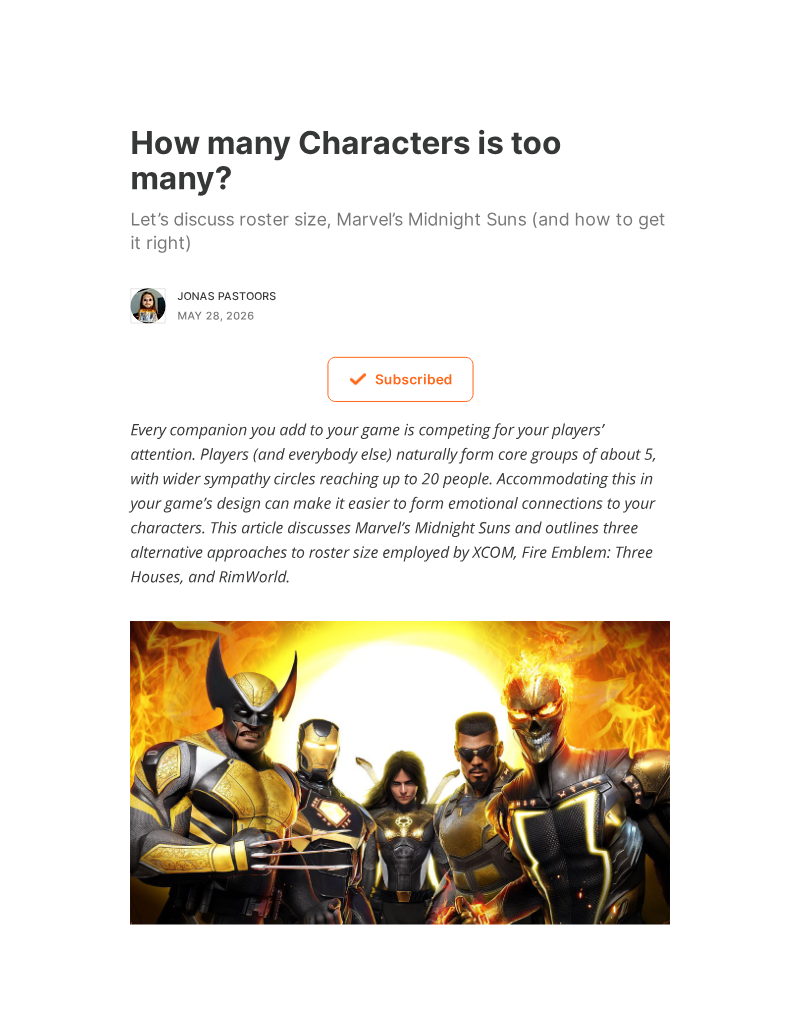
How Many Characters Is Too Many? Let's Discuss Roster Size, Marvel's Midnight Suns (and How to Get It Right)
This essay examines how the number of companion characters in a game affects player attention and emotional attachment, using Marvel's Midnight Suns as its central case study.
- Dunbar's Number suggests people maintain a close 'support clique' of about five people and a wider 'sympathy group' of roughly 10 to 20, and the author argues game rosters should respect these social limits because an oversized cast dilutes emotional attachment to individual characters.
- Marvel's Midnight Suns has 13 fully voiced heroes in its base game and 17 with DLC, a total the author considers within the sympathy group range, yet the game lacks a mechanism for players to naturally form a core group of regulars.
- In Midnight Suns, a three-hero combat team limit and friendship progress gating legendary abilities and cosmetics force players to either narrow their focus to two or three favorites and forfeit content, or spread attention across the whole roster, which makes attachment to any single character difficult.
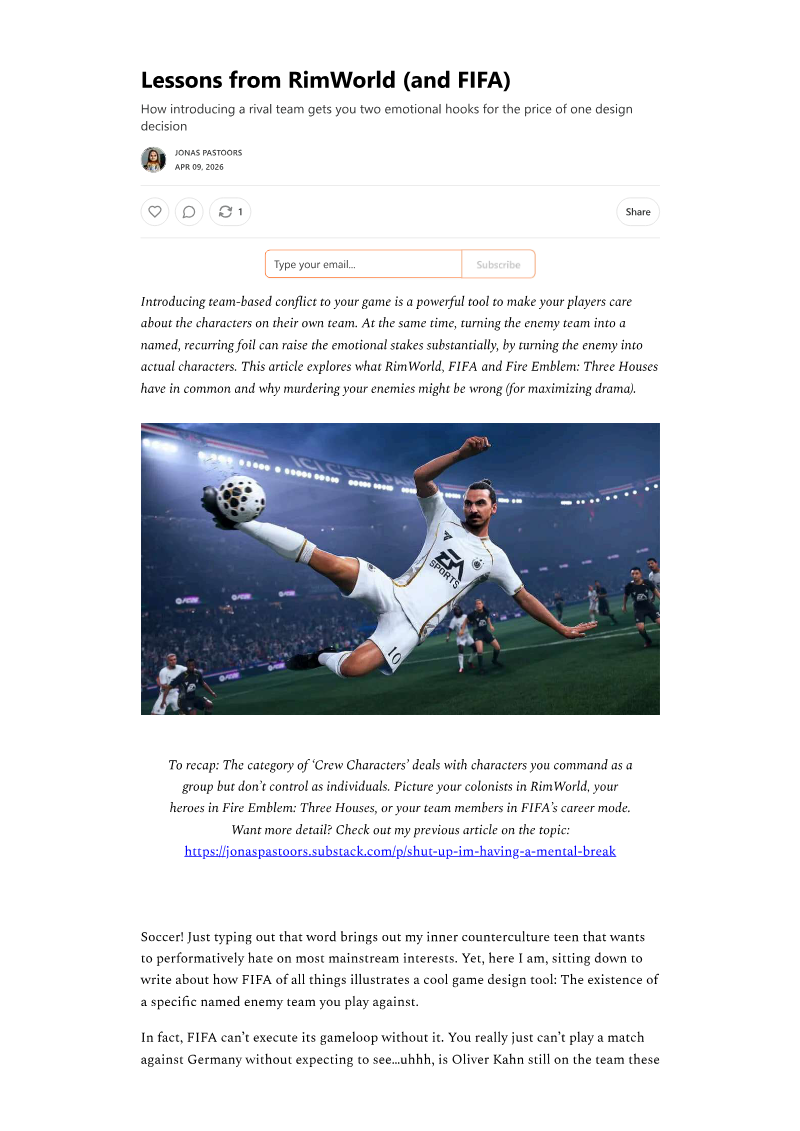
Lessons from RimWorld (and FIFA): How Introducing a Rival Team Gets You Two Emotional Hooks for the Price of One Design Decision
Jonas Pastoors argues that introducing a named rival team into a game creates two emotional hooks from a single design decision: players bond more quickly with their own team, and they develop a personal grudge against recurring enemy characters.
- Introducing a named rival team creates two emotional hooks from one design decision: faster bonding with the player's own team and a personal grudge against recurring enemy characters, drawing on intergroup empathy bias.
- In the author's small study, in-group empathy and out-group counter-empathy appeared almost immediately after participants were assigned to a competing team, and the bias strengthened as play continued.
- The intergroup bias was strongest when the contest was close and the rival posed a real threat, and weakened when the player easily dominated the opposition, suggesting challenging flow states heighten the effect.
Nintendo Financial Results Briefing: Six Months Fiscal Year Ending March 2020
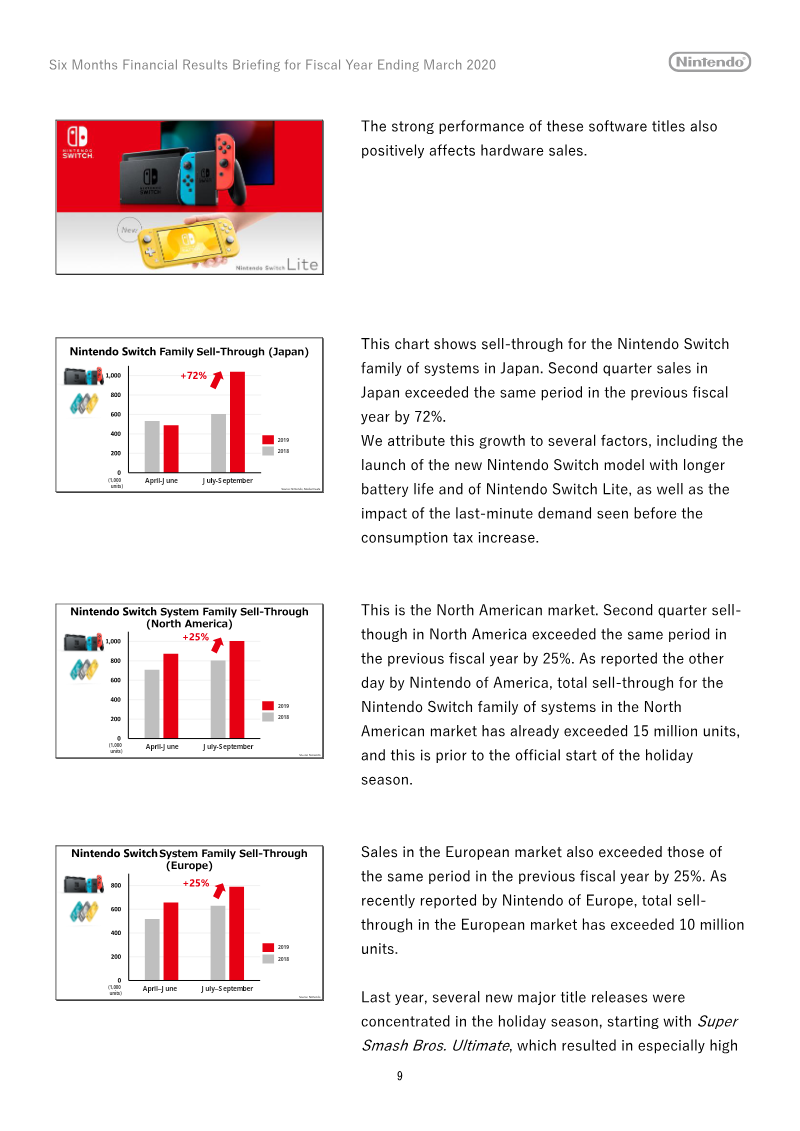
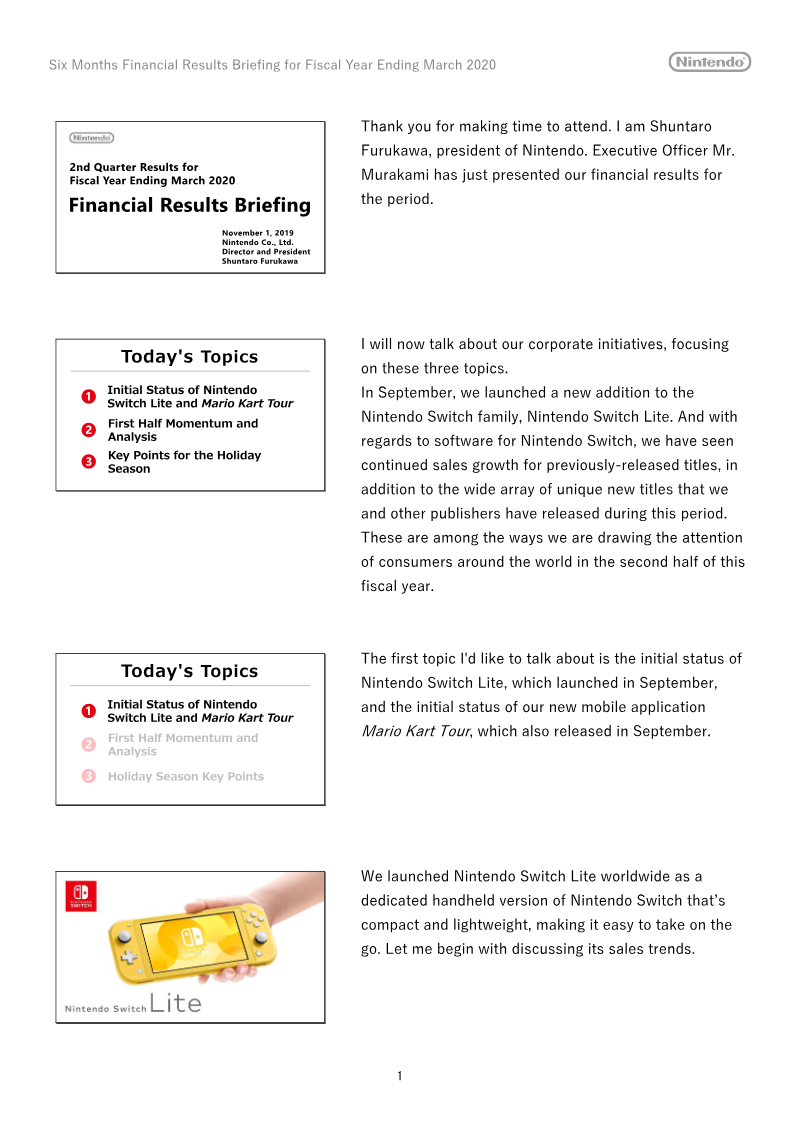
The Nintendo financial results briefing for the first half of the fiscal year ending March 2020 highlights strong momentum for the Nintendo Switch platform, driven by the successful launch of the Nintendo Switch Lite and a robust software library.
- First-party software sell-through grew 53% year over year in April through September 2019, driven by titles including Super Mario Maker 2, Fire Emblem: Three Houses, and The Legend of Zelda: Link's Awakening.
- Fire Emblem: Three Houses achieved the best start in its series history.
- Titles released before March 2019 accounted for over 60% of total software sell-through, highlighting the long-term value of the Switch library.

Nintendo Consolidated Financial Highlights: Six Months Ended September 30, 2019
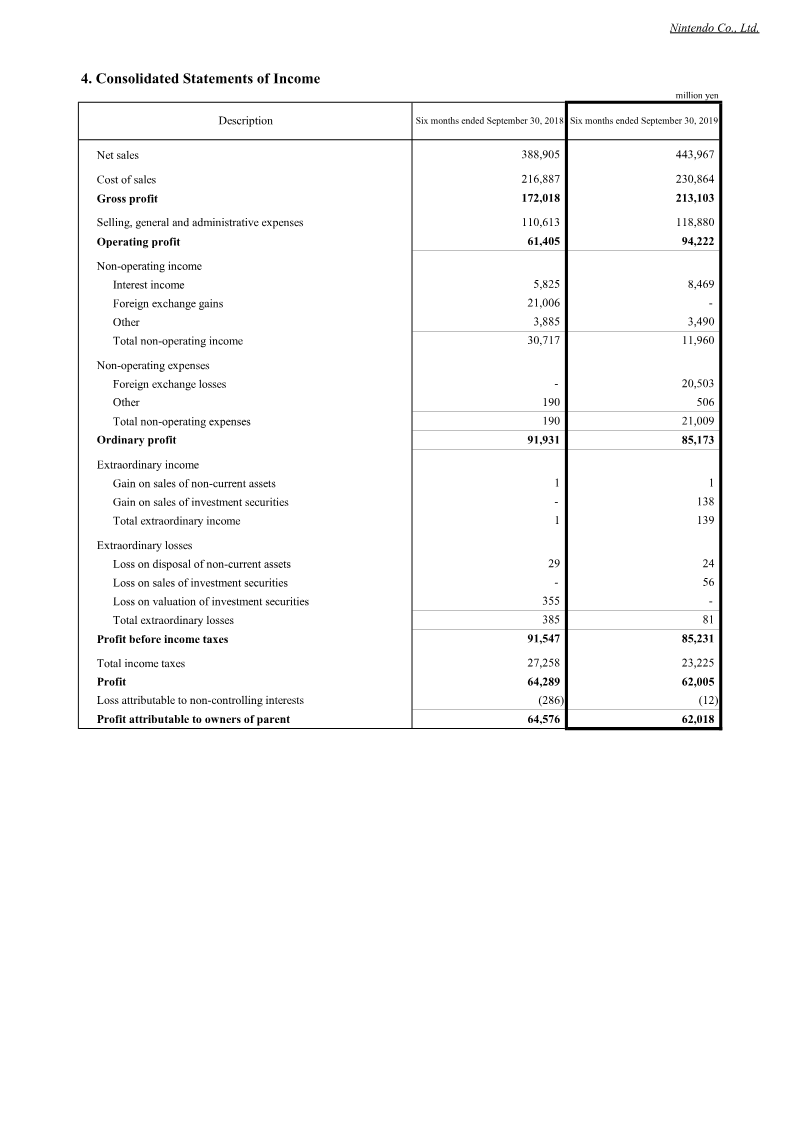
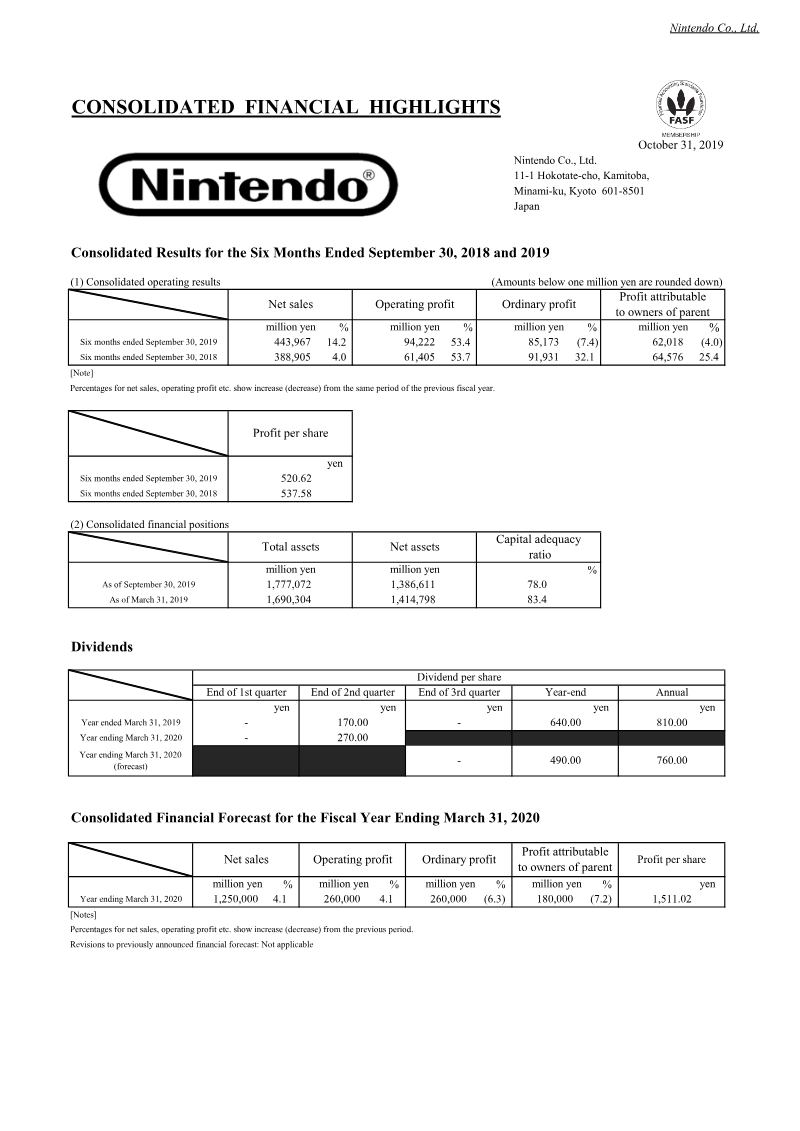
Nintendo’s consolidated financial results for the six-month period ending September 30, 2019, demonstrate strong growth driven primarily by the expansion of the Nintendo Switch platform.
- Nintendo’s operating profit grew 53.4% to 94.2 billion yen, while net sales increased 14.2% to 443.9 billion yen for the six months ending September 30, 2019.
- Nintendo Switch hardware sales rose 36.7% to 6.93 million units, and software sales increased 38.8% to 58.49 million units, driven by new hardware models and key titles like Super Mario Maker 2.
- Digital business revenue surged 83.0% year-on-year to 71.6 billion yen, bolstered by strong performance in downloadable software and the Nintendo Switch Online service.