Donkey Kong
Game
Documents about Donkey Kong
Article
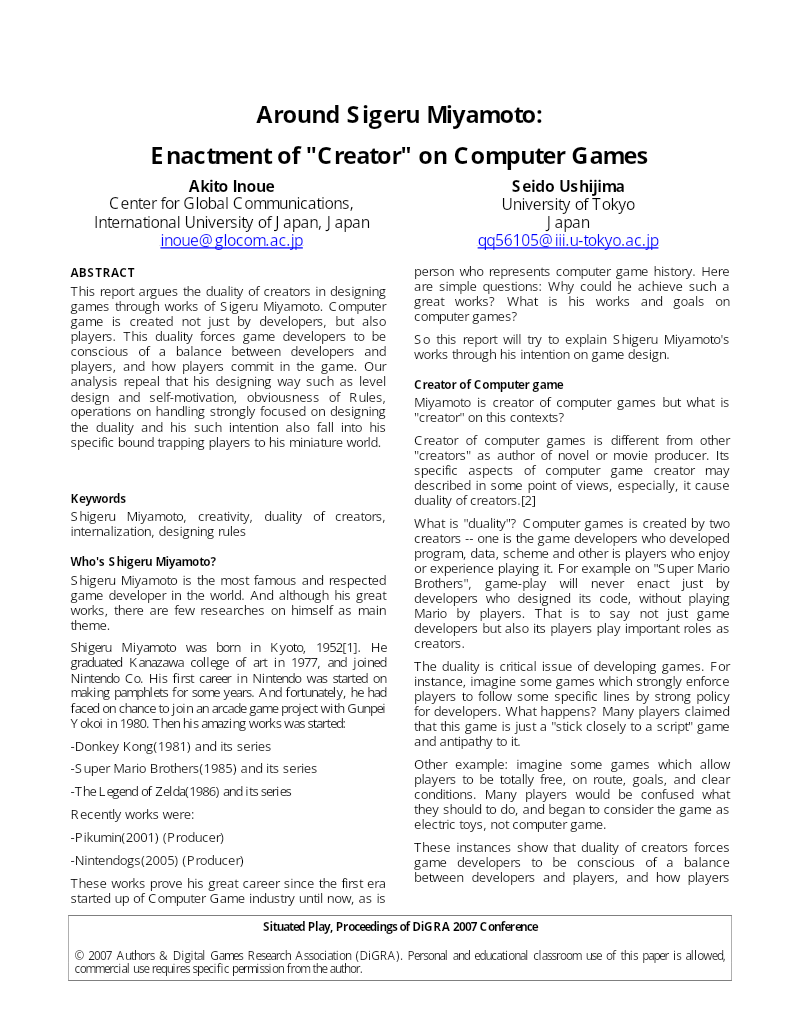
Around Sigeru Miyamoto: Enactment of "Creator" on Computer Games
This paper examines the work of Shigeru Miyamoto through the lens of the "duality of creators," the idea that computer games are authored jointly by developers, who build the program and rules, and by players, whose engagement completes the work.
- Miyamoto's design rests on a 'duality of creators': developers build the program and rules, while players complete the work through their engagement, and his designs aimed to make players feel creative while subtly shaping how they play.
- Miyamoto introduced challenges in staged progression (remembering, then practicing, then applying a mechanic) and favored rules players could absorb without conscious effort rather than treating player freedom as unqualified good.
- Miyamoto's stated preference for 'golf-type' games with clear, immediately understood goals over 'baseball-type' games with complex rule sets is presented as a deliberate choice that shapes how play becomes internalized.
DiGRAJan 2007
Article
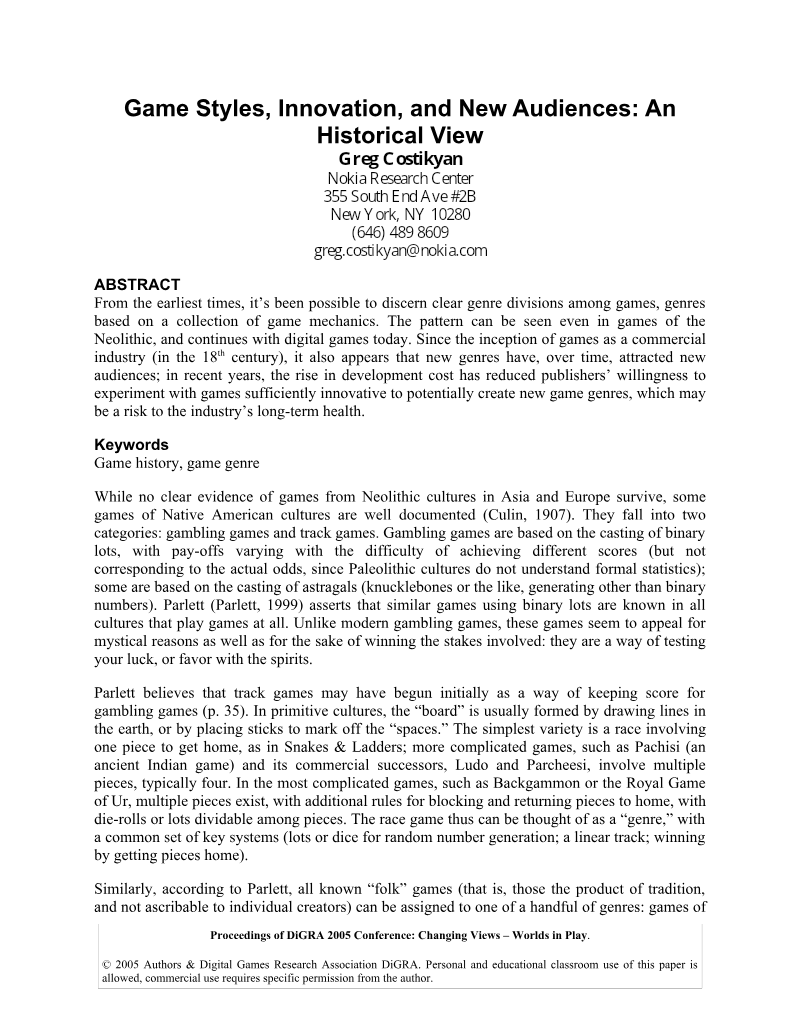
Game Styles, Innovation, and New Audiences: An Historical View
Costikyan's paper argues that games have always been organized into genres defined not by theme but by shared core mechanics, and that new genres, once discovered, drive a wave of imitation and, in turn, attract new audiences.
- Games are organized into genres defined by shared core mechanics rather than theme, and new genres, once discovered, spawn waves of imitation and attract new audiences.
- The largest commercial successes typically arise from genuinely new genres that discover new 'peaks' in gameplay space, rather than from refinements of existing ones, making such innovation the most valuable contribution a designer can make.
- Rising development costs have made publishers increasingly reluctant to take risks on experimental designs, which the author warns may threaten the games industry's long-term health.
DiGRAJan 2005
Companies behind it

As the documents state it.