Design Home
Game
20 documents in the library are about Design Home, from writers such as Deconstructor of Fun, SuperJoost and GameRefinery. Each has a summary and key insights with the page they come from.
Connections
Each row is a game or company named alongside Design Home, each column a document, oldest first. A mark means that document names it. Select a row to see those documents.
Key figures from the reports
User retention metrics for Design Home lag behind top-tier simulation games, with a 29% Day 1 retention rate compared to the 49% industry benchmark, and a 5% Day 30 retention rate versus the 9% average.
Udonis, 2021 · Design Home Analysis: Targeting Millennial Women
Design Home, launched in 2016, has scaled to over one million daily active users and generated more than 215 million dollars in bookings by blending interior design mechanics with real-world brand partnerships.
PocketGamer.biz, 2019 · Redefining play – Blurring the lines between app and game, p. 1
Glu Mobile's acquisition of Crowdstar for approximately $50 million has been a primary driver of its financial turnaround, with Crowdstar's titles, Covet Fashion and Design Home, accounting for over 50% of Glu's revenue in Q2 2018.
Mobile Dev Memo, 2018 · As Glu’s Stock Price Soars, Its Crowdstar Acquisition Looks Prescient
Documents about Design Home

BITKRAFT Summit Day 2: Scaling Today's Consumer Apps with Dani Tran, Xiang Shen, Mark van Ryswyk
This discussion explores strategies for scaling consumer applications and games by integrating engagement loops, data-driven development, and nuanced market positioning.
- Validate product concepts early using CPI testing, gameplay video analysis, and retention metrics before committing significant development resources.
- Design monetization strategies that align with the user journey starting from the first seven days of engagement, as product development and business models are inseparable.
- Navigate the post-IDFA landscape by leveraging advanced ad technology and performance marketing to identify and target high-value user cohorts.

TWiG #367: A Certain IPO, 2026's 1st Cozy Launch & When CEOs Get Sued
Corporate governance and strategic pivots define the current landscape of the interactive entertainment industry.
- Shareholders have initiated legal action against former Activision Blizzard CEO Bobby Kotick, alleging that the $69 billion acquisition process prioritized personal financial gain and legal protection over fiduciary duties.
- Adtech firm Liftoff has reached a $4 billion valuation via IPO, signaling a growing industry reliance on AI-driven user acquisition financing to maintain growth despite significant debt burdens.
- Major publishers like Krafton are shifting strategies toward operational efficiency by leveraging AI-integrated development and user-generated content to scale established intellectual property like PUBG.

Redecor: Playtika’s Reverse Midas Touch
Redecor, a competitive home design mobile game, experienced a significant decline in player retention and revenue following its acquisition by Playtika for $400 million in 2021.
- Playtika’s acquisition of Redecor for over $400 million in September 2021 has resulted in a performance decline, with the game experiencing a 46% drop in monthly active users between July and October 2022.
- Applying social casino monetization tactics to Redecor—a game with a different audience profile and higher price sensitivity—has led to a decrease in revenue per download (RPD), making it the only game in Playtika’s portfolio to see such a decline over the past year.
- Redecor’s D90 retention has steadily declined throughout 2022, indicating that aggressive live-ops changes aimed at squeezing more value from existing players have failed to foster long-term engagement.

TWIG #178 EA’s acquisition of Glu does not seem to be going according to the plan…
Electronic Arts’ acquisition of Glu Mobile faces significant performance challenges, as evidenced by a decline in the revenue and download metrics of key acquired titles.
- Electronic Arts’ acquisition of Glu Mobile is underperforming, as key titles including Golf Clash, Design Home, Covet Fashion, Kim Kardashian: Hollywood, and MLB Tap Sports show consistent declines in both revenue and user acquisition.
- While EA reported a 68 percent growth in mobile bookings for Q3 2022, this increase was driven by the consolidation of acquired portfolios rather than organic growth within the business.
- The integration of Glu assets is hindered by a significant exodus of leadership talent from the acquired studios, threatening the long-term viability of the portfolio.
Casual Gaming Trends Snapshot Report
GameRefinery's March 2022 analysis of the US casual mobile market argues that competition is intense and that success increasingly depends on meta layers built around core gameplay.
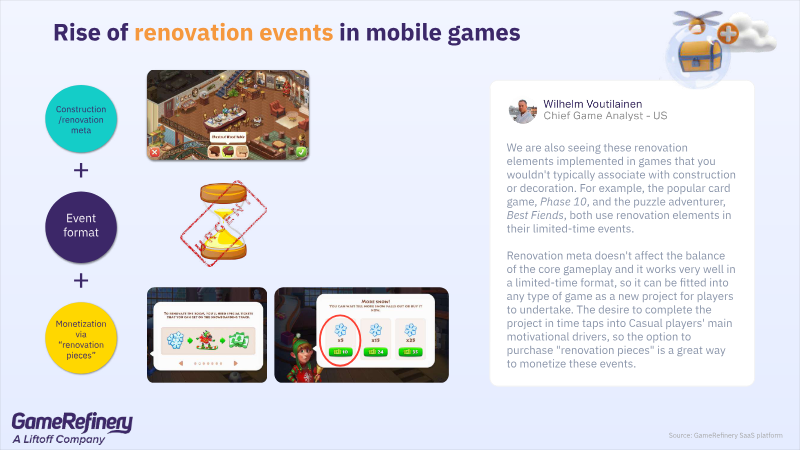
- Every top-100 casual game released in the last two years now incorporates renovation elements to drive visual progression and player satisfaction.
- The integration of construction mechanics in top Match3 games has surged from 7% to 49% over the past six years.
- 70% of top-grossing Match3 titles currently utilize hybrid designs that blend core puzzle mechanics with complex meta-layers like RPG elements or collectibles.

Research Methods to Improve Live Game Retention, D1 to D100
Games user experience research serves as a critical bridge between raw telemetry data and actionable design improvements, specifically targeting the enhancement of player retention from the first day through the hundredth.
- Improving player retention from D1 to D100 requires a mixed-methodology approach that combines quantitative A/B testing with qualitative insights to identify the 'why' behind churn.
- Mobile titles like Design Home and Cooking Dash successfully improved retention by using granular funnel tracking to pinpoint specific usability hurdles.
- Longitudinal research tools, such as ten-day diary studies, are essential for observing player behavior over time and refining complex late-game systems.
How the Games Industry M&A Frenzy is Making New Genre Leaders in Mobile
Sustained mergers and acquisitions are reshaping genre leadership in U.S. mobile gaming, with a single major deal or string of smaller purchases able to elevate a publisher to category leader in a short time.
- The mobile gaming industry is experiencing a significant M&A frenzy, driven by a maturing market, a lockdown-induced bump, and intense competition, allowing major publishers to quickly become genre leaders.
- EA became the No. 1 mobile Sports games publisher by U.S. revenue ($176 million) and the No. 1 Lifestyle games publisher ($123 million) between January 1 and August 31, 2021, largely due to its acquisitions of Glu Mobile and Playdemic.
- Activision Blizzard (including King) maintained its position as the No. 1 publisher in the Puzzle genre, generating approximately $873 million in U.S. player spending from January 1 to August 31, 2021, with Candy Crush Saga performing strongly.

TWIG 148: China curbs playtime + Nexters SPACs at $1.9B + Playtika acquires Reworks for $400M cash
The gaming industry is currently navigating significant regulatory shifts in China, where new government mandates restrict individuals under the age of 18 to three hours of video game playtime per week.
- New Chinese regulations restrict minors to three hours of gaming per week, limited to one hour daily between 8:00 p.m. and 9:00 p.m. on Fridays, weekends, and holidays, forcing Chinese developers to pivot toward Western markets.
- Playtika acquired an 80% stake in Reworks for $400 million in cash, with an option to purchase the remainder for up to $200 million to compete in the design entertainment app market.
- Mobile developer Nexters went public via SPAC at a $1.9 billion valuation, aiming to consolidate the Eastern European and Russian markets despite concerns over its reliance on the $20 million monthly revenue generated by Hero Wars.

Design Home Analysis: Targeting Millennial Women
Design Home, CrowdStar's interior design simulation game (later under Glu), is analyzed as a case study in how a mobile title built around Millennial women has sustained success since its 2016 launch.
- Design Home targets Millennial women (ages 25–34) by offering a digital escape that allows them to simulate the fantasy of home ownership and interior design, addressing a demographic often priced out of the real-estate market.
- The game differentiates itself through a unique monetization and engagement model that features real-world furniture brands like West Elm, Kathy Kuo, and Pottery Barn, creating a revenue stream while enhancing player immersion.
- Despite being released in 2016, the game remains a top-grossing simulation title, achieving 6 million downloads in 2020 and maintaining a peak of 1.2 million daily active users in May 2020.

How to Crack the Match 3 Code: Part 2
Match 3 is splitting into Classic and Meta camps, and both face steep barriers to entry in 2020; the way forward, this guest analysis by UX strategist Om Tandon argues, lies in experimentation, genre blending, and new audiences.
- The Match 3 genre has high barriers to entry due to established giants like King, which is evolving Candy Crush Saga by adding secondary meta goals and events, and aggressive UA spending by competitors like Playrix.
- Successful new entrants are increasingly using 'genre blending' to target specific audiences outside the classic Match 3 demographic, such as Storm8’s use of realistic home decoration and real-world IP in Property Brothers Home Design.
- Data indicates that 'Collapse' mechanics are currently outperforming 'Swipe' mechanics in the meta-driven puzzle market, as evidenced by the success of Property Brothers compared to its identical Swipe-based predecessor.
Unity Readies up for IPO Roadshow: Can It Get Out of Epic's Shadow?
Unity is positioning itself for an IPO by pairing CEO John Riccitiello's Bloomberg interviews and revenue disclosure (about $500MM) with its acquisitions of Bolt and Finger Food, one of its largest purchases to date.
- Unity Technologies is preparing for an IPO with $500 million in revenue while attempting to differentiate itself from Epic Games through acquisitions like Bolt and Finger Food and expansion into non-gaming verticals.
- Tencent’s online game revenue grew 31% year-over-year to $5.3 billion, highlighting strong performance in the Asian market during early 2020.
- Sony’s annual gaming revenue declined 14% to $18 billion as the PlayStation 4 lifecycle ended, though its PlayStation Plus service reached 41.5 million subscribers.
Is Twitch Losing the Live Streaming Wars?
Twitch's position as the leader of live game streaming is increasingly vulnerable, according to this January 2020 industry newsletter, which argues that the platform lacks a convincing second act despite its Amazon backing and 2014 acquisition for $970 million.
- Twitch underperformed in 2019, generating approximately $300 million in revenue against internal projections of $500 million to $600 million.
- YouTube is aggressively challenging Twitch’s dominance in esports by securing exclusive broadcast rights for Activision Blizzard’s Overwatch and Call of Duty Leagues.
- Twitch’s market position is threatened by a lack of a clear 'second act' and a heavy reliance on ad monetization and a limited number of core titles like League of Legends.
Companies behind it

As the documents state it.