Design Home
Game
Documents about Design Home

Redecor: Playtika’s Reverse Midas Touch
Redecor, a competitive home design mobile game, experienced a significant decline in player retention and revenue following its acquisition by Playtika for $400 million in 2021.
- Playtika’s acquisition of Redecor for over $400 million in September 2021 has resulted in a performance decline, with the game experiencing a 46% drop in monthly active users between July and October 2022.
- Applying social casino monetization tactics to Redecor—a game with a different audience profile and higher price sensitivity—has led to a decrease in revenue per download (RPD), making it the only game in Playtika’s portfolio to see such a decline over the past year.
- Redecor’s D90 retention has steadily declined throughout 2022, indicating that aggressive live-ops changes aimed at squeezing more value from existing players have failed to foster long-term engagement.
How the Games Industry M&A Frenzy is Making New Genre Leaders in Mobile
Sustained mergers and acquisitions are reshaping genre leadership in U.S. mobile gaming, with a single major deal or string of smaller purchases able to elevate a publisher to category leader in a short time.
- The mobile gaming industry is experiencing a significant M&A frenzy, driven by a maturing market, a lockdown-induced bump, and intense competition, allowing major publishers to quickly become genre leaders.
- EA became the No. 1 mobile Sports games publisher by U.S. revenue ($176 million) and the No. 1 Lifestyle games publisher ($123 million) between January 1 and August 31, 2021, largely due to its acquisitions of Glu Mobile and Playdemic.
- Activision Blizzard (including King) maintained its position as the No. 1 publisher in the Puzzle genre, generating approximately $873 million in U.S. player spending from January 1 to August 31, 2021, with Candy Crush Saga performing strongly.

Design Home Analysis: Targeting Millennial Women
Design Home, CrowdStar's interior design simulation game (later under Glu), is analyzed as a case study in how a mobile title built around Millennial women has sustained success since its 2016 launch.
- Design Home targets Millennial women (ages 25–34) by offering a digital escape that allows them to simulate the fantasy of home ownership and interior design, addressing a demographic often priced out of the real-estate market.
- The game differentiates itself through a unique monetization and engagement model that features real-world furniture brands like West Elm, Kathy Kuo, and Pottery Barn, creating a revenue stream while enhancing player immersion.
- Despite being released in 2016, the game remains a top-grossing simulation title, achieving 6 million downloads in 2020 and maintaining a peak of 1.2 million daily active users in May 2020.

How to Crack the Match 3 Code: Part 2
Match 3 is splitting into Classic and Meta camps, and both face steep barriers to entry in 2020; the way forward, this guest analysis by UX strategist Om Tandon argues, lies in experimentation, genre blending, and new audiences.
- The Match 3 genre has high barriers to entry due to established giants like King, which is evolving Candy Crush Saga by adding secondary meta goals and events, and aggressive UA spending by competitors like Playrix.
- Successful new entrants are increasingly using 'genre blending' to target specific audiences outside the classic Match 3 demographic, such as Storm8’s use of realistic home decoration and real-world IP in Property Brothers Home Design.
- Data indicates that 'Collapse' mechanics are currently outperforming 'Swipe' mechanics in the meta-driven puzzle market, as evidenced by the success of Property Brothers compared to its identical Swipe-based predecessor.
Unity Readies up for IPO Roadshow: Can It Get Out of Epic's Shadow?
Unity is positioning itself for an IPO by pairing CEO John Riccitiello's Bloomberg interviews and revenue disclosure (about $500MM) with its acquisitions of Bolt and Finger Food, one of its largest purchases to date.
- Unity Technologies is preparing for an IPO with $500 million in revenue while attempting to differentiate itself from Epic Games through acquisitions like Bolt and Finger Food and expansion into non-gaming verticals.
- Tencent’s online game revenue grew 31% year-over-year to $5.3 billion, highlighting strong performance in the Asian market during early 2020.
- Sony’s annual gaming revenue declined 14% to $18 billion as the PlayStation 4 lifecycle ended, though its PlayStation Plus service reached 41.5 million subscribers.
Is Twitch Losing the Live Streaming Wars?
Twitch's position as the leader of live game streaming is increasingly vulnerable, according to this January 2020 industry newsletter, which argues that the platform lacks a convincing second act despite its Amazon backing and 2014 acquisition for $970 million.
- Twitch underperformed in 2019, generating approximately $300 million in revenue against internal projections of $500 million to $600 million.
- YouTube is aggressively challenging Twitch’s dominance in esports by securing exclusive broadcast rights for Activision Blizzard’s Overwatch and Call of Duty Leagues.
- Twitch’s market position is threatened by a lack of a clear 'second act' and a heavy reliance on ad monetization and a limited number of core titles like League of Legends.

2019 Predictions: Simulation & Customisation Games get Primed for Growth
Simulation and Lifestyle games, two casual-game categories often seen as stale and entrenched, are positioned for further growth in 2019.
- The Simulation category experienced significant growth in 2018, with revenues increasing by over 20% to approximately $1.1 billion and total installs rising by 13% to 463 million.
- Cooking Craze achieved the top grossing position in the time management sub-category in 2018 with $46 million in revenue, representing 182% growth compared to 2017 despite having fewer downloads than its competitors.
- Interactive Story games saw a 50% revenue increase in 2018, though the category faces challenges with low retention and a lack of social or progression mechanics, leaving market dominance to established leaders like Choices and Episode.

As Glu’s Stock Price Soars, Its Crowdstar Acquisition Looks Prescient
Glu Mobile's November 2016 acquisition of a controlling stake in Covet Fashion developer Crowdstar, at roughly $45MM, has proven to be one of the shrewdest deals in mobile gaming history.
- Glu Mobile's acquisition of Crowdstar for approximately $50 million has been a primary driver of its financial turnaround, with Crowdstar's titles, Covet Fashion and Design Home, accounting for over 50% of Glu's revenue in Q2 2018.
- Glu's stock price increased nearly 300% between November 2016 and August 2018, rising from $1.91 to $7.57 per share.
- The company is successfully transitioning toward profitability by stabilizing losses while growing top-line revenue, reporting a $4.4 million loss on $90.2 million in revenue for Q2 2018 compared to a $23.6 million loss on $68.7 million in revenue for Q2 2017.

Industry Update: Q3 2018
This weekly industry newsletter from Q3 2018 combines a personal essay with news items and quarterly earnings snapshots across games, media, and emerging technology.
- Sony achieved record operating profits in Q3 2018, supported by total PlayStation 4 hardware sales reaching 82.2 million units.
- Nintendo generated $1.51 billion in revenue, though analysts remain skeptical of the company's ability to meet its 20-million-unit annual sales target for the Switch.
- Activision Blizzard experienced a 14% decline in Blizzard revenue, a downturn attributed to increased market competition from Fortnite.

Predictions for 2018: Casual Games
Casual mobile games in 2017 saw a market where soaring cost per install has pushed developers toward deeper, better-retaining, better-monetizing products.
- Rising user acquisition costs have forced casual game developers to shift focus from simple portfolio expansion to creating deeper, higher-LTV titles with advanced mechanics.
- Playrix has emerged as a dominant force in the puzzle category, leveraging gameplay innovations and cross-promotion across its titles to challenge industry leader King.
- The hyper-casual market is experiencing a surge in growth driven by short, ad-monetized gameplay loops, leading to industry consolidation as major publishers acquire smaller developers to secure talent and scale.
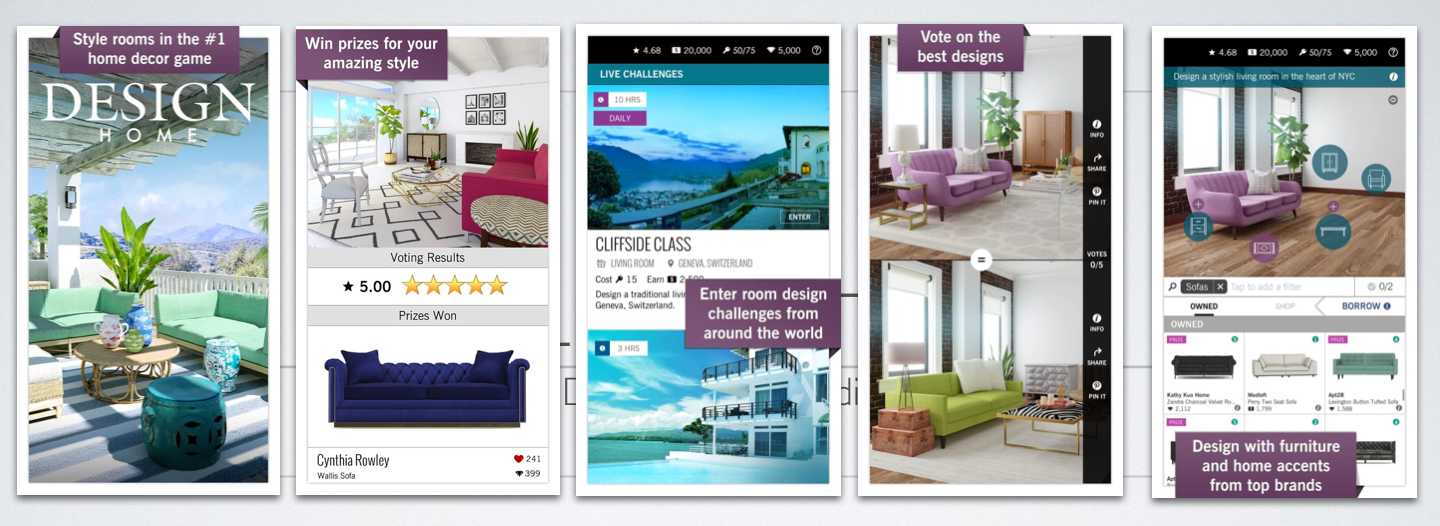
Design Home and the Art of Monopoly
Design Home, Crowdstar's interior decorating game, is analyzed as a rare success in "female first" mobile gaming, one that abandoned the cutesy, pink, animal-centric stereotypes common since Facebook embraced free-to-play.
- Crowdstar achieved market success by moving away from stereotypical 'female-first' gaming tropes toward a professional simulation model that treats players as interior designers rather than casual users.
- The game's core loop relies on a 'Key' system where players must vote on 45 other designs to earn enough currency to enter a single new competition, creating a self-sustaining social ecosystem.
- Monetization is driven by 'just-in-time' purchasing, where players spend currency to acquire specific furniture items required to complete a challenge and maintain a high community rating.

Can Mobile Gaming Companies Go Public Again?
Mobile gaming's relationship with public markets shifted markedly between the Zynga and King IPO era of 2012 to 2014 and autumn 2017, and Eric Seufert argues that the once-prevailing belief that public investors are structurally hostile to mobile games has become outdated.
- Public market sentiment toward mobile gaming has shifted from hostility to acceptance, evidenced by Rovio Entertainment’s 2017 IPO, which achieved an enterprise value exceeding $1 billion.
- The industry has moved beyond the 'hit-driven' model that caused early public failures like King, which saw its stock price drop significantly after its 2014 IPO before being acquired by Activision for $5.9 billion in 2015.
- Mobile gaming companies have matured their business models by mastering sustainable user acquisition, effective monetization, and the integration of brands to improve retention.
Companies behind it

As the documents state it.