Dear Esther
Game
Documents about Dear Esther
Whitepaper15 pages
First-Person Walkers: Understanding the Walker Experience through Four Design Themes
First-Person Walkers represent a distinct genre challenging conventional game definitions through their emphasis on minimal player interaction, deliberate pacing, and often ambiguous objectives.
- The report defines First-Person Walker games (e.g., Dear Esther, Proteus, Gone Home, The Stanley Parable) by constrained interaction, deliberately slow movement, and ambiguous goals, distinguishing them from combat-oriented shooters like Half-Life 2.
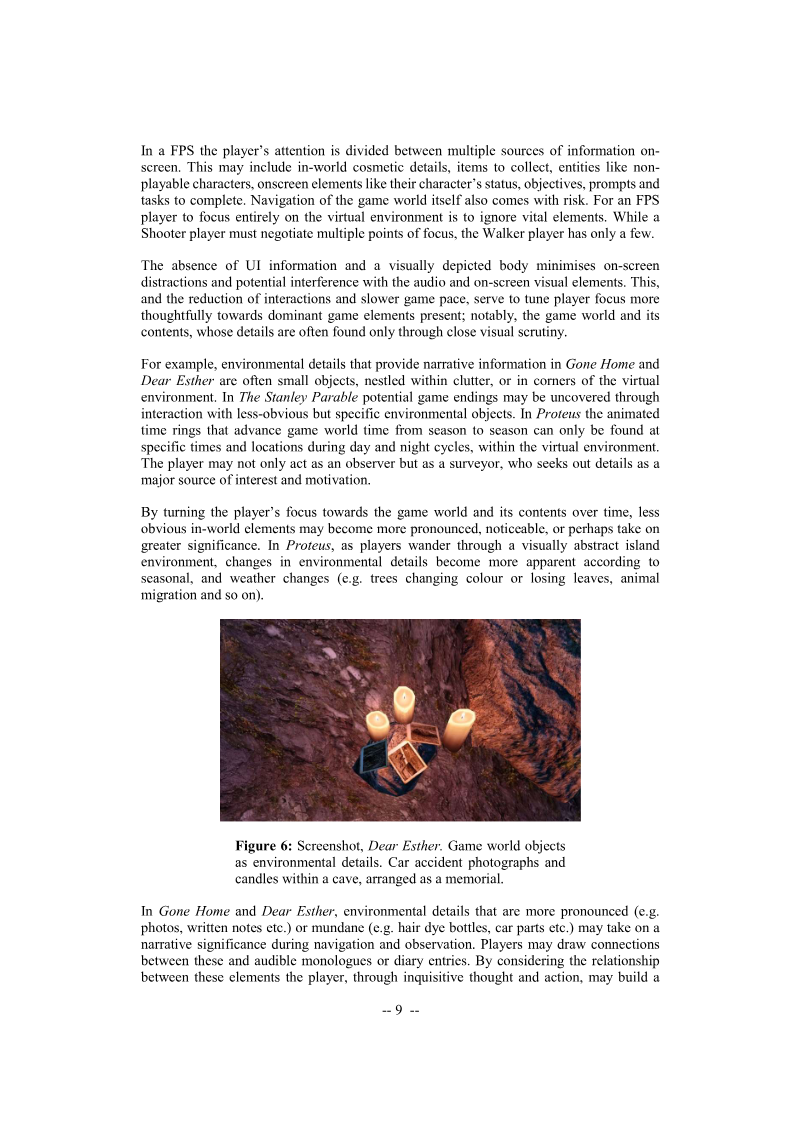
- Its central finding is that limited controls, the absence of obstacles, and contextual "use" actions lengthen the time players spend in each environment and shift them from active challengers into attentive observers.
- The study identifies four design themes (player interactivity, temporal space, player focus, and ambiguity), derived from a qualitative method combining interaction mapping, interface study, object inventory, and gameplay logging across four representative games.
DiGRAJan 2016
Whitepaper15 pages
Hackers and Cyborgs: Binary Domain and Two Formative Videogame Technicities
Brendan Keogh's paper "Hackers and Cyborgs: Binary Domain and Two Formative Videogame Technicities" uses Sega's Binary Domain as a lens for arguing that two competing modes of identifying with videogames have shaped the medium.
- Using Sega's Binary Domain as its lens, the paper treats the cyborg as a resistant and complementary perspective rather than a strictly opposed one, arguing the two identities are entangled and interdependent.
- The author contends the hacker ideal is masculinist and that this "technicity" influences which games get made, which are celebrated as exemplary, and how scholarly and popular discourse values the medium.
- Mainstream journalism and design privilege skill-based mastery, leading critics to dismiss exploration-focused and queer or women-created titles such as Dear Esther and Gone Home as "not real games," a rhetorical policing that also hits casual and avant-garde games reaching broader, more diverse audiences.
DiGRAJan 2015

Extra Credits8 min
Games You Might Not Have Tried - ep 3 - Find New Games - Extra Credits
This overview highlights a curated selection of diverse video games, emphasizing titles that offer unique mechanics, experimental narratives, or unconventional genre blends.
- Game design innovation often occurs through unconventional genre blending, such as the fusion of physics-based action with historical humor in Rock of Ages or the integration of grand strategy with RPG elements in King Arthur II.
- Meta-narrative and subversion of traditional tropes can redefine established genres, exemplified by Recettear’s approach to RPGs and the fast-paced, top-down shooter mechanics used to disrupt traditional MMO structures in Realm of the Mad God.
- Mobile platforms are capable of hosting high-quality, immersive experiences, as demonstrated by the horror title The Dark Meadow.
Extra CreditsMay 2012
Companies behind it
As the documents state it.