BioShock
Documents about BioShock
Combining Genres - How to Pick the Right Design Mechanics For Your Game - Extra Credits
Successful genre integration in game design requires a disciplined focus on the core player experience rather than the arbitrary combination of disparate mechanics.
- Successful genre blending must be driven by a clear, core emotional or aesthetic goal rather than personal preference or market trends.
- Designers should use secondary genres to fill functional gaps or address specific deficiencies within the primary gameplay loop.
- Every borrowed mechanic must be evaluated for its ability to reinforce the game's central purpose; otherwise, it risks creating a disjointed experience.
Graphics vs. Aesthetics - Why High Resolution Graphics Aren't Enough - Extra Credits
The distinction between graphics and aesthetics is a fundamental component of game design that is frequently misunderstood by both industry professionals and consumers.
- Aesthetics define a game's unified visual identity and emotional context, whereas graphics are merely the technical rendering capabilities like polygon counts and lighting.
- Prioritizing technical fidelity over a cohesive aesthetic often leads to bland, forgettable experiences and visual dissonance where imagery fails to support gameplay.
- Strong, deliberate aesthetic choices allow games to remain visually engaging over time, regardless of their technical limitations or aging hardware.

Bad Writing - Why Most Games Tell Bad Stories - Extra Credits
The primary thesis regarding the perceived poor quality of video game writing is that the industry conflates narrative with dialogue.
- The industry's primary failure in storytelling stems from conflating narrative with dialogue, ignoring that true game narrative is an integration of mechanics, art, level design, and UI.
- Narrative must be treated as a core architectural component from the start of development rather than an afterthought used to bridge gaps between gameplay segments.
- Developmental constraints, such as bringing writers in late to reconcile scripts with pre-existing mechanics or technical limitations, frequently undermine narrative cohesion.
Take-Two Interactive Form 10-Q: Q2 Fiscal Year 2011
Take-Two Interactive’s financial performance for the second fiscal quarter of 2011 reflects a strategic pivot toward core publishing operations, underscored by the divestiture of the Jack of all Games distribution business.
- Take-Two completed the sale of its 'Jack of all Games' third-party distribution business to SYNNEX Corporation in February 2010 for approximately $44 million, including $37.25 million in cash, to focus resources on core publishing operations.
- Selling and marketing expenses rose by $23 million for the three months ended July 31, 2010, compared to the same period in 2009, driven primarily by advertising costs for the release of Red Dead Redemption.
- The company issued Convertible Notes maturing June 1, 2014, with an initial conversion rate of 93.6768 shares per $1,000 principal amount, representing an initial conversion price of approximately $10.675 per share.
Take-Two Interactive Form 10-Q: Q1 FY2011
Take-Two Interactive’s financial performance for the first quarter of fiscal year 2011 reflects a strategic pivot toward core publishing operations, underscored by the divestiture of the Jack of all Games distribution business for approximately $44 million in February 2010.
- Take-Two completed the sale of its 'Jack of all Games' third-party distribution business to SYNNEX Corporation in February 2010, resulting in the classification of these operations as discontinued.
- Marketing expenses for the three months ended April 30, 2010, increased by $13.9 million compared to the same period in 2009, driven by advertising for BioShock 2 and Red Dead Redemption.
- The company issued $138 million in 4.375% convertible senior notes in June 2009, which are due to mature on June 1, 2014.
Take-Two Interactive Form 10-Q: Q2 FY2010
Take-Two Interactive experienced a period of significant financial contraction during the nine months ending July 31, 2009, reporting a net loss of $115.9 million compared to a net income of $112.1 million in the prior year.
- Take-Two Interactive reported a net loss of $55.5 million for the three months ended July 31, 2009, a significant decline from the $51.8 million net income recorded during the same period in 2008.
- For the nine months ended July 31, 2009, the company incurred a net loss of $115.9 million, compared to a net income of $112.1 million for the same period in the prior year.
- As of July 31, 2009, the company had no outstanding borrowings under its $140 million credit facility and maintained $88.6 million in available borrowing capacity.
Take-Two Interactive Form 10-Q: Q2 FY2008
Take-Two Interactive is currently undergoing a comprehensive corporate restructuring and leadership transition aimed at stabilizing its financial position and pivoting toward next-generation console development.
- Take-Two is under formal SEC investigation regarding historical stock option grants, with the Staff indicating an intent to seek charges and civil monetary penalties as of August 9, 2007.
- The company is undergoing a major business reorganization, including the consolidation of international operations and the alignment of label administrative functions to improve corporate accountability.
- Management is transitioning to a ZelnickMedia-led structure, with newly elected Chairman and CEO Strauss Zelnick and his team operating under a management agreement that includes a recent grant of 2,009,075 stock options.
Take-Two Interactive Form 10-Q: Q1 FY2008
Take-Two Interactive is currently navigating a period of significant corporate transformation and financial volatility, characterized by a strategic shift in leadership and a comprehensive restructuring of its business operations.
- Take-Two Interactive entered a management agreement with ZelnickMedia, appointing its principals as Chairman and CEO, with compensation including an annual $0.8 million fee, performance bonuses, and stock options equal to 2.5% of outstanding common stock.
- Total net revenue for the six months ended April 30, 2007, declined to $482.8 million from $530.1 million in the prior year period, reflecting the industry-wide transition to next-generation hardware.
- Publishing gross profit rose significantly to $104.4 million for the six months ended April 30, 2007, compared to $59.3 million in the same period of 2006.

Ubisoft Appoints Christoph Hartmann to Lead Creative House 2 and Its Growing Portfolio of Franchises
Ubisoft has appointed industry veteran Christoph Hartmann as the General Manager of Creative House 2, a strategic division central to the company’s revised operating model.
- Ubisoft has appointed industry veteran Christoph Hartmann as General Manager of Creative House 2, a strategic division overseeing its tactical and competitive franchises.
- The Creative House 2 portfolio includes major intellectual properties such as Tom Clancy’s The Division, Ghost Recon, Splinter Cell, and the newly acquired title March of Giants.
- Hartmann will coordinate development across key internal studios, including Massive, Ubisoft Montreal, Ubisoft Paris, and Ubisoft Toronto.
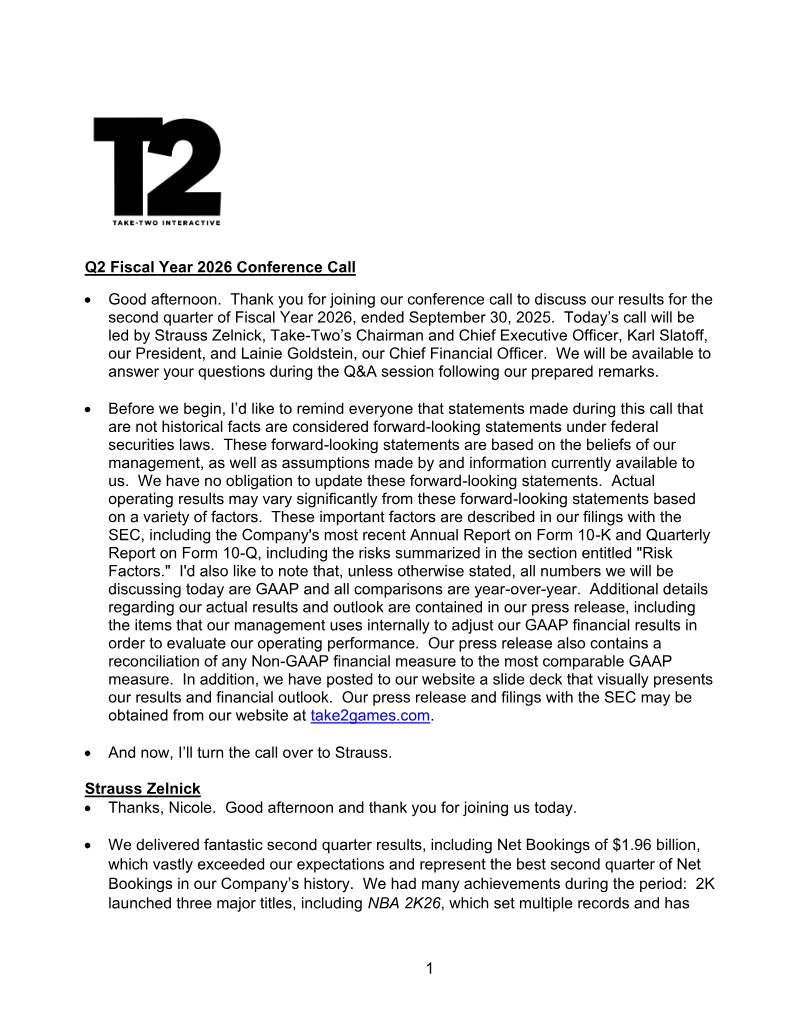
Q2 Fiscal Year 2026 Conference Call
Take-Two Interactive’s second quarter fiscal year 2026 conference call highlights a period of record-breaking financial performance, characterized by strong growth across its diversified portfolio of console and mobile gaming assets.
- Take-Two Interactive achieved record-breaking Q2 fiscal 2026 Net Bookings of $1.96 billion, leading the company to raise its full-year outlook to a range of $6.4 billion to $6.5 billion.
- Grand Theft Auto VI is officially scheduled for release on November 19, 2026.
- Recurrent consumer spending accounted for 73% of total Net Bookings this quarter, with an annual growth forecast of 11%.