Asteroids
Game
Documents about Asteroids
Annual Inside Conference Report: 2026
Void Miner is presented as a deliberately unglamorous postmortem within an annual inside conference focused on the current "golden age" of rapid-release, short-playtime indie games.
- Void Miner, an 'Asteroids meets incremental roguelike' game, achieved 10,000 sales in its first 12 days and converted 22% of its 8,449 launch wishlists, demonstrating strong conversion for a 'middle game' that didn't go viral.
- The game's success is attributed to its 'consumable' genre (incremental/roguelike/spaceship), which players readily purchase and move on from, similar to idle or horror games, leading to high conversion rates.
- Void Miner was developed by a solo developer, RyanJakob, over 7 months, with 6 months dedicated to marketing, utilizing free pixel art assets and contracting only for music and capsule art.
Nova Drift: The Making of a Steam Holiday 'Sleeper' Hit
Pixeljam's Nova Drift, an arcade space combat roguelite described as Geometry Wars meets Asteroids with procedurally generated runs, became a Steam holiday sleeper hit in winter 2020-21 after nearly two years in Early Access.
- Nova Drift experienced a significant sales surge during the 2020 holiday season, with daily unit sales rising from a 10–50 baseline to 100–500 units.
- The game’s visibility was driven by a positive feedback loop where a 98% approval rating across 2,000+ reviews triggered Steam algorithm recommendations within the indie roguelike category.
- Sustained growth was supported by inclusion in the Steam Winter Sale, which acted as a catalyst for increased exposure within the space genre.
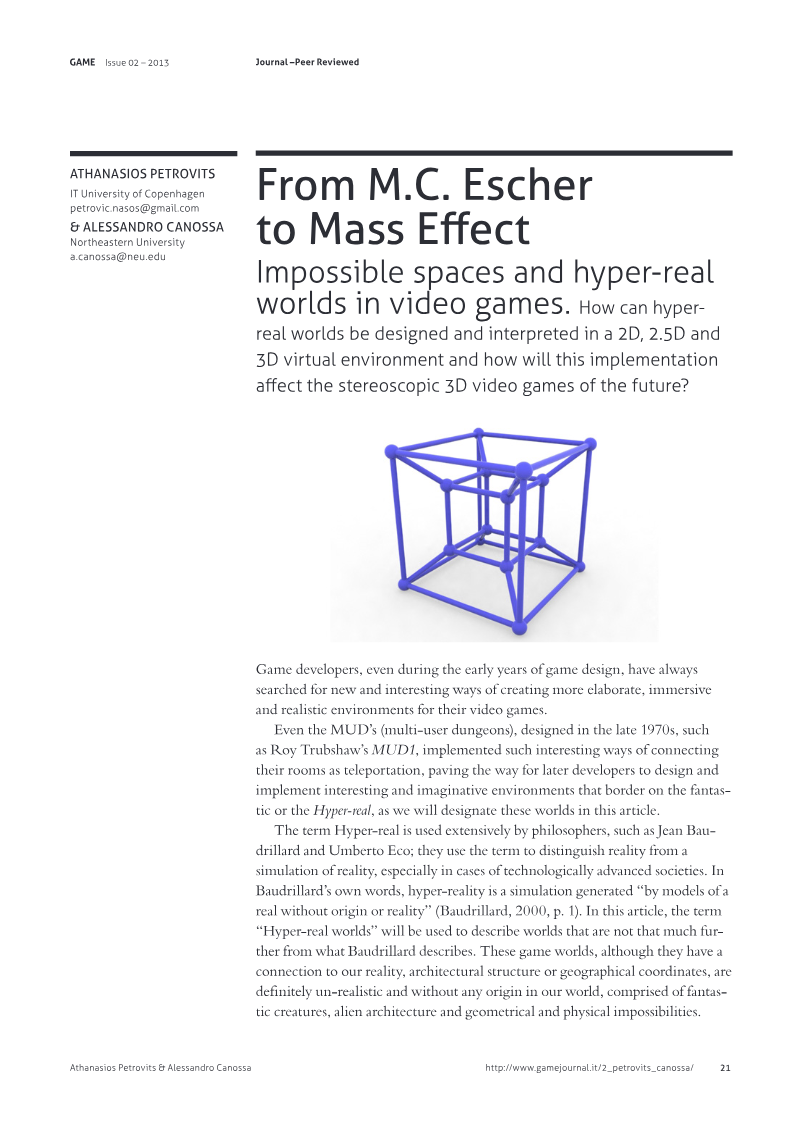
From M.C. Escher to Mass Effect: Impossible Spaces and Hyper-Real Worlds in Video Games
Petrovits and Canossa examine how hyper-real worlds, meaning game environments with a loose connection to reality but populated by fantastic creatures, alien architecture, and geometrical or physical impossibilities, can be built in 2D, axonometric, 3D, and stereoscopic 3D games.
- The authors argue that game engines represent objects as Cartesian meshes, so a shape like the Penrose triangle cannot be consistently built in three dimensions, and a true four-dimensional coordinate system cannot exist in a 3D rendering space.
- The practical workaround is to fix an impossible object at a single viewing angle, preserving the illusion only so long as the player cannot move around it.
- Isometric and axonometric projections, used in titles such as Zaxxon, Populous, Diablo, and Civilization II, are presented as the most natural vehicles for impossible-space techniques.
La Voce del Sonnambulismo Contemporaneo
Stefano Gualeni's critical essay uses the 1990s controversy over Mortal Kombat as an entry point to argue that the debate over violence in video games misses what is most significant about the medium.
- Midway Games' graphically brutal Mortal Kombat, which imitated Capcom's Street Fighter II, triggered a congressional hearing in December 1993, and the political pressure that followed produced the ESRB rating system in 1994.
- Nearly two decades of debate over video game violence had produced no conclusive empirical evidence linking virtual violence to real-world aggression, according to Stefano Gualeni's 2012 essay.
- Industry defenses treat virtual worlds as separate, non-communicating realms in which depicted violence acts as a formal feedback mechanism, similar to an explosion in Asteroids.
Cinematic Camera as Videogame Cliché
Thomas and Haussmann argue that the videogame camera is not an optical device but a computational system for producing light, and so is free to render any perspective rather than the linear, scientific perspective associated with photography and cinema.
- The videogame camera is a computational construct, not an optical one, so it is not bound to the linear, lens-based perspective that dominates cinema and photography.
- The authors argue that contemporary game design has increasingly adopted cinematic camera conventions, a tendency they describe as a cliché that narrows games' expressive vocabulary and blurs the boundary between games and film.
- The paper traces linear perspective from Renaissance scientific perspective through Cubism's rejection of it, and cites Lev Manovich's account of how linear perspective became an unquestioned default in computer interfaces.
The Ideology of Interactivity: Video Games and the Taylorization of Leisure
Matt Garite challenges the prevailing theory that video game interactivity is inherently liberating, arguing instead that games discipline players through relentless demands for repeated input and thereby hail them as ideological subjects in the Althusserian sense.
- The central thesis is that video game interactivity is an ideological mechanism rather than genuine player freedom: games train players, through repeated input, to internalize the designer's mental structure while feeling they are choosing.
- Games are framed as productive labor that reproduces dominant ideology, functioning as symbolic violence in which players learn to police both the screen and themselves, drawing on Foucault's panopticism and Jameson's concept of "autosurveillance."
- The author argues that player options are largely illusory, tightly constrained to predetermined responses such as choosing between buttons "A" and "B," with meaningful choice emerging only after the designer's decisions are already fixed.