1 free read left. Create a free account for unlimited reading + AI research.
Create free accountArticle Deconstructor of Fun
1 free read left. Create a free account for unlimited reading + AI research.
Create free accountArticleDeconstructor of Fun
This is the weakest annual total in more than a decade. It is far below the $12.5 billion peak of 2021.
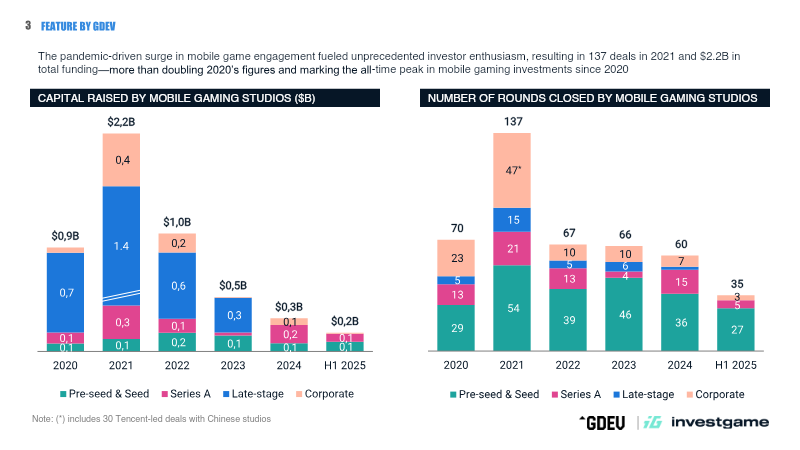
Gaming startup funding reached a low of $627 million in the first half of 2025, the weakest annual total in more than a decade and far below the $12.5 billion peak of 2021 or the $2.54 billion raised in all of 2024. No gaming venture round surpassed $100 million in 2025, while consumer-app investors poured capital into high-growth platforms: a16z launched a $15 billion Apps Fund in January 2026, and L Catterton raised $11 billion across strategies in 2025. The shift reflects two structural problems for mobile gaming after 2022: consolidation of acquirers (Zynga, Activision Blizzard, King) reduced exit opportunities, and Apple’s IDFA deprecation crippled targeted user acquisition, raising marketing costs and shortening revenue cycles. Venture-fund math now requires a $1 billion company to generate $300–$700 million in revenue for a 10% stake, but the market lacks sufficient independent studios to reach such valuations. In contrast, consumer apps demonstrate predictable recurring revenue and higher multiples: Duolingo trades at 17× forward revenue, Noom at 6×, and Strava targets a $3 billion IPO. These apps benefit from subscription models that deliver long-term LTV, broader market appeal, and investor perception of utility rather than content. While gaming VC still funds AI-powered development tools ($1.8 billion over five years), the studio thesis has largely shifted to “picks and shovels.” The capital, exits, and valuation multiples now favor consumer-app companies that leverage gaming-derived engagement expertise.
The games and companies this document names on the inner ring, other documents about them on the outer one. Select a cover to see it up close and open it in a new tab; drag to move, pinch or Ctrl + scroll to zoom.
Deconstructor of Fun · 2026

Deconstructor of Fun · 2026
Deconstructor of Fun · 2026