ReportDrake Star
Global Gaming M&A and Growth Financing Advisory: Q1 2025
202519 pages~37 min full read
Key insights
6 slides
The rebound
Gaming M&A activity rebounded in the first quarter of 2025.
The quarter was anchored by a significant $3.5 billion acquisition of Niantic’s games division by Scopely.
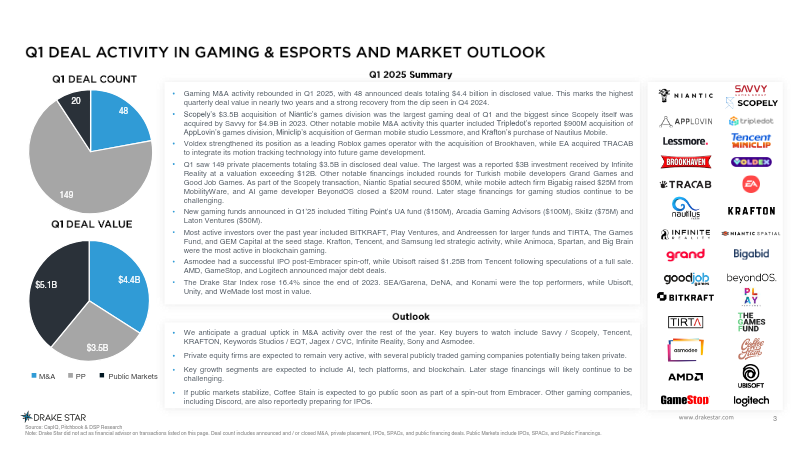
M&A rebound. Q1 2025 saw 48 M&A deals totaling $4.4 billion.
Page 3 of the report$4.4 billion
Total value of 48 announced acquisitions in Q1 2025
- Scopely’s acquisition of Niantic’s games division
- $3.5 billion
Private capital
Private placements recorded 149 deals worth $3.5 billion in Q1 2025.
Capital primarily flowed into mobile developers and AI-integrated entertainment platforms. Strategic investment from entities like Savvy Games Group and Tencent remains a primary driver of current market momentum.
Page 7 of the reportEarly141
Mid7
Late1
Index performance
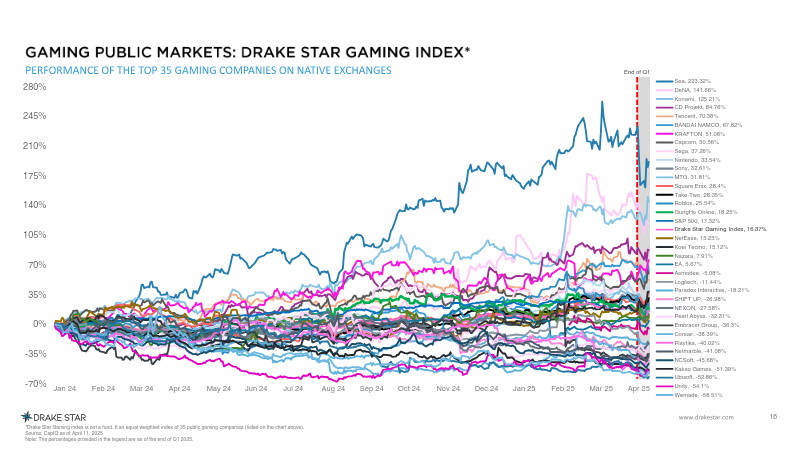
The Drake Star Gaming Index rose 16.37% in Q1 2025.
Performance remains highly volatile across the top 35 public gaming companies. Valuation gaps are widening, with industry leaders like NVIDIA and AppLovin commanding premium revenue multiples.
Funding hurdles
Later-stage financing continues to present significant hurdles for gaming companies.
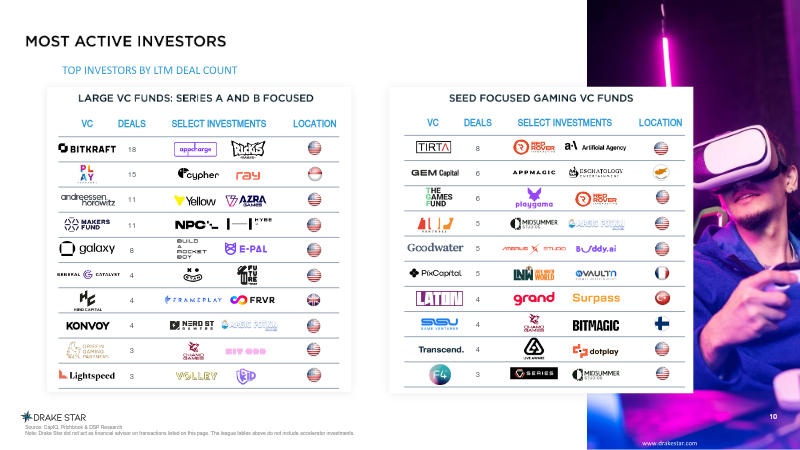
Early-stage funding remains accessible, but companies seeking later-stage capital face substantial hurdles. The financial landscape remains bifurcated despite the broader sector's recovery.
Future catalysts
AI integration and technological platforms are expected to drive future growth.
The industry is positioned for a gradual increase in consolidation as public markets stabilize. A renewed pipeline of initial public offerings is likely as market conditions improve.
Premium multiples
Valuation gaps are widening across public gaming companies.
Industry leaders like NVIDIA and AppLovin command premium revenue multiples. Many other firms face a more challenging environment and significant capital constraints.
1 / 6
Ask AI about this report