Updated Mar 17, 2026 by DDM
Report · July 1, 2024
Published by DDM
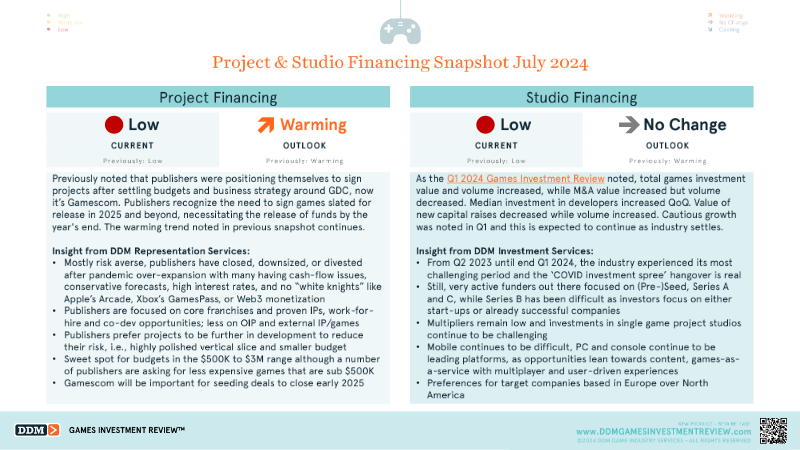
The snapshot evaluates financing conditions for game projects and development studios as of mid‑2024, highlighting a persistently constrained capital environment while noting modest signs of warming in project funding. Publishers remain risk‑averse after pandemic‑driven over‑expansion, with many having reduced staff, divested assets, and facing cash‑flow pressures compounded by high interest rates and the absence of large platform backers. Consequently, they prioritize core franchises, proven IP and work‑for‑hire arrangements, demanding projects that are further along in development, feature polished vertical slices, and fall within a budget sweet spot of roughly $500 k to $3 million, though an emerging demand for sub‑$500 k titles is evident. The upcoming Gamescom event is expected to catalyze deal flow for releases slated for 2025 and beyond. Studio financing remains low with no change in outlook, reflecting cautious growth after a volatile Q1 2024 period in which total investment value and volume rose, M&A value increased while deal count fell, and median developer investment grew quarter‑over‑quarter. New capital raises saw a decline in total value but an increase in deal count, underscoring a shift toward smaller, more frequent funding rounds. Investors continue to focus on early‑stage (pre‑seed, Series A) and later‑stage (Series C) opportunities, while Series B financing proves scarce as capital gravitates toward either nascent start‑ups or already successful entities. Geographically, funders exhibit a preference for European‑based studios over North American counterparts, and platform trends show mobile projects facing heightened difficulty, whereas PC and console titles dominate, especially those built around games‑as‑a‑service, multiplayer, and user‑generated content models. Overall, the financing landscape is characterized by conservative publisher behavior, modest but steady studio investment, and a strategic emphasis on later‑stage, lower‑risk projects as the industry settles post‑pandemic.
# Project & Studio Financing Snapshot July 2024 ## Project Financing - **Low** - CURRENT - Previously: Low - **Warming** - OUTLOOK - Previously: Warming > Previously noted that publishers were positioning themselves to sign projects after settling budgets and business strategy around GDC, now it's Gamescom. Publishers recognize the need to sign games slated for release in 2025 and beyond, necessitating the release of funds by the year's end. The warming trend noted in previous snapshot continues. ### Insight from DDM Representation Services: - Mostly risk averse, publishers have closed, downsized, or divested after pandemic over-expansion with many having cash-flow issues, conservative forecasts, high interest rates, and no "white knights" like Apple's Arcade, Xbox's GamesPass, or Web3 monetization - Publishers are focused on core franchises and proven IPs, work-for-hire and co-dev opportunities; less on OIP and external IP/games - Publishers prefer projects to be further in development to reduce their risk, i.e., highly polished vertical slice and smaller budget - Sweet spot for budgets in the 500K to 3M range although a number of publishers are asking for less expensive games that are sub $500K - Gamescom will be important for seeding deals to close early 2025
er in development to reduce their risk, i.e., highly polished vertical slice and smaller budget - Sweet spot for budgets in the 500K to 3M range although a number of publishers are asking for less expensive games that are sub $500K - Gamescom will be important for seeding deals to close early 2025 ## Studio Financing - **Low** - CURRENT - Previously: Low - **No Change** - OUTLOOK - Previously: Warming > As the **Q1 2024 Games Investment Review** noted, total games investment value and volume increased, while M&A value increased but volume decreased. Median investment in developers increased QoQ. Value of new capital raises decreased while volume increased. Cautious growth was noted in Q1 and this is expected to continue as industry settles.
ted, total games investment value and volume increased, while M&A value increased but volume decreased. Median investment in developers increased QoQ. Value of new capital raises decreased while volume increased. Cautious growth was noted in Q1 and this is expected to continue as industry settles. ### Insight from DDM Investment Services: - From Q2 2023 until end Q1 2024, the industry experienced its most challenging period and the 'COVID investment spree' hangover is real - Still, very active funders out there focused on (Pre-)Seed, Series A and C, while Series B has been difficult as investors focus on either start-ups or already successful companies - Multipliers remain low and investments in single game project studios continue to be challenging - Mobile continues to be difficult, PC and console continue to be leading platforms, as opportunities lean towards content, games-as-a-service with multiplayer and user-driven experiences - Preferences for target companies based in Europe over North America DDM GAMES INVESTMENT REVIEW™ www.DDMGAMESINVESTMENTREVIEW.com NEW PRODUCT – BETA RELEASE
The first quarter of 2024 presents a gaming sector still contending with macro‑economic headwinds, as growth rates trail inflation and firms grapple with widespread layoffs and volatile equity markets. Despite these pressures, deal flow is projected to recover to levels seen before the pandemic, driven primarily by cash‑rich public owners who are now favoring syndicate‑style financing structures and targeting mid‑cap merger‑and‑acquisition opportunities. This shift signals a renewed appetite for strategic consolidation even as overall market confidence remains tentative. Mobile gaming, the largest revenue generator within the industry, shows a modest contraction in the current year. Average in‑app‑purchase earnings have settled between $6.3 billion and $6.4 billion, indicating a slight dip from prior periods. The data suggest that while the segment is experiencing a short‑term slowdown, the underlying user base and monetisation mechanisms remain robust, providing a foundation for potential rebound later in the year. Geographically, the analysis spans the global market, encompassing North America, Europe, and the Asia‑Pacific regions, and focuses on the period from January through March 2024. It covers the full spectrum of interactive entertainment, with particular emphasis on mobile platforms, public‑company investors, and mid‑cap entities engaged in M&A activity. The overarching conclusion is that, although growth momentum is muted, the infusion of capital from well‑funded owners and the persistence of core revenue streams position the industry for a gradual return to pre‑pandemic transaction volumes and a possible stabilization of mobile revenues in the ensuing quarters.
The gaming industry entered a period of stabilization during the first quarter of 2024, signaling an end to the post-pandemic market correction. While transaction activity is trending toward a new baseline that exceeds 2019 levels, the landscape is defined by a bifurcated investment environment. Early-stage and seed funding remain robust, supported by over 65 specialized gaming funds and significant strategic injections such as Disney’s $1.5 billion investment in Epic Games. However, late-stage financing and initial public offerings continue to stagnate under the weight of high interest rates and the lackluster performance of recent public listings. M&A activity has similarly transitioned away from massive consolidations toward midcap deals and private equity acquisitions as major strategic buyers prioritize operational efficiency and divestitures. A distinct divergence has emerged between platform segments, with PC and console gaming demonstrating significant resilience compared to the mobile sector. Driven by record-breaking revenues on Steam and the breakout success of independent and mid-tier titles like Palworld and Helldivers 2, the PC and console space has attracted over $3 billion in venture capital since 2020. Investors are increasingly favoring these platforms due to higher success rates for new intellectual property. In contrast, the mobile market remains hampered by privacy-related tracking changes and extreme consolidation. The barriers to entry for mobile developers have reached an all-time high, with only seven titles released in 2023 managing to break into the global top 100 by revenue. The current market reality dictates that success for new studios requires a sophisticated publishing strategy that extends far beyond traditional user acquisition. To attract increasingly conservative capital, developers must master complex live-ops management, off-platform payment systems, and high retention metrics. The probability of a small, independent studio successfully launching a new mobile title without a major strategic partner or substantial marketing resources has effectively dropped to near zero. Consequently, corporate investment is shifting toward risk-sharing models where strategic players co-invest alongside venture capital firms to mitigate the inherent volatility of the current gaming ecosystem.
The review aims to deliver a data‑driven snapshot of capital activity in the video‑game sector, quantifying investment, merger‑and‑acquisition (M&A) and fund‑raising trends for the second quarter of 2024 and placing them in a half‑year context. By tracking only transactions that have officially closed, the analysis avoids speculative figures and provides a consistent baseline that has been applied for more than a decade across Western‑focused development, publishing and technology deals. In Q2 2024, total investment reached $3.0 billion across 222 deals, a 32 percent rise in value and a 21 percent increase in deal count over the previous quarter, marking the highest investment volume since Q3 2022. Combined investment and M&A activity summed to $3.8 billion in 262 transactions, representing an 11 percent dip in value but a 16 percent lift in volume. M&A activity contracted sharply to $845 million in 40 deals, down 59 percent in value, while no IPOs occurred, ending a five‑year streak of at least one public listing per quarter. New fund announcements totaled $21.9 billion across 38 funds, a 48 percent jump, with four flagship funds—General Catalyst, ICONiQ Capital, Norwest Venture Partners and Kleiner Perkins—accounting for 74 percent of the capital raised. Segment analysis shows Tech/Other categories captured 83 percent of investment value, while Console/PC led in deal volume at 33 percent. Blockchain‑related funding rose to $416 million in Q2, driven by regulatory approvals for crypto ETFs, and undisclosed deals comprised 40 percent of the quarter’s activity. In the first half of 2024, investments surged to $5.2 billion across
The analysis presents a quarterly snapshot of investment activity in the global video‑games ecosystem for the third quarter of 2024, aiming to map how capital is flowing across content creators, platform and technology providers, and the broader market. By aggregating closed‑deal data from public sources and proprietary research, the study tracks private equity, venture capital, corporate venture, mergers and acquisitions, and public offerings, while excluding gambling, betting and blockchain‑focused entities. Capital deployment in Q3 2024 reached $113 billion in private investments, $119 billion in merger‑and‑acquisition transactions, and $63 billion in public‑market offerings, reflecting a stabilization of private rounds at roughly $1 billion across 120 deals. M&A activity shows a resurgence, with at least one transaction exceeding $1 billion announced each quarter, whereas public listings remain scarce, with the first IPO in two years and continued market pressure. Gaming studios secured more than $100 million per quarter across 30 rounds, with early‑stage VC funding concentrated in North America and Western Europe (13 deals totalling $48 million and 10 deals totalling $45 million respectively), while late‑stage rounds and corporate investments were modest. Investments in platform and technology ventures outpaced pure gaming content, accumulating $768 million in private capital across 28 rounds, driven by AI