1 free read left. Create a free account for unlimited reading + AI research.
Create free accountWhitepaper European Conference on Games Based Learning (ECGBL)
1 free read left. Create a free account for unlimited reading + AI research.
Create free accountWhitepaperEuropean Conference on Games Based Learning (ECGBL)
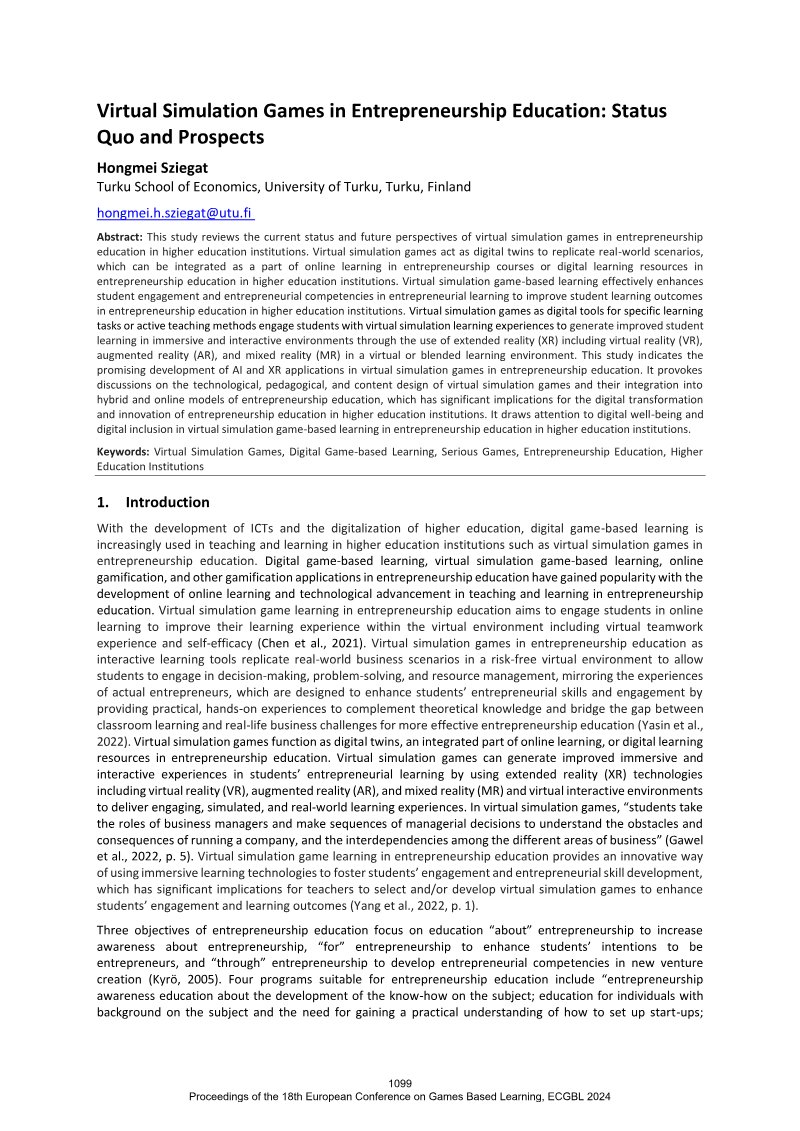
They use extended reality such as virtual, augmented, and mixed reality. The paper argues they complement classroom entrepreneurship instruction.
Virtual simulation games, which use extended reality technologies such as virtual, augmented, and mixed reality to recreate business scenarios in risk-free settings, are examined in this paper as tools for entrepreneurship education in higher education. The central argument is that these games complement classroom instruction by building decision-making, teamwork, risk management, and self-efficacy, and that they are most effective when technological, pedagogical, and content design are carefully aligned. The study assesses the current status of such games and their future prospects, drawing on a keyword-based search of Google and Google Scholar and a catalogue of widely used simulation tools, including GoVenture, SimVenture, Harvard Business Simulations, and The Startup Game.
The evidence reviewed is encouraging but uneven. Several studies link simulation-based learning to improved engagement, self-efficacy, and collaborative skills, yet others find no significant effect on entrepreneurial intentions, and one reports that mobile business simulations improved attitudes and self-efficacy without changing intentions. Digital games were found to have limited influence on teamwork skills, and the paper notes that evidence on how well these tools fit existing curricula remains insufficient. Aarhus University is presented as a successful case of game-based learning integration, offering a model for institutional adoption.
Looking forward, the paper identifies artificial intelligence and extended reality integration, including digital twins, as the most promising directions for the field. The reference base spans roughly three decades, from the mid-1990s to 2024, and covers business simulation games, serious games, gamified entrepreneurship education, learning analytics, and game-based effects on entrepreneurial intention and competence, reflecting a maturing but still evolving research literature.
Each row is a game or company this document names, each column a document, oldest first. A mark means that document names it. Select a row to see those documents.



European Conference on Games Based Learning (ECGBL) · 2026



European Conference on Games Based Learning (ECGBL) · 2026



European Conference on Games Based Learning (ECGBL) · 2026



European Conference on Games Based Learning (ECGBL) · 2026



European Conference on Games Based Learning (ECGBL) · 2026



European Conference on Games Based Learning (ECGBL) · 2026



European Conference on Games Based Learning (ECGBL) · 2026
University of Toronto · 2026



European Conference on Games Based Learning (ECGBL) · 2026



European Conference on Games Based Learning (ECGBL) · 2026



European Conference on Games Based Learning (ECGBL) · 2026



European Conference on Games Based Learning (ECGBL) · 2026
International Journal of Serious Games · 2016