1 free read left. Create a free account for unlimited reading + AI research.
Create free accountWhitepaper European Conference on Games Based Learning (ECGBL)
1 free read left. Create a free account for unlimited reading + AI research.
Create free accountWhitepaperEuropean Conference on Games Based Learning (ECGBL)
The study notes enthusiasm for game-based learning alongside a scarcity of practical implementation guidance.
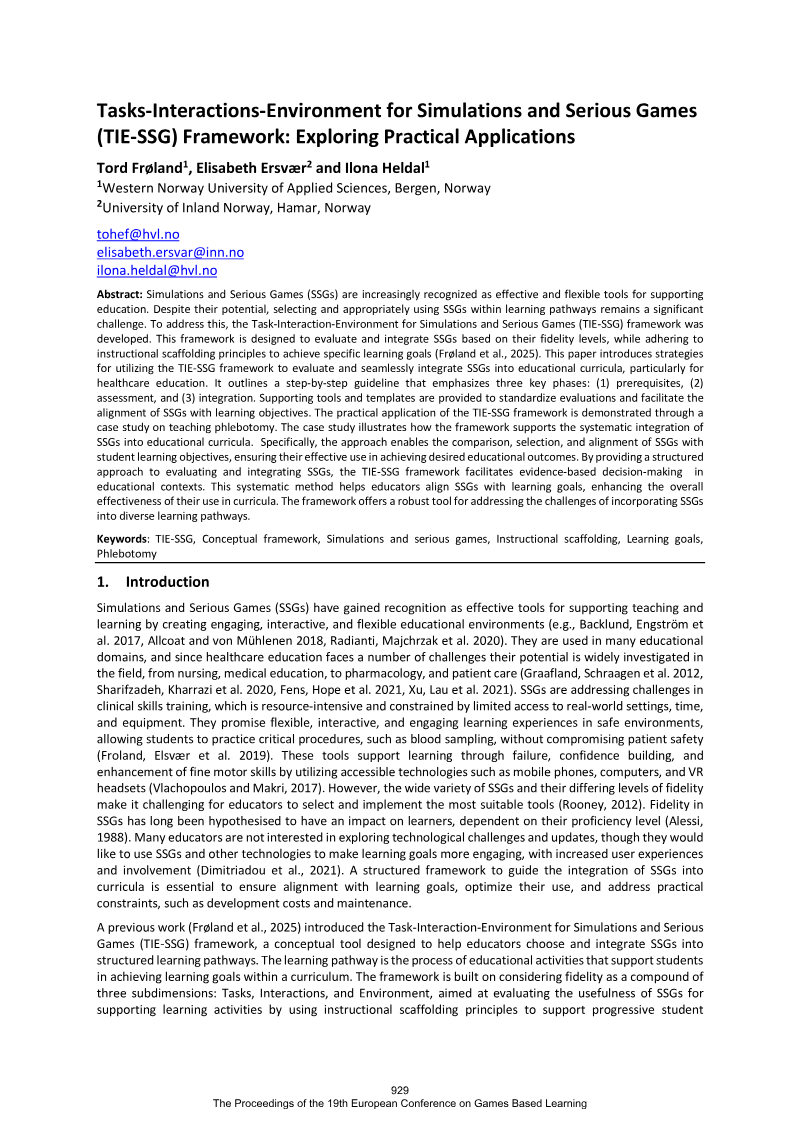
This preliminary study evaluates four climate-themed board and simulation games for use in university classrooms, with the aim of giving instructors practical guidance on which games can realistically fit into a course and what pedagogical value each offers. The games assessed were Carbon City Zero, Climate Cooldown, Keep Cool, and Kyoto, selected to represent low-cost mass-market products, a small independent release, and a title suited to political science instruction. Two cooperative and two competitive games were included. The authors position the work as an early step toward a framework for evaluating climate games across disciplines, motivated by enthusiasm for game-based learning alongside a scarcity of practical implementation guidance.
Evaluation combined play-testing by a small group of interdisciplinary faculty and staff with no prior experience of the games, Likert-scale rubrics assessing complexity, engagement, and learning potential, and observer notes on setup time, rulebook consultation, and player comments. Each game was judged on classroom usability, including setup, play duration, rule complexity, facilitation needs, and scalability, as well as pedagogical framing, such as cause-and-effect understanding, trade-offs between mitigation and adaptation, and oversimplification risks. The authors also drew on a literature review of serious games in higher education.
Findings show that every game ran well beyond estimated play times during first sessions, with the authors recommending a full two-hour class period for any of them. Kyoto was judged the most immediately classroom-ready and particularly suited to governance and interdisciplinary courses, while Keep Cool offered strong political-economy insights but demanded careful debriefing. Climate Cooldown, though the most complex to facilitate, provided a structured route into mitigation and adaptation policy, and Carbon City Zero worked best as a supplementary activity. The authors conclude that pedagogical value depends more on how a game is integrated into course design than on the game itself. The study acknowledges limits, including a small tester pool, no classroom trials, and rubrics still requiring refinement.



European Conference on Games Based Learning (ECGBL) · 2026



European Conference on Games Based Learning (ECGBL) · 2026



European Conference on Games Based Learning (ECGBL) · 2026



European Conference on Games Based Learning (ECGBL) · 2026



European Conference on Games Based Learning (ECGBL) · 2026



European Conference on Games Based Learning (ECGBL) · 2026



European Conference on Games Based Learning (ECGBL) · 2026
University of Toronto · 2026



European Conference on Games Based Learning (ECGBL) · 2026



European Conference on Games Based Learning (ECGBL) · 2026



European Conference on Games Based Learning (ECGBL) · 2026



European Conference on Games Based Learning (ECGBL) · 2026
International Journal of Role-Playing · 2016