1 free read left. Create a free account for unlimited reading + AI research.
Create free accountWhitepaper European Conference on Games Based Learning (ECGBL)
1 free read left. Create a free account for unlimited reading + AI research.
Create free accountWhitepaperEuropean Conference on Games Based Learning (ECGBL)
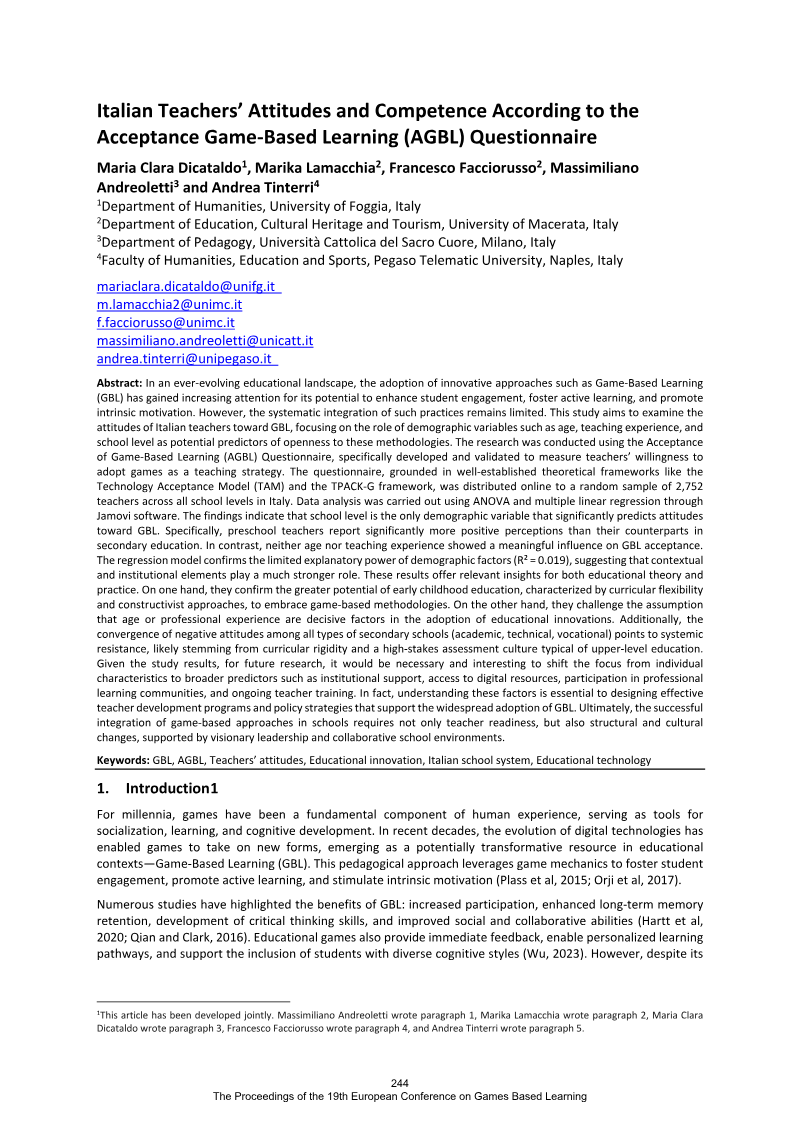
A systematic review of games in mathematics education examines sixteen studies drawn from twelve CERME conferences held since 1999, selected from an initial pool of thirty-two papers that contained "game" in their titles and were filtered against criteria covering full-text availability, research design, and centrality of the game. The analysis codes each study by year, target group, objective, research method, data collection tool, mathematical subject area, game type, theoretical framework, and definition of games. Publication counts peak in 2020, which the authors connect to heightened interest in digital tools during the COVID-19 pandemic, and the sample shows a shift from non-digital didactic games in the early 2000s toward digital puzzle games and dynamic geometry environments in recent years.
Methodologically, qualitative approaches dominate, with thirteen of sixteen studies using them, most often case studies, and observation combined with interviews is the most common data collection pairing. Secondary school students aged 11 to 14 are the most frequently studied group, cognitive development is the leading stated objective, and number sense and geometry are the most common content areas. The authors note the absence of university-level studies and the scarcity of quantitative designs, recommending mixed methods to strengthen findings.
A central conclusion is that most studies do not define games at all, and those that do tend to frame games as instruments for acquiring mathematical knowledge rather than as systems with defined mechanics. Entertainment games appear only once, and dynamic geometry software activities are frequently labelled as games despite lacking rewards, penalties, and other core mechanics. The authors argue that future research should integrate mathematical theories with game mechanics and develop a clearer theoretical distinction between games and educational activities, while acknowledging that the small sample limits the generalizability of these trends.



European Conference on Games Based Learning (ECGBL) · 2026



European Conference on Games Based Learning (ECGBL) · 2026



European Conference on Games Based Learning (ECGBL) · 2026



European Conference on Games Based Learning (ECGBL) · 2026



European Conference on Games Based Learning (ECGBL) · 2026



European Conference on Games Based Learning (ECGBL) · 2026



European Conference on Games Based Learning (ECGBL) · 2026
University of Toronto · 2026



European Conference on Games Based Learning (ECGBL) · 2026



European Conference on Games Based Learning (ECGBL) · 2026



European Conference on Games Based Learning (ECGBL) · 2026



European Conference on Games Based Learning (ECGBL) · 2026
European Conference on Games Based Learning (ECGBL) · 2025