1 free read left. Create a free account for unlimited reading + AI research.
Create free accountWhitepaper European Conference on Games Based Learning (ECGBL)
1 free read left. Create a free account for unlimited reading + AI research.
Create free accountWhitepaperEuropean Conference on Games Based Learning (ECGBL)
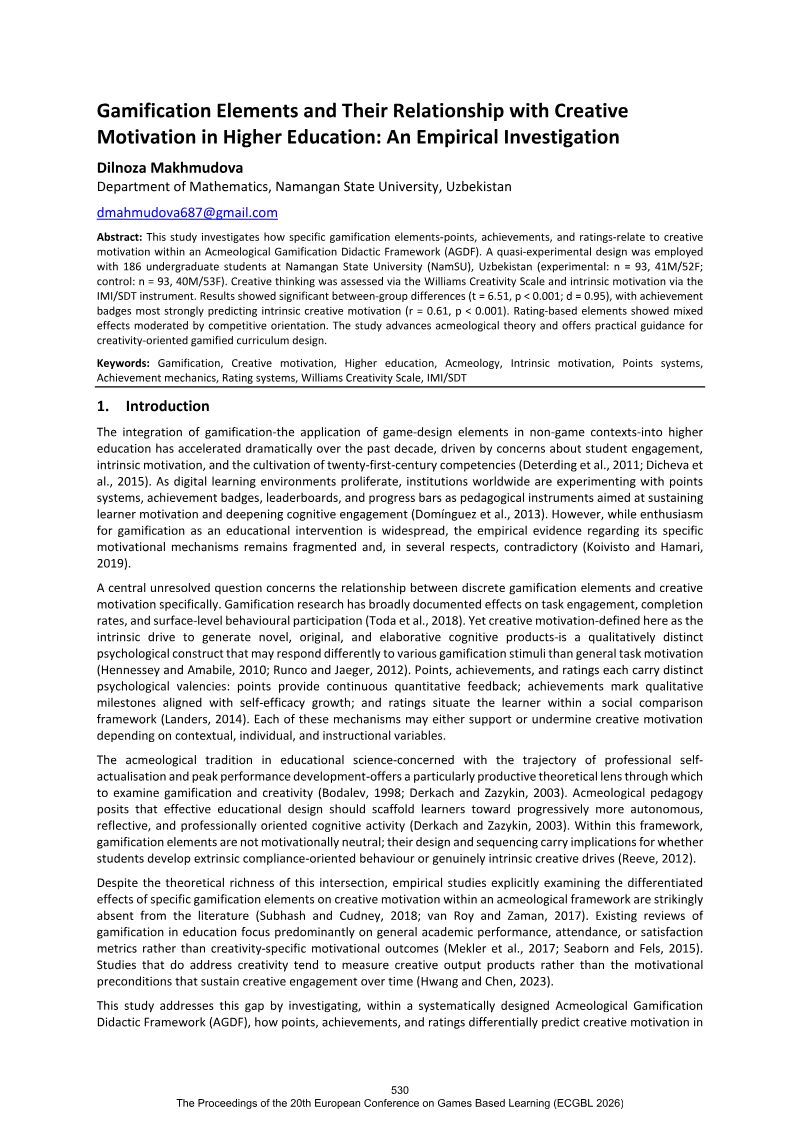
Researchers compared an experimental group receiving gamified instruction with a control group receiving standard instruction. The study covered 186 students at Namangan State University over one semester.
This study examines whether an acmeologically designed gamification framework, incorporating points, achievement badges, and rating systems, can enhance creative thinking and intrinsic creative motivation among higher education students. Using a quasi-experimental design with 186 students at Namangan State University, the researchers compared an experimental group receiving the gamified instruction against a control group receiving standard instruction, over a single semester.
The experimental group showed large, significant gains relative to controls on both creative thinking, measured with the Williams Creativity Scale (d = 0.95), and intrinsic creative motivation, measured with the Intrinsic Motivation Inventory grounded in self-determination theory (d = 1.48). Among the gamification elements, achievement badges emerged as the strongest predictor of intrinsic creative motivation (β = 0.47). Points exerted a smaller positive effect, which the authors attribute to a creativity-bonus design. Rating position was non-significant overall, but it predicted motivation positively only among students with high competitive orientation, and growth-framed rankings outperformed absolute rankings (d = 0.45).
The authors are careful to frame these results as indicative rather than causal, given the single-institution, single-semester, quasi-experimental design. They also acknowledge that the engagement indices used lacked validated psychometric development. The reference base draws on self-determination theory, gamification design research, systematic reviews of gamified learning, and critiques identifying potential negative effects of gamification, situating the findings within ongoing debates about when and how game elements support learning.



European Conference on Games Based Learning (ECGBL) · 2026



European Conference on Games Based Learning (ECGBL) · 2026



European Conference on Games Based Learning (ECGBL) · 2026



European Conference on Games Based Learning (ECGBL) · 2026



European Conference on Games Based Learning (ECGBL) · 2026



European Conference on Games Based Learning (ECGBL) · 2026



European Conference on Games Based Learning (ECGBL) · 2026
University of Toronto · 2026



European Conference on Games Based Learning (ECGBL) · 2026



European Conference on Games Based Learning (ECGBL) · 2026



European Conference on Games Based Learning (ECGBL) · 2026



European Conference on Games Based Learning (ECGBL) · 2026
European Conference on Games Based Learning (ECGBL) · 2025