1 free read left. Create a free account for unlimited reading + AI research.
Create free account
Superstar Session: Don't Go Indie, Go Hyper!
Key insights
6 takeaways- 01Hypercasual games rely on broad accessibility and engaging mechanics rather than deep narratives or high-fidelity graphics, allowing for the use of asset packs and simplified programming to lower entry barriers.
- 02Hypercasual development prioritizes rapid prototyping, with core functionality often developed in under one week to allow for immediate marketability testing via click-through rate (CTR) analysis.
- 03Publishers in the hypercasual sector provide essential infrastructure support including user acquisition, localization, quality assurance, and technical integration, enabling developers to focus primarily on design.
- 04The professional landscape offers a hybrid model that combines the creative autonomy of independent development with the financial security of steady salaries and profit-sharing schemes.
- 05Monetization is driven primarily by ad-based revenue, which facilitates profitability across diverse global markets.
- 06The business model mitigates financial risk by utilizing a 'fail fast' approach, where developers abandon underperforming concepts early to focus resources exclusively on high-potential projects.
Ask AI about this video
Transcript
so gabriel tell us why should we go hyper casual rather than indy i will uh hand over to you so go for it thank you oscar thanks for having me allow me to share my screen [Music] so there we go um i hope you all can see my screen so yeah great um i'm gabriel and i'm here to tell you why not to make uh traditional quote-unquote um indie games uh so a little bit about myself um i have been i'm the head of design at quality i've been five years in hyper casual
games not even sure how how old that genre is but it isn't much older than that and i'm not even sure if we called it hyper casual back then if that term even existed um and what's maybe relevant to this talk i've started out as a solo developer like i had my own little studio self-funded so that this will be relevant later um a little bit about quality we are based in beautiful lemington spa in the uk uh we are growing really really quickly like we have a new teams in bangalore in india being scaled in beijing in turkey um we our games have reached almost half a billion downloads which is staggering like a significant portion of the world's population has played our games which is mind-blowing and we are the uk's uk's biggest hyper-casual games publisher we publish games from external developer and we develop our own games um
so just for those who might not be that familiar with hyper casual games or what are hyper casual games it's uh if you if you go on your phone and uh open the app store or the google play store you go to the game charts scroll to the top usually you'll see a lot of hyper casual games there those are these simple approachable games um they're free so so we make our most of our money through ads um and in order in order to do that we um need to reach a very wide demographic so it's really interesting when we look at our analytics data we see uh from from little kids to uh pensioners basically playing our games which which i believe hyper casual games are the genre that reaches the widest possible audience i could be wrong which which makes hyper casual games also unique in that sense and yeah who is this talk for it's uh this talk
is for anyone who wants to make their own games who think who likes to play games from every things oh i want to i want to do that i want to bring i want to show my creativity to the world and maybe you're a student who has just graduated from some kind of game design game programming related course uh maybe you're a hobbyist uh maybe you've you've gone through a few unity tutorials and you think oh i want to give this a try and this talk is for you uh so where do people go to most of the time when they want to do their own thing it's what i said like quote unquote traditional indie games like stuff you'd see on steam is steam is big for that and um i can clearly see why those are those games are amazing uh everybody loves to play them and people obviously want to make stuff that they like to play themselves uh there there's uh the the amount of
genres and the create creativity you can bring into these games is limitless which is very very appealing you you're not constrained by by any rules that maybe like traditional aaa games are and last but not least there's also these stories of fame and fortune of bedroom developers working for years on their on their games and and suddenly getting having a huge success with them becoming billionaires over millionaires overnight um having their name printed in in game magazines and whatnot like these stories are certainly appealing to to some people at least and um what i'm here to tell you is basically hyper casuals working on hyper casual games offers all of that and then some and has some distinct advantages um which i'll get into in detail in this talk um so an important aspect is of course the creativity like you
if you're a creative thinker if you're a creative person you want to express yourself you don't want to be you don't want to be constrained by by boundaries by by certain rule sets uh you you uh and and i'm here to tell you like hyper casual games are probably the more most diverse genre of games there are countless sub-genres there are new ones being discovered constantly and just to give you a sort of a quick uh um a quick glimpse into our portfolio what quality has made in in recent times uh for example this game it's called overtake which is a game sort of like a racing game but you're more racing against traffic really fun game uh bake it this is a pastry baking simulator essentially this is a sharpshooter blitz basically a first person shooter in a in a simplified hyper-casual format really fun game so we've published that recently was
developed by an external developer amazing game one of our big hit games is droid it's a basically pictionary as a mobile game uh was a huge success for us uh made huge waves uh off the rails 3d here you get to be a train conductor this is a very very recent release they stay stay tuned to to to see more of that one it's a called blade forge and uh you make swords here and you make swords and then you get to use them in sort of a competition a really cool game this one is a top three in the charts at the moment uh called teacher simulator is you play as a teacher but it's actually more of a trivia game uh but packaged in a really appealing format uh this is big battle 3d a game we released last year was it was a big hit for us and that one was reminiscent of like uh real-time strategy games genre which i really love on pc and and this game sort of scratches that age
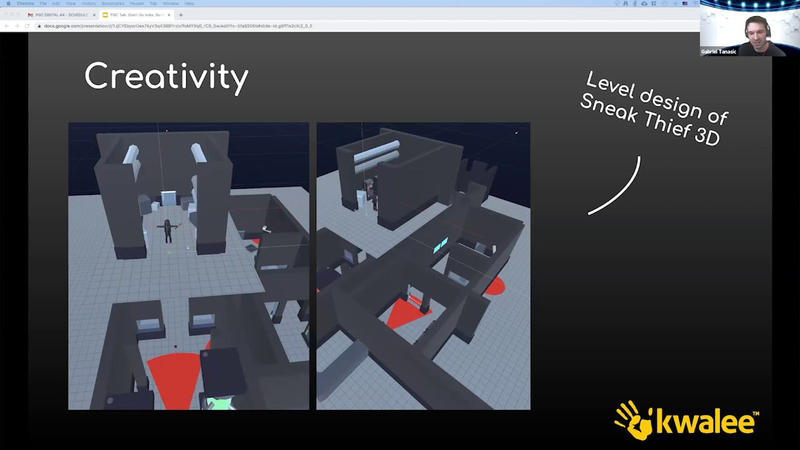
another one of our recent hits let's be cops you get to play as a traffic police uh officer this is a looper this looks completely different like minimalist aesthetic it's a rhythm based uh timing game very arcady very fun has a great soundtrack you should check it out this is another one of our recent hits it's called sneak thief 3d and it's a first person stealth game believe it or not so you see this very wide range of different genres we can have um and the creativity extends also to the to making the games themselves like this is just a behind-the-scenes view of sneak teeth 3d and you can see the the complexity of the levels we made like i started making games as in the in the half-life and counter-strike modding community i used to make half-life mods and counter-strike maps and when we worked on sneak thief like i had total
flashbacks and working on these maps like so so uh if you if you're uh if level design is your thing uh hyper casual games certainly can offer that uh uh that as well um and uh we like to say that quality working on hyper casual games is like doing a game jam every day because we are working on so many varied games and and the sky is the limit another thing i really like about hypercash games is that uh gameplay um is uh goes above everything else doesn't matter that presentation doesn't mean that presentation doesn't matter but uh it's if you have a fun game and it's truly fun to play and it's also original so it's not a clone or anything like that you you're very likely to have a to have a hit game on your hands uh especially if it also looks fun to play if you can see the video and see oh yeah that that looks fun to play i want to play that and all that stuff that matters more in
aaa games and even indie games like graphics and story and character and maybe even ip like we have the marvel franchise behind you stuff like that it doesn't really matter in hypercast games it's a so it's a really pure genre if i say like in the sense that it's all about gameplay um or mostly about gameplay graphics do matter a little bit uh i'm not gonna deny that but way less than in other genres um so another thing that really appeals to me personally i'm i'm i'm i'm a person who craves novelty who who doesn't like to get stuck on the same thing for for months and years so uh the short development time on of hyper casual games it's some something that really really appeals to me we a lot of our prototypes and most of our prototypes are developed in less than a week like on the left side you can see a screenshot of our recent hit let's be cops
and i've checked actually the the uh the timestamps on slack uh when i got this uh this is a screenshot from a video and i got the screenshot from and it took us less than a day to have like the core functionality of the game we we then spent a little bit more time to polish it and add a pre a little bit prettier graphics and stuff like that but the core functionality was there after less than a day so hybrid casual games can be developed in a really really uh uh in very little time uh which makes it appealing you you you get to work on something new virtually every week which at least for me is very very appealing and now we're doing something called cpr tests which means we we just test the marketability of the game and what ctr tests uh allow us to do is basically we don't even need a prototype anymore we just need a gameplay video it doesn't even need to be recorded from
uh on a phone it can be recorded from from the unity editor uh it doesn't need to have a lot of uh content like like if we have a minute of gameplay we can show that's all we need it doesn't need to be very polished it doesn't need to work properly there if if if it has bugs we just don't record the footage of these bugs so that that allows us to even quicker test game ideas which i think is very very exciting um especially if you're somebody who has like this stream of creative ideas and you just won't want them all made um hyper casual games are cheaper to pro produce like there is just less less of an expectation of production quality um like using asset packs is not frowned upon like like if you sometimes on steam you see games like um which and you see their reviews and it says something like oh this is just an
asset flip because the uh players recognize that this is an asset pack that was used in the game uh we that's not an issue in hyper casual nobody's going to care if you're using asset packs so that saves a lot of money and time programming is often not very complex like there's usually the if there's any ai then it's very very simple we don't really do multiplayer like we we use bots as a i mean there are some hyper casual games that sort of imply that that they look like they are a multiplayer games but that's just smoke and mirrors those are all bots um sorry if i give gave away the the secret of anyone um we don't need sounds people usually play it don't play them with sound on so those are not really needed at least not for the for the initial versions we can add it later on if if the game does well uh and there's not a lot of content
required like there's no expectation of having like eight hours of play time it can do with much much less than that as long as the game is fun uh uh and engaging that's that's all you don't need to have like i don't know eight hours of unique levels or anything like that so that that that saves production time um here's a scary headline i have found on ars technica it says 80 percent of steam games earn under 5 000 in the 5 000 in the first two weeks which is frightening like that's means there's a lot of developers that don't break even maybe or or barely make a profit with their games and uh um and also if you think about it uh with traditional indie games the development times are much much longer so you spend months if not years working on your baby you don't have any income during that time you're just eating into your savings or your investor money or whatever source
of funds you have or you're doing it on the side you don't have any income and then you release your game to the world and then it's like the the the dice roll is it gonna make enough money is it gonna make the money back or not which is a frightening prospect like i've been there it's it's uh it's it's it's indeed very very frightening and what hyper casual games offer at least when working with quality i cannot speak for our competitors but when working with quality when we're publishing a game with us we do offer uh advanced play payments we do offer milestone payments if certain kpis are met we we we can build that relationship with the with the nintendo solo developer or an independent developer to to stay afloat even and and get some some money even before the game is really released even before the game is really profitable we do offer that uh and uh like i've mentioned earlier
um with hyper casual games you you won't waste a lot of time and money on something that simply won't work like uh and uh another thing casual games you need an artist you need a programmer you and you need a game designer um as i've mentioned earlier like like asset packs are a thing so if you're a programmer who has a good good sense for for uh aesthetics and knows how to put together some assets maybe you don't even need an artist or if you're an artist who sort of dabbled into scripting maybe the game you come up with is uh is simple enough that it doesn't uh even that you can basically write it yourself the code it's uh a lot of them are can be written in very rather simple unity scripts um and uh so so that's why i say it's uh you need a team of three people or less to to get to work on hyper casual games um and another thing that really really would
appeal to me and uh if i were um if i were an independent developer making hyper casual games it's uh that you only for at least again with the caveat working with with us working with quali publishing your game with quali means we take care of the heavy lifting we take care of the boring stuff if you look at the pie chart on the left that's that that's actually based on a real indie game i found i believe in kamasutra i changed it switched the numbers up a little bit um but but it's representative of where time is being spent um in the in the in the development of an indie game so you see the uh more than a third is actually spent on uh boring stuff i i i would say like marketing and bug fixing i mean if you're a game developer you don't want to you want to make make games you don't want to spend ages bug fixing or marketing the game
and we take care of all of that we take care of ports if you make an ios build we port it to android and vice versa we take care of quality assurance we do we integrate all these sdks you know the facebook sdk and and and add sdks and analytics sdk really tedious stuff that can go wrong uh we do we take care of that we take care of a localization and of course of user acquisition and marketing uh so in the indie scene the list is saying that the last ten percent is really the last ninety percent uh meaning like the the polishing a game and just getting it out feels like a never-ending story and i've been there it's it's really not fun uh but that doesn't necessarily apply to hyper casual games at least not when working with us like we we take care of that tail end that that boring thing um and you don't have to worry about that so yeah if um
if that sounds like something you'd want to be a part of you you you'd want to try get in touch with us write us an email at publisherpublishingquali.com if you're an indie developer maybe maybe you you don't even exactly know where to get started with hyper casual games just just contact us we will we will help you get your foot in the door and and help you get started uh uh with with the hyper casual development um we um also also of course if you already have hyper casual games you're working or if you're already working on a hyper casual game or a game that could be turned maybe into a hyper casual game contact us please we have a really talented team of publishing managers that are going to help you and what's i believe it's something i'm not sure uh sure how common it is in in with our competitors but you know
with quality the publishing team works very very closely with the design team we have a very talented design team we have a proven track record of hit games like we uh not not to brag but we have two um two two games in the top five charts in the us at the moment in the app store charts so we have a track record we we know how to make these games and we are there there to uh not only make our own games but we're also there to help um uh indie developers and hyper casual external developers uh and we the design team supports the publishing managers to make sure if a game doesn't quite meet the kpis uh so we we can help there to drag it across the line and um uh check out quality.com we have an interesting blog with uh with where we go where we um write more about how we work on casual games and if going solo is not really for you
maybe maybe you lack the funds or it's too terrifying or or or you pre doesn't fit your uh life circumstances and you prefer to have that steady paycheck um go to quality.com join uh slash join us it's a it's a great place to work like fun people a bunch of perks all that stuff great great environment to work we have something called creative wednesdays which means every wednesday uh everyone at the company i mean literally everyone can work on their own game ideas uh and we give we give we give you that creative freedom to work on your own game ideas uh uh and uh what sweetens the deal we have a profit sharing scheme in place that means every quarter we get we get bonuses based on profits and based on your contribution to a to a profit making game which means uh you sort of get to be almost a little
bit like an entrepreneur you get the creative freedom you would get you would have if you were your own if you were a solo developer or a small studio you get paid like an entrepreneur you get the share of the profits but you don't have any of any of the risks because you have a steady paycheck you have have an office environment where everything is provided to you so it's a the best of both worlds it certainly suits me like i've been a solo developer and um i've been an entrepreneur and working at quality definitely scratches that entrepreneurial itch i always had and so yeah quality.com join us thank you very much thanks gabriel that's great stuff um i've got so many questions for you and i've only got about two minutes to do it in um but i did start you five minutes late so uh that's that's my fault um so just want to tap into some of these
so the first question here um do you do user acquisition in tier three and four geos like india and are you able in those uh economies to get return on investment can you make money basically in the indian market with this kind of game ruth be told we do strive for profitability when we scale a game so worldwide yes india in particular i don't know the numbers it's not really my forte but i would assume so because we do strive if we scale a game that means we're making a profit on it uh so i do assume that applies for uh to india as well yeah and in my my understanding of it is i think that um because we're dealing with uh advertisers rather than direct payment mechanisms it's actually in some ways a bit more easy to make some level of profit um because of the issues with the way um billing particularly credit card base
billing works which can be a problem so um yes i know some organizations that do okay but i i don't think it's as as kind of profitable as the u.s for example another one here is um uh in fact i'm going to go for once in the chat so um i will be saying um what guarantees it after showing you the game that you collap that if a deal was rejected um how do what stops you from appropriating their idea um should there be an nda in place before showing you a prototype what do you think about that um this is a excellent question i'm not entirely sure what the publishing team how they approach this but what i can tell you is doing something like that would just create a a bad reputation throughout the industry if we would were to do something like that that word gets out and we would tarnish our reputation forever so i don't know the details would exactly sign what's in the contract but it's not something we would do we
are looking for long-term partnerships exactly and i think this is the thing that we often see actually is that there is a problem where we get very precious about our ideas and there is no investor who will sign an nda that's worth the salt because basically it's a pointless exercise for them if you don't have the capacity to produce lots of ideas in hyper casual there's no point in having a relationship with you and the fact that you think your idea is unique is probably wrong and i i suspect from my observation it's mostly about can you deliver the relationship that delivers the quality of experience for the player on a regular basis and that's about teamwork not about a specific idea is that makes sense to you that's absolutely how it is don't get too attached to your ideas be learn get the mindset of failing fast moving on failing fast moving on like having that mindset not getting too attached not trying to um but maybe if i twist it a little bit like that it will work just move on if the game doesn't meet
the kpis if it's near the target kpis we can work with you like i mentioned we have a design team that will work with you that will help you drag that game across the line but if it's far from the mark it's better to move on as harsh as it can be so purnima was saying um that uh video ads versus playable prototypes um have you seen a difference in terms of click-through rates for testing hyper-casual games is uh in in comparatively prototypes to to click-through rates if i understand correctly which means uh with prototypes we get the full set of data we get cpi data we get uh retention data uh however with with uh with the ctr test we only obviously get ctr and some other stuff cpc and ipms uh in terms of like what exactly the metrics are that we're looking for this is again a question more for our publishing team unfortunately i have to refer you to to publishing at quad oh that's fine hey
i know those guys pretty well uh but if anyone's interested um if you ever participate in the big indie pitch quality are fantastic sponsors of that event and i'm very lucky i spent a lot of time doing judging on that myself and they're they're so much more generous than i am i'm i'm so much more brutal uh they're a great bunch of people to work with and um you know again um but that you know obviously there are other people who are in this space and we're going to talk about the uh one of the bigger teams next so i'm going to say thank you to one gabriel uh from quality you
Summary
The hypercasual gaming sector offers a distinct alternative to traditional indie development, characterized by rapid prototyping, high creative turnover, and a focus on gameplay over complex production values. By prioritizing short development cycles—often producing core functionality in under a week—developers can test marketability through click-through rate (CTR) analysis before committing to full production. This approach mitigates the financial risks associated with the traditional indie model, where long development timelines often lead to unsustainable costs and uncertain commercial outcomes.
Hypercasual games are defined by their broad accessibility, targeting a demographic that spans from children to older adults. Unlike traditional indie titles that may require extensive content, deep narratives, or high-fidelity graphics, hypercasual success is driven by original, engaging gameplay mechanics. The industry standard allows for the use of asset packs and simplified programming, which lowers the barrier to entry for small teams or solo developers. Furthermore, publishers often provide essential support, including user acquisition, localization, quality assurance, and technical integration, allowing developers to focus primarily on design.
The business model relies heavily on ad-based monetization, enabling profitability across diverse geographic markets. For developers, the professional landscape in hypercasual gaming provides a balance between creative autonomy and financial stability. Many studios offer profit-sharing schemes and collaborative environments that mimic the entrepreneurial spirit of independent development while providing the security of a steady salary. Ultimately, the sector rewards a "fail fast" mentality, where developers are encouraged to iterate quickly and move on from concepts that do not meet key performance indicators, ensuring that resources are focused on high-potential projects.


















Comments