VideoDeconstructor of Fun
Secrets Behind Monopoly Go’s Record-Breaking Launch with Ben Webley, CMO of Scopely
15 Jul 202511 min video
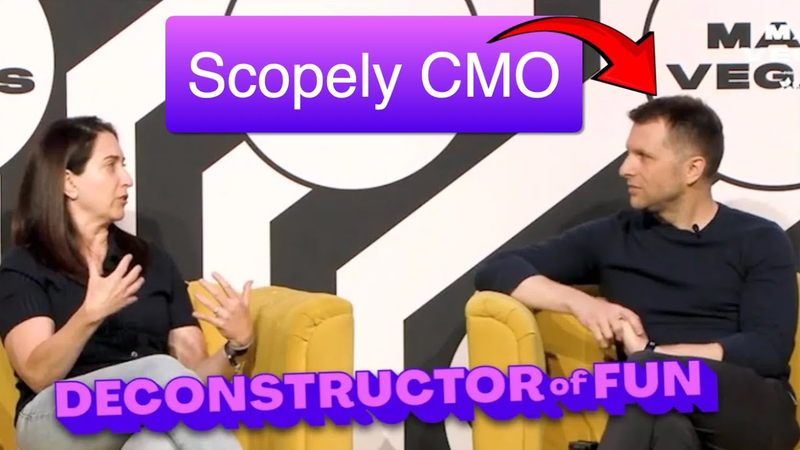
This is the kickoff of MAU Vegas 2025. I'm Jen Dano. I host Deconstructor of Fun. Uh we are a game industry podcast and I'm also a reform big company game industry marketer. Uh Monopoly Go, that's the reason we're here today, is the mobile game that has broken records and rules. And I'm thrilled to speak with Scoply CMO Ben Webb. Uh we're going to go behind the scenes and unpack a lot of what made the go to market so amazing. So before we jump in, let me just set a little bit of the game board uh with a little background on Monopoly Go. So Monopoly Go launched back in April of 2023 and it broke a ton of records. It was the number one game launch of that year. It reached a billion in revenue just seven months later. It was one of the fastest mobile games to ever reach this milestone. Fast forward and Monopoly Go is still crushing it. They just announced passing five billion in revenue in just two years. One of the things that I learned
from Monopoly that I've been really impressed with is that uh they have such global awareness and you know what's really interesting is most people think that Monopoly is from their own country. So how did you think about leveraging this kind of insight that is really unique for an IP which is everyone thinks that the IP is from their country.
Yeah. So, I've got quite an interesting story, actually, and it's embarrassing one for me, but here we go. And I was in a meeting with Hasbro and a bunch of Hasbro executives, and uh they were talking about playing Monopoly growing up. And I I was really confused and I asked them, I was like, "You guys played Monopoly growing up?" And they're like, "Well, yeah." And I was like, "Oh, that's weird." And they were like, "Why is that weird?" I was like, "Well, it's a British game. I just didn't think that would be that popular in America." And um so obviously after being laughed at for a while uh one one of the executives actually said to me well to be honest he said what's really interesting with this brand is that people actually think it's their own game in their own country. He said in France they think it's French and in UK they think it's British and and that's what's so great about this
brand everyone thinks it's their their local game. You know I I I think I I hear a lot of people talk about Monopoly as global IP. And I I just it didn't resonate with me and I I thought that wasn't the right way for us to think about it. So instead what I asked the team to think about and and for myself as well is I was like I think we need this isn't a global IP. That's the wrong way to think about this is everybody's local IP. You know we work with a lot of IP at Scopely and it's really important when you work with IP to be very respectful to the IP to be very authentic to the IP and uh and I wanted to do that with Monopoly. Um so instead of just localizing the creative we went to the level of truly culturalizing the creative. So, I wanted to make sure that the creatives themselves were truly culturalized because I wanted to give everybody their game and bring that nostalgia and make it feel like the monopoly they they knew and love. So, um it was a lot more work. I won't lie. We created thousands and thousands of creators because we were trying to do that in as many countries as possible. Uh but I think it paid off and I think it was so important. Um and we wanted to
win in every country. We did. We um we got to number one over 100 countries which we're very proud of. We had um a strategy we called uh leave no country behind because we just didn't want to to sort of leave countries out. We wanted every country to get their version of monopoly and and we we we were playing a win and we wanted to win in every country. We also have a philosophy um at Scopely and that's we try and break our own ideas and I think this is important both for product and for marketing and what we mean by breaking our own ideas is I think as humans like human nature is when we come up with a good idea we seek out the information and the data that supports that idea right and and I think we'll do it and I think it's very natural to do and one of the things we try and do um be it and and I'll walk through this example with the app app icon in a minute, but is we try and challenge our ideas not by not just looking for other information but actually looking for information that basically makes our idea wrong that that breaks it right in the way we look at it
is if you try and break your ideas enough and they just don't break then they are good ideas. If they break easily it's not a good idea and you should really rethink about that. Here's an example of app icon testing. Now this is doing a disservice to the number of app icons we actually tested. We created a lot. So the first thing we did is we put out a bunch of different icons, right? And you can see in the first test, again, there were a lot more than this. These are just some samples of things that we thought are going to resonate. Now, I care about every little tiny part of the funnel. So app icon, it's important to me.
The number one thing.
Yeah, it's important. This is important as a creative. Yeah, as a description. Every part of the funnel can be optimized. So we should optimize every part of the funnel. So with the app icons, you know, we asked the team, okay, let's go and test a bunch of stuff. We did um player insights testing as well as ASO testing. But if you see the uh the green box around the top left icon in test one, that's actually the one you see today. So that was the the winning creative. But after we did the first test, rather than stopping there, but also rather than saying, "Oh, that's
probably the best icon. Let's just check." Instead, we said, "No, no, no. We don't like it. We want to find a better icon." Like, "Let's break that icon. Let's make let's find there's got to be something better. Let's go and find something better." And the difference, I think, in doing that is your mindset's different, right? if you're trying to just say it's probably the best one. Let's do some other tests. You're not really trying to break it, right? You're not really putting the effort in. So, we really tried to find something better. In fact, I didn't tell my team I liked the icon. I actually told them I didn't like it and I wanted a different one. And um so I was like, let's go find something else. That's not good enough. Let's find something else. But the whole point is we just kept trying to break it. Trying to break trying to break it.
Well, one of the things that's interesting and I was having this conversation with someone recently is notice that it's red and um so in my prior world, I made a lot of toys. um you know power all these different toy brands and what I always found is that red packaging tended to do the best because it's a hot color whereas blue and some of the lighter colors are cool colors and so you feel more calm red is more attention getting red or yellow are hot colors and so and pro tip is always
make sure that you are testing cool versus hot and understand you know red does kind of that's why red and yellow tend to be the most popular uh ASO backgrounds. Uh free free tip for everyone uh going into that.
Cool. All right. So, you broke it and then um you know, let's talk a little bit about like how people actually break each other playing this. I don't know how many of you like fought with your family every holiday playing Monopoly. But it is a timeless game that has two kind of core aspects or key aspects to the core fantasy. So, one is you're making alliances and then you're breaking them. The game features actually leverage this incredibly well. But how did you take that core fantasy of like alliances and breaking alliances and really look at that from a community and a a social perspective to really think about the verality from a marketing perspective?
Yeah. I I mean if again if you've played Monopoly Go you realize this game's a lot more fun and rewarding playing with others, right? And that's by design.
This game is really designed to play with others. One that's very true to Monopoly, right? It is a game where you're you're playing you're playing with people you love, but you're also attacking them and taking all their money, right? So, we want to capture a lot of that in in the game. A big part of this game is the the sticker trading. So, there's, you know, you're attacking each other. You're doing co-op events together. The meta around this game trading is very very popular. It gives a sort of larger purpose to why you're doing the core loop every day. We made a very conscious decision in the product to not build the trading into the product, which sounds counterintuitive because it'd be nice and easy if you and I can trade and click the button, right? Be very easy. But one one of the things is we really care about building hyperengaged communities at Scopely and you know we believe a lot of the biggest and best games have that they have huge communities around them that live and exist outside the product. Um so we wanted to kind of meet communities where they are and develop communities outside the product and we wanted trading to be a way communities engage with each other
and not just a transaction. So instead what we did is we pushed the trading to Facebook. We have about just over 9 million people in our core group today. Um, and we figured if we push on to Facebook there, they can meet people, they can interact, they can trade. Um, and and and it's more of a community platform. Then we thought about, well, how can we leverage though this really engaged big population of people to help sort of, you know, drive awareness and and promotion. So, one of the things we did is I was like, we need to get them to Tik Tok. So, we had this place now where we could talk to our really engaged community members. We did more things like that where we're moving people onto Tik Tok onto Insta where we could then get things going where again those channels themselves are going to show the game to new people and that's what I wanted. So again like these these whole community groups they're not only great for building community around the product they can actually be leveraged and used in a way that helps us drive more reality and organic growth for the product as well.
So back in November you actually launched a brand campaign uh it's called friendship pays and so this had Will
Ferrell as Mr. Monopoly. It also had Chris Pratt, Kiki Palmer, and then the best hair guy of all time, Jason Mamoa. So, in this campaign, you know, everyone knows that friendship is is a part of this, even though it's also about, you know, breaking alliances. So, there's often this tension that happens between performance marketing and brand marketing. I know all of you feel it. Um, so, but you were crushing it in your way. Absolutely winning. How did you think about and conceptualizing? Okay, now we want to do a brand campaign.
Yeah. So we actually see this we don't really think of brand campaigns. We think more around how do we extend what we're already doing and we think of it more 360. So um I mean first of all you know we didn't do this campaign for about 18 months after launch. I'm a big believer for launch community creative and UA do so much heavy lifting. So think 360 everything influencers TV connected TV UA it all worked together and was all part of the campaign. We actually saw this as this is going to be like this thing that's going to last over a year and we're going to build
creative in a way that benefits UA, it benefits uh a social and Tik Tok and we actually recorded and by the way Jason wonderful guy has great hair. Um but they were a lot of fun. So we were trying to get things even with them authentically to record you know some things they were doing where they're talking to the camera and they're messing around cuz we're like that's not good for TV that's fantastic for Tik Tok.
Thank you for sharing the secrets and and thank you to the marketing team behind this. Um, you know, they often don't get all the credit. The game team gets a lot of the credit. So, I'm glad that we had a chance to hear a little bit more of of the story.
Awesome. Cool. Thanks for having me.
Auto-generated captions from YouTube — names and numbers may be misheard.
Monopoly GO! has achieved significant commercial success since its April 2023 launch, reaching $1 billion in revenue within seven months and surpassing $5 billion within two years. The game’s strategy centers on the concept of "localizing" a global intellectual property by treating it as a local brand in every market, acknowledging that players worldwide often perceive Monopoly as a domestic game. This approach required extensive culturalization of creative assets, resulting in thousands of variations to ensure regional resonance and helping the game reach the number one spot in over 100 countries.
A core tenet of the marketing and product philosophy is the rigorous testing of ideas to the point of failure. Rather than seeking data to confirm existing hypotheses, the team actively attempts to "break" their own concepts—such as app icons—to ensure only the most resilient ideas reach production. This methodology extends to visual design, where the team utilizes color psychology, specifically favoring "hot" colors like red and yellow to maximize attention and conversion rates in app store optimization.
The game’s social strategy leverages the inherent tension of the Monopoly experience—the cycle of forming and breaking alliances—to drive virality. By intentionally omitting in-game trading features, the developers successfully pushed player interaction to external platforms like Facebook, where a community of over 9 million members now facilitates trades. This community-first approach is further amplified by cross-platform social media campaigns that convert engaged players into organic promoters. The "Friendship Pays" brand campaign, featuring high-profile celebrities, was designed as a 360-degree initiative that integrates traditional television spots with authentic, short-form social content, ensuring that brand-building efforts simultaneously support performance marketing and user acquisition goals.

Deconstructor of Fun · 2026

Deconstructor of Fun · 2026

Deconstructor of Fun · 2026

Deconstructor of Fun · 2026

Deconstructor of Fun · 2026

Deconstructor of Fun · 2026

Deconstructor of Fun · 2026

Deconstructor of Fun · 2026

Deconstructor of Fun · 2026

Deconstructor of Fun · 2026

Deconstructor of Fun · 2026

Deconstructor of Fun · 2026

Deconstructor of Fun · 2025

Almedia · 2026

Deconstructor of Fun · 2026

Deconstructor of Fun · 2026
InvestGame · 2026
Deconstructor of Fun · 2025
Deconstructor of Fun · 2025
AppMagic · 2025

Deconstructor of Fun · 2025

Deconstructor of Fun · 2025
Deconstructor of Fun · 2025

Sensor Tower · 2025
Comments