Transcript
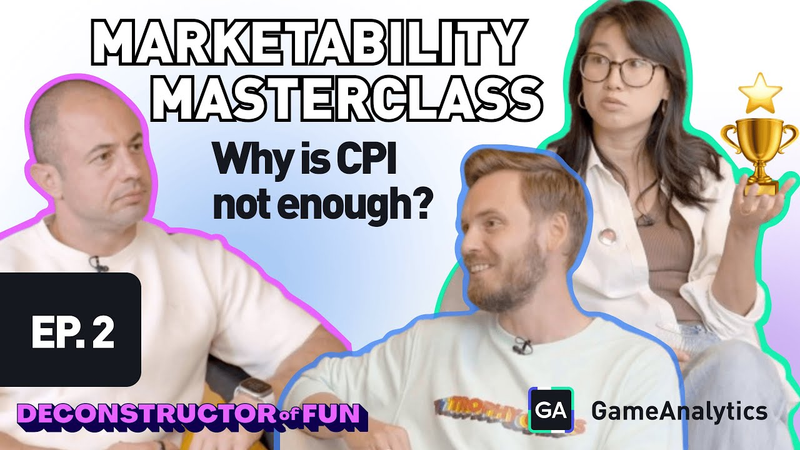
So whether you're killing prototypes in 3 days or scaling your UI spend to $10 million a month, marketability is the make or break factor. And to unpack this make to break factor. We got two amazing guests. Technically I'm a guest here, but we got two amazing guests. Stephanie Jang from Game Analytics. You're the uh head of product growth and someone who sat on the intersection of product user acquisition and creative testing more times than most people have opened up Firebase. So, thank you for joining to unpack this.
Pleasure.
And we have Frederick V, CMO of Trophy Games, which is clearly visible on your beautiful shirt.
Thank you.
Frederick, before we start, can you tell a little little about Trophy Games? We have been around for um almost 20 years now and I have been in the company for almost 10 years. I started our marketing department back then. Um what we have
been focusing on since we started the the company has been management games. We started with football manager games that became kind of a red ocean over time. Um we did an IPO four years ago that also made us um change our business strategy a little bit uh focusing a bit more on M&As as well and not just um self-developing games. So now we are focusing a lot on real life hobbies in our management games. We have a whole series of transport games with airline manager, truck manager and so on.
Basic hobbies that one would have in in
Exactly. Everyone wants to be a pilot or driving a truck. managing an airline. So today I'm hoping we we talk about something that is much more easier than airline management and that is marketability. And Stephanie I wanted to kick off with you about the definition of marketability. Like what does it actually mean?
And when we say marketability I think first we need to start with who is
asking the question. Different platforms same principle. I think each platform has its own way of rewarding if your game has the right appeal.
Mhm.
And especially coming from game analytics platform, we are serving all different platforms. So I think it's it's good to keep in mind where are you launching your products and then make sure you're targeting that to build your marketability. Hm. And Stephan, when you're thinking about marketability from your perspective as a mobile games publisher and developer, is it purely a CPI question or is it more broader as as Stephanie was describing kind of like a product channel fit question?
I think CPI only gives you kind of a glimpse of the truth really. Uh, and at worst it actually might drive you on in a wrong path as well. And for us, we're working this management genre. uh when we have an airline game or a truck game, people would automatically think, "Oh, there's a truck, there's an a plane, I
can drive that truck or I can fly that plane." So already if we look at it from a CPI perspective and doesn't look further down the funnel, then it would be kind of misleading. Uh because people just automatically assume things that are not true in our game. Um we don't want to be misleading, but at the same time, we also want to catch people's attention. we have 1.7 second to uh to catch their attention before they uh they scroll further. And if you have a game that is very data heavy,
kind of looks like a spreadsheet with makeup, maybe no action going on, uh that's it's a difficult practice, right? Um another thing for us when we talk about marketability, we also look at it from a broader perspective than just early stage testing. um we have a lot of experience and know how about the genre about the audience uh about the mechanics in the games. So so we also look further and see okay early on we might look at appeal and the core game loop but later
on we want to uh do some volume and then for scaling we could be looking more at um value to really start finding the right target audience. So when we look at marketability, we also look at how does this uh project fit into our our ecosystem of games. Can we crossromote these users when they decide to turn into more of the games? So really funnel them through our ecosystem. It's not a necessity when we talk about marketability, but it's just an example of how broad marketability can be.
Yeah. So you're thinking about portfolio value at
Exactly.
Stephanie, is this typical approach of a of a game studio or atypical? because we are actually a platform serving so many different type of games, so many different genres. I I do notice like for example, you mentioned the 1.7 second like threshold, right? Like that might not be the case really for every single big smaller studio out there. But that's also where we're trying to be this
platform to aggregate it all the insights in one and then see based on that where you can draw your benchmark and what you could apply to your own game.
Um you do have some of your own approach like your community approach. Not every studio have that advantage, right?
Yeah. Fred, you talked a lot about like how you look at marketability in different stages and really approach it holistically. But we if we start breaking it down into starting from like the early prototyping then soft launch and then scaling. What are the type of a metrics Stephanie that you feel companies should be looking at?
If we start from prototype stage I think at this point you want to prove the concept. The goal is to test does your game gain attentions and then when you move to the soft launch that's that's actually where this pressure test starts you start looking at um payer conversion CPI ROS early stage a common approach is
to break it down first you check the tech crash rate latency server stability like making sure your game is actually running for the for the soft launch phase and then move to uh engagement uh retention metrics day one typically day 1 day 7 day 30 I think a a good thumb of rule at this stage you can take a 40 to 20 10 breakdown like try to aim at very high level 40% for day one 20% for day seven maybe 10% for that's still very very general but it's a good thumb of rule then once you prove your game is working, retention is viable. Now it's monetization metric, CPI, ROS, average revenue per user and all that. And then we move to global launch stage. That's where you scale, you adapt to regional uh differences.
So you would look at the DAO, the MA, the conversion, not just download, but also like install registration and also LTV. It just gets more and more complicated when you move, right? And then depends on the game. Some games also move to the maintaining or scaling stage after the global launch and that's when you also maybe pay attention to the churn. On top of all this and a bit longer term LTV,
so let me try to dumb it down for myself and tell me if I'm wrong. In the prototyping phase, you're looking at the overall attention towards that game or like how clickable it is. You talked about click-through rate. It could be in a way IPM if you do like let's say uh so installs per thousand impressions where you do essentially a fake app store you can see when when people are tapping clicking on the ad they go to the store so you get the double conversion get the conversion from the ad you get the conversion of the app store and it's also fun to make an app store and that can be your early test and that gives
you a view of perhaps deciding maybe what kind of a style of a game it is it you know ships or is it planes or is it trains and you can actually run those side by side at the same time and and find that and that would be sort of early marketability. What should we focus on? Then when it goes to soft launch, you talked about CPI and early ROS.
Do you feel like rorowass should be a soft launch metric?
I I do see people start to adopting ROS more on top of CPI these days. It seems more common.
Yeah.
Um because eventually you can't just celebrating a low CPI on itself. It doesn't mean anything. Yes,
but I I see more common teams start to
have a look at OS already starting maybe early uh even in the soft launch stage.
Yes, I've seen that as well. Well, Ferdick, let's go then in your particular case. I'm especially interested in like how do you choose what type of a game it is and like from the early prototyping phase in which maybe you know type of a style you go
and then how do you validate it in soft launch? So, and then when do you know when you should make that big investment of a global launch?
When we do the the prototype just to start at the the early states, um we also looking a lot at the same thing like the attention um the appeal already at that point. We also look at at the core game loop like does it does it work as we want because that's very essential for the game. But instead of looking at it from a quantitative UA perspective, we look at it a bit more from a qualitative feedback perspective, I would say, because um over the last year, we have we have focused a lot on building a community across our game titles. So we have a Discord server with almost 100,000 users now. Um
that's impressive.
Yeah, thank you. And it's gone really fast actually. I'm a bit surprised as well. But we try to leverage the value of this community already in their prototype states because these users they really represent our our core users right um and our games they don't differ too much from each other anyways. So
what we do is we have them helping us test for more qualitative um approach and then we see okay does this actually um appeal to our target audience. Um but at the same time we also look a lot at um UA and here we start first by looking at the top funnel as you mentioned with CTR IPM CPI goal for us even in the prototype states is to make sure our creatives are driving uh monetization as well like they're driving rowers and I do believe it comes down to our confidence in our way of developing games because we have this knowledge about the genre and about our framework from the previous games we can make the decisions quite early. Then in the soft launch it's pressure test super important. We have multiplayer games as well. So testing server performance. One thing that that has become more and more important to us is the uh ANR. Both Google and Apple they are focusing more and more on um quality in their stores
right and not not as much quantity anymore. So they're very uh very strict about the ANRs now and they have these thresholds. So if you if you're above the ANR threshold on Google, you'll get a lot less shelf space, but you'll also basically be shadowbanned if it's too high. So if we release a game with too high in ANR, it'll be very difficult for us uh to go on from there.
Do you look at LTV and CAC? So typically when I'm seeing like we've talked about early early marketability um soft launch phase where you're looking at basically your installs per thousand impression your CPM so the cost per thousand impression divided by installs per thousand impression gets you the cost per install. So you're basically looking how that changes as you're adding more and more user acquisition. But then when it comes to scaling, do you look at your LTV curve versus the CAC curve and especially like the the shape of your LTV curve that even though it's not bringing a rorowass right now, but you can see that the players are retaining, payers are retaining and in the end this will be a profitable title.
Yeah, I mean we have so much knowledge about our audience and how the monetization our games work. with just a little information about conversion to paying users, we can with quite a lot of confidence estimate what's going to happen when we add this feature, we add this live up to the game later on in the stage. So,
so marketability is the most important metric for your portfolio because that's the main variable.
It's very important. Yes.
So, Stephanie, if somebody doesn't have this portfolio of very similar type of games like trophy games,
a lot of games,
like most of the or the Discord with hundred thousands of users that you can test out your concept with. How would they get the marketability figures to benchmark against?
That's a good question. Actually, I also want to challenge this obsession with benchmarks a little bit. I mean, it it it is important. It gives you a good starting point to do some sanity test about your data and sets a direction. But do bear in mind every team has different game play, art style, budget,
resources. So certain metrics, yes, it's more suitable to to try to compare. They are also investing so much more. They have a much more resources, people behind it, right? It's good to try to have a look at the benchmarks, but it's not your own road map. For example, Lily's Garden and Royal Match, they sit in the same match three category, but they they scaling with very different approach, right? at game analytics and especially with market IQ actually we do encourage teams to go beyond just the statics benchmark data but try to look at what's really driving the impression and identify these performing ads and try to analyze the recipe behind underneath it and then use okay what's already proven to work in the market
because we provide those data like benchmarks at this level, not just numbers, but actually the performing ads and then summarize your own recipe and then adapt to your own game.
So, you're saying deconstruct the uh the creatives of other companies that are succeeding and then build out of those ingredients your successful strategy.
Yeah. Adapt to yourself
and then the investors or the board would still ask is this better or worse? And then so you end up needing the the benchmark number.
Yeah. Take take both approach. Yeah. Frederick, you've moved outside your core portfolio as well from time to time. How do you approach marketability with those?
With less confidence, I guess you could say. We had a true crime game a few years ago, but it had really um really strong uh CPI, but when we started looking at the uh intention to buy or the actual purchases as well a bit later on, it wasn't looking really great, right? uh so it didn't really keep up with the uh with the CPI and the the
completion rate of the prototype and that that was kind of a difficult decision for us to make like and I think the decision came down to our experience in the games really um do we have good enough estimates about whether or not if we apply let's say live ops or we apply more cases to this true crime game or we apply better um better offers like what's the impact going to be and we just didn't have the experience to really make educated guesses here. Um, we ended up killing this project. Um, and I think the reason was that um, we just didn't have um, enough knowledge to uh, to make the right decisions. I mean, we could of course guess a lot, but there there would just be a huge risk.
So, you're trapped by your own success of your own genre.
Exactly. Exactly. Compared to We also had a truck manager that was released a year ago. We had that in a quite early stage as well. Basically, every metric I can uh, I can think of it. It wasn't looking it wasn't looking great. It's not where we wanted it to be at least at that point. We decided to go in another
direction compared to the true crime game. And that was simply because we had so much knowledge about again the target audience, the way we monetize these types of games. If we add specific features or or mechanics to the game, we have a very good idea from our historic data like okay, this is going to uplift the retention this much or it's going to increase the monetizations with so and so much. So um so we actually decided to go on with that. Um and that was just based on our ability to really make um good estimates about how much can we improve this.
So just having the conviction and the experience in the genre allows you to bet on a more long term.
That helps you a lot right when you try to determine where can we take this product even though it's not where we want it to be. I'm curious to hear from both of you like some of the typical mistakes that teams do when they are testing marketability because that is still a huge question especially for those going into genres that are new for them is like how do they get that conviction if they don't have the
background of the similar genre.
I think a very common mistake is measuring the wrong KPIs at the wrong stage. um for example at prototyping already trying to you know optimize for average user um revenue or or CPI or iOS that's just way too early or overindexing on on CPI without having a viable game play and solid retention. I guess another case could be overproducing your creative
and sets the false expectation for or the other way around, right? Or creating a creative that is just not reflecting the quality of your game and you know sometimes you overlook this this kind of uh details.
Another mistake could be ignoring just geological differences not try to you
know you cannot launch everywhere the same way. uh keep that in mind and also know where your audience really are because if you're testing on Facebook or Google but actually depending on the type of game your audience if they're mostly on YouTube or Tik Tok then you're not getting the right market signals. I also think that a lot of people uh if it's indie studios or maybe midsize studios, I think there's like this idea that there's kind of a golden rule to to look at this.
That's just not the way to do it. Like you can't just look at just CPI or whatever we decide is the right thing to do. It depends so much about what type of game you have. Like if it's a casual game with a very broad audience, then makes much more sense to look at CPI and look at the broad appeal. But if you have more of a niche game or whatever it might be, then it's it's also super important to understand your audience and and try to reach them because you can't just do a broad campaign if your audience is not that big. Then you'll
get some probably some pretty poor results and that then you will lose confidence in your in the project you're having. So it's really important to to have that understanding and not just follow the
the golden rule of uh of testing uh marketability. Stephan, you mentioned that putting in in-game metrics too early, tying them too early with marketability is a common mistake. What is the right time to tie in in-game metrics with marketability?
I think the marriage start from soft launch of in-game metrics and monetization metrics because before that it's been like trying to make a paper plane fly, right? you want to just violate the hook or the attention at the prototyping stage. You can't
and so it's it's a bit too early trying to merge these two metrics.
Yeah. before soft launch I think but once you are moving to soft launch I think I mentioned earlier then you you definitely want to make sure your
service stability your game is people can play smoothly and then retention is there on top of that starting to check all these uh monetization metrics CPI and conversion rate
um conversion to pay and yeah
product metrics
yeah exactly And Frederick, talking about product metrics, can user acquisition improve product metrics? Can you just improve your game with UA alone?
Yeah, absolutely. I would say you you could, but um I mean, of course, you can with UA you can improve your organic traffic. That that makes a lot of sense. But uh I also think it's really important to look at it when the marketing team and the development team comes together and we have these type of uh meetings to to synchronize. The marketing team has a lot of uh knowledge that that could really help the product as well. There even games that's that originates from this, right? Um the last C the shooter game that was just a
misleading ad that had nothing to do with the actual product, then they saw it had just such good metrics that they decided to make an entire game based on UA. That's a kind of an extreme example. It happens time and time again. in Farm Manager, which is our latest game released a couple of months ago, we just introduced um breeding and the horses and so on to a to a game that was more focused on crops and tractors and fields and so on. So, a bit more male uh heavy audience we had originally, but when we started testing creatives with horses in focus now, I guess it's no big surprise, but it attracts uh more female users than the tractors did.
Yeah, surprise. And we could just see the CPI being lower. We could see that we are actually getting 40% female uh installs now compared to we typically get around 5% across our games. They're very male uh male heavy.
Yeah. But now suddenly we're tapping into a huge new audience with farm manager that we have never been able to tap into before.
No.
And that's knowledge that we're sitting
with. But at the same time we can also see oh the retention sucks for these users, the monetization sucks. And then when we come together and figure out what's happening, that's actually because you're only introduced to horses after playing three or four days into the game. So of course they fall off. They're promised that they have livestock and animals and so on and but they don't see them until they actually get
quite far into the game. So that's just an example of how how important it is for development and marketing to work together and figure that out because they could easily be fixed.
I think that might be the new thing or simulator.
Yeah. No, just saying that there are a lot of things can happen when you actually share this knowledge.
And um I wanted to kind of like talk about the sort of a decision traps and and trade-offs. And so let's say Frederick, you talked about your product that had amazing CPI that had really strong early metrics in the end like what is the decision tree to continue development to kill it or to park it?
We're not really risk takers and especially not over the last few years when we went public and really um cut to the bone about what we want to do and what we know we are good at. If we're not super confident in the data we see, then then it's just too big of a risk for us. Whereas at the management jungle, we um we can be a lot more confident in the in the estimates and decisions we're making.
So historical data and expertise in the genre.
Exactly. It can help you quite a lot. Stephanie, can you use game analytics for historical data to help maybe continue development of some of these games that feel more risky
on the platform? First of all, depending on the product, if you're tracking with our SDK, you can only look at your own games. Or if you're publisher, then you have the same advantage. Then you can have even multiple genre data, right? Then you have probably even more confidence jumping slightly different genres on market. Then you have the whole markets creative data and uh UA
insights that's for you to do your decision making by looking at other games and their benchmarks right you have to make their own decision based on what numbers you you're making the green light or or kill decision and maybe it's also a progress maybe that's not something you learn you maybe you make a few mistakes um and then you you start building your own formula of okay we I need to look at these numbers for my my type of games so we do provide these tools but then it's up to our user our community then how they use it adapt to their own game
yeah yeah it's difficult for sure uh I wanted to ask you also like what is the biggest myth about marketability that you wish product leads would understand better
I think depends on the different communities right because I feel mobile are very datadriven that they have to be right they they're actually pretty good
in terms of understanding what is marketability especially for more mature teams
but we also see a lot of indie developers or PC developers they still have this concept like you stumble on marketability a game is something make it or break it but that's not true like there are so many signals you don't have to invest so much so early you and really optimize, observe, make decisions at each step of the way. For me, it's a science lab. It's not like uh pure luck or a lottery ticket. There are, you know, games you invest a lot two years of time, right? And then you only find out who becomes a hit at the bottom line. Still marketability is really something you earn early and you constantly iterate on and improve not just you stumble on. That's
yeah I also I completely agree with the
whole being datadriven it's it's just so important but I also feel like in terms of myths I think especially in the mobile industry um there's a mindset of indie studios being like okay so we create a game we're a small team of developers we create a game now we need a publisher
I really want to challenge that a bit because uh if you are developing a game you're probably quite smart so I'm sure you can also set up a UA campaign at least a basic one and maybe add an SDK. So like before you just automatically think, okay, I've made the game, now I need the publisher. And then you'll literally just yourself for the rest of the game's life. Uh there are also good cases, but still they are going to take some of your both organic and non-organic revenue going forward. So it' be very difficult to grow the game if it's not a match made in heaven. You can very easily start testing yourself. It's it's not rocket science. If you can make a game, you can definitely do a few UA campaigns. I've done my UA campaign. If I can do it, anybody can do it.
No, I just get sad when I see people and their game is ruined because they got stuck on a publishing deal where they weren't in the top 10% focus of the publisher, right? At least just to know your own value of the game because you will get so much better insights and uh be a lot more datadriven also in your decision making about
whatever you want to do with style of the game or maybe new features. There are so many things you can learn
and so many services that can help you with that.
Exactly. So, uh please just rethink the whole I just need a publisher otherwise I'm not going to make it.
So, changing the process from build a game, give it to somebody to distribute to build a game for a specific audience because you're in connection with that audience early on through the tools distributed and then possibly take it to a publisher saying we did something that the market wanted. you'll be uh position positioned much better in a negotiation process if you know the value of your or the potential at least of your product right and also nobody cares more about your product than yourself that's for sure
hopefully uh
yeah hopefully
the last question I want to ask is of course about AI so AI made creatives are everywhere right now what is the impact of AI on marketing and marketability that you're seeing in the near and maybe a little more distant future we're talking about year to 3 years.
I think people are actually able to be less dependent on agencies, you know, uh or hire a creative uh agency to produce. Now, a lot of people can just go ahead and and test a lot of things and much faster turnaround process of creating them. For example, earlier I mentioned getting the recipe of what's proven to work. This is something you could also combine. First identify what are the top performing arts of your specific genre and even under your specific genre identify the ones that have similar
mechanics have similar really like narrow it down and then try to maybe uh download all the videos and upload into through just a a quick chat and they can help you generate. Okay, based on the analyze of all these videos with the formula behind them, you can share that with your team, then create your own strategy. So, and also another use case could be, oh, this seems to work now. Maybe I can experiment just changing the background from a Egypt, you know, to Paris Epha tower or to a city scene
or this component seems to work for this type of game showing in all the cratom that something seems common and then how do you add something even make it more performing to beat the other ads by using your you know your own knowledge and connect connection to your game and just apply it to another image model too
and that's very quick and then you can quickly test does it work does it not and create so many variants so much faster
so iteration speed is because you can produce creator faster and you can analyze them faster that means you can test faster
yes
so it's not groundbreaking it's just faster and cheaper
definitely cheaper and faster but also it depends on who is able to spot on the really valuable insight like insight
and not just looking at because quantity is still there right if you spend your time going through all of them then you're not getting the result
we use uh GNAI quite a lot of trophy games across all our departments um especially the marketing team we are we are heavy heavy users of
prompters
yeah we're prompters right and we're very happy about it uh to um because it fits our business size our type of um games really well we don't have too about quality or trademark and all of
these things that we really need to it has to look exactly like this and so on. We have a lot of freedom and flexibility in our work. The power of it, it has stagnated a bit, especially if you look at from a marketing perspective. Uh creatives and so on. It's it's just not at the same pace anymore as it used to be. At least in the sense that it's not as groundbreaking anymore, right? Uh it is prompting uh text to image or image to video and so on. I I feel like they're kind of desperate to try to keep up the pace we have seen over the last two or three years. Um because that's what we are getting used to. We need to adapt all the time to this uh hype train of AI. Um and I I just think it's difficult to keep that pace. Um instead of chasing new desperate uh hooks where that has nothing to do with your game to just produce as much quantity as possible. Um I think should take a step back and really leverage the fact that the quality of these uh tools V3 uh the new updates to chat GPT or Mid Journey
or there's always a new update to one of the tools right I think you should really take advantage of the the increase in quality and instead of looking at quantity and just producing a high of an output as possible doubling down on the quality and make um a better output with the help of this uh these new updates that are coming. having that that's what we're focusing on at least. I think the market is kind of fed up with poor quality AI that is just being prompted and sent out. Um,
has your results dramatically changed post AI usage?
I think early on it did because we could be so much more efficient in our work but at the same time I also think all our competitors are also adapting to this. A AI is not going to take take away our jobs, but those people not adopting to AI, they will probably be left behind. And I kind of feel that that's very true. And also,
especially if you're selling AI,
especially if you're selling AI, but but I but I do tend to agree with the quote though that um that it's more about
you're left behind if you're if you're not adapting to it. I don't really see like these huge increases as we used to do right when it was introduced and you were a first mover on
on GNAI tools.
Well, thank you. This is not a lot of information marketability and we'll add a link on how to use AI and your tool to efficiently analyze the market and come up with your own creative solutions.
Sounds great.
Thank you.
Thank you.
Thank you.
Auto-generated captions from YouTube — names and numbers may be misheard.






















Comments