VideoDeconstructor of Fun
Life at the Speed of Play: Mark Pincus, Zynga founder, on Leadership and Risk
28 Sept 202652 min video

Transcript
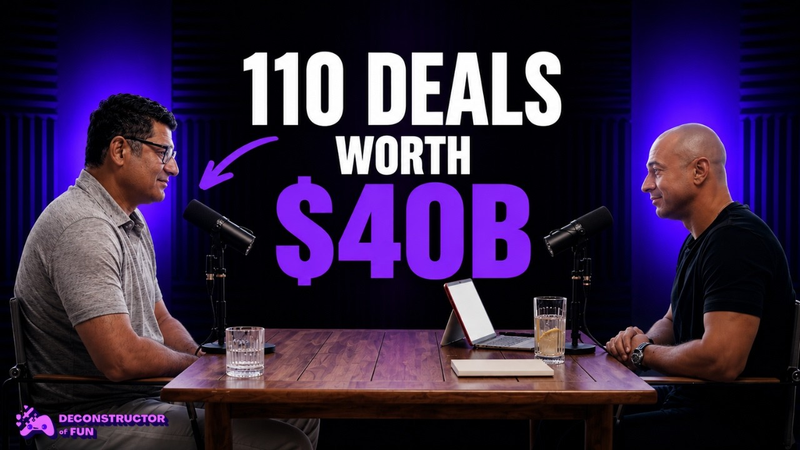
Mark Pincus, you founded Zynga, pioneered social gaming, and helped turn play into a mass market activity for hundreds, if not billions of players who have never played any type of a game before. And talking about before, so before Zynga, you founded and sold FreeLoader in just about 7 months. You also had a company called support.com, which you took public. And you were a seed investor in little startups known as Facebook and Twitter. Your new book, which I actually have over here, Life at the Speed of Play, is essentially a product management Bible of a 30-year operating manual building products people can't live without. You've also created a product management class at Stanford Business School, which means that you're teaching founders how to kill their losing ideas now for years. Mark, sincerely welcome to Deconstructor of Fun.
Wow, I'm going to have to get it that
copy of that. I think that's the best intro I've heard ever.
Oh, thank you. I do have to say that Zynga was the launch pad for my career. So, in that sense, it's a it's an honor playing games like FrontierVille, FarmVille, like those were how I started my gaming career. So, so truly an honor to to have you on the podcast and to talk about your your your latest book. Is this your first book?
It's my only book, yeah.
[laughter]
It's Is it your last book?
It It may be, yeah.
So, it's two books?
Books. Yes. [laughter] Yes.
Uh what made you write the book?
Well, I've been working on this playbook for product management for 30 years. I'd say maybe the first half just doing it and learning by instinct and a lot of failure, and the second half starting to be more conscious about a playbook and writing things down and building frameworks. And I created this class at Stanford, and I've given input and advice, you know, to
hundreds of founders. And I was like, "Okay, I'm really saying the same thing over and over and over. Probably makes sense to put a book out and at least point some people to that or the podcast like this where I get to talk about these points, you know, in the book. And my my hope was that I could get these ideas out, move product management a little bit, move move the science, if you call it, or best practices, you know, some kid at IIT in India or a mom in Pakistan or a nurse in Indiana, you know, who is thinking about doing something, maybe maybe there'll be some concepts in the book that'll help them win, help them, you know, get to hit products or or even, you know, minorly successful products.
Oh, yeah. Hopefully, 100%. No, don't know about moms in Indiana, but I know that everybody who's building a product in any kind of software development or even outside the software development is is benefited from a book like this
because you read it over and over and over again. And and there's ton of different interesting pieces. And this is the kind of thing that I wanted to jump in on this podcast and kind of take little elements out of it and and
[clears throat]
have you kind of explain because it's not always clear through the first one as you read through the book of like, what do you really mean? So, it's a it's it's awesome to be able to ask the author.
I have to update it with your your questions and input.
Satori. It's the Japanese [music] Zen Buddhist term for sudden enlightenment. That flash where everything clicks. We're told that Heroic Labs team had theirs when they realized [music] that most studios run live ops like a horoscope. Vague, kind of generic, same advice for everyone. So, they built Satori. Real-time experimentation, player-level personalization, events that [music] actually respond to player behavior. Say sayonara to your old live ops stack
and konichiwa to Satori from Heroic Labs.
Unless you've been living under a rock, you know this is Webstore Ram Springer. 70% of top apps are using a Webstore and the best ones, they're doing it with AppCharge. Do you want a $20,000 in-app purchase? Yeah, [music] AppCharge does that. Do you want to pretend that subscriptions are still a viable monetization strategy for games? Yeah, [music] AppCharge even lets you do that. They get what high average revenue per paying customer means [music] and they're already doing over half a billion dollars in transactions a year.
[music]
So, are you going to be the first to do a $20,000 IAP? Don't accept microtransactions, embrace macrotransactions. Learn more at appcharge.com.
[music]
This episode is sponsored by Moloco. More than 2 billion daily active users, over 2.8 million independent apps globally. That's the reach Moloco ads unlock for performance marketers who don't want to stop at the usual walled
garden. It's all powered by Cara. Moloco's compound AI system continuously learning from billions of events and getting [music] smarter with every campaign. Hop over the walled garden. Check out moloco.com. That's m o l o c o dot com.
[music]
Yeah. So, so let's just uh jump in. The first quote, "Your instincts are right 95% of the time, but your ideas are right 25% of the time at best." What do you mean by this? Like, what's a what's an instinct and what is an idea?
Well, without getting too philosophical into Buddhism and religions, you know, I would say that part of the process we need to go through is killing our ego. Because our ego creates all these narratives and stories for ourselves
that usually are divorced from reality. And what we're trying to do with our products is get to reality as close as we can get because we're trying to get to the reality of is is this product hitting for people? Is is it getting to true signal? And true We can't manufacture true signal. It's It's It's a truth in the world. And so what is usually or I'd say always happening with us as founders is that we have instincts that are driving us somewhere and and they're coming from reality. Like in 2003, I write about it in the book that I, like a lot of other people, had this instinct. I was holding this flip phone. I was like, "There's probably a better way to get a taxi." I was like, "If you're at a theater in New York and it's raining and you know there's going to be a run on taxis afterwards, how nice
would it be to be politely, you know, under your seat texting, you know, I said SMS taxi so that you're the smart one with a car outside, you know." Now, obviously, that's Uber. But I had that instinct like so many of us. But but that idea that I put on top of it wasn't right. It wasn't right at that moment. The technology wasn't really right. My My, you know, instantiation of that instinct of, "Okay, I'm going to provide this as a service to taxi brokers who are then going to market this to their end users" was a small idea and a wrong idea. I didn't have Travis's idea of I'm going to let anyone in the world become a driver in the gig economy and you know so many other things that he got right and so I was off on the idea I was off on timing I was off on technology. Tribe tribe.net I like to say it was three world-changing winning instincts and one wrong idea and I stoically
stubbornly you know went down with the ship with my one idea and I don't if I could go back in time and try four more I don't know that any of those would work. I could have copied Friendster copied Facebook copied LinkedIn it still might have failed but at least I would have tried some more things that at least you know were working and not stuck with you know this one idea and so often I think we listen to a founder and like it's just not quite right it's it's a B plus or less and we think of the courage of founders to you know to be misunderstood to pursue an idea that the world doesn't believe in that that's that's Jeff Bezos and that's Elon but unfortunately they were right in the end and you probably are not
[laughter]
it's like and it could take you you know a lifetime of doing this to to figure out the difference between being misunderstood
and just being plain wrong.
Like with everything there are different kind of edge cases that are very interesting to discuss because the hard thing about hard things there's a lot of great advice but when you're in the midst of those hard things it's very hard to distinguish what is the right call like in this one you're saying like you might have the instinct correctly but then it is about the the ideas and you can try multiple ideas none of them work so like the first question that would arise from that is how do you know that your instinct is correct because at some point the right instinct with a wrong idea becomes indistinguishable from just being wrong, right?
Actually, you know, it's the opposite. It you can get false signal and it's indistinguishable. That's a B plus. A B plus is you got the instinct right, but the idea wrong. And so you're getting enough signal back that it's right to keep going even though the idea isn't quite right. It's an easier correct signal. If you have a wrong instinct and
a wrong idea, you're getting no good signal back. But But to your question, how do you know? What are signs that your instinct is right? Let's start with that. The easiest is you see somebody else doing something very close that is proving your instinct. So that's proven. And And in my book, I talk about this framework of proven better new. Let Let's take games. It's the easiest way to talk about this and learn. And I do think games are the best learning and teaching grounds for product management and development. The easiest proven is a game mechanic that's been proven over years. Endless runners, you know, match three, right? If you have an instinct that people are addicted to those, that's pretty easy to see true, right? Cuz not only have those games been working for years and years, you yourself will get addicted to those games, you know, your friends and family will, I mean, for the most part. And so those are game mechanics that are highly proven, okay? Then can you do anything that is better
and new on top of what is proven? If First, can you isolate the proven? Can you recreate that mechanic of an endless runner or a match three or whatever, you know, tower defense has been one of the, you know, most proven since we first got Windows PCs. That's the easiest to isolate the proven and say, "Okay." In some ways, I used to say that these are like slot machines. Like if you copy the exact balance and mechanics and art of a slot machine, it will generate the same dopamine hit in somebody. And software is, you know, very, very similar to to that slot machine. It's It It just doesn't need the hardware part of it. And so, we can isolate instincts and prove them out for the most part. And then then we get to your idea beyond that, and that's the better and the new. And And better, you know, as I said in the book, is usually a much smaller level of innovation than we like as humans to go
after because it's it is not very satisfying. But better is usually It's something our users really, really passionately care about. It might be the price. It might be it's half the price or free. Fine. 10 out of 10 people are going to say, "Fuck, yeah." to free, right? It might be less clicks. It might be, you know, more polished, better art. You know, it's Better is usually, you know, in very, very small atomic units. And new is the thing you're most excited about. It's your novel, big idea. It's the reason someone probably is going to try your product. It's not the reason they're going to stick with your product because, you know, one of the mantras Scotty K can tell you about, you can ask [clears throat] him if these mantras are still repeated inside his hallways at my former beautiful company, uh Zynga, is all new fails. And I always said, "All new fails." Because if you live by that, you mostly won't be disappointed. That if
you expect the new to fail, then you're probably in the right expectation zone. And if you expect the new to win, then you're not serious. You know, you're not a serious product maker. This is just hope and you probably have too many resources or you're not ambitious.
I have to totally understand. So, basically, this quote is about being bold enough to kill your ideas while establishing yourself on a foundation of an instinct, correct?
Yeah, and it's there's so many paradoxes in my book and in this and and I apologize to all your listeners who go read my book and say Hey Gus, you're every other sentence you're disagreeing with yourself and and that's fair and I've been accused of that by product teams and people for years. But if but if you if you're willing to go a little deeper and and accept the nuance of this and the world is nuanced. What I believe is that the more ambitious you are, the more
committed you are to intellectual honesty the more you're willing to kill your own ideas and and pivot all the time and and at the risk of losing team members it's a really important point for people to think about. Like how much courage do you have? How ambitious are you? Are you willing to disappoint your team and your investors? Because we feel so much pressure, right? But what do you do when it's Sunday night or Monday morning and you think your product isn't quite right and it's not that good? Do you want to like maintain this confident face to your team like we're supposed to do? You know, I err on the side of transparency. To to a fault. I mean I think I said that my team said working for Mark can be like third grade soccer. Like every Monday he wants to go a different direction. And that's often true until it's not. I mean and I don't you know, and I I'll
own that. Can you own that?
Yeah, but well, most people can't. I think you need to have a lot of success on your background to be able to pivot so freely. Because it's like through the success you you believe your instincts more. Let's put it that way.
I I talk in the book about different the difference between belief and hope. And it's such a nuanced point, but it's so important. I in in a product sense, I think that you can build belief based on facts and data and and trustable instincts that you have. And we got to separate that from hope, which is it's not based on anything, right? Hope is just you just want this to be true in the world, but there's no reason to believe that it is true. And so, I want your listeners to have the to sleep at night with conviction-based belief and not to be up all night with the anxiety caused by
hope.
Understood. That's a That's a well put. Um I wanted to move to another quote that I have, and that is, "Know your goal or suffer death by 1,000 compromises."
Yes.
How did you land on on this?
Through 1,000 compromises. Through so many painful I'd say every company I did, and this is probably true with founders who are listening, I know all of you listening have had this experience. We all make these compromises as we go because it's in the name of getting to the next level and success. And we're betraying ourselves in little bits every time we do that, and it's it's a calculated trade-off. And I'm not saying that you're wrong, but we should be conscious of that. And what I mean is there was so many moments I was tested on this with Zynga where I passed the test, and so many moments in my previous companies where I failed the test. And I
mean, when we fail the test, when we compromise so much, you take an investor who's a douchebag, but you say, "Yes, I I know I can learn from you, and your firm is so impressive." But that guy is going to be on your board, or that woman, they're a douchebag, and you know it, and other people know it and no one will say it because you can't cuz you think it's so important I have that brand and I need that money. But at Zynga I remember early early on I had a brilliant CTO. But I spent my whole wedding unlike this guy this poor guy what's his name um who whose hedge fund just blew up who spent his wedding probably just in such pain.
Yeah, yeah I mean a hedge fund.
Yes, yes. I spent my wedding recruiting the most brilliant CTO I've ever worked with Khadir Lee and he was at my wedding he was captive and I spent the whole weekend recruiting him. It was a year into Zynga and it was 2008 and and then I went back and my my current
CTO I said "Hey, I'm going to have this concept of multiple CTOs." And that's what I want to do it and he said, "Well, if you go through with this it's very risky and I can't tell you that I'm going to stay with the company." And that's scary, right? And what do you do as a founder? You have this pit in your stomach. This CTO that I'm working with Lux has built it all, right? He's he's got the keys to the kingdom. You know, he knows how this stuff is like jerry-rigged together and barely working. If he left tomorrow I I think we'd tip over. But Khadir represents such a bigger future so what do I do? You know, I'm I'm in my office with him and he's saying this to me. He said, "I just might not stay. I got to think about it." And I said, "Lux you're brilliant, you know, I don't know what I'd do without you. I also know that that you're going to love Khadir and that we're going to be a much bigger company and a bigger future if he joins and I hope you decide to stay."
And I said, "But but my decision's already made. Khadir's agreed and he's joining the company and I hope you'll stay." And he looked at me and he thought about it for a minute he said, "Okay, I'll stay." But it was such a test. I mean and there's so many of those, and those are the thousand plus compromises. And we want I want to encourage your founders to build a house that you want to live in. That's you're the number one person we got to keep at your company. You're the most important person. And after you've betrayed yourself so many times, you'll wake up one day, I promise you, and you'll just be like, "Well, this isn't really the company for me, and I guess the best thing I can do is bow out, right?" As I did at support.com. The company's future is not just half, it's probably zero when you leave, because you're the one who invented this, and it's got to be reinvented, and we can't afford for you to leave. And so, keep true to that, and keep saying, "What is it that makes me love this place and want to be here and be passionate about it?" And it's okay if other people don't, because we'll find
someone who share your passion. Whatever your weird quirk is, double down on that, and I promise you that you'll find other weirdos just like you that want that, too. And you'll repel those you should repel, investors and employees, but you the ones you attract will follow you like a religion.
I'll be honest, I've heard this from many founders who are incredibly successful, who have taken their companies like just like you public, who have sold their companies for billions, and they always say the same thing, like the biggest mistake that they have done is lose the control of the company that they had. Despite what they have achieved is literally the dream of every founder and every investor backing every founder. So, those those have been interesting things. But, you also describe companies as democratic dictatorships. How does one actually function day-to-day in democratic dictatorships?
Okay, well, that's my approach to being a CEO, okay? And I've always said, and I think I got this from my father,
I'm a team player as long as I'm running the team. And I that's just my truth. And you know, I'm not a good board member unless it's my board. I think boards are terribly run. I think you try to get impressive people and then you waste their [ __ ] time. You know, you get all these people in a room or on a Zoom call for 4 hours and then you waste so much time with presentations and not tapping their brilliance and not tapping your own brilliance. And so, I'm too frustrated by badly run board meetings to ever be on a board. And so, you don't want me on your board cuz I would just be disruptive and I would just say you suck as a leader as a board. That's my opinion cuz I'm not running it. So, that's just a a pitch to don't put don't ever invite me to be on your board.
Would you still join a board even if somebody hears this and will be like, yes, I definitely Mark on my board.
I won't. I won't be on a board unless I'm running it. It's I mean, look, if I sat down with someone and they told me how they want to run the board and I agreed, you know, great. I'd I'd consider it,
you know, if I loved what they're doing. But, I don't think that's never happened so So, democratic dictatorship. I would advise you to run your board like a democratic dictatorship. I would advise you to be a CEO in that way and create lots of CEOs below you and they're running their own democratic dictatorships. And what I mean by that is a company is not a democracy. Get rid of anybody at your company who believes it is. Kill that misconception. It is not. But, we want to hear your best ideas and we want you to fight passionately for them and I want to create a culture in your company of intellectual truth seekers. I believe those are the most successful companies and cultures. I want everybody to be able to express their opinion and passionately fight for it. But, then I'm going to make the decision or you are if you're the CEO and then we're going to look for everyone to buy into that and make it successful. And, you know, disagree and commit. That's an old idea now. You know, and Jeff Bezos said the number
one criteria to be a leader is to be right. Turns out I agree. I think I'd rather have someone who's right than liked. I'd rather have someone who's right than can keep the best talent. Great, you have the best talent, you know, now you could say Anthropic is an example where they're really, really catering to the best talent. They're talking about this save the world mission of protecting the world from, you know, dangerous AI and they're getting great talent. So, you know, they might be the exception to the rule. In my lived experience, being right will ultimately attract and keep the best talent.
So, you're essentially describing a professional sports team. Like, you don't vote who plays in tomorrow's game.
Yes, but at the same time, you have to take care of your constituents, just like the coach, you know, of any great pro team. If you're the coach of the Warriors and the team feels like you're making bad decisions and ignoring the correct things, you know, they will
also start to opt out. And so, we need buy-in from people. I'm not saying be a jerk. I'm not saying be a dictator. So, we need to take people along with us on this journey. We need to sell them on why we're right. But, we still ultimately have to make unpopular decisions when when we believe them.
Is there a risk that this sort of a no-compromise culture turn into a it turns into a culture where nobody tells founder that they're wrong?
There is a risk of that, but that's why at the same time, we want to elevate truths, especially when they come from people other than us. When you have what I call these expert witnesses in your ranks, people who are closest to the data, they're closest to the truth, and they're furthest from the decision, we want to find those people, and when they're right and we're wrong, elevate them in those truths, because that is how you create a culture that says this isn't about my way or the highway. This isn't This is not about my ego.
This is about the truth. I am going to be the ultimate arbiter and judge of that truth and you got to decide whether you like my judgment or not. But doesn't mean the truth came from me. Oftentimes it's coming from someone else at the table, someone else in the room. And so so much of our jobs as CEOs is to get exposure to those expert witnesses and give them exposure. And so I never do one-on-ones. And when I meet with a leader, I meet with their team, too. And I want to hear from everyone in the room. That is how we create a culture that's fighting for the truth to win.
Yeah. And if you read this, you might get the impression that you like the type of organizations where everybody listens to the leader and are almost like passive, but I can you know, having worked at Zynga as well, I guess and and if you look at the Zynga's history, how many founders have Zynga spawned? So it's not like you hire people who are just there to listen and to exactly what's being told and are in afraid under this tyranny of
dictatorship, but it is a quite of an organization with a lot of self-starters.
Yeah, for sure. As you may recall, one of our values on the wall was be a CEO, own outcomes.
Yeah.
Level up. And so we wanted every I wanted My job as CEO was to make you a CEO. My job was to give you a big hill and a big mission. And if you deliver that hill, to blow you away with the rewards, with with giving you more responsibility, more compensation, you know, that was so much of my job was to convince you from the day you joined that we were not a normal company, to convince you that if you brought everything to us and passionately fought for the right answer and took that hill, you were going to do better here than anywhere else.
Well, talking about that, there's another quote that that kind of leads to this. It is I define scaling as getting people to do the right things when you're not in the room. So, the question immediately comes into like what are the right things?
Whatever the right answer was, and that's my point. Our job is CEO to define the hills for our teams to take, for a company to take, for the teams to take, not how they take the hill, just what is that outcome, what is that hill. And it's so easy with games, with metrics, you can do somewhat subjective qualitative things like app review ratings, but that's still ultimately a metric. That can be gamed somewhat. You know, you you can't fake DAUs. Really, you can't really fake revenues. I like those. Um You can kind of judge and fake your quality ratings or, you know, team health and stuff. But, if I define that hill well and give you the enough room and rope to take that hill, then I'm going to give you a chance to lead in your own way and and to be your best and really to shine and to be a CEO in in your own right. That's the greatest thing we can give people is is the chance to
be creative, you know, problem solvers and and to think big and act big and say Mark, I didn't do what you asked for, but I did what you wanted.
Mhm.
I didn't do what you told me, but I took the hill you you wanted me to take. And and that was the the kind of culture I try to create and I think those are the best cultures anywhere.
In the book you you also admit that teams wouldn't jump off the cliffs to try new things.
Yeah.
And and that and the and jumping off the cliff is incredibly important when creating something new. That's a That's a taking a hill that you don't know even is there. So, how do you get teams to do that?
The way we negotiated hills or OKRs were top-down, bottom-up. And the top-down is this is theoretically possible. We can build a belief that it's possible. The industry is growing at 30%. We ought to be able to grow at 30%. Someone else took this hill, we ought to be able to take this hill. So, it's theoretically possible. That's the first thing. When you tell people to take a hill that they don't believe is even possible,
I don't think they're going to really buy into it. So often at Zynga, we had to do we had to do new because we're flatlining. And if we don't do something new and bold, we're not going to grow. The industry at that time wasn't going to grow. Or Facebook created more moratoriums and more they changed the rules on us again or Apple's changing the rules on you again. So, we had to grow or die. And and and our job as leaders is like we've got these soldiers and and we're in a foxhole and we're warm and comfortable and safe. And the hardest thing is to pull them out of the hole and say, "Guys, we got to run against those bullets. Some of you're going to die. Maybe all of us. We're going to take that hill or we're going to die. And I can tell you one thing for sure is if we sit in this foxhole, we're all going to die. So, do you want to run up that hill and maybe die or stay here and for sure die?" Most people are warm and they're like, "This feels okay right now. I'd rather stay here." And that's this experience of running startups. It's it's getting people to go do something that you do not know is possible.
And it's so hard and it takes so much bravery and it's so beautiful when we do it and it works and they get to the next hole and they're so thankful that you did had them do that, but now they don't want to run again. I called it the penguin effect. Nobody wanted to do new because it wasn't a good use of engineering resources. It made sense. I can do mouse nuts things and I know those will work. I know I can grow my DAUs 5%. So often at Zynga, it was I know I can actually keep my keep it zero for the quarter by doing all these little features. And I know if I do nothing, we're just going to decline. And by the way, that's what I said to my board and my investors. I said, "Every quarter I would show them the forecast and I they and it was miserable. I said, 'It's going to be a slow decline. The only thing I can guarantee you is a slow decline and that's games, right? That's all media. It's like a melting iceberg, right?'" But we kept crushing our numbers and growing, but I was never willing to sign up for that growth cuz I
couldn't guarantee it. And if I guaranteed it to them, I was going to bet on new in a way I that I knew would fail. What I had to do was shared pain. I had to get I had to force teams "You are going to do." So, the way we ultimately did and you can ask Scottie K, they still do it as far as I know at Zynga to this day is in your OKRs for this quarter, I said, "You're going to do one bold beat." Right? A bold beat is a big, hairy, audacious feature that's an OMFG moment that people are going to say, "I can't believe you did that." It's at least going to find a vein. It it may be a caffeine hit and may be no hit, but you're going to [ __ ] do at least one of those this quarter. And that's how I grabbed you by the back of your, you know, shirt and said, "You're [ __ ] taking something on this hill this quarter. You might as well make it bold and make it make it something with a chance of hitting." That's how we forced innovation inside a
culture that was very, very metrics based and those could be hope. That's why I was telling you you might need a hope, you know? But even there, try to prove a vein, try to top of the funnel find something that 25% of our users will click on before you build any of it. Yes, it was very, very hard to drive innovation in a culture that I built to be so metrics focused and ROI focused. It's hard in any culture because you it's hard to get it right because if everyone believes in new, you know, we'll all die. And that is all of management. That's the whole [ __ ] MBA. I don't care if it's Jack Welch or whoever we now think is the the model greatest CEO, greatest leader in the world. All they're trying to do is get people to do the right thing when they're not in the room. Number one, they got to be [ __ ] right. I got to be right. Or I'm not sending you up the right hill. Number two, I need mechanisms to get you to do the right thing when I'm not in the room. It doesn't mean what I would do, but it
means the right thing is whatever was right to take that hill. And so, that's all culture is. Culture's the dorkiest [ __ ] thing. People talking about culture, I say automatically don't trust them. Anyone who's It's like Fight Club, you know, it's like if you
[laughter]
Anyone who's trying to lecture you about what good culture is, I promise you they have a team rolling their eyes in the background at them. And I don't want to be that fake CEO, either. So, I would just say to you, culture is whatever the [ __ ] it took to get them to do the right thing when you weren't in the room. There you go. That's culture. I just gave you culture. You don't need to go to Harvard.
[laughter]
And or read a bunch of books about it. No, I I agree on
You don't need to read my book. I just gave you culture. Yeah. [laughter] And people don't like OKRs, fine. Make up whatever the [ __ ] it takes. Give them a million dollars for taking the hill. There's your culture.
That That's a legit company that was very successful in gaming. It got acquired, but they had uh for leaders $1 million. I remember we were doing due
diligence for another company on that one, and the management of that company that was due diligence was in shock. Like, how can you give million dollars to head of UA? I'm like, that's the best bonus ever. You don't need to have the You have zero one-on-ones with that guy. He knows exactly what needs to be done for the rest of the year.
again for a year. Yes. I promise you [laughter] they will figure out what's the right thing to do for their million dollars.
Exactly. And And they had for key leaders, they had those roles. It was also an Eastern European company, so the $1 million goes far away in Eastern Europe. So,
And if they're smart, they parse
that out, right? They give each of your team members 50,000 if they get it right.
It was even before COVID time, so they were also fully remote, and the remote was a weird thing back then. I'm like, it's not weird. If you give them a million dollars, they they can work out of anywhere. They're just going to get it done.
[laughter]
Okay. So, so yeah, that that was a that was a very simplistic motivation tool, but that company was extremely successful.
Yes.
[music]
Stay ahead of the competition with Sensor Tower, the trusted source for mobile marketing intelligence. Whether you're tracking trends, benchmarking performance, or scouting the next big hit, Sensor Tower delivers the data that drives strategy. Dominate the charts with Sensor Tower.
In today's hyper-competitive digital landscape, understanding your app's journey from discovery to download isn't just insightful, [music] it's the difference between scaling and stagnating. Enter AppsFlyer, the undisputed leader in mobile attribution and marketing analytics. They've mastered the science of making every ad dollar work harder [music] by revealing exactly where your players come from and how they interact with your app. Their platform transform mountains of complex data into clear actionable intelligence that separates winning campaigns from budget-draining experiments. [music] And I know that many of the top game companies leverage AppsFlyer and are a key partner in their success. AppsFlyer, [music] where your app's potential meets
performance.
In sickness and in health, in soft launch and in live ops, through every meta shift and every platform policy change, that's the kind of loyalty Vibe builds between your game and your players. [music] AI-powered targeting, a real metal layer, ROAS optimization [music] that actually compounds. That's what makes Vibe the fastest growing loyalty platform in mobile games. Till churn do us apart. Vibes, v y b s [music] dot c o.
Uh another point that you had in your book that was interesting was that Bing Bing Gordon, famous investor, also investor in in Zynga, he was grading your calendar to ensure that 50% of your time was spent on product. This is very counter to many many many CEOs who are told to focus on building a culture and
getting out of the way and kind of like communicating to investors and lead the people to build the products. How did you end up on on being the product guy?
First of all, I'm assuming that you're a CEO good at product, which I hope you are, but but I was good at I was very good at product. I think I might [clears throat] have been, you know, the best player to put on the ice. And the idea that the person who's the best at product and motivates the teams the most spends their time on Zooms like this or talking to investors, you know, is just, you know, it's a fake CEO moment. And Bing said, you know, manage yourself by your calendar. And it I was like, okay, I believe you. I had my EA make sure and tell me was it if I was ever spending less than 50% of my time on product with product teams, then that we consider that redlining for the company. Similarly, if our product teams were ever spending less than 25% of their engineering days against growth
features, bull beats, that was redlining for the company. It meant we were not investing in the future of the company. We're harvesting the present. And you can't care about investors. [ __ ] investors. You know how you serve investors? By delivering something of value 3 years from now. If you're my investor, I'm not going to do anything valuable by talking to your meeting with you. I'm going to ignore you. You've already invested. You That bad it is made That ship has sailed. I want to deliver something that an investor likes in 3 years. That's how I'm going to serve you. Because ultimately, you want something that is valuable in 3 years or whatever your time frame is to another investor. So, first to a customer, but then to an investor. So, investors are the end of the value line. And same with media and press, lest you really are relying on PR. They're just fake CEO moments. The real [ __ ] the rubber meets the road, is building a better product and better
product marketing, everything it takes for your product to win. And yeah, if you're not spending half your, you know, waking hours on that or more, I don't know what the [ __ ] you're doing.
[laughter] [gasps]
I agree and disagree, both. Because there's different types of But if you're a product CEO, then of course
Yes. It depends on your business, but if if you're relying on raising lots of money, I mean,
I I agree with with both sides of it. So, anyways, let's move on. I I think that's a that's a powerful sell for for spending most of your time on the product, and I I wouldn't disagree. Um Mark in 2012 and Mark in 2015 thought he was dealt a bad hand. Mark in 2025 or 2026 right now thinks it was a great hand. He just wasn't ready to play it.
Yeah. Well said. I had a moment in 2012 where I I had still had voting control the company. I had a handshake with Ilkka to buy Supercell for 400 million
in cash and went to my board, and they were grumpy, and they said, "Until you prove you can manage what you have, we don't want you to buy anything else." And I bought OMG Pop, Draw Something, and that had end up being a failure. We only wasted 200 dollars. And now, you know, $400 million I had the chance to buy the winning hand. You know, Hay Day was eating our lunch. They were like the number two game from them. Then they had Clash of Clans that just come out. They're like number 18. We were all obsessed with their games and and didn't buy them. And I could have I went to my lawyer who I turned out realized later was the company's lawyer, not mine. Make sure you understand that better. And he said, "You could do this, but to exercise your voting control, you'd have to fire everyone on the board, replace them with your own people, and then you would be sued personally." Elon would have done that. Elon has much bigger balls than Elon has much bigger balls than I have. I wish I had more conviction. I wish I
had bigger balls. I think I do today. Wish I had more confidence as a founder and CEO to go against the grain and fire my [ __ ] board for being idiots. And I didn't want to fight them or Wall Street, and I went along with it to the detriment of everybody, okay? And a year later, you know, Supercell made $500 million in net profit. And then a year later, I handed over the reins to a guy who was like the golden resume of the industry. And he said, "First thing he did is say I want to buy this company for $550 million." And my board said, "Great. We believe in you." And the company had no revenues, no hit games, and they completely blindly said, "Great." So, yes, I had a winning hand. In 2015, when I came back as CEO, we had like a billion foreign cash. Yes, I had to do painful cuts. I had to go fix our games, our old franchise. I had to build what became our forever franchise strategy. Now, it's like the
whole industry's. And I I spent 800 million of that cash buying back our stock. It was a good investment. You know, ultimately, I bought the stock back at 220. We sold the company for $10. But, there were so many other good investments that I I could have done at the time and and didn't cuz I was playing defense. I was licking wounds. I was playing defense. I was not my best CEO self. It was a good move, I think, you know, in retrospect, hiring Frank Gibeau, who was a product guy, who went on a series of acquisitions. He was right on most of those, and he built a very successful company, but it was a $12 billion company. You know, we had the chance to build the biggest game company in the world. There's no game companies with any [ __ ] vision today. There wasn't then. Tencent's the only big game company. There still is not a single Western world game company with a market cap over $100 billion. And and and I
thought by now there'd be five or six. And there's just no [ __ ] vision in the industry. There's no innovation. They're all just playing defense.
What specifically changed in you between 2015 and 2025 that lets you see things differently?
I I'd say the biggest difference is I just have more lived experience, more time to reflect. You know, Zynga was so fast. I mean, we were 4 years to IPO. It was just such a rocket ship. 4 years to IPO and then another like 4 years to fix it. And then I've had some time afterwards to really reflect and have more lived experience. And that's the biggest difference is just looking back and saying, "What could I have done better? And where have we gone since then?" Which is pretty much nowhere. You know, the games industry is [ __ ] boring. There's not a single game I play other than chess.com. It's a sad, sad industry.
You said it's called Deconstructor of Fun?
I [laughter] don't know how you have any content cuz I don't think any games are fun.
Well, well, this is a fun interview. So.
Okay, the games aren't though.
There are there are fun games for sure. Maybe you're not playing the other all of them, but they are fun. And plus, let's look at Roblox that has been inventing a lot of different things.
Is there a single game that I could pay you to play on Roblox?
Uh yes, I would play Rivals for sure.
Really? When's the last time you played Roblox games? Not for your job, but just for fun.
Just for fun, it was I think it was either Saturday or Sunday. I played it with my daughter.
Okay.
Uh
Okay, you played with your daughter. What's on the front of your iPhone? Is there a game on the front of your iPhone that you play every day?
Yes, there's a currently a game called Castle Crushers, I think. It's from Voodoo. It is called It's It's Castle Crusher that these names are Castle Busters. Castle Busters. I've been playing it every day
Okay. Fair. But you love this industry.
I'm I'm I'm the dumb [ __ ] I represent the the mass market. And I'm not saying the game industry is big, right? And And everyone's doing it. But it's this big and it's this bad, all right? This is where games were in 2007. It was 23 billion and it [ __ ] sucked. And now it's 280 billion and it [ __ ] sucks. It's a waste of your [ __ ] time. It does not offer you anything for your time. I promise you every minute you're spending in Castle Busters is a time waster. So, I'm I I'm not to be a buzzkill, but this is why it's such a big opportunity because it's this big and it's this bad.
Yes, you you make a point, 100%. There are companies that have been spawned with game-like experiences like Duolingo, for example. We can argue whether you really learn languages or not. I've learned few words. I mean, I've changed countries. It's a
I haven't learned a single language on Duolingo, but I see it's successful.
But But if you are in that country and you're using Duolingo at the same time,
then you start picking up their certain things, but we can argue whether that is a time waster or not, you know, arguably less of a time waster than
not a time waster.
Yeah.
Yes.
And and then then to micro dramas or micro learning that is a lot in in different type of games where you're doing progress like like history bites and I forgot the name of the app, but I have one of those. I have one for like a little bit of religious slash sort of a thinking type of an app, meditation type of a thing.
it my truth doesn't mean it's the truth. Maybe it's my ego. But my truth is that social gaming died in, you know, 2013. That we don't have social games anymore. I don't play any games with my friends and family. I don't see them doing it. I don't find any dimensionality in games anymore. There there's games don't relate to my real life, real world anymore. I think that when Zynga stopped innovating on games, I think the world saw a freeze on game
innovation. There's my ego talking, but that's my truth.
That that's a that's definitely an ego talk and you're allowed to do that. I But again, I would say the social gaming today, if you would see how the kids are playing Roblox and what kind of a social experience that is, it is truly unique. Again, I'm not really into that. I'm into it through
But that's fair. I There's social gaming going on, okay? I mean, there's still people playing Words With Friends.
Then
Yeah. A few. It's happening, but it's to me it's a trickle. It's not mass market. Play, the idea of play being a part of our day for the mass for busy adults, I think it's on a gigantic hiatus.
Yeah. Yeah. And it competes against against social media, against short form content, against streaming.
social media, I think this is great, okay? I think podcasts are great and I think they're mostly nourishing. I love
X. I I'm on it every day, but but I think every minute you spend on Instagram, Facebook, TikTok, I think those are brain-crushing waste of your [ __ ] time and and it's like an addiction that you got to try to put down and put away and stop your kids from doing, you know, they're they're sad products that I hope somebody hope kills soon.
So, when I'm on a my bathroom breaks and I'm not on Instagram, but I'm busting castles of another player, that's arguably a better use of my few minutes.
It's an equally bad use of your time. Maybe it's not as bad. I don't know. Cuz you're getting your brain is getting full of garbage on TikTok and Instagram. So, at least you're turning your brain off for 5 minutes is better than filling it with garbage.
Yeah.
So, that's my truth, you know. I don't know what I don't I fight that battle every day to stop my kids from being on this garbage, but and look, I am so
confident that someone is going to build something beautiful that replaces all this garbage because that's the way the world works and the world wants beauty and and we we're all headed towards beauty.
And that's an instinct, right? And then you just have to find the idea.
instinct. Yes, exactly. Yeah.
Uh la- last question. So, for product makers, not question, last quote of of of your book. So, for a product maker ADHD is a feature, not a bug, but only when anchored to a singular vision.
Yes. If you have this instinct and you're pursuing it like your North Star, like you're spearing, you know, harpooning that great whale and you are true to that instinct, you should have ADHD. You should be twitchy. You should change every [ __ ] day until you get it and spend 80% of your time looking out at the rest of the world for that idea in the wild, someone else doing a piece of it. 20% on your
own because you're probably doing the opposite. You're probably spending 80 to 100% staring at your own [ __ ] navel like I do. I can only say this with so much conviction cuz I'm so guilty of it that I get so focused on making my idea work that I lose sight of that North Star, which is more likely than not someone else is doing it. You know, when Bill Gates was pursuing his North Star, Paul Allen showed him the cover of whatever [ __ ] magazine it was and he said, "Oh my god, there it is. Someone has done what you and I are trying to do." Right? They didn't invent it, they found it. You're probably not going to invent it either. You're probably going to find the aha moment from somebody else, but only cuz you're looking for it.
Raph Koster, thank you for joining the podcast and thank you for being yourself and authentic.
It's my only My only gear is is authentic. All right, thank you.
All right, thank you. Bye.
Bye.
You did it. You made it to the end of the episode. As a fan of the show, it would help us out if you'd subscribe and
leave us a review on the podcast service [music] of your choice. Those stars and likes, while a small action on your part, mean a lot to us and help to grow the show. More importantly, are you a member of the Deconstructor of Fun Slack Group? If you have 5 years or more of games industry experience, go to deconstructoroffun.com/slack and apply to join. [music] Join the games industry's best professional community filled with peers always willing [music] to lend a hand or subscribe to our newsletter to get all the latest insights from the Deconstructor of Fun content [music] creators. Thanks for listening.
Auto-generated captions from YouTube — names and numbers may be misheard.



















Comments