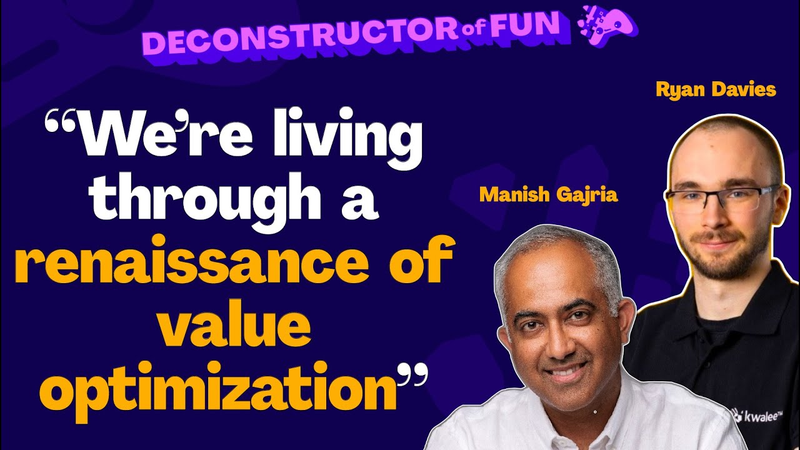
VideoDeconstructor of Fun
Meta Is Back in the Game. Here's What That Actually Means.
2 Mar 202651 min video

Transcript
Gabe Maybaum Meta's EMEA Gaming Director Why did Meta leave game developers after ATT? Well, first of all, hi. Hello.
Um secondly, I don't think that Meta left gaming developers. I think ATT was a big shock. It was a big shock for everyone. It was a big shock for us. It was a big shock for gaming developers. And I don't think we deliberately said, "Okay, here's something that we're not going to invest in anymore or we don't want to provide value for gaming developers." I just think that objectively, the reality became very difficult to provide the same value. That mean That means that if someone invested $1,000 pre-ATT, he would get better results than what he got the minute later, especially for mobile apps and within mobile apps, especially for gaming developers. If you're asking if I would like us to
move faster, yes, I would like us to move faster. But this is a big company with many priorities and sometimes it takes time. Before you took this position as a gaming director, was there another gaming director or is this a new position?
Yeah, that that's a good question. So, our org structure with gaming was always kind of interesting. So, before joining Meta, I actually worked in a gaming company. I was leading the acquisition for Fantomic. It was a gaming startup based out of Tel Aviv. And then I joined Meta. Um and when I joined Meta, our go-to-market was always country first. That means that we have offices in many places in the world and we generally speaking, look at different countries with a bit of a different strategy because we acknowledge that that there are differences. When I joined, it was actually a global organization managed out of Dublin with people all over the world. Um but it broke the regular go-to-market strategy
of Meta, uh, Facebook at the time, which was countries-based. So, it was like, uh, EMEA, LATAM, North America, APAC, obviously, and gaming. Mhm. And then after ATT came, I think there was this notion that this org is not required anymore because the numbers also in a way did not justify it. And then what the leadership of the business org did was to take this industry and put it within the country. So, we said, "Okay, we have an office in, uh, whatever, Warsaw." They work with commerce clients, they work with fintech clients, they work with CPG clients, they work with gaming clients that are based out of Warsaw as well. And the same for many, many territories. And that was the strategy for quite some time. And a year ago, uh, we figured out that it's not really working for us, that gaming's actually different and we should treat it differently. And the local aspect of gaming is not as important as the industry
aspect in gaming. And that means that there way more similarities between a gaming developer out of Turkey and a gaming developer out of UK than commerce out of UK and gaming out of UK. So, we decided to change it. It was like two two main things behind it. One, that will up-level the way that we work with clients and give them like the right benchmarks and the right value that is tailored to their industry. And at the same time, that will be able to work really closely with our product. Because as you mentioned, after ATT, it took some time to our product to like be back in a place where we generated enough value for our gaming developers. And we need this constant feedback from the market. And the best way to do it is just to have a dedicated team working with gaming developers and with product at the same time which is also based out of London today. So we can win back our position in the market and
doing that is usually derivative of us just providing way better value to developers. So basically this new structure that's like the old structure means that the messages coming in from the developers are getting directly into the London HQ so that the product improves according to the needs of the gaming. Yeah, so I mean I've been with Meta for a long time.
Yeah. I've never seen us working so closely with product. It's to to an extent that there isn't one day that I don't have some sort of interaction with our product leaders around apps and gaming and this is very different from what it used to be. And we shipped some really impressive improvements over the past couple of months, but again, we're just getting started. And I hope that when we'll have this conversation in a year from now, we'll be in a different position. I want to jump in with what works now, but I want to just ask one more question about the change in the organization. And that is like what were the signals that you were seeing from the outside where you decided to make such a big change inside the
corporation? When you look at the performance marketing industry and gaming is a performance marketing industry, unless there is a big thing that is, you know, I don't know, people they don't have any more free time. They say that playing games is something that they don't like anymore or anything big like that, money follows value. Okay? So if we provide a lot of value, people will invest more. If we'll provide not amazing value, people would spend like developers would spend less. So it's actually really easy to see that cuz if you would analyze many four verticals, you'll see that in many territories gaming was not growing while other verticals were growing really impressively and that's not something that I need to say. You can look at our earnings over the last, I don't know, three, four years and you'll see a very, very clear trend. That trend in a way didn't happen to the same extent in gaming. So, it was a very clear sign for us that Houston, we do have a problem, and we need to fix it. Like
acknowledging the fact that we have a gap here and put it under one structure and one work is the right thing to do if we want to really tackle it. Right. Perfect. Uh well, let's get into the the beef or the meat or whatever you want to call it. But, you're in a unique vantage point, and as you said, your team works very closely now with the product. So, I'm very curious to understand is like what is working in today's market as you're talking to all these different studios, and what are the most savviest, the smartest, the the fastest-moving, the ones who are succeeding in this mature market? What are they doing that you feel others are not doing quite like that? When a gaming company comes to a VC and they're raising whatever, I don't know, five, six, 10, 20 million dollars. That sounds like a Turkish company.
Yeah. [laughter] Well, a big chunk of that money is going to be spent on user acquisition at the end of the day, no matter on what platform. And I think that if developers will pay close attention to what is working now, they can actually save a lot of money
for their investors and to invest it in a more precise way. So, for me, it's mainly like shortening the learning curve. Like a learning curve can actually be really costly. Many developers, they are very like numbers kind of people. They like to analyze the data. They like to do a lot of pivot tables to look at the data in Tableau. And for me, by the way, it was the same as as a user acquisition lead like 13 years ago. I love to crunch numbers all day. And then you go to the office in the morning, and you see that your CAC that was let's say 30 is now 20. And you're a Wow, what happened here? And your first reaction is, "Okay, there is probably a bug." And then when you dive into that, you usually see that you uploaded a new creative. Now, that sucks, okay? Because it's not
predictable. It's like harder to understand what exactly did we do here? It's not formula. When you're like numbers people, they love to see how everything comes into formulas. Okay, if I do X and then Y and then the outcome will be T. And then comes creative. And creative is not like that. You don't need to create the right creative. You need to have the right mechanism in place. And if you have the right mechanism in place, if you understand that you don't know how to do good creative, but you just need to create lots of them, really diverse one in high high high speed. And change them a lot. Not just change the background between light blue and like blue. Like really change them. Creative is a factory. It's not a one-off. It's not a very impressive kind of production they say, "Oh, this is so fine. That's going to perform amazingly well." But they actually created this kind of factory that produces many creatives in
high volume, velocity, speed, and diversity. And they manage to get like really good results. And I see time after time after time. Whenever we have a huge success, most of the times it's new creative. One thing that I hope everyone will take from it is invest more in creative. Yeah, App Store is latest report gave some numbers on the amount of creatives the the top spenders are are doing and it's about 29 currently a day. Yeah. Different variations. I wanted to kind of challenge you on the creative side because on the high-level strategy level networks has one targeting. Like you show the ad to the right person at the right time. That's it. And so, what the developers or the studios can control is not who the ad is shown to, but what is the creative of the ad. And when it goes to, as you said, the creative factories,
I don't feel like that's very much a moat because in two to three years I assume that whatever the number is, they can do it with the help of AI to really push the variations. What do you think the superpower the moat has to be, assuming, you know, you get over the rookie numbers and you get to the uh the high numbers of creative your factory is pushing stuff out? How do you stand out? Well, to be honest, I'm not looking for a moat here. Like I optimize for best CAC possible over the next 18 months, okay? I think the concept in a way of moat in an AI-first world would be challenged many, many times in many, many ways. Um like when I was a teenager, I used to work in a bicycle store, okay? We sell sold bicycles. And I remember every time that we change like the the bicycles that were in the window, whenever we put like a road bicycle, a different audience would step into the store. And whenever we put a mountain bike, a different audience
would step into the store, right? So, creative is like your window. In the traditional world, you could only have one window at the time. So, that's what we would done like when it was Tour de France, we would put uh road bicycle because, you know, there was higher intent for that. You don't need to do just road bicycle or just mountain bicycle. You can actually do them all at the same time. So, I'm not looking for a moat. I'm looking for diversity, and I'm looking for developers that understand that different creatives is incremental reach. So, let's say that more creative that means probably the half time of a good creative keeps decreasing because there's the changing so fast so you have to keep up the pace. The interesting part that I have about creatives then is when you have this big diversity of all sorts of creatives as you said there's all sorts of bikes from one wheeled to three wheeled all in the windows at the same time. How do I separate the signal of what
type of customers are the right type for me because the way I understand is like in Meta's case is the network is largely built towards e-commerce and the signal is very much focused on the first 7 days but with games we're trying to build habits that are over the years and so there's a lot of elements there is like what type of a signal I'm looking for what type of a signal I can get and how do I separate from from being able to pull out of audience with this creative to understanding is that really the right audience that I'm pulling in.
Yeah, first of all I completely agree. Let's say if the ad says hey click here and you'll get a I don't know a new iPhone or a donut and it turns out to be a game most probably these people will churn and they will not be your best players over 2 years or I don't know like a long period of time. So obviously the ad should communicate that it's a game and should talk about the like the USP of that specific game and I think that that's the right thing to do. However, that's also on us as a platform
cuz when you optimize to what we call value optimization it's our job to make sure that we actually reach the right audience. Now I'm just saying that when you do diverse creative you let us actually reach all the relevant right audience and when you have just a very specific genre of creative you're limiting our ability to find those users who will turn out to be the best LTV cohort ones. I think different people react differently to different creatives and we want to tailor the message to everyone, so everyone can actually come into our store and enjoy the the amazing game that we built. Got it. So, if I summarize it, uh if I got it correctly is the more diversity of creatives you have, the more volume you produce, the more opportunity there is for a network to optimize for the right user at the right time to bring to your game and that right user at the right time is not a specific profile in your market research. It can
be almost anybody, but you have the volume now, the creatives to find those people. Yeah, I mean, generally speaking, I think that marketers should put very little limits because this is not how algorithms work. Usually, algorithms just work better with more data, right? And creative, in a way, is a limit. If you don't create diversity and volume of those. So, the more you create, the less limits you put on our algorithm, the higher the chances that will get to all the relevant audience. What would you say to studios that are self-limiting themselves in terms of creatives? Like, there are ads that studios may perceive sexist or misleading or so forth that are doing actually really well in the marketplace, but the studios have made the decision we are not going to go there. We are going to do different, something that that is, you know, right for us and we don't want to steer that way even if that works. I think they're doing the right thing. I
think people should treat consumers in the right way. And if you do stuff that are later, I don't know, causing some frustration, uh that might be a very short-term win, but a very big long-term lose. So, I I highly suggest them not to do that. And I think putting those limits, if this is the reason, please keep on doing that. That's the right thing to do for sure. Yeah. So, having clear guardrails is smart. If you want to build a real company and to provide real value to consumers, you better put the right guardrails in place. We try to do it ourselves, but obviously developers should do it as well. I mean, when I talk about diversity and volume of creative, I in in no way talk about anything that will create not the best experience for users. I mean, optimizing for user
experience is most more the most important thing for us and I hope for developers as well. Mhm. Yeah, I'm just saying because like again, the executives are talking about because they're seeing top grossing companies using those tactics and then they're thinking should we be also doing that because they are top grossing and they're clearly getting some kind of an advantage and if they try to do that, they get pushed inside of the companies. And so, that's a that's a difficult line between business and ethics that they have to come up with.
Yeah, well, I think this line was always there in many kind of businesses. You want to make sure that you don't over promise and under deliver, right? That's not a good thing. But that's most of the top grossing games, especially when I look at the ads. I I'm not sure because I I see most of the top grossing games and I think they actually provide amazing value. Okay. And I think that it's really fun to play in those games. I don't disagree.
Yeah, so I think we don't need to be over judgmental in a way because at the end of the day, if this is a game that people really enjoy and you see really
high ratings in the stores, etc. I think they got something right in the product. I don't think that they create a bad experience. Again, it's hard to to to say exactly who referring to, but I think generally speaking, when I look at the top developers at least from Emea, I think they develop excellent games.
Yeah. Okay, I was maybe talking maybe outside of me advertisers. As as you said, I'm only looking at me.
[laughter]
Eiffel Tower, iconic. Tower of London, historic. The Two Towers, simply epic. But none of them tell you anything about mobile app intelligence. Downloads, revenue, active users, and my personal favorite, weekly cohort of retention. Get the real story, get the real data, get Sensor Tower today. Game devs, here at Heroic Labs, we know that great gameplay is what players love. But integrating meta game features like challenges, progression, and rewards is crucial [music] for retention and monetization. But coding them is a tedious and time-consuming process. That's why top
studios have turned to Hero from Heroic Labs. Hero provides a complete suite of battle-tested meta game features that are quick to implement, letting you spend more time on the core gameplay experience. Ready to ship fully featured engaging games? Check out Hero today at heroiclabs.com. All right, let's move on talk about a little bit attribution. I want to understand is like what are the studios under misunderstanding right now about measurement? Yeah, so measurement is a tricky business. Um I'll tell you why it's so tricky. It's so tricky because developers just invest so much money in marketing. So whenever they make a mistake in the formula, the mistake is really expensive. So I don't know if you remember from high school you were like you had this math [clears throat] test and you would do something wrong in the first line and then you would continue to solve that exercise and you would get this very weird result because you got something wrong in the first line like you missed a plus or a minus or
something like that, right? And then the entire exercise you you just get it wrong, right? I think in a way it happens a lot with attribution, with measurement in general. So companies have this concept of like what's the right way to do attribution. It can be last click. They say, "Okay, it worked for us when we spent $500 a day. It worked for us when we spent $5,000 a day. Now we're spending half a million dollars a day and we're still relying on the same practice we did back then." And when they spent $500 a day, the mistake, let's say they have 15% mistakes. It cost some money, but not a lot. And it was when it was 15% out of 5,000, it cost more money, but still a bearable amount. When they're spending half a million a day and they're getting 15% wrong, that's a whole lot of money. And that money could be funneled into, I don't know, better talent, more creative
as you spoke before, or some other stuff. But they just don't challenge enough the way they look at attribution and measurement. And I think the only way is to look at what people usually refer to as incrementality. Now, incrementality is a very easy concept to understand, a very difficult concept to execute. But the concept in generally is asking what will happen with or without. So, let's say I do network A. How much revenue will I get with network A or without network A?
sequential testing almost. I mean, you can take it to many stuff in your company. I'm going to hire an additional person. What will be our profit line with that person or without that person? You can think about it in stuff in life. I'm going to do another vacation, go skiing. What will be the incremental impact on my well-being, right? And companies are doing it with what they call geo lift. So, they're like turning on and off different media platforms in different geographies trying to
understand the incremental impact those channels have on on specific geos. They do it with lifts, all kind of lifts. Sophisticated ones, the ones that get it right, they just don't rely on last click in the MMP. They just don't do it. Cuz if they do it, they have this 15% off. And if they spend $1 million daily, 15% is a lot. So, I I I think it was just this week that Singular, one of the MMPs, just published a big study and they're they're really smart about like misattribution. And they showed that if you look at multi-touch and not just last click, Meta, for instance, is very under valued. And I I I And I think, by the way, it's not just us. I think it's many discovery platforms that if you look at just on last click, you're not getting the full value. You're not getting the full value in your BI, it means that you're not allocating budgets in the right way. It means that
you're making a big mistake. And this big mistake translates into a lot of dollars. So, I think measurement in general is one of the things that is never fun to deal with cuz you don't want to challenge every day how you split your budget and allocations and multi-prizes, etc., etc., etc. But fixing it can actually mean a lot, a lot, a lot, a lot. And this a lot of money, if you accumulate it over a year, is sometimes additional 20 people. So, in practical term, last click attribution, the way I understand is I would be on Instagram, I would see an ad, I wouldn't download it and go, "Interesting." I would go on YouTube, I would also see the ad for the same game, and I would play a different game, but in that game, let's say I would see the ad. I'm like, "Oh, yeah, this is the ad that I've been seeing through social media platforms." But now I'm playing this game and I download it, and now it is attributed as the last click to the network that showed me, but not to the
ones that showed me multiple times and got my interest through different ad formats on different networks.
Yeah, you're right, but this is I'll say the most like the best scenario. I can even think about okay, I I clicked by accident on an ad and I got to the store and I'm not downloading the the app. And then I see an ad on YouTube or Instagram or Facebook and I go to the store and I download the ad, but the credit goes to that platform that I accidentally clicked on. And then on the other side there is a developer that said, "Oh my god, that that network they gave me amazing performance. I'm going to invest more money there." They they invest more money there, they make a mistake and again this mistake, the compounded impact of it over a long period of time for developers who invest lots of money in performance marketing is just huge. Just huge. I mean this is not a small thing. And I think we have a couple of
developers at least in EMEA that look at incrementality today in a very impressive way and they invest money and time in it to make sure that they do the right decisions when allocating budgets. You're absolutely right with the with the creatives that are being [clears throat] developed all the time it's almost impossible to exit that creative without going twice to the app store page. Exactly. And that if you did download the app because of that and you played the game and you're an amazing user, okay, they deserve the credit. But if you just, you know, you continued you with your life and then you saw this ad on Instagram, you did not click but went on downloading the game and the attribution goes to that network that showed you that ad that you tried to click out on. I mean there is a huge gap between reality and the way you allocate your budgets. Like another thing about attribution is how you're able to attribute to different cohorts that are coming through different networks and also look at from the outside of the platform window to much further. Like most of the
games are looking at you know, ROAS way over 2 years now.
Yes. How do they handle that? Well, I don't think there is an easy solution. Okay, this is a a big challenge for gaming developers. It's a big challenge not just for gaming developers. I think it's a big challenge for every company and a bit like we said about creative, I think this is an area that is at the moment under index in terms of investment and I just think that companies should invest more in that. Obviously, AI can be a big tailwind in analyzing this data over a long period of time. But, you know, if I were to open a studio, I think obviously creative would be one of my first hires and then a data scientist most probably the second hire in marketing because it is very difficult to measure and if we want to get it right, like we should invest in it. Otherwise, it will not happen by itself. The other thing that attribution partners are talking about a single source of truth.
Mhm. Like what's your perspective on the single source of truth? In order to not just be on the academia philosophical side of attribution, but also to be in on execution, you need to have a source of truth. Otherwise, you cannot do everything you cuz you will question every assumption you say, "Oh, no, I don't think that's actually right, etc. etc." So, you need to have this source of truth that will enable you to execute in the day-to-day. However, I think once in a while, you need to challenge that source of truth. So, not on a daily basis because then you cannot do anything, right? And I want companies to move fast and to be agile and if they are challenging every day the source of truth, they will never move. But, once a quarter, do a lift, see if the source of truth is still reliable. Otherwise, you will be in that 15% state of mind where you all the time miss 15% of your budget and you just keep on accumulating the error and that would be
a mistake. So, I think companies should have a source of truth. Otherwise, they will not be able to function. But they should challenge it.
Mhm. What's the best way to audit that single source of truth? The best way to audit it is lift. Lift is what happens with or without. Mhm. So, stop marketing with a certain channel in certain geo or double marketing in a certain channel in a certain geo and have multiple geos, so it will be stat-sig. Mhm. But make sure you challenge it cuz otherwise, you will stay with that mistake for a long time. Mhm. Makes sense. So, you mentioned something about like your first hire would be creative. I'm curious to hear from you, especially like you're looking at so many different studios, of what does a UA team look like in 2 to 3 years? Yeah, well, I wish I could I wish I knew the answer.
been in the UA since like what, 12 years ago? So.
Yeah. Well, if a gaming developer is standing still with everything that's happening with
AI, they're probably getting it wrong, right? And especially on the UA front, I just don't think that we can do what we did 2 years ago with all the developments around AI. I mean, AI at the moment in some areas, it's more of a promise than reality, but not in UA. I think that in UA, you actually have tools today that you just didn't have a year ago. And that means that UA departments can become way more efficient. It doesn't mean that they need to let people go. It just means that they can do way more. And make sure that like they really optimize and squeeze the lemon out of all available tools. And the tools that are available are absolutely amazing. And I guess, without being too too of a prophet, that looking at the next 6 to 12 months, the amount of amazing tools that will come out will just be outstanding, right? I think the first thing that a developer should do is challenge a bit the old structure of UA. Just because
there are way more tools and these tools can actually really enhance your performance. Let me give an example. This is from Josh Shanley of Wildcard Games and I asked him the same question kind of preparing for this one. So, your UA team shifts from those who turn the knobs to those who design the control system. They define the objective function, so what are they actually optimizing against? They define the constraints, the risks, the paybacks, the portfolio balance, and they define the escalation rules, which is when do humans intervene with so many AI tools running. And he broke down into people that he would have on the team. The first one is your UA lead, your growth director, you name it. Somebody who's in responsible for the portfolio, for the objectives, for the network strategies. Then you have your growth analyst or data scientist or somebody who looks at the yield models, the maturation curve, the incrementality of things. Then you have a creative strategist, so I know that there is the factory that is pumping all this stuff, but he would have somebody with a hypothesis, with the segmentation, with
the creative portfolio design, and of course somebody who's managing the creative studios outside of your own in-house. Then you have operations person, a producer, the pipelines, the tooling, the versioning, testing, the cadence, and finally somebody who's responsible for marketing technology or automation. And that is the person probably responsible of the robots talking to each other, the feeds, the APIs, the rules, the creative seeding, the governance, and then of course the shared services with the rest of the studio. So, how does that sound?
Yeah, it sounds solid to me. I tend to agree with this statement. I think what all those people share in common is critical thinking. It can be critical thinking on acquisition user acquisition, but can can critical thinking on creative, it can be critical thinking on models, it can be critical thinking on APIs and I don't know, overall budget distribution, right? And I think this is perhaps the most fun part in our job is just to think and to think critically, right? And that's why I look at AI as an
amazing tailwind because it will take off some of the more boring stuff or more repetitive stuff and leave more room for critical thinking and for people to challenge assumptions and to think creatively about different stuff. Well, okay, so moving on to the next topic since you're optimistically looking at the other creative teams and the UA teams, how are you looking at the market going from, you know, we're in the beginning of 2026, but maybe one or two years beyond. Yeah, I like to think about it first from a more macro perspective. In 5 years from today, will people use the internet more or less? I think for sure not less. Okay, my assumption is that the answer is more. In 5 years, will people want really cool experiences to spend their time on? Will they want it more or less? I think the answer is more. So, is there a room for amazing game developers to thrive
in the next upcoming years? I guess the answer is yes. Okay. So, that's like from a very macro perspective. Does that mean that every game developer will thrive? Obviously, no. And I think some of the things will get harder. I think we're going to see some winners taking more share of the market, developing really good stuff. In a way, sometimes small developers or one that are just not developing really good games, not managing to succeed, and that's fine, I guess. That's part of the evolution of the industry. One other thing that might arise, and this one excites me a lot. I think we're already seeing it in software, like very, very lean teams getting to really impressive results. Uh which is also something that makes me very optimistic because the barrier to entry is just lower due to AI. And that means that if you have like a really creative
idea and you develop a really good experience, you can actually compete with the big guys in an easier way. In today's hyper-competitive digital landscape, understanding your app's journey from discovery to download isn't just insightful, it's the difference between scaling and stagnating. Enter AppsFlyer, the undisputed leader in mobile attribution and marketing analytics. They've mastered the science of making every ad dollar work harder by revealing exactly where your players come from and how they interact with your app. Their platform transform mountains of complex data into clear, actionable intelligence that separates winning campaigns from budget-draining experiments. And I know that many of the top game companies leverage AppsFlyer and a are a key partner in their success. AppsFlyer, where your app's potential meets performance. Using clunky payment systems in your game? That's like fighting a boss with a
wooden sword. AppCharge gives you the power-up you need. Seamless in-app purchases, global payments, and analytics that don't require a PhD. Monetize smarter, not harder. AppCharge, because your game deserves better loot. Let's be honest, you're tired of chasing installs across the same crowded networks. We all are. That's why Wybs built a new playbook. They're the fastest-growing gamified rewards platform and they are helping studios scale smarter, not just bigger. Their AI-powered targeting means you will finally hit the audience you want and with their new ROAS optimization engine, performance doesn't just grow, it actually levels up. So, if you're looking for growth with a fresh angle, check out Vibe it's built different, it's designed for growth and it's powered by good vibes. So, head over to v y b s.co
and get yourself some good vibes. Let's go over to some of the details that are happening in the market. Like overall, of course I I share your viewpoint and especially the fact that there's 5% growth of like compound annual growth of players overall in the world. But, the market is different and we're looking of course on mobile first at this point because though we are again in that record revenue rate, the downloads have been declining quarter-over-quarter pretty much.
mean to you? I Of course, I don't know. I have hypotheses. Well, one is the concentration of the market. For example, the amount of new games being launched it's lower than in 2013, much lower. Without naming names.
Yeah. Amazing gaming companies really, really like making it like we're already thriving. Ones that were not like did not exist 3-4 years ago. I do see them. I see an amazing game developer actually taking the market.
Yeah. So, does it mean that in order to thrive you
need a more creative idea or better execution? It might mean that and that's again fine in my perspective as long as it's not a market that doesn't allow new developers to rise. And by the way, a good way is also M&A and I'm sure that many big companies will take those amazing studios that are now growing and acquire them. That's not bad. The entry barrier is lower because smaller teams can make bigger games or more creative games and focus on that. I agree on that part, but I would say that the entry barrier has moved more towards scaling those games and standing out and coming up in the market. And I would say the understanding of the LTV and the CAC equation, not only understanding but putting that into an effect, being able to monetize your game and not just creating something really great. Because we've seen last year is a good example again without naming the name or naming the games. I say Destiny would be a good example of that launched on mobile. By all metrics, it is a phenomenal product.
And by all metrics, it's a financial failure because it hasn't scaled. Now, I don't know the details because of that, but one is is like it hasn't been able to overcome the marketing barrier. At the same time, we see a lot of Turkish developers launching really fast, really creative titles, French publishers as well, being very fast that they move very fast how they iterate, and very fast how they scale. And part of that is definitely understanding the business equation, understanding that you need to put something that stands out in the market so that it looks interesting so that people are more likely to download it. And the CPIs are going to be lower because it stands out and at the same time that's not enough. Now, the CPIs might be low but you have to push the monetization pretty hard whether it's ad, whether it's in-app purchases, preferably both, in order to continue scale super fast so that other fast companies won't be able to fast follow you, outbid you, and kind of leave you in the dust. Yeah. Well, I think that you know, understanding the unit
economics is true for every industry for very long period of time, perhaps since ever. Yeah. I see your point around like the need of big marketing budgets in order to thrive in this concentrated world, but at the same time I see a lot of vehicles such as UA funding and stuff like that that did not exist perhaps to the same extent a couple of years ago. And these are allowing companies to scale without diluting too much shares in the company or without putting tons of people on the cap table. And I think these things will happen more and more as long as people create good unit economics and develop great products that people want to keep on playing them over a long period of time. So, I think with the combination of AI, UA funding, also VC money going more into gaming than what it what it used to be, and people
keep on looking for amazing experiences, I'm quite optimistic. Yeah. What's what's Networks' view on UA funding? I mean, I see very similar stuff that happened in the traditional world. So, UA funding, in a way, is uh you can look at it as kind of debt. It is debt. Yeah, but it's a debt specific debt to an industry, right? But that's not a new thing in the world, right? Again, look at many other industries and how they grew over the years. Some gave part of the company, which is, I don't know, selling their shares.
Mhm. And some just, you know, raised debt and they later on paid that debt with some interest. So, I think it's actually quite interesting because you see traditional financial vehicles getting to more online and new world, and I think it's a really good development. Uh I think it will allow more developers to grow. And generally speaking, the whole idea behind VCs and like
money going into the gaming ecosystem, I think it's a good thing. Yeah. Yeah, yeah. I mean, one one type of investor leaves and then the other type of investors come in because the investment thesis changes. Definitely, it's not as friendly to VCs anymore just because the multiples are not quite there as they used to but now it's much better to UA or lending companies because the predictability the attribution is much clearer and the tools are much better. Yeah and I think you know this is a guess for a long time said okay I were just going to invest in like high multiplier SAS companies and now looking at the last six months I don't think that SAS is doing that good and they say okay I'm just going to invest in defense tech because that's the big thing now and then so it's very hard to predict and this is one area where you can actually get really fast feedback from your [clears throat] audience and see if the unit economics make sense really fast so I think that more VCs will actually rise in gaming with time and also by the way
the couple of ones that are already very active at least to my knowledge are doing really well and that will most probably open the appetite for more to join this party. Yeah how about Chinese developers they're doing ever better. They're doing amazingly well I think we have a lot to learn for me personally
we learn from them? I think the best way to learn is just by experience so just see the ads download the games and playing them. I mean you can start and doing a lot of market research but I think it has some sort of a glass ceiling especially with so much cultural differences
Yeah. but just to experience the game in your own hands is something that usually will give you strong insights but if you have more tactics on how to learn I would love to hear them because for me it's it's also like something that I'm I'm inspired by. I'd say go to China. Yeah. Yeah that's a good one I guess. That's [laughter] the easiest one. Yeah it's the easiest Probably faster too. Yeah than to download the game than to
download the game and play it enough for you to understand just go there.
[laughter]
Um I'm I mean I worked for a Chinese company before so it is a different way of working different process and different mentality for sure. Different organization structures, too.
Yeah. I wanted to ask you about the rising CPIs. Cuz with the rising CPIs, and of course we see the decreasing download as part of that. But with the rising CPIs comes the need to hire LTV. Understandable. Unit economics, as you said. Do you feel that the games are becoming more aggressive in monetization because that early signal has to be shown, because they have to compete against the LTVs of older titles that are controlling like over 70% of the market? That might be true in some instances, but the best way to fight CPIs that are going up is just to make sure that people stick longer with your games. And that's mainly [clears throat] about just creating better experiences. So, I think being very aggressive in monetization usually has high price of churn, and people just I mean, they
would stop playing. So, most probably the right thing to do is just to continue in developing a really cool experience over time, so people will stick longer, and then the equation will become profitable. Mhm. That's what game companies would like to hear. Uh
[laughter]
I hope so. All right. I I'm not disagreeing. Uh I'm just saying that uh it's not quite that easy to get profitable.
easy at all. Well, that's the fun part of my job, right? I I I can say stuff, but I don't need to deal with the very difficult reality in executing them. And I think you're right. It's difficult to create a lot of creatives. It's difficult to do measurement right. It's difficult to create amazing experiences that people will stick for long time. But, though it's difficult, whoever gets it, I think can win like a big prize. Mhm. Yeah, for sure. Is there anything that that game companies should almost unlearn going forward compared to the previous? Because the way you sometimes describe is kind of goes back to, you know, I've been in this industry for a
while. So, it goes back to like, "Listen, guys. Let's just make a good experience. Let's think about the players." Very sort of a product-focused and user-focused. And now we're in the world where that hasn't gone away, but we've added this marketing machine on the side that is not always against it, but it is critical and it has effect on the product. It's not like what comes after the product.
I think for many B2C companies, regardless of industry, marketing is a huge chunk of their success. And obviously, if they don't invest enough there and if they're not on top of every new trend and ahead of the curve, they will not win their competition, no matter what product they'll build. So, marketing is like it goes hand in hand with building awesome experiences, right? I think for a while gaming developers had this idea that in terms of marketing, they know best. Uh because it's a very mature online marketing industry,
because it started like that. So, if you compare it to other online marketing industries, gaming started actually before. So, there is a lot of accumulated knowledge that in in like on one hand it's a huge blessing. And on the other hand, sometimes it stops you from innovating. And I see in a way some other industries innovating more in terms of online marketing and I think gaming developers used to learn only from other gaming developers in terms of marketing. And I think the one thing that they should unlearn, perhaps, is to learn also from other industries. So, to look at the big commerce companies on the big fintech, on the big education apps, etc., etc. just to see what they're doing. Not everything is applicable, for sure, but some is. I mean, you've been at Meta for a long time and you've seen the whole the whole wider industry. And what we've seen now on the gaming side is that these app companies, first of all, they're doing
better than gaming companies in terms of in-app purchase revenue is now more than 50% in App Store, which used to be like only 25%.
Yeah. And they have also been active at hiring very business-focused people from gaming, whether they're marketers, whether they're product manager, whether they're data scientist, and so forth. And I wanted to kind of ask you like, what is there that game companies are not learning from app companies cuz they are learning from us and we're sort of not learning from them. I think actually it goes back to the main theme that we discussed. I think gaming companies in a way rely too much on like last click MMPs. And this something that many other companies right from the get-go understood that it's only very partial. And I think they rely too much on like one onboarding experience. So, like, okay, this is the ad, this is the app page in the store, this is the game. But there might be more onboarding experience that we just haven't tried
enough. It explodes in apps. Explodes. Like, people are doing amazing stuff, amazing onboarding experiences. And I think it also goes back to creative. Uh so, we said, "Okay, this is a cool game. Let's just show the gameplay." But other industries are looking at creative in a different lens. And I think this is something that we can learn from. So, if you would ask me 5 years ago, I would tell you that all other industries should learn from gaming and gaming should learn one from another. And today I think that gaming also need to learn from other industries and that's a big shift. Mhm. So, we're really good at habit building and the apps are really good at onboarding. Apps are more of a challengers on like things that this is what we did 5 years ago, so we need to continue in doing that today. And apps, some of them, many of them did not exist 5 years ago. So, they don't have this legacy, which again, in some aspects is a huge blessing and in some aspects is a bit of a blocker. Totally understandable.
Last thing, I mean, first of all, thank you for having this conversation because it's really important to talk to companies like Meta because you're looking for the whole industry to grow. You're not servicing somebody. You're not servicing the winners. You're not servicing the losers. You're not servicing with anybody in the middle. You're servicing everybody, and when the industry does better, you do better.
Exactly.
So, it's very nice position to be in is that the growth of the industry is the only target that
It's an amazing position because, I mean, when the companies that I work with are seeing better results, I hit my KPIs.
Yeah. Okay. So, we have the same interest. It's one of the best things in my work in this.
Exactly. And so, regarding that, I wanted to kind of ask one thing that you believe that the studios or the publishers should take away from this conversation. Not one thing. You can have multiple things, but what are the sort of a key mental marks from this? I think the biggest things that they should take out of it is, first of all, to challenge
things that are having for long time. Like, to challenge the status quo, which is never an easy thing. So, you can challenge the status quo in the org structure of your UA team. You can challenge the status quo in the way that you produce creatives, in the number of creatives that you produce. You can challenge the status quo in the way you allocate your budget and how you measure it. You can challenge the status quo in the way that you onboard players to your game. You can challenge the status quo in many, many things. But, having this mindset of challenging the status quo, I think is really important because I mean, the world is not standing still, and many things are changing. For some time, challenging the status quo wasn't the biggest strength uh of the industry, at least on the marketing side of things. And we reach now a point where I think it becomes essential. Um so challenge the status quo. All right. Audit what you're doing, make sure that it still works because things are changing fast. Yeah, but like audit
for real. Like change stuff. Be aggressive in changing stuff. If it doesn't work, you can always go back to what you did before, right? Guy Mabel, thank you so much for having this conversation. Thank you everybody for listening. You did it. You made [music] it to the end of the episode. As a fan of the show, it would help us out if you'd subscribe and leave us a review on the podcast service of your choice. Those stars and likes, while a small action on your part, mean a lot to us and help to grow [music] the show. More importantly, are you a member of the Deconstructor of Fun Slack group? If you have 5 years or more of games [music] industry experience, go to deconstructoroffun.com/slack [music] and apply to join. Join the games industry's best professional community filled with peers always willing to lend a hand.
[music]
Or subscribe to our newsletter to get all the latest insights from the Deconstructor of Fun content [music] creators. Thanks for listening.
Auto-generated captions from YouTube — names and numbers may be misheard.





















Comments