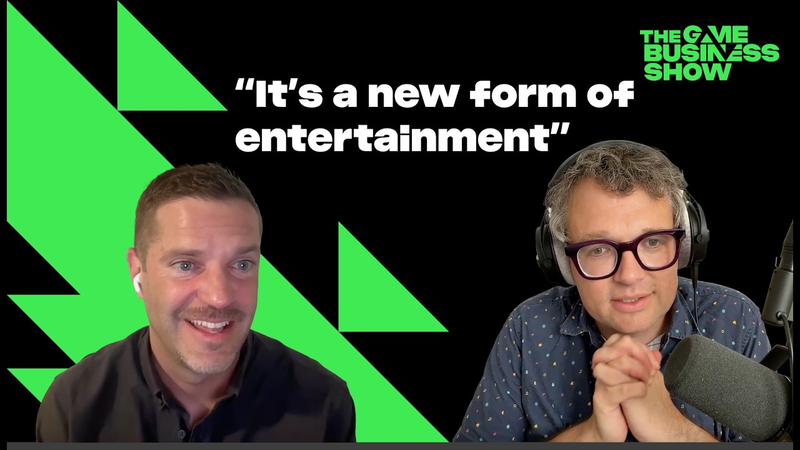
Transcript
The casting department that works on our game is the same casting department that is helping cast films and series. This could have been a big swing and a miss, too. Like, honestly, it was a hypothesis that was not based on any data. It was based on our our gut. When people talk about the elusive non-gamer that we're trying to bring into our industry, sometimes people extremely oversimplify or lower the bar too low on all the other aspects of what make a story or an experience interesting, right? Like, it's like, okay, to get a non-gamer, it has to be a Fisher-Price baby toy.
[music]
Hello and welcome to the Game Business Show. Today, we are talking with Netflix. Now, we've covered Netflix quite a bit, and I'm personally quite excited by what they're doing. Rather than try to take on PlayStation and Xbox, Netflix is instead building games for its existing audience of around 700 million people. That's a really good thing, I believe, for the video game industry. It's audience expanding rather than competitive. And it's trying to achieve that through signing kids' games like Peppa Pig and Sesame Street. It's
working on big mainstream partnerships such as with its recent FIFA World Cup game. It is developing party and puzzle games similar to what Jackbox Games is doing. In fact, some of those Jackbox Games titles are actually included in Netflix. But, it's also doing this through narrative games. And its latest effort in the narrative space is a game called Unhinged, developed by Netflix's Night School Studio. It is a horror game. It's only about 30 minutes long. It stars Sadie Sink, who is famous for Stranger Things. She's also in the new Spider-Man movie. So, we got her to do the for the Batman and Divergent and Fantastic Beasts and Big Little Lies and Troy Baker, who is of course no stranger to the world of video games. In this game, you play as Ava, who is trapped in an apartment building during a storm. There's no power, and there's a killer on the loose. The game is played on the screen. I played it on my laptop. You use your phone as the controller, but it's more than just selecting where to go. It's also part of the experience. The game is in first person. Ava has her phone on her, and people call her, text her, and it'll will come through your phone. Ava also uses her phone's
flashlight, and again, you control that with your actual phone. It reminded me a bit of those found phone games, which Night School had in fact made before. They made a found phone game based on the TV show Mr. Robot. If you don't know what a found phone game is, it's basically a story-based smartphone game which simulates a stranger's lost phone, and you explore the apps, you send messages, you read emails, and so on. Anyway, I found Unhinged to be very clever. I liked how it bridges the worlds between a classic Netflix original TV show and video games, and I'm now interested to see where this goes next. And who better to ask than Sean Krankel? He is the Chief Creative Officer and Studio Director at Night School Studio. He's also the General Manager for Narrative Games at Netflix all up. So, he's working with internal and external people on building these experiences. And here he is. Hello, Sean. Welcome to the show.
Thank you for having me. Excited to be here.
I I see that you've bought the new Star Fox. How are you finding that?
Man, it is exactly what I wanted out of that game. I am in the mode right now where I just need something that I can be very focused on, a short,
easy-to-play, yet highly polished thing, and I think those guys just killed it. Yeah, I love it.
I normally [snorts] have a a Skull Knight at the moment. I don't have a Star Fox poster. Uh but I just love Guha and Kaff it. I always think they're under under sort of appreciated gems in this industry.
100%.
The fact that Balance Studios is making the game, I think, really excites me.
You know, I met those guys in like 2000. Wow. And then they did uh we worked together on on the Crash Bandicoot GBA game together. So, it's been a minute.
Ah.
Yeah.
First game I played of theirs was the Tony Hawk's GBA game, which was incredible.
Unbelievable.
It was really brilliant.
Yes.
Uh that's We're not here to talk about Star Fox.
[laughter]
We're talking about another game that came out around the same time, Unhinged, which I have now fully experienced. How has the launch gone? How's it How's it done for you so far?
It's been great. It's weird because I feel like it it's been out only about a day, but we're we're about a week in and so last week has been incredible. Of course, it's nerve-wracking to launch anything at all. I don't know. Launching
anything is is hard, but then putting it on a relatively new platform with a design modality that nobody's really done before with a story that goes places that our studio has never really gone before all makes you kind of bite your fingernails a bit, but it's gone super super well. So, we're really happy.
You've got a platform of what I think? What's the numbers that I've heard thrown around like 700 million or something people that have access to it and you're suddenly in front of such a huge like no other games platform I think has that kind of audience. It's just the uh uh uh terrifying, I guess.
It is just I mean, you know, discoverability in this industry right now is so so difficult and so to have at least that be a little bit easier. It's not a ton easier, but to have that be easier just because we already know people are are showing up there to watch a movie or a show and then they're in a certain mindset. It's uh it's nerve-wracking, but it's also like uh that's one one box we can check off that if we're on a normal storefront would be more difficult. So, we're yeah, I think
I think we kind of leaned into that and go, all right, how how can we woo folks who are already there for one type of behavior aka to watch a show or a film or even more specifically a genre thing and then give them a little bit of something that will scratch that itch automatically. So, yeah, it is both helpful and definitely scary at the same time.
Brilliant. I think it's exciting. I mean, I liked I like how the phone is more than just a controller in this, you know, it is it's part of the experience. Cuz obviously, I remember when you worked on the Mr. Robot found phone thing, right? So, I feel like an evolution of the found phone genre in a way even though it's not it's more than that. Um
Can I just cut you off to say that we have talked about this as a spiritual sequel to that title? So, I love that you brought that up cuz nobody brings that up anymore and I don't even think you can get it on the App Store anymore, but it's one of our favorite titles, especially because and for those that don't know what it was, it was basically you find a phone from the hacker group F Society and it's like a burner phone of theirs and they puppet you to participate in major
events from the first season and what was so fun about it that we found was like because it was just text and photos and interactions that felt more intrinsically understood I guess by players than than some esoteric input like here's how you run around and do combat or whatever. It closed the gap on the uncanny valley where it was just like oh this just feels kind of real to people and so we wanted to tap back into that thing for this. So sorry, quick aside, I'm glad you brought that game up.
Oh no, I was going to ask if it was you did chance my question or was it an actual evolution of that? And I guess it was cuz obviously in this game for those that haven't played it yet is use the the phone to decide which directions you go in and and what items you you you can interact with, but also people will call you on the phone and you can go through text messages in there and it sort of it brings the world out of of the screen which I just thought it was very clever. It was very fun and also one point the screen cracks and I genuinely got oh no, I've only just had it fixed. And yeah, [laughter] the uh Um it's a very fun and but you talked
about a moment ago trying to do something that might might speak to the Netflix audience as much as anything else. And of course I've imagined the cast is part of that. A very starry A-list cast. Now did Netflix help you with that?
Most definitely. Yeah, I think that the cool thing that I've loved about being at Netflix or one of the cool things is just the combination of all these departments and not really having a a big tall wall between everything from casting to product or whatever. Like everybody really can collaborate with each other in a pretty pretty straightforward way and so the casting department that works on our game is the same casting department that is helping cast films and series and so when we started this game, it definitely came from the angle of how do we approach fans of thrillers and horror film and shows in a way that is approachable and novel and make an experience that feels like it caters to those folks. And having a great cast was part of that for us. Like I think we wanted to make it feel like it could be an event. We wanted to lean into things that would draw folks in like a certain type of
mechanics or a story that you can understand very quickly that's not a big lore dump. And so fundamentally, yeah, getting this cast we were we were very fortunate and got to work with Netflix closely on that.
Yes, it's got the starry cast. The gameplay is relatively accessible. There's a mode in it where you can just not die. You can just experience the story if that's what you want. This is obviously a play to reach beyond what we would consider traditional gamers. Do you think you've managed that so far? Have you found that a lot of the people that playing this are of a different world to the ones that perhaps we've worked with in the past?
Totally, yeah. Um and that feels great cuz this could have been a big swing and a miss, too. Like honestly, it was a hypothesis that was not based on any data. It was based on our our guts. It was based on some data, but the the point being like we know there is a massive audience who loves horror and or thriller films and series. I mean, we're seeing in this last year all of this amazing horror renaissance happening on the film side and we, you know, about a year and a half ago we're like, I believe that there are folks out there
who love that type of story and storytelling but maybe intimidated by a certain set of mechanics that are very difficult or an experience that's whatever 30 hours long or one that is rooted in achievements and dying over and over and over again. And like, I love that stuff. I personally play the heck out of that stuff, but the thought here was can we make it so that the the mechanics and the way you interact with the story are extremely novel and immersive, but the skills that it takes are very, you know, it's super approachable. And so first one out the gate at least with this new sort of model or or or approach is I think definitely helping. I think the the duration of how long you play it helps as well. and even us kind of telegraphing that to people like, "Hey, this is only going to be 30, 40 minutes of your time." I've heard everything up to an hour, down to even 20 minutes. Um and I think that that is a lot of the language that folks who are consuming streaming linear media are already familiar with, and so we tried to lean into a lot of that.
Yeah, I was going to say it's a fairly short experience, but I was surprised at the number of names in the credits. Isn't there like eight production babies
in there as well? Like it's
There is We got babies. We got I mean, some of those are like dogs and cats, too. I'm kidding.
Yeah, okay. Yeah.
[laughter]
Yeah. Yeah, there there were a ton of folks who helped out on this both internally and externally. The game, I think, really started in earnest about a year and a half ago, but there were other iterations that led up to it from everything from different stories to different uses of those mechanics. And so, the kernel of it was always like, "Can we crack first-person but on a phone?" Which was certainly a challenge that was scary, but what But a phone one, um can we make it so that first-person feels good on a phone? A, um B, when we found the the audio interplay between how we could feed audio into the phone and back and forth, we're like, "That feels interesting." And then, C, that flashlight was just continually an intriguing uh a concept for us. So, I give all that background to say that, you know, some of those teams that you see that we we had worked with worked on even prior iterations of it, and some of the work never made it in, some of it made it all the way there, but ultimately, like, everybody helped us get to to kind of where we
are. And the other thing is there's a lot of Netflix folks in there as well in the central function who helped really get it across the line.
Yeah, yeah. Well, I guess with Netflix, I I understand that when they release anything, it's in every language, it's everywhere.
Yes.
So, was it a bigger production than it might appear, or was it still relatively tight team?
It's a bigger [clears throat] production than it might appear in that there are different types of teams and resources that we had not tapped into in the past. So, I think that, you know, like the art fidelity of the title and aspects of some of the camera work, things like that are things that were very new for this studio and that we worked closely with some other other folks on, but ultimately it was still, I'd say, a a very core central team that that carried it all the way through um and that, yeah, to your to your point about things like localization, product, you know, all of the marketing and and comms and all the things that sort of surround that. These are things that, you know, 5 years ago when the studio was independent, you'd have somebody wearing 93 hats that sat on top of each other and now we're very fortunate to
have this incredible, you know, Netflix uh machine that's so able to help support it and launch it in a way that we couldn't have done otherwise.
What were the biggest pain points in making this game? What was the trickiest bit?
I think it was, and this is probably the least sexy-sounding answer cuz I wish it was like, "Oh, there was this big one dramatic moment during production that was crazy." But it was more of like the meat and potatoes of it because when we And what I mean by that is like, even just the language of how the player character moves and and the language of should we have branching dialogue or not? Cuz spoiler, the title does not have branching dialogue, but in the in the beginning it did and it felt cumbersome and weird or giving the player too much ability to navigate, you know, freely it felt weird. And so, there was just I think the refinements of the the language of the game were some of the biggest challenges because in the beginning you you go, "Okay, we have a phone and we have this crazy story. We can do everything. We can do a
fake full phone interface with dating apps and all these other things on it and we And if it's a narrative game, of course it should have branching dialogue and there's internal debates about that forever. And we went, "You know what? No, the agency the player will have will be more about whether or not they're making calls or accepting calls or whether or not they go to a certain place and reveal a certain thing and that actually branches the story under the hood, but it took a while to get there." And and I think it took a while to get there because the the the ability to do a lot of player verbs was in direct competition with the pacing that we were trying to to keep. And so, we had to be very subtractive as we went. We wanted the pacing to be quick. We want you to be stressed and and moving. And if you have 30 little toys on your phone, it kind of boxes with that. So, that was probably the biggest challenge, finding the language.
I did read that if I'd have decided to go that way first, then I might have discovered something first, which might change maybe a phone call or whatever. And I I did read that, and that's all really smart because you're not putting that choice on the player. The player's
made that choice not realizing they necessarily made the choice. It's a good way of simplifying it, I guess.
Thank you.
[laughter]
So, let's talk about you mentioned sort of this is the first. Is there an ambition to go bigger and deeper with this? Could there be an unhinged TV series? Like, how do you see it?
I think for this game, for other games that we're starting to ideate on, and things that are in the pipeline, like each one has a core philosophy that is driven by something that is very creative, but they also have a series of sort of hopeful bets and learnings that come out the other side of them, right? And so, this one, there's a lot that came out of it. It was everything from the base-level mechanics and input to is this is horror going to resonate to could this turn into something linear? To what what is the right length of the game? To should the should we sequalize it or anthologize it? Like, there's there's a lot of those things that we're sort of looking at right now. And so, I think that the the um it's not just can we turn this IP into something that can show up as a film or a TV show, which
certainly is being talked about, but nothing is remotely like you know, real yet. It's just like there's conversations around it. And so, when we look at that, but when we also look at like, wow, a phone as a controller doesn't actually have to be a hindrance. It can be something extremely cool and novel. And players, if you can deliver it to them in an elegant way that feels pretty painless, um you can tell all kinds of stories through this. So, yeah, I think it's it's really branching out from this into form factor, into delivery method, like doing a 30 or 40 minute thing is not something that will be gospel. It could be anything from episodic to what could a multiplayer version of this look like? You know, there's a lot of really interesting things that we're kind of learning from now.
I'm gathering from your enthusiasm that you feel like you found something here that can go in multiple different directions.
Yes, there's like a kernel and that's the part where I said earlier like the the language of how to play the game stuff, even though it feels so simple and rudimentary on the surface, like you probably like you could be as reductive
as this and go like it's missed with talking once in a while or you know, like you could look at it through that lens, but it I don't think it is. Like finding how to move fluidly and have people like we did so much play testing not just with folks who are adept at playing, you know, Resident Evil Village, but folks who have never picked up a game before. The fact that all of them can get through it and experience the thing as intended is feels like a big win and a foundational thing. But, there's a lot of I don't know, I always use a weird metaphor for like or analogy of like lily pads. How many lily pads can we jump to from the current one we're on and there's a lot we can jump to from what this just taught us.
Yeah, I'm a big Resident Evil fan and obviously this is compared to Resident Evil Requiem, this is is relatively, you know, simplistic, but it it still has the same horror components. We talk about horror, but actually what I was going to talk about is that um, this excites me from an industry journalist point of view cuz we're talking about a non-gaming audience sort of here. Not yet, obviously gamers will be interested too, I'm sure, but what Netflix is doing and also what Amazon's doing to a degree and what Next
Playground is doing, it feels like the proper industry expanding. That's what it feels like to me. Reaching people who maybe, you know, might play on a phone, but probably don't have a Nintendo or a PlayStation or a PC or whatever. How hard have you found getting into that mindset of that hang on, these people may not know anything about games at all. We need to make sure that it this is as accessible to them.
I feel fortunate that our team in general has always kind of tried to approach it that way. Even if some of the games haven't looked like it, I think our team is always gone like and and now when we look at the rest of the narrative team inside of Netflix games, there is a there's a difference between sort of a a player fantasy or the fantasy of what a story or genre or world can bring and then mechanical depth. And I think a lot of the time when people talk about the the elusive non-gamer that we're trying to bring into our industry, sometimes people extremely oversimplify or lower the bar too low on all the other aspects of what make a story or an
experience interesting, right? Like it's like, "Okay, to get a non-gamer, it has to be a Fisher-Price baby toy." And like I don't [clears throat] think we need to to look at it that way. And so I think that for for our team, um it's really more looking at what is the emotional depth and and core and what's exciting about either a particular franchise or world or genre, in this case chasing thriller and horror stuff, and going, "Let's not pull any punches on the story or the presentation." Like the game goes places. It's just how do we how do we let you touch that easily. And so um I think it's it's a kind of a hard mind shift to take because it is easy to conflate complexity with like uh more elevated air quotes you know, like uh types of stories or world, but I don't think you need to do that. I think we can shave off a lot of the mechanical roughness or the the turn offs of video game language and and let people access that those types of stories were pretty well. And then the
other thing is just like it helps being inside of Netflix seeing what does resonate. And so the Venn diagram overlap of like fans of horror or thrillers or true crime or romance or whatever it may be, like we we we can go, all right, what are some mechanics that can
Mhm.
match up nicely with that. And so, this game being out and this now not being a theoretical conversation anymore, but rather us seeing that it's resonating feels really good cuz it can lead to the next ones.
Last year you did Froglets, which was the Black Mirror episode play thing was based on. Uh in various ways now you've been bridging this gap. We talked about Mr. Robot there. You've been bridging this gap between the linear and interactive storytelling. Do you have like a goal? Are you Is there something specifically you're looking to achieve?
I mean, creatively it's going to be stupid-sounding, but I just want to make really cool stuff that excites people. Like I that I I'm probably naive in that regard. Like I want to just make sure that our teams are bringing people stuff that they're like, wow, I can't
believe I got to experience the like the the feeling of a great show or a film, but but meaningfully with a player verbs sort of added, and not just a binary go left, go right type of a thing. And so, yeah, even with Thronglets, the the impetus for that wasn't just, oh cool, you know, Charlie Brooker's going to have a game and a show, so maybe we could ape that game, cuz there's a version of that had we gone and chased it and just done a Tamagotchi style thing that showed up in that Black Mirror episode, we would have missed out on all the other aspects what made make the series fun. So, we wanted to bring that sinister dark thing, and we wanted to have it have heart, and ultimately like we wanted to make people maybe even cry at the end of playing that that tiny game that was connected to that. So, I don't know, that's a meandering way of me saying that on at a creative level, it's just like, can we let people um yeah, push and pull at story? And then, I think just at a business level, each one of these titles will serve different things. Some of them will be to key up a
new IP, some of them will be to try a new type of uh of of, and be sort of like the bleeding edge of what the platform can be if we're, you know, thinking about it through the lens of being a first-party studio. Some of it is longer engagement, so that might change different release models, but each one, you know, we're still kind of in the learning mode with them. So, I want to make sure that while we're in the, these early days of learning that it's rooted at something that has a lot of heart, you know, and has, has character to it.
I also was going to ask is, how do you know if these things have been successful? Do you have some internal metrics and how you can work that out?
Yeah, there's a few and that's another thing that's being still sort of that it, that is evolving and it's very similar to the, the early days of Netflix. Like the, the success metrics change, um, you know, have, have changed over time. I think that right now the thing for this one that we're so thrilled by is just, um, you know, without giving specific numbers, there, this has been a very big sort of, you know, top of funnel for people who have not tried a game at all on Netflix, let
alone a cloud game, and then let alone uh, an experience as, you know, rated M as this thing. So, getting lots of players is, is for me a, a great success story.
I was playing this the other day and my studio is based in my parents' old house. And, um, my mom comes and sees me playing it and I just caught her playing it earlier. Yes, she's definitely never played a game on Netflix before or anything, any outside of Solitaire on Windows. Not much at all, so it's
That means a lot.
There's an anecdotal piece of evidence. Obviously, you're not just in charge of Night School, you are, you head of narrative, I think I don't know what that job title is, but at Netflix. Does that mean you're, you working with other developers to sort of develop sort of similarish projects?
Yeah, think of, it's kind of like, so there's, there's four different main kind of verticals or areas of interest for the business. One is for kids, and so you've seen that, that there's a very different sort of strategy there and an approach to the types of titles that ship there. And then you've got party and puzzle, is another one. You've it
mainstream, which is, which can include a wide swath of different types of experiences, and then and the narrative. And so I have been sort of overseeing the narrative vertical for a little over a year now, and think of it as like a bunch of mini publishers inside of that space. And so we have some other internal development stuff that's kicking up, but it's very, very early. And then we've got third-party developers and second-party developers that were, you know, going to start working with as well. So it's exciting cuz now we get the opportunity to work with all kinds of different really talented folks out there, and and there will be but definitely more of that that we'll be hearing about in the next you know 6 months to a little longer.
Really exciting. It's always great when you get new competitors coming in, and people trying to, you know, or maybe we can we can be a rival to Nintendo or whatever. But here this feels really additive to me. It's not competing with God of War.
Right.
This is about the Netflix audience thinking, "Hey, can we get them to interact in this medium?" I I This isn't a question. I I genuinely am quite excited by this developing area of the industry. I think it's it's fascinating.
That's so exciting to hear. And as somebody who has just, you know, worked in games for a while, it is a not a relief, but it is a nice thing to go let's go play in this smaller yet very currently smaller cuz there's not a lot of competition in it space that can reach new folks. And that if we shift our mindset from how do we just keep improving on what the rest of the game industry does on that linear path, and instead we go how do we, you know, woo folks who love story and or story worlds into some new aspects of interactivity, it means we're going to yeah, we're just going to approach it very differently. So yeah, it's been a nice a nice shift.
Not only is it a good thing from an industry point of view of trying to reach new people, but also I do think it's experimental. I imagine that's quite satisfying. Scary as well, but to try stuff that you don't know if it's going to work. And it is a thing the rest of the industry can learn from that as well in what they do, you know, as I know lots of people are learning from what's going on in Roblox, completely different.
Yep. Yep. That's doing a different thing as well. That's inspired and I just anyway, I would like it, Shawn. I'm just
playing nice things now.
Um the end. Um I was going to end by saying where do you see these experiences going? That was going to be my final question. You kind of already answered it, but I'll ask it again. Where where do you see these um experiences going?
Um I'm trying to get if there's anything new that I didn't uh express in that. I mean, I guess ideally I would see these experiences seeming less experimental and more natural. I would love for in a year or two for people to be going, this is naturally the place that I would go to play a story as it relates to narrative at least and and that playing a story doesn't sound weird as opposed to, you know, like cuz cuz to a lot of folks they go, well, what does that mean? Especially folks that are not super fluent in games. And so, I think the most ambitious thing here is that we start to create a new way of interacting with story and character that doesn't feel like you have to be trepidatious or worried about trying it or am I going to be good at this or not? And it's more just like, cool. I want to go I want to go try it out the same way that somebody will go to Disneyland and jump on a ride
or go into an escape room and it just becomes a new uh a a new form of entertainment. So, I think that's where I'd love to see this go.
Yeah. I love the fact you started with horror, which obviously is very much the genre
[laughter]
uh for everything at the moment. So, um I think it obviously fits very nicely. Shawn, I've taken up too much of your time.
Not at all.
I hope the game continues to do well. I look forward to what you do next. Congratulations on its launch.
Thank you so much. Appreciate it. And I I would love to come back any other time you want.
I'd love to have you back. Right. Thank you to Shawn there. If you get a chance, do give Unhinged a play. It's pretty simple. It takes about 30 minutes and I think it is all very interesting. Now, if you like that interview, we do them all the time. And if you go to the gamebusiness.com, you sign up for free, you'll get an email every time we put one out, which is every single Tuesday. But that's it from us today. Until next time, thank you for tuning in.
Auto-generated captions from YouTube — names and numbers may be misheard.




















Comments