The Bureau: XCOM Declassified
Game
3 documents in the library are about The Bureau: XCOM Declassified, from writers such as Breda University of Applied Sciences and Thomas Brush. Each has a summary and key insights with the page they come from.
Connections
Each row is a game or company named alongside The Bureau: XCOM Declassified, each column a document, oldest first. A mark means that document names it. Select a row to see those documents.
Documents about The Bureau: XCOM Declassified
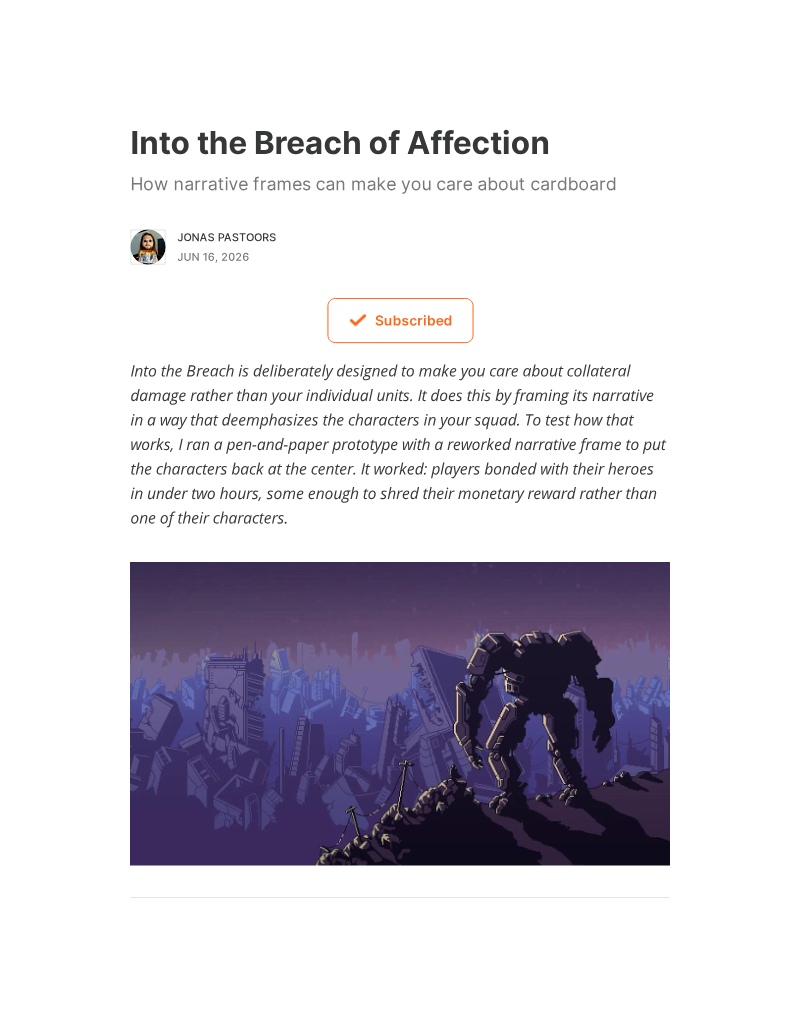
Into the Breach of Affection: How Narrative Frames Can Make You Care About Cardboard
This essay by game designer Jonas Pastoors examines how narrative framing shapes player attachment, using the tactical roguelike Into the Breach as its central case.
- Into the Breach deliberately deemphasizes its pilots: players lose their characters after each run, and pilots mainly serve as a bonus-delivery mechanism while the mechs do the visible fighting.
- Pastoors argues these choices stem from a narrative frame centered on collateral damage, and that the same mechanics could foster bonding if the frame were reversed.
- To test this, the author ran a small, informal pen-and-paper prototype based on Bury Me in the Rift, recasting mechs and pilots as heroes and magical artifacts defending a monastery from demons, with books at stake instead of civilians.
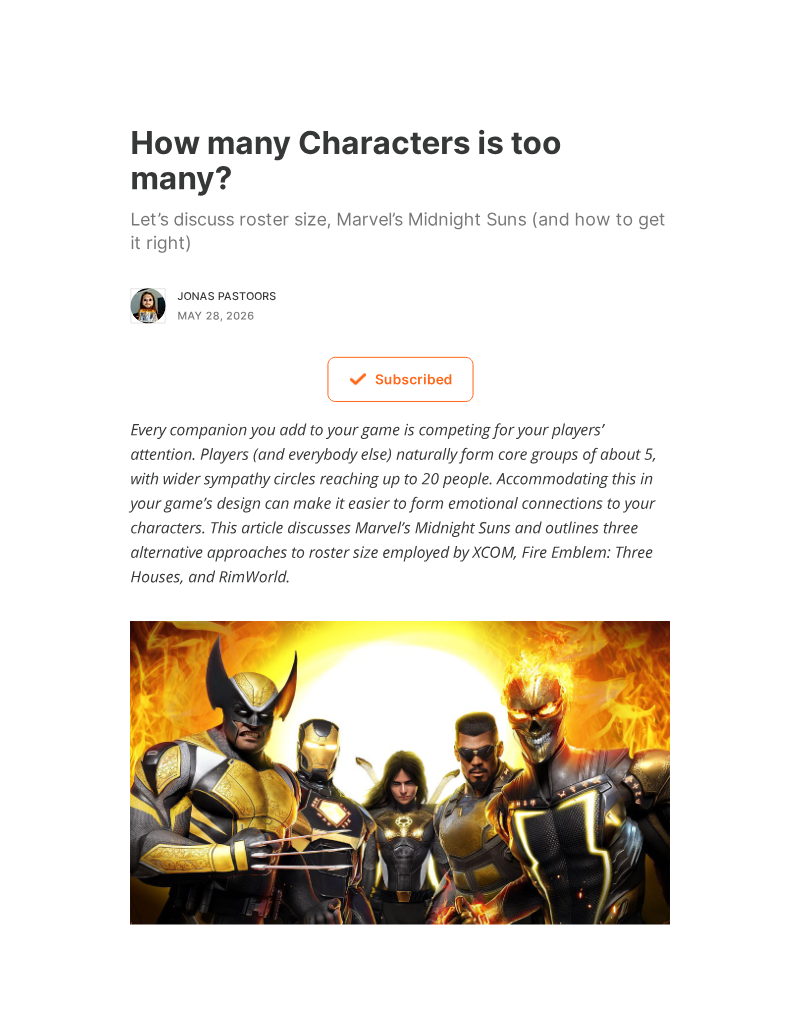
How Many Characters Is Too Many? Let's Discuss Roster Size, Marvel's Midnight Suns (and How to Get It Right)
This essay examines how the number of companion characters in a game affects player attention and emotional attachment, using Marvel's Midnight Suns as its central case study.
- Dunbar's Number suggests people maintain a close 'support clique' of about five people and a wider 'sympathy group' of roughly 10 to 20, and the author argues game rosters should respect these social limits because an oversized cast dilutes emotional attachment to individual characters.
- Marvel's Midnight Suns has 13 fully voiced heroes in its base game and 17 with DLC, a total the author considers within the sympathy group range, yet the game lacks a mechanism for players to naturally form a core group of regulars.
- In Midnight Suns, a three-hero combat team limit and friendship progress gating legendary abilities and cosmetics force players to either narrow their focus to two or three favorites and forfeit content, or spread attention across the whole roster, which makes attachment to any single character difficult.
If You Want To Make Games, Listen To THIS First (Xalavier Nelson Jr.) — Full Time Game Dev Podcast
Sustainable success in the modern game industry requires a fundamental shift away from high-risk, singular project gambles toward a disciplined, process-oriented business model.
- Game development is inherently high-risk, functioning more like gambling than traditional construction because developers often lack a predictable process to ensure financial success.
- Experienced developers like Xalavier Nelson Jr. leverage their history—having shipped over 110 games—to identify invisible pitfalls and manage multiple projects simultaneously, a feat that is significantly more difficult for those with less shipping experience.
- Specializing in a specific genre or 'tonal territory'—such as atmospheric horror—is a valid brand strategy, but it requires a sufficient volume of released titles to establish that identity in the audience's mind.