1 free read left. Create a free account for unlimited reading + AI research.
Create free accountArticle Journal of Games Criticism
1 free read left. Create a free account for unlimited reading + AI research.
Create free accountArticleJournal of Games Criticism
Distilling the key insights…
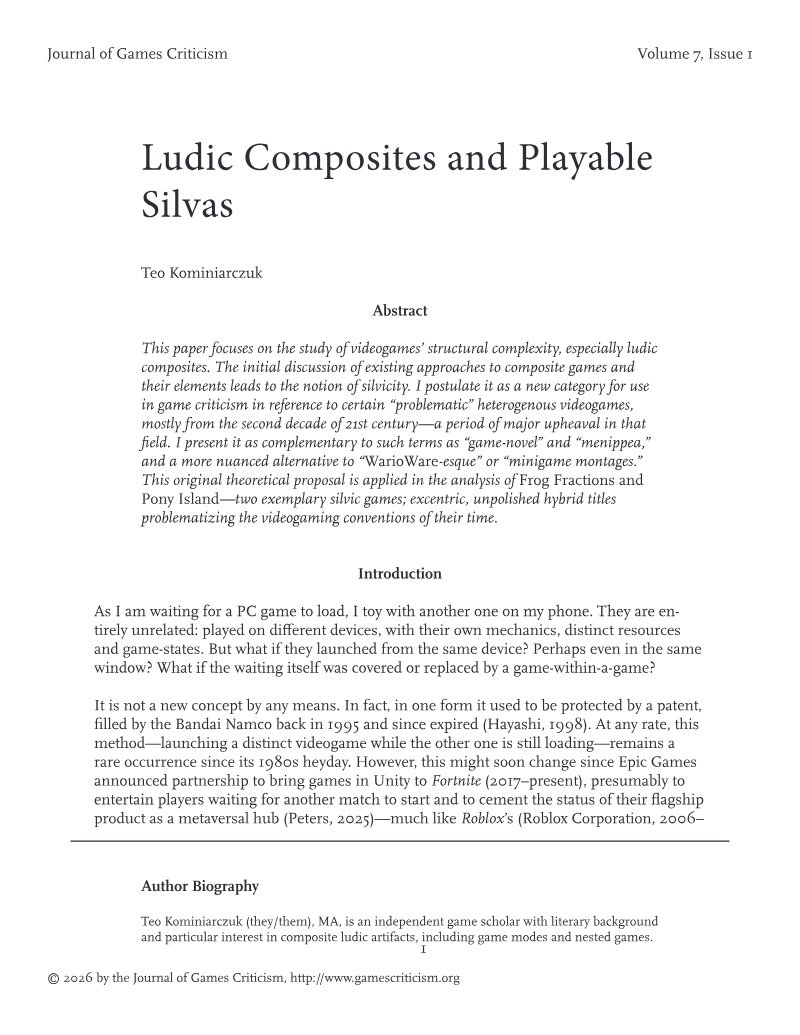
Ludocriticism functions as a comprehensive framework for evaluating the aesthetic and functional value of videogames, moving beyond traditional textual interpretation to address the medium’s unique interactive nature. The central thesis posits that a game is not merely a static text but an artifact played, requiring a recursive process where the player’s actions and interpretations continuously reshape the experience. By integrating classical hermeneutics with cybernetic and performative approaches, this methodology accounts for the polyvalent nature of gameplay, where meaning is derived from the intersection of internal mechanics, narrative structure, and spatiotemporal context.
The evaluation of a game’s worth relies on the intensity and duration of its depletion, a metric that distinguishes ludocriticism from conventional thematic analysis. Critics must navigate three distinct layers of interpretation: the ludic, which concerns immediate gameplay; the extra-ludic, which addresses broader cultural conditions; and the meta-ludic, which allows for the assessment of the game as a stable aesthetic object. Through this meta-ludic lens, critics establish a generic understanding of the artifact, enabling them to situate specific titles within a wider cultural and historical framework.
This analytical approach is applicable to a broad spectrum of digital entertainment, as evidenced by case studies ranging from platformers like Trine to complex narrative-driven titles such as Metal Gear Solid 4. Because ludocriticism is a practice accessible to any participant rather than a specialized professional designation, it democratizes the critical assessment of games. Ultimately, effective evaluation requires a mode of hermeneutic play that acknowledges the material and multimodal reality of the medium, ensuring that the final judgment reflects both the player’s subjective engagement and the objective qualities of the game as a cultural artifact.
Journal of Games Criticism · 2025
International Journal of Role-Playing · 2026