1 free read left. Create a free account for unlimited reading + AI research.
Create free accountWhitepaper DiGRA
1 free read left. Create a free account for unlimited reading + AI research.
Create free accountWhitepaperDiGRA
The paper argues that perceived authenticity of a vocal performance depends on the listener's contemporary familiarity with Egyptian history, their mode of interaction with the game, and their experience with the franchise and gaming more broadly.
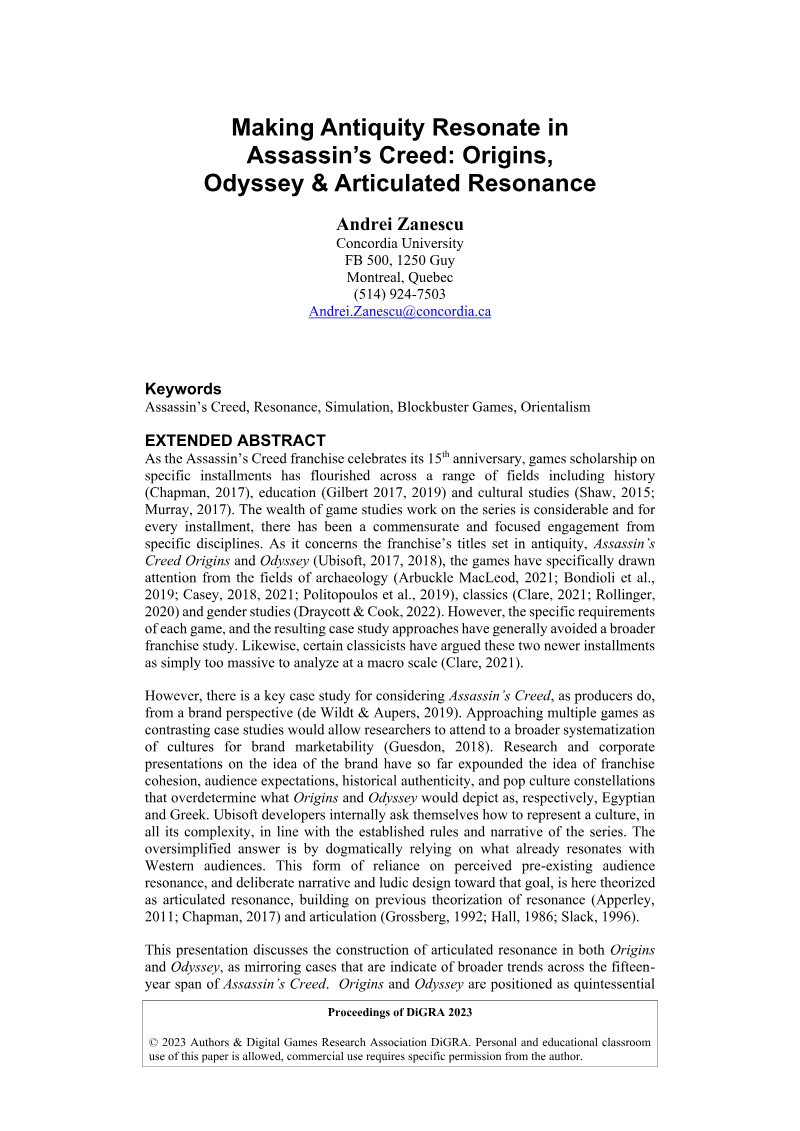
This paper examines how vocal performance in Assassin's Creed: Origins (2017) shapes player perception of authenticity, identity, and historical representation. It focuses on the English-language voice work for the three embodied avatars: Bayek of Siwa, voiced by Abubakar Salim; his wife Aya, voiced by Alix Wilton Regan; and the contemporary character Layla Hassan, voiced by Chantel Riley. The author argues that the question of what a Hellenistic-era Egyptian accent sounded like cannot be settled, and that the perceived authenticity of a performance depends on the listener's contemporary familiarity with Egyptian history, their mode of interaction with the game, and their experience with the franchise and gaming more broadly.
The analysis draws on scholarship in voice studies, theater, and feminist new materialism to argue that accent is not a stable marker of identity but is produced in the act of listening. Drawing on work by Michelle Pfeifer and Angela Pao, the paper contends that listeners reproduce racialized and gendered assumptions about accented speech, and that embodied dialects on stage and screen often become the dominant signifier of ethnic and national identity. This framing positions perception as a central element of how identity is heard and constructed in performance.
The central theoretical contribution is the "constellation" concept, adapted from Walter Benjamin through John Durham Peters's account of history as arranged across the present rather than as a linear chain. Using Karen Barad's notions of diffraction and "spacetimemattering," the paper proposes that meaning in interactive historical games emerges simultaneously across time, space, and social context during gameplay. The paper notes that the Assassin's Creed franchise, with its themes of simulated time travel and technologically mediated history, makes this framework especially relevant.
The paper is a conceptual and interpretive essay rather than an empirical study; it presents no survey data, sample, or quantitative findings. Its scope is limited to a single installment of one franchise and to English-language voice performances, and it situates its claims within game studies, performance studies, and media history.
Each row is a game or company this document names, each column a document, oldest first. A mark means that document names it. Select a row to see those documents.
DiGRA · 2023
DiGRA · 2023
DiGRA · 2023
DiGRA · 2023
DiGRA · 2023
DiGRA · 2023
DiGRA · 2023
DiGRA · 2023
DiGRA · 2023

DiGRA · 2023
DiGRA · 2023
DiGRA · 2023
DiGRA · 2009