1 free read left. Create a free account for unlimited reading + AI research.
Create free accountWhitepaper DiGRA
1 free read left. Create a free account for unlimited reading + AI research.
Create free accountWhitepaperDiGRA
Distilling the key insights…
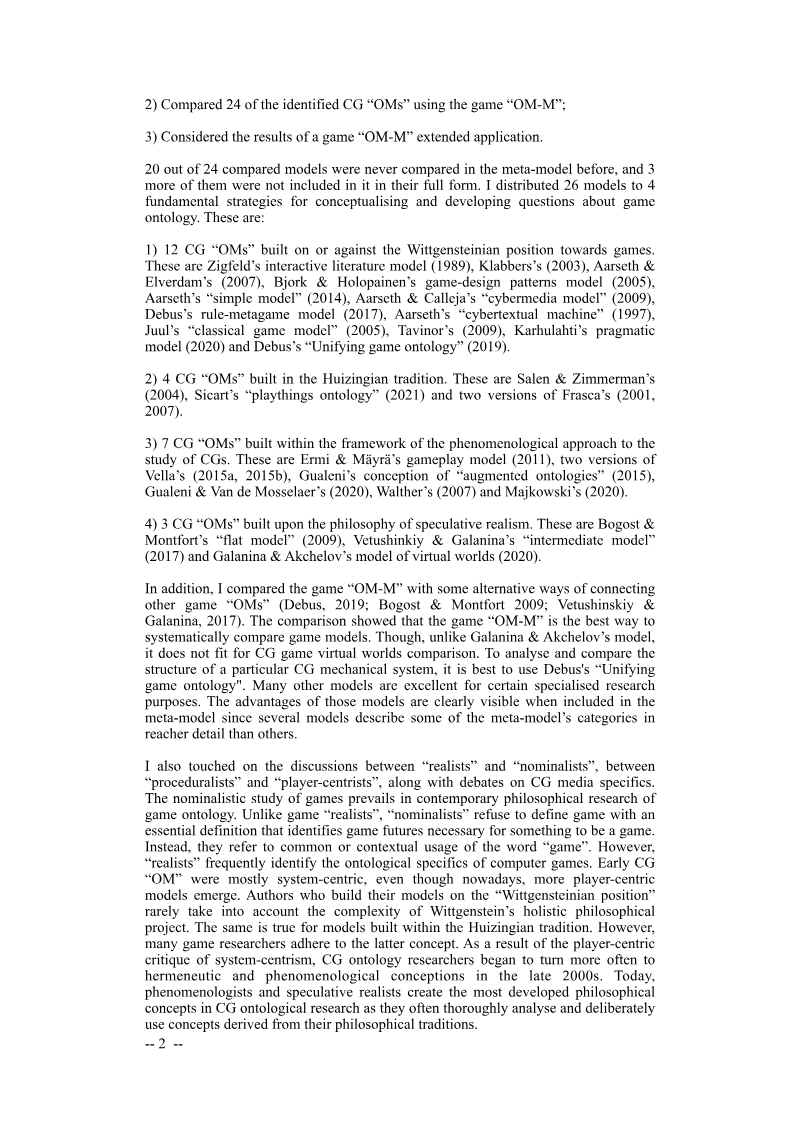
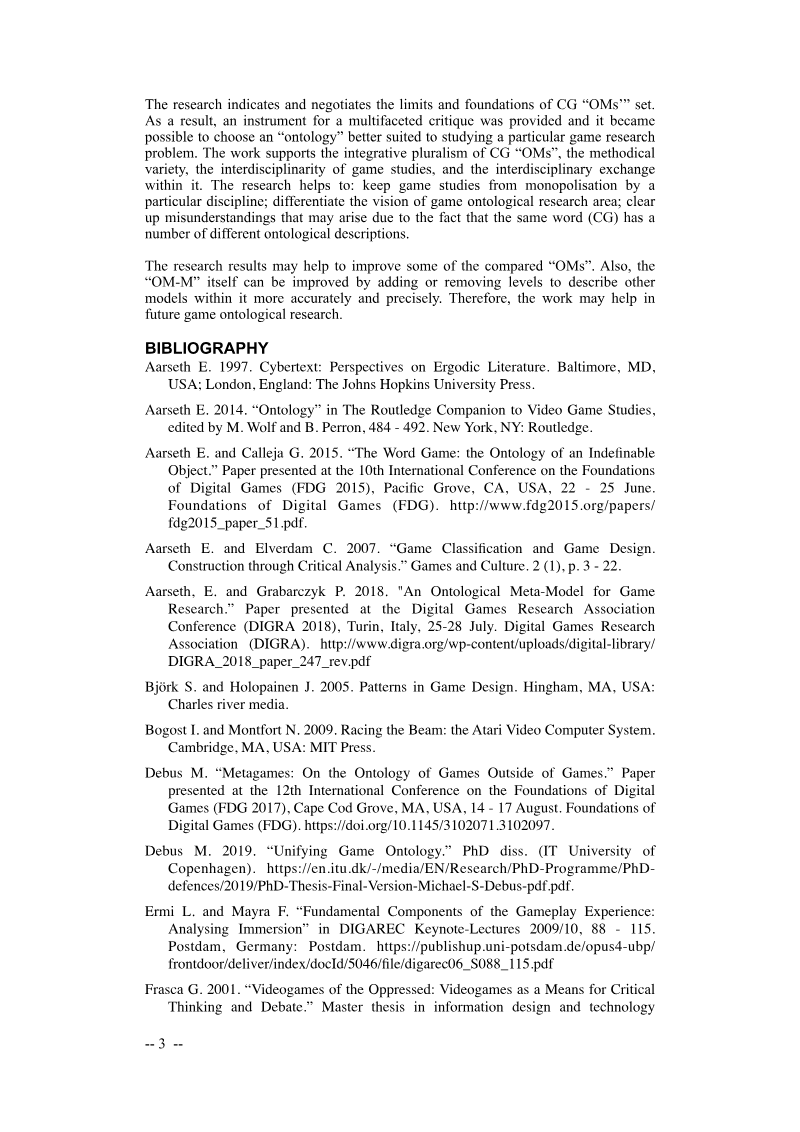
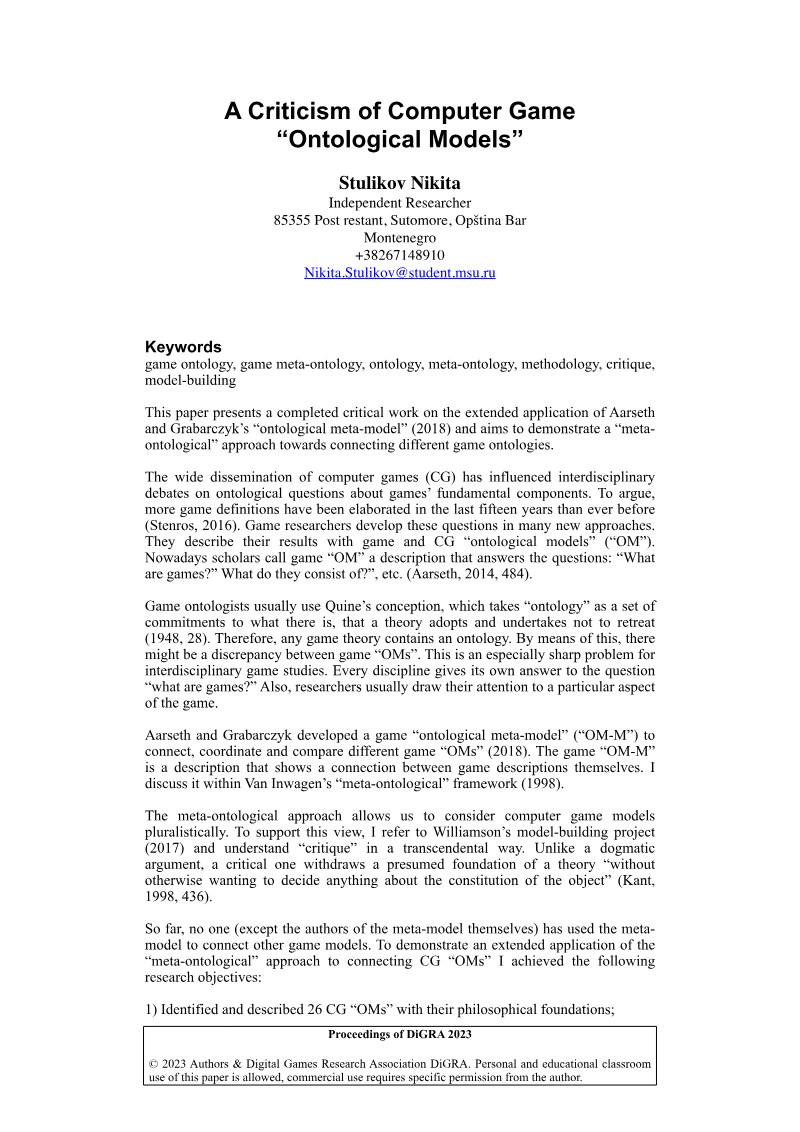
This paper argues that the ontological meta-model proposed by Aarseth and Grabarczyk in 2018 can be extended beyond its authors' original use to connect and compare a wide range of computer game ontological models, and it frames this effort through a meta-ontological and transcendentally critical approach. The author identifies 26 computer game ontological models, compares 24 of them using the meta-model, and finds that 20 of those 24 had never previously been compared within it, with three more included only in partial form. The models are sorted into four strategic families: those built on or against Wittgenstein's position on games, those in the Huizingian tradition, phenomenological approaches, and models grounded in speculative realism.
The central findings concern the relative strengths of competing frameworks. The meta-model is judged the most systematic way to compare game models, though it is unsuited to comparing virtual worlds, a task better served by Galanina and Akchelov's model. Debus's "Unifying game ontology" is recommended for analysing the structure of particular mechanical systems, while many other models are valued for specialised purposes, with their advantages becoming visible when they are placed within the meta-model, since several describe its categories in more detail than others. The paper also observes that early computer game ontologies were largely system-centric, that player-centric and phenomenological conceptions gained prominence in the late 2000s, and that nominalist approaches now dominate philosophical work on game ontology.
The scope of the study is primarily philosophical and theoretical, drawing on a corpus of published game studies literature, conference proceedings, and dissertations spanning roughly 1989 to 2021, with a predominantly English-language and Western academic orientation. Its method is comparative and critical rather than empirical, relying on textual analysis of model structures rather than survey or quantitative data. The author concludes that the work supports integrative pluralism and methodological variety in game studies, helps prevent the domination of the field by any single discipline, and may guide future refinement of both the compared models and the meta-model itself.
DiGRA · 2023
DiGRA · 2023
DiGRA · 2023
DiGRA · 2023
DiGRA · 2023
DiGRA · 2023
DiGRA · 2023
DiGRA · 2023
DiGRA · 2023
DiGRA · 2023
DiGRA · 2023
DiGRA · 2023












Comments