1 free read left. Create a free account for unlimited reading + AI research.
Create free accountWhitepaper Bina Nusantara University
1 free read left. Create a free account for unlimited reading + AI research.
Create free accountWhitepaperBina Nusantara University
This research explores the development of a hybrid artificial intelligence architecture designed to enable fully autonomous gameplay in a classic Pac-Man environment. The primary thesis posits that combining evolutionary optimization with deterministic search algorithms creates a more robust and adaptive agent than single-technique models. By separating long-term strategic decision-making from short-term tactical pathfinding, the system aims to balance survival, pellet collection, and adversarial navigation.
The methodology utilizes a Genetic Algorithm (GA) to optimize high-level gameplay strategies, such as risk management and route selection, while employing A pathfinding for efficient movement. Additionally, the system incorporates Breadth-First Search (BFS) and Depth-First Search (DFS) to model distinct, adversarial behaviors for the four ghost agents. The environment was developed using Python and the Pygame library, with the final application deployed as a web-based game via WebAssembly and Pygbag to ensure cross-platform accessibility.
Experimental results indicate that this hybrid approach improves navigation stability and survival duration compared to baseline models. The study includes a comparative analysis against Reinforcement Learning (Q-Learning) and Neural Network-based Heuristic Search, finding that while the hybrid model incurs some computational overhead, it provides superior adaptability in dynamic environments. Despite these successes, the researchers noted limitations in the convergence of the Genetic Algorithm, suggesting that future iterations should focus on refining fitness functions and exploring the integration of reinforcement learning to enhance overall stability. The study serves as a structured educational framework for applying complex AI techniques within retro arcade-style game simulations.
Each row is a game or company this document names, each column a document, oldest first. A mark means that document names it. Select a row to see those documents.
Bina Nusantara University · 2024
Bina Nusantara University · 2023
Bina Nusantara University · 2023
Bina Nusantara University · 2021
Bina Nusantara University · 2021
Bina Nusantara University · 2021
Bina Nusantara University · 2021
Bina Nusantara University · 2021
Bina Nusantara University · 2021
Journal of Games, Game Art, and Gamification · 2021
Bina Nusantara University · 2021
Journal of Games, Game Art, and Gamification · 2021
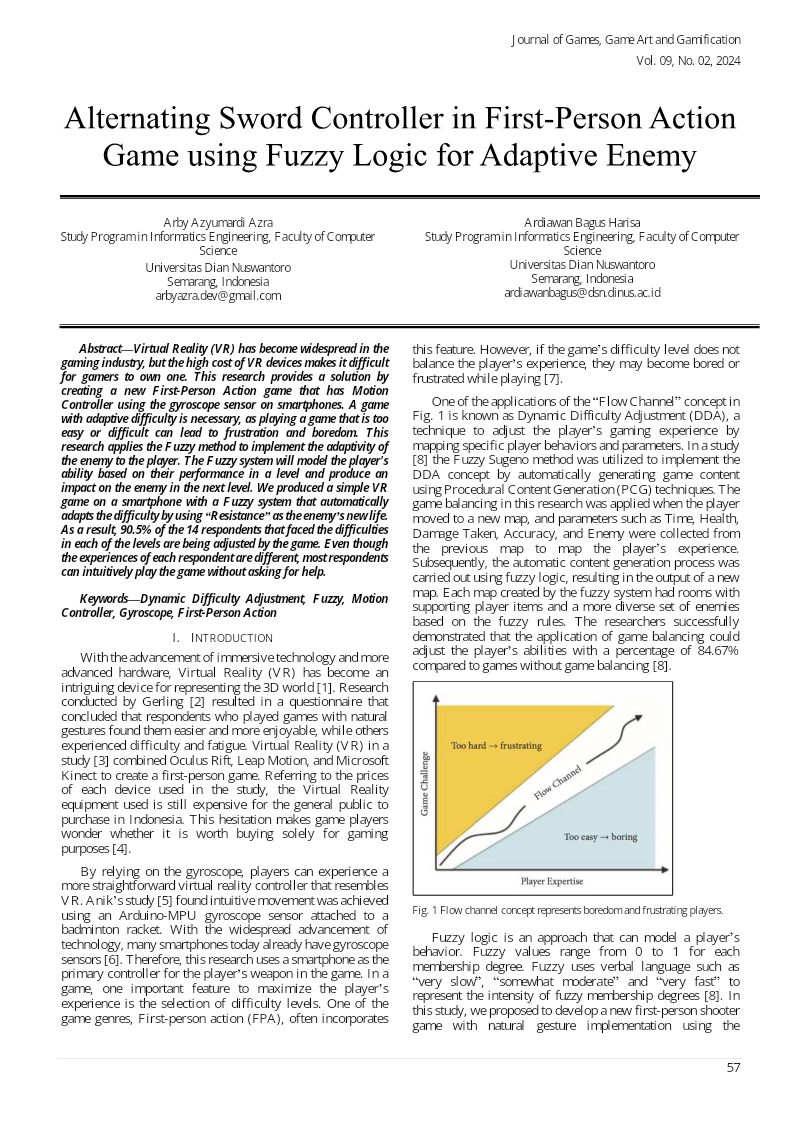
Universitas Dian Nuswantoro · 2024