1 free read left. Create a free account for unlimited reading + AI research.
Create free accountWhitepaper DiGRA
1 free read left. Create a free account for unlimited reading + AI research.
Create free accountWhitepaperDiGRA
The controversies concerned skin-tone whitewashing and colonial symbolism that followed the release of these regions. They drew substantial public petitions.
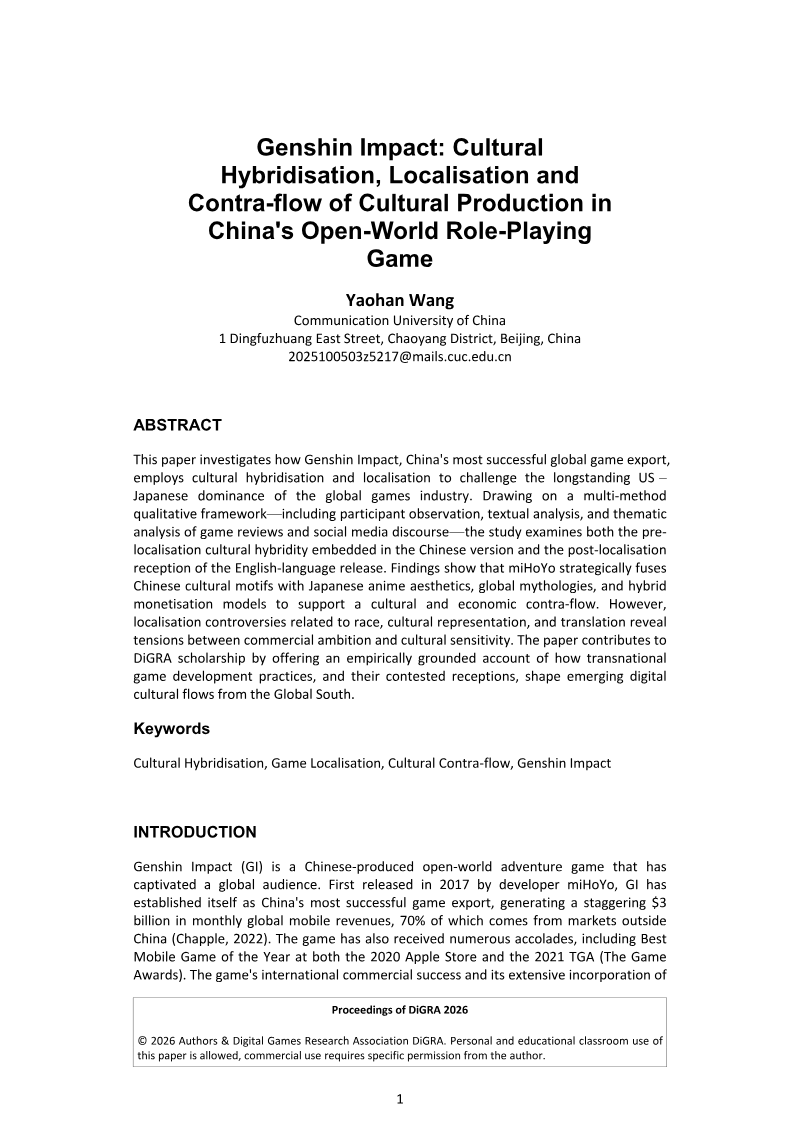
This paper applies Roland Barthes' three-tiered semiotic model (denotative, connotative, and mythic levels) together with critical transculturalism to examine how Genshin Impact's character designs for the Sumeru and Natlan regions negotiate cultural difference and hybridity. Its central argument is that cultural hybridization in games is not neutral: it serves commercial recognition and global circulation while often proceeding asymmetrically, with dominant cultures rendered in depth and marginalized ones reduced to symbolic surfaces. The study is motivated by the 2024 controversies over skin-tone whitewashing and colonial symbolism that followed the release of these regions, which drew substantial public petitions.
The analysis draws on 24 playable characters from Sumeru and Natlan, using character illustrations, 3D models, and cutscenes, which were coded into four categories of visual signs: bodily, clothing, accessory, and action signs. Signs were classified as original, hybrid, or fictional at the denotative level, with semantic shifts examined at the connotative level and ideological functions at the mythic level.
The findings identify three patterns. First, the designs reflect an ACG (anime, comics, games) aesthetic logic of collage, with roughly 17 percent of the collected signs drawn from sources outside the prototype cultures, such as German military uniforms, Nordic elf attire, and knight costumes. Second, Natlan's design replaces its prototype culture's distinctive techniques with motorcycles, pixel art, and electronic dance, an intentional hybridity that challenges the equation of "original" with "backward" yet implicitly equates progress with industrialization and overlooks local knowledge such as shamanic rituals and herbal medicine. Third, Sumeru and Natlan fuse elements from the Middle East, South Asia, Latin America, and Africa into a composite that enhances visual diversity while thinning cultural depth, producing what the author describes as depoliticized, surface-level diversity in which colonial and religious conflicts are effaced.
Each row is a game or company this document names, each column a document, oldest first. A mark means that document names it. Select a row to see those documents.

DiGRA · 2026

DiGRA · 2026



DiGRA · 2026



DiGRA · 2026



DiGRA · 2026



DiGRA · 2026



DiGRA · 2026



DiGRA · 2026

DiGRA · 2026



DiGRA · 2026



DiGRA · 2026

DiGRA · 2026
Mobilegamer.biz · 2026