Reports in the Country Reports category.
The Vietnam Game Industry Monthly Report for May 2026 provides a comprehensive analysis of the mobile gaming landscape, highlighting a shift in market dynamics from pure volume-based acquisition to a focus on operational depth and regulatory compliance. The report synthesizes quantitative data from AppMagic with internal insights to evaluate performance across various subgenres, emphasizing that while overall market demand remains stable, success is increasingly contingent upon localized content, strong community management, and adherence to evolving government policies.
Market data for May 2026 indicates a recovery in total mobile game downloads, which rose to 121 million, a 3.98% increase over April. However, this growth was uneven; midcore segments experienced a 4.69% decline in downloads, underscoring a reliance on consistent launch pipelines and recognizable themes. Conversely, total in-app purchase (IAP) revenue grew by 3.13% month-over-month, with midcore revenue rising by 4.44%. This revenue expansion was driven primarily by long-lifecycle titles in genres such as Battle Royale, MOBA, and Sim Sports, which leverage established communities and recurring live-ops rather than relying solely on new user acquisition.
The report identifies cultural familiarity as a critical driver for success, noting that titles featuring wuxia, xianxia, or established IP consistently outperform generic Western fantasy products. Furthermore, the industry is undergoing a structural transition toward greater professionalization. Vietnam is increasingly positioning itself as a regional hub for esports, evidenced by the formalization of tournament calendars and hosting of major international events. Simultaneously, the introduction of Decree 174/2026/NĐ-CP, effective July 2026, mandates stricter compliance regarding account verification and data management. These regulatory requirements necessitate that publishers integrate operational and legal safeguards directly into their product design, favoring those who partner with experienced local entities capable of navigating the increasingly complex Vietnamese market environment.
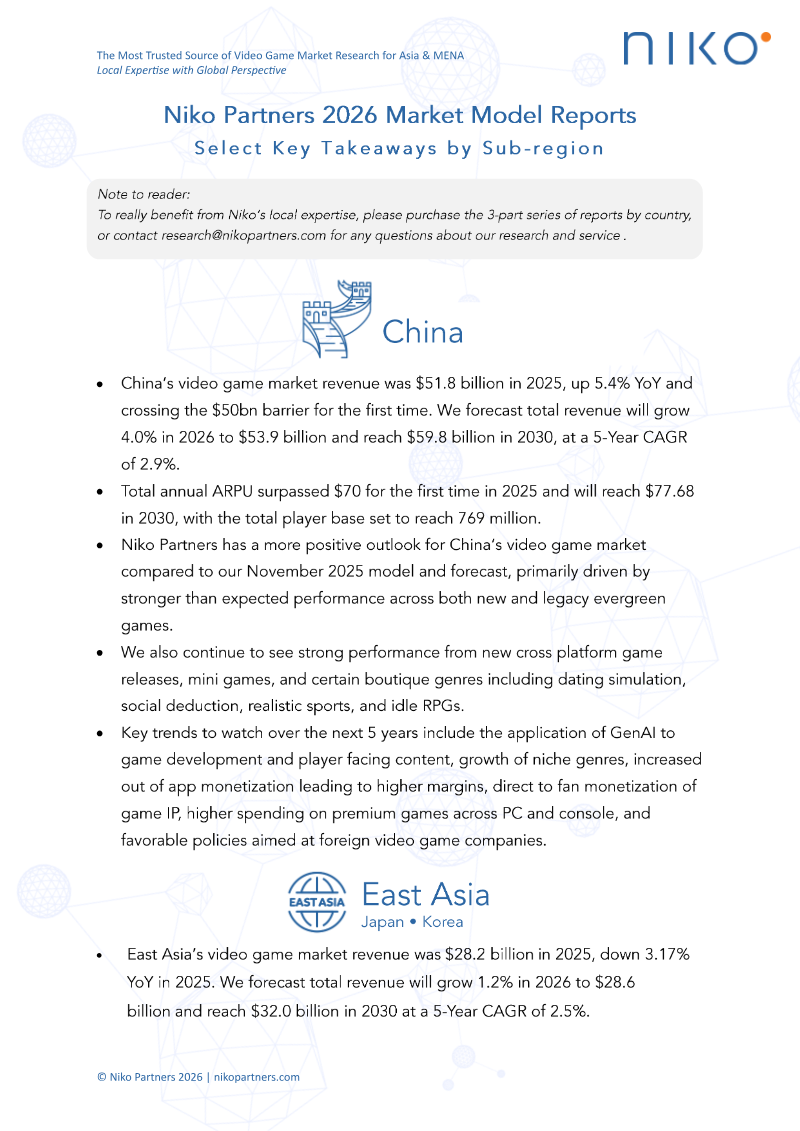
The 2026 Market Model Reports provide a comprehensive analysis of video game industry performance and growth projections across Asia and the Middle East and North Africa (MENA). Covering China, East Asia, India, Southeast Asia, and the MENA-3 region (Egypt, Saudi Arabia, and the UAE), the research evaluates revenue trends, player demographics, and macroeconomic influences through 2030. The analysis utilizes proprietary market modeling, player survey data, and regional expertise to assess the evolving landscape of mobile, PC, and console gaming.
Key findings highlight significant regional disparities in growth and maturity. China remains a dominant force, with 2025 revenue reaching $51.8 billion and a projected 2.9% CAGR through 2030. India emerges as the fastest-growing market, having surpassed $1 billion in revenue in 2025 with an expected 11.2% CAGR. Conversely, East Asia experienced a 3.17% revenue decline in 2025 due to macroeconomic pressures in Japan, though South Korea shows signs of recovery. Southeast Asia continues to expand, driven by mobile adoption and internet penetration, while the MENA-3 region benefits from strong government support and rising disposable income, despite potential geopolitical headwinds.
The research identifies several critical industry drivers, including the integration of generative AI, the rise of niche genres, and increased government regulation across Southeast Asia. Higher average revenue per user (ARPU) remains a focal point, particularly in East Asia, which maintains the highest regional spending levels. Overall, the findings suggest that while short-term volatility persists due to economic and geopolitical factors, the broader outlook for these markets remains positive, supported by increased localization, infrastructure development, and shifting consumer spending toward digital entertainment.
Türkiye has emerged as a preeminent global force in the mobile gaming sector, characterized by a resilient ecosystem that achieved 6% year-over-year revenue growth despite broader international market stagnation. This expansion is underpinned by a maturing domestic industry where local developers have increased their collective revenue by 450% since 2020, now commanding a 5% share of the global market. The sector’s success is heavily concentrated in the puzzle genre, which accounts for nearly 97% of local earnings, while a strategic pivot toward hybrid-casual titles and sophisticated LiveOps strategies continues to influence international development trends.
The rapid professionalization of the Turkish gaming landscape is driven by a self-sustaining flywheel effect, where successful exits and high-profile valuations for studios like Dream Games and Loom Games attract consistent capital and elite technical talent. Since 2020, the number of local developers has tripled, supported by a robust network of venture capital firms and over 700 active gaming startups. This growth is further accelerated by proactive government intervention, including substantial tax incentives and user-acquisition subsidies, which provide a competitive advantage in an increasingly saturated global environment.
Looking toward 2026, the industry is transitioning from rapid iteration models toward AI-native development and deeper engagement mechanics to maintain its competitive edge. With over $3.6 billion in total investment fueling the rise of category-defining companies, the region has solidified its status as a global hub for mobile gaming innovation. By leveraging a data-driven creative playbook and a highly replicable development framework, the Turkish market is well-positioned for sustained dominance, effectively balancing rapid scaling with the long-term technical maturity required to navigate the evolving demands of the global mobile gaming audience.
The Vietnamese mobile gaming market represents a significant growth sector in Southeast Asia, reaching a valuation of approximately $825 million in 2025. With an estimated 54 to 58.5 million mobile gamers and a year-on-year revenue growth rate of 9.16%, the market is characterized by high engagement, with users averaging 2.5 hours of daily gameplay. The industry is supported by a robust digital infrastructure, serving 79.8 million internet users, and is projected to exceed $1 billion in annual revenue by 2030.
Market performance is dominated by specific genres, with MMORPGs leading at 23.12% of total revenue, followed by team battle and 4X strategy games. Payment ecosystems are heavily localized, with e-wallets, bank transfers, and domestic card schemes—primarily through the NAPAS network—accounting for the vast majority of transactions. This preference for local financial infrastructure necessitates strategic partnerships for international entities seeking to enter the region.
Regulatory compliance remains the most critical barrier to entry for foreign developers. Under Decree No. 147/2024/ND-CP, all game distribution requires a formal license, and foreign companies must operate through a local legal entity or a licensed domestic publisher. Mandatory requirements include strict KYC identity verification, a 180-minute daily playtime limit for minors, and the physical hosting of server systems within Vietnam. Furthermore, upcoming advertising regulations effective in 2026 will mandate shorter, user-friendly ad formats, prompting a shift toward rewarded ads and enhanced in-app purchase strategies. To navigate these complexities, stakeholders are increasingly relying on local advisory and publishing ecosystems to manage licensing, legal documentation, and market-specific operational requirements.
Latin America has solidified its position as a formidable force in the global gaming landscape, transitioning from a peripheral source of cost-effective labor to a sophisticated hub of creative innovation and live service expertise. Driven by massive, mobile-first player populations in Brazil and Mexico, the region is increasingly defined by high levels of community engagement and a thriving esports culture. While economic challenges such as currency volatility and limited infrastructure persist, the industry is successfully pivoting toward sustainable, long-term business models that prioritize authentic, socially integrated experiences over traditional, short-term monetization strategies.
The regional ecosystem is characterized by a strategic shift toward self-publishing and advanced Live Ops, supported by a deep pool of engineering talent that is increasingly utilizing artificial intelligence to enhance production efficiency. Although major hubs like Brazil and Mexico anchor the market, smaller nations such as Argentina and Ecuador are gaining international visibility through indie innovation and strategic global partnerships. This evolution reflects a broader maturation of the industry, where developers are moving beyond simple localization to address the specific technological and cultural nuances of individual domestic markets.
Success within this territory requires a departure from standardized global frameworks in favor of localized strategies that account for unique payment preferences and regional economic constraints. Despite systemic hurdles regarding access to specialized venture capital and user acquisition, the region offers significant growth potential for developers who commit to long-term engagement. By fostering trust and prioritizing accessibility, the Latin American gaming sector is effectively countering the stagnation currently impacting global mobile markets, establishing itself as a vital, influential player in the international creative economy.
The report establishes that Africa’s video‑game industry has entered a phase of rapid maturation, driven largely by mobile play in urban centres such as South Africa, Nigeria and Kenya. Mobile accounts for roughly 90 % of the $1.8 billion market in 2024, with a 10 % year‑over‑year rise in players to 349 million. PC and console remain niche but critical for studio visibility, with Steam dominating distribution (≈70 % of PC use) and local platforms like Gara and Jiwe capturing the remainder. Funding for studios is overwhelmingly sourced from international incubators and grants—Pro Helvetia, the French Agence Française de Développement, the British Council’s Ignite Culture and Digital Lab Africa—yet local infrastructure gaps (low internet penetration, limited payment systems, unreliable electricity) continue to constrain broader market development.
Key findings show that the fastest‑growing economies—Eritrea, Niger, Egypt, Ethiopia, Nigeria and South Africa—host studios such as Maliyo Games, Kayfc and Legends of Orisha that are producing mobile‑first IP while experimenting with higher‑production PC/console titles. Female representation and gender inclusivity are addressed through programmes like Pro Helvetia’s “She Got Game”, yet overall skill development remains uneven, with many studios still operating at the indie level and lacking robust business training.
The esports sector mirrors this mobile dominance, with titles like PUBG Mobile and Free Fire generating substantial prize pools and viewership across hubs such as Morocco, Egypt and Kenya. However, talent development is concentrated in a handful of urban centres, leaving Francophone and non‑English speaking regions underrepresented.
The analysis concludes that sustainable growth hinges on three pillars: deeper, studio‑level talent development; reliable data infrastructure for market intelligence; and evolved payment systems that reduce friction. Strengthening African‑European partnerships, expanding local incubation pathways, and ensuring annual data updates are essential to unlock the continent’s commercial potential while preserving African leadership in game creation.
The study evaluates the German games industry in 2025, building on earlier reports to assess economic performance, employment, and the influence of federal funding. It surveys 343 companies—28 % of a population of 1,205—and integrates primary data with secondary sources such as gamesmap and DLR. The sector has expanded rapidly, doubling core‑market firms from 619 in 2018 to roughly 1,200 by mid‑2025 and nearly doubling the extended core market. Revenue rose from €3.06 bn in 2018 to €3.73 bn in 2024, a 22 % increase, with development‑sector sales growing 148 %. Despite this growth, the market remains highly fragmented: three‑quarters of firms employ fewer than ten people and only 19 % belong to foreign conglomerates. Export earnings dominate, accounting for 76 % of revenue, largely within the EU and North America/Asia.
Employment data reveal a clear link between company size and workforce composition. Larger firms (>€25 M revenue) employ 85 % full‑time staff, whereas micro‑enterprises rely heavily on owners and freelancers. Female representation has risen to nearly one‑third of the workforce, and international talent now constitutes 35 % of employees. Technical and creative roles dominate, while commercial positions have declined. Salaries average €62 k annually, with lead‑level pay ranging from €50–80 k and a strong correlation between company size and remuneration.
Federal funding has been pivotal, with 71 % of developers receiving or planning to receive support. In 2023, €70 million in subsidies generated €277 million of investment and €453 million of total value‑creation, yielding a multiplier of 6.5 for output and 2.5 for fiscal impact. However, high personnel costs remain a significant challenge, with 57 % of respondents rating them as “very bad.” The industry also serves as a talent magnet and innovation catalyst, with 70 % of spill‑overs stemming from game engines, gamification, and AR/VR technologies adopted across automotive, architecture, film, training, AI, and other sectors.
The digital landscape in the United States has reached a pivotal turning point as smartphones and connected televisions officially surpass traditional broadcast media as the primary vehicles for entertainment. With smart TV penetration reaching 63% and subscription services now more prevalent than cable or satellite, the American household is firmly rooted in a digital-first ecosystem. This transition is fueled by a surge in spending among younger consumers aged 18–34, who have increased their annual digital media expenditure by $235 over the past year. While the average household maintains 3.5 subscription video services, a growing trend of "subscription cycling" suggests consumers are becoming more price-sensitive and strategic with their digital commitments.
Gaming has emerged as a near-universal activity, with 80% of the population engaging across various platforms and over half of the country playing mobile games daily. The industry is seeing a significant rise in social and cloud gaming, alongside a burgeoning interest in user-generated content and non-programmer creation tools. Although traditional game discovery channels are losing influence, total annual in-game spending has risen dramatically. Notably, 70% of computer gamers now spend $30 or more annually, and there is a growing consumer appetite for the ability to trade virtual goods between different titles, potentially facilitated by blockchain technology.
Emerging technologies reveal a stark generational divide in adoption and sentiment. While the 18–34 demographic shows double-digit increases in familiarity and interest regarding the Metaverse and Virtual Reality, interest in Augmented Reality has declined sharply across all age groups. Cryptocurrency remains a niche expertise, yet a significant portion of younger investors plan to commit substantial capital to the sector in the coming year. Despite these advancements, privacy remains a critical barrier; over 60% of Americans express deep concerns regarding information security and the use of personal data for advertising. This tension between high digital engagement and data anxiety defines the current state of the American digital consumer.
The China Region Report provides a comprehensive analysis of the Chinese games market as of July 2025, positioning it as the most lucrative and influential territory in the global industry. The central thesis asserts that while China presents significant regulatory and cultural hurdles for Western companies, its domestic firms have evolved into global leaders through rapid innovation, sophisticated live operations, and a mobile-first development philosophy.
Key findings indicate that the Chinese market generated approximately $48.7 billion in 2024, representing nearly 30% of global games revenue. Data from AppMagic and Newzoo highlight that while the domestic App Store saw a slight peak in 2021, the broader ecosystem remains robust, supported by over 701 million players. The report identifies a significant shift in industry capabilities, noting that 14 of the top 30 grossing games worldwide in early 2025 were developed or owned by Chinese entities. Furthermore, the success of titles like Black Myth: Wukong signals China’s successful expansion from mobile dominance into the premium triple-A PC and console sectors.
The scope of the analysis covers major industry segments including mobile, PC, and the emerging HTML5 mini-game market on platforms like WeChat, which boasts 500 million monthly active users. It profiles dominant publishers such as Tencent, NetEase, and HoYoverse, detailing their global investment strategies and internal development successes. Methodology relies on market intelligence from AppMagic and Newzoo, supplemented by expert interviews with regional executives.
The report concludes that the regulatory environment has stabilized, offering a more transparent licensing process for international partners. Future growth is expected to be driven by AI integration in development and the continued export of original Chinese intellectual property, further blurring the lines between Eastern and Western gaming markets.
Germany’s video‑game sector generated €5.84 billion in 2024, ranking fifth globally but declining 6 % year‑on‑year. The contraction was most pronounced in game purchases, which fell 17 %, while online gaming and subscription services surged 43 % to €3.26 billion, underscoring a decisive shift toward digital and cloud‑based play. In‑game and in‑app purchases accounted for €4.6 billion, a modest 3 % drop, yet mobile gaming alone grew 63 % since 2019 to €3 billion. Console and PC revenues were €1.9 billion and €1.5 billion, respectively, while hardware sales fell 10 %, with consoles down 26 %. The workforce expanded to 37.5 million players, nearly half women and with an average age of 39.5 years, indicating broader demographic penetration.
Policy analysis reveals that restrictive federal and state funding schemes have limited access for start‑ups, contributing to an 87 % negative perception of Germany’s international competitiveness. The 2025 coalition agreement introduces tax breaks and a €2 750/month “Press Start” grant for new studios, signalling a shift toward a hybrid funding model. A projected €125 million annual increase from 2026, with each tax‑credit euro expected to generate €4.80 in economic spill‑overs, is coupled with calls for university programmes, incubators, and a dedicated “Games University” to supply skilled talent. Without these reforms, Germany risks falling behind global leaders.
The industry’s ecosystem has expanded through high‑profile events such as devcom and gamescom, which attracted record attendance and showcased international diversity. Initiatives like the Press Start: Games Founding Grant, esports talent pipelines, and the Equal Esports Cup demonstrate a coordinated effort to build inclusive professional pathways. The German Games Association, through gamescom and sustainability initiatives such as “Playing for the Planet,” positions Germany as a climate‑friendly, diverse hub. Market data confirm that 60 % of Germans play video games, with mobile gaming dominating at 37.9 %, while over 90 % of households have internet access, underscoring a mature, multi‑platform market poised for continued growth across consoles, PC and mobile channels.
SensorTower’s Southeast Asia Mobile Game Market Insights 2025 positions the region as a pivotal growth engine for mobile gaming, with 1.93 billion new installs and $625 million in IAP revenue reported for Q1 2025. The analysis draws on App Store and Google Play data, classifying titles by genre and tracking revenue while excluding ad income. Casual genres such as Arcade and Simulation dominate download volumes, whereas Strategy, Shooters, and social‑driven RPGs generate the bulk of monetization. Mobile Legends: Bang Bang and Garena Free Fire remain revenue leaders, while newer IPs like Ragnarok M: Classic and Magic Chess: Go Go rapidly climb both download and revenue charts, illustrating the market’s receptiveness to fresh, socially rich experiences.
Vietnam exemplifies deep localization success: Roblox leads downloads while Garena Free Fire dominates revenue, and local titles such as “Trò Vẽ Vui Tuổi Thơ” fuel organic growth. In the Philippines, hyper‑casual “Block Blast!” captures the largest download share, yet Mobile Legends: Bang Bang sustains top revenue. Across both markets, robust community engagement and localized content underpin strong monetization even as casual download volumes fluctuate.
From 2017 through Q1 2025, Southeast Asian titles have consistently topped global download and revenue charts. Vietnamese and Singaporean publishers now rank among the world’s top download leaders, with titles like Free Fire and Car Race expanding genre breadth. The region’s high mobile penetration, community‑driven marketing, and IP collaborations enable SEA publishers to scale player engagement and revenue on a global stage. Overall, the report underscores Southeast Asia’s emergence as both a production hub and a lucrative monetization frontier for mobile games worldwide.
The analysis demonstrates that Japan’s mobile gaming sector has reached a mature equilibrium, with download volumes stabilising after 2020 while in‑app purchase (IAP) revenue continues to grow, largely driven by high‑spending iOS users. Domestic publishers hold a dominant position in downloads—capturing roughly one‑third of the market—and command more than half of total IAP revenue, underscoring Japan’s robust monetisation models and loyal consumer base. Genre preferences have shifted toward strategy titles such as Pokémon TCG Pocket and SD Gundam G Generation ETERNAL, alongside puzzle games that now lead download charts.
Live‑ops and event‑driven monetisation prove highly effective, as illustrated by Last War: Survival’s H1 2025 performance. Aggressive daily offers and themed events produced a 2.7‑fold increase in downloads and significant revenue spikes during campaigns like Double Joy, confirming that adaptive event strategies resonate with Japanese players. Anime‑style IPs maintain a commanding presence, accounting for 42 % of in‑app purchase revenue from January to July 2025. Legacy franchises—Monster Strike, Fate/Grand Order, Umamusume—continue to perform strongly, while new titles such as Shadowverse: Worlds Beyond and Honkai: Star Rail expand the ecosystem, illustrating the enduring commercial relevance of anime IP.
Digital advertising remains tightly coupled with gaming, with mobile action/strategy titles consuming 63 % of ad spend in H1 2025. LINE dominates the channel landscape, delivering approximately 40 billion impressions and over 80 % of mobile ad exposure. Cross‑IP collaborations and event‑driven campaigns sustain long‑term monetisation, reinforcing gaming’s role as a core growth driver for digital advertising in Japan. Overall, Japanese publishers retain global leadership through strong IP‑driven franchises across PC, console, and mobile platforms, with culturally resonant engagement and targeted advertising underpinning sustained revenue growth. Sensor Tower’s comprehensive analytics platform provides the critical insights that enable stakeholders to navigate this mature yet dynamic market.