Country Reports·Updated Apr 8, 2026 by SpielFabrique
Report · April 5, 2026
Published by SpielFabrique
The report establishes that Africa’s video‑game industry has entered a phase of rapid maturation, driven largely by mobile play in urban centres such as South Africa, Nigeria and Kenya. Mobile accounts for roughly 90 % of the $1.8 billion market in 2024, with a 10 % year‑over‑year rise in players to 349 million. PC and console remain niche but critical for studio visibility, with Steam dominating distribution (≈70 % of PC use) and local platforms like Gara and Jiwe capturing the remainder. Funding for studios is overwhelmingly sourced from international incubators and grants—Pro Helvetia, the French Agence Française de Développement, the British Council’s Ignite Culture and Digital Lab Africa—yet local infrastructure gaps (low internet penetration, limited payment systems, unreliable electricity) continue to constrain broader market development. Key findings show that the fastest‑growing economies—Eritrea, Niger, Egypt, Ethiopia, Nigeria and South Africa—host studios such as Maliyo Games, Kayfc and Legends of Orisha that are producing mobile‑first IP while experimenting with higher‑production PC/console titles. Female representation and gender inclusivity are addressed through programmes like Pro Helvetia’s “She Got Game”, yet overall skill development remains uneven, with many studios still operating at the indie level and lacking robust business training. The esports sector mirrors this mobile dominance, with titles like PUBG Mobile and Free Fire generating substantial prize pools and viewership across hubs such as Morocco, Egypt and Kenya. However, talent development is concentrated in a handful of urban centres, leaving Francophone and non‑English speaking regions underrepresented. The analysis concludes that sustainable growth hinges on three pillars: deeper, studio‑level talent development; reliable data infrastructure for market intelligence; and evolved payment systems that reduce friction. Strengthening African‑European partnerships, expanding local incubation pathways, and ensuring annual data updates are essential to unlock the continent’s commercial potential while preserving African leadership in game creation.
Contents Executive Overview P.12 ~~I~~ iew P.12 ~~II~~ Industry Ecosystem Overview P.19P.19 P.39 ~~III~~ Players Profile P.39 ~~IV~~ Market Insights: P.48 Country-Level Trends P.48 ~~V~~ Esports Landscape ope P.90 P.90 ~~VI~~ Local and Global Initiatives P.102 I Initiatives P.102
Introduction & Research Intent SpielFabrique Institution (Country) Major Support Programs Website This report was produced in order to compile all available data on the African video game industry and compare the ecosystems’ dynamics across the continent. Our attention particularly focus on the existing similarities and disparities within local and regional indie clusters. Our objective is to provide a comprehensive—though non-exhaustive—overview of the industry’s current realities in Q1 2026, while identifying key market signals and areas of potential. https://www.britishcouncil.org Council (UK) fund boosts cultural industries (incl. game dev) through financing and /east-africa-arts/ignite-culture capacity-building During the initial review of available materials (existing specialised reports, articles or experts’ interviews), we identified a large number of fragmented publications. These were often framed for investment AFD purposes that compare today’s market with the situation ten years ago: of limited infrastructure, low access to capital, and minimal visibility for independent developers. In contrast, the current landscape reflects a maturing and multifaceted ecosystem, shaped by a growing number of initiatives, support programmes, publishers’ interest, and partnerships addressing long-standing structural challenges in different ways. We will attempt to paint a current picture of African industry. in-gaming-apply-for-she-got-g ame/ Through residencies like Playful Obscura, and international showcases (e.g. Goethe-Institut (Germany) Gamescom), Goethe supports African dev visibility.
anding structural challenges in different ways. We will attempt to paint a current picture of African industry. in-gaming-apply-for-she-got-g ame/ Through residencies like Playful Obscura, and international showcases (e.g. Goethe-Institut (Germany) Gamescom), Goethe supports African dev visibility. Goethe-Institut also supports https://www.goethe.de/en/kul Enter Africa (15 countries) and GamesConnect AFRiCA to build networks and
Introduction & Research Intent SpielFabrique Institution (Country) Major Support Programs Website This work involved compiling, cross-referencing, and analysing data from multiple industry reports, market studies, and expert contributions to ensure consistency and relevance. Nevertheless, we urge readers to apply critical thinking when assessing the relevance of certain figures & data. We would also be grateful to anyone who could provide us with relevant critical feedback, if they have information that contradicts or qualifies the statements made in this report. https://www.britishcouncil.org Council (UK) fund boosts cultural industries (incl. game dev) through financing and /east-africa-arts/ignite-culture This report does not promote specific actors, models, or policy choices. The objective is to document the state of the African market as it stands on the date of publication (February 6, 2026), highlighting key trends, structures, and realities observed across regions. In doing so, it also recognises the resilience and self-driven growth of African studios and developers, whose continued efforts have been instrumental in building the foundations of today’s industry. https://prohelvetia.ch/en/what
ing key trends, structures, and realities observed across regions. In doing so, it also recognises the resilience and self-driven growth of African studios and developers, whose continued efforts have been instrumental in building the foundations of today’s industry. https://prohelvetia.ch/en/what Our interest for this She Got Game is a mentoring and networking programme for women in the s-on/inspiration-connection-a work has started during the Gamescom 2025 meeting with our SpielFabrique’s African Partners, where the need for such document became apparent. We have worked on the following document between September 2025 and January 2026, and we hope he will remain relevant even if outdated fast. Goethe-Institut (Germany) Gamescom), Goethe supports African dev visibility. Goethe-Institut also supports https://www.goethe.de/en/kul Enter Africa (15 countries) and GamesConnect AFRiCA to build networks and
Credit & Partners Writers Xsolla The study was initiated and co-produced by the SpielFabrique team: Pr. Odile Limpach is Co-Founder at SpielFabrique and Professor for economics and entrepreneurship at the Cologne Game Lab, TH Cologne. video games, Xsolla is resolute in the mission to bring opportunities together, and continually make Olympe Challot is Project Manager at SpielFabrique, responsible of the acceleration programs in Europe & Africa, and the International Coproduction market for indie studios. operates as the merchant of record and has helped over 1,5oo+ game developers to reach more Prince C. Oguguo (PhD) leads research and insights at Analytics for Africa and an innovation economist He previously worked at the World Intellectual Property Organisation, where he contributed to research and policy publications on the global video game sector and other creative industries. Outside of work, he enjoys puzzle games like Nerdle and Wordle, as well as the Asphalt series of mobile games.
The analysis evaluates Italy’s esports ecosystem in 2024, aiming to map its audience composition, revenue structure, and strategic priorities for industry participants. Findings reveal a core fan base of 7.3 million individuals, of whom 3.3 million regularly watch esports content. This audience skews younger, resides in urban centres, is predominantly male, and is more likely to hold full‑time employment than the broader gaming population, indicating a segment with disposable income and commercial appeal. Revenue streams are heavily weighted toward advertising and sponsorship, with 80 % of organisations citing these as primary income sources and accounting for roughly one‑third of total market revenue. This concentration underscores the sector’s dependence on brand partnerships and suggests that monetisation beyond traditional media rights remains limited. The study draws on a balanced consumer survey of approximately 1,000 Italian internet users aged 16‑65, conducted in September‑October 2024, and a complementary questionnaire administered to an equal number of esports‑industry stakeholders in partnership with IIDEA. All quantitative data are rounded, sourced from publicly available information, and have not undergone independent verification. Overall, the Italian esports market emerges as a youthful, urban‑centric niche with significant advertising potential, yet its financial model remains narrowly focused. Stakeholders are likely to continue prioritising sponsorship acquisition and related promotional activities to capitalise on the identified demographic strengths.
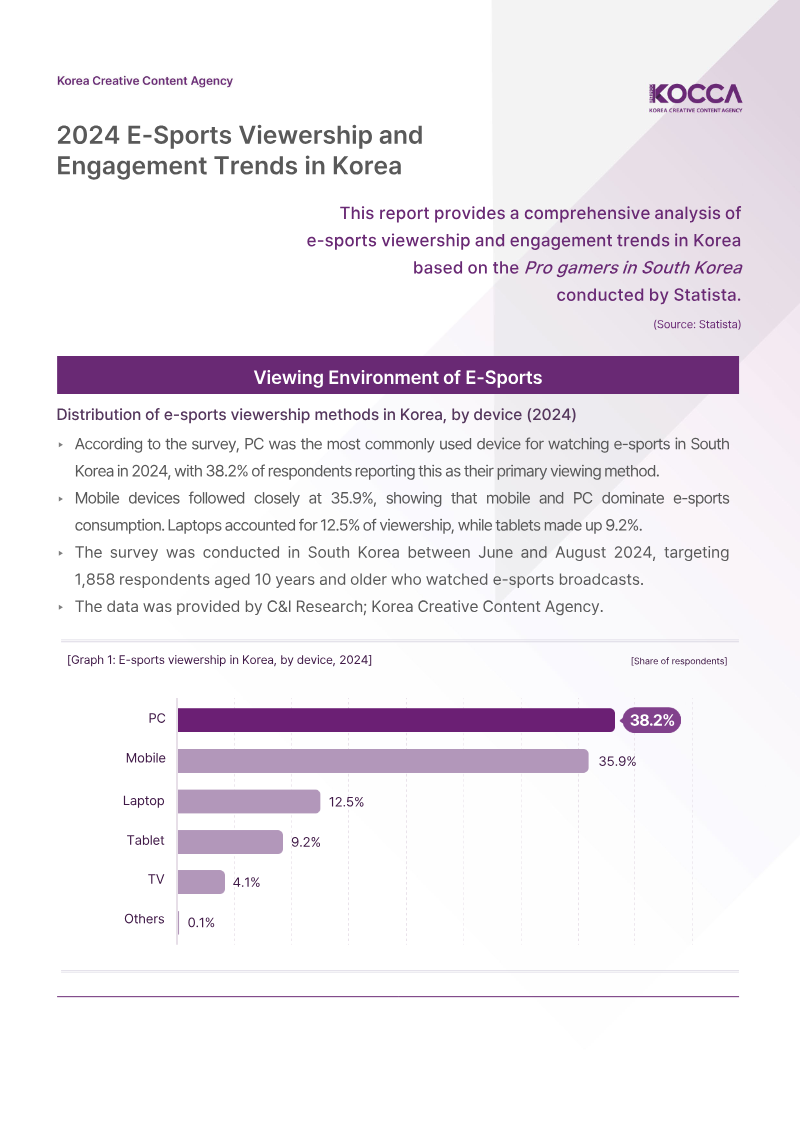
The analysis aims to map current e‑sports viewership and engagement patterns among South Korean audiences, highlighting how consumption devices, platforms, and motivations shape the market and indicating the potential for offline event conversion. Findings reveal a sharply concentrated viewing environment: personal computers account for 38.2 % of primary devices and mobile phones 35.9 %, together representing 74.1 % of usage, while laptops, tablets and televisions capture smaller shares. Platform preference is even more centralized, with YouTube commanding 78.5 % of respondents, far ahead of SOOP (14.1 %) and CHZZK (7.2 %). Regularity of consumption is high; 38.5 % of participants watch e‑sports 1–2 times per week and 20.4 % watch 3–4 times weekly, meaning at least 58.9 % engage at least once a week. Weekday sessions cluster around one hour for the majority, whereas weekend viewing extends, with 22 % spending two hours on weekdays and 28.6 % doing so on weekends; longer sessions of five hours or more occur for 4.7 % of weekday viewers and 8.1 % of weekend viewers. Motivational drivers are dominated by entertainment and self‑improvement: 62.1 % watch because the game is fun, 41.9 % seek to enhance their own gameplay, and 37.5 % cite stress relief. Additional reasons include boredom or free access (27.3 %), support for specific players (22.1 %), and social bonding with friends or coworkers (8.6 %). The survey, conducted between June and August 2024, sampled 1,858 South Korean e‑sports viewers aged ten and older, with data supplied by C&I Research and the Korea Creative Content Agency. A clear majority—62.7 %—expressed willingness to attend live e‑sports events, while 26.9 % remain undecided and 10.4 %
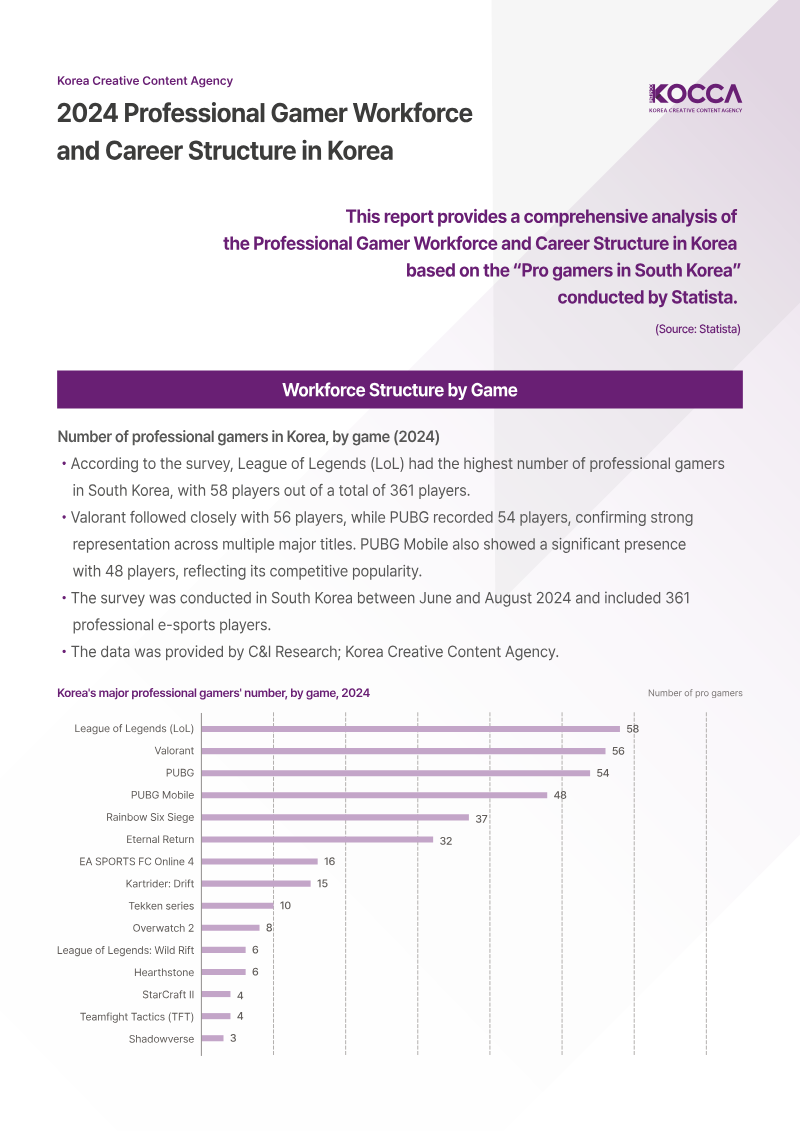
The analysis aims to map the composition, demographics, career trajectories, and income streams of South Korea’s professional e‑sports workforce, drawing on Statista surveys conducted between June and November 2024. It covers domestic players across major titles, Korean competitors active in overseas leagues, and the age, tenure, and earnings profiles of a sample of 138 active professionals, providing a snapshot of the industry’s structure during the current competitive season. Domestic data identify 361 professional gamers, heavily clustered around four titles: League of Legends (58 players), Valorant (56), PUBG (54) and PUBG Mobile (48). Smaller but notable presences include Rainbow Six Siege (37) and Eternal Return (32). Internationally, 372 Korean e‑sports athletes were reported competing abroad, with League of Legends accounting for 169 participants and Overwatch 2 for 108, while StarCraft II, Valorant and other games each contributed fewer than 30 players. Age distribution reveals a predominance of young adults, as 37.7 % fall within the 22‑24 year bracket, followed by 29.7 % aged 25 and older, 23.9 % aged 20‑21, and 8.7 % under 19. Career length shows a polarized pattern: 29.7 % have six or more years of experience, while the
The Middle East and North Africa (MENA) gaming market, specifically within the Gulf Cooperation Council (GCC), represents a high-growth frontier projected to reach $3.24 billion in player spending and 38.9 million gamers by 2028. This expansion is fueled by 96% internet penetration, high per capita income, and substantial government investment. Despite Arabic being the fifth most spoken language globally, a significant supply gap persists, as only 3.5% of Steam titles are currently localized for the region. This disparity exists even though 41% of regional gamers prioritize localized titles and over 50% highly value content tailored to their linguistic and cultural background. Successful market entry demands a sophisticated approach to localization that transcends literal translation. Technical execution must account for right-to-left user interface formatting and complex cursive script rendering to avoid the legibility errors that have plagued previous major releases. Strategically, developers should utilize Modern Standard Arabic for text while employing regional dialects for voice-overs to enhance immersion. Culturalization is equally critical, as 40% of players are more likely to recommend games that include accurate religious considerations and regional festivals. Conversely, 27% of players will abandon a title if it relies on inaccurate stereotypes or disrespectful portrayals, highlighting the reputational risks of superficial localization. Case studies indicate that deep culturalization can lead to exponential growth, with some titles seeing their MENA-based revenue and daily active users jump from 3% to 80% of their global total within months. Achieving these results requires integrating regional voice talent, ensuring historical accuracy, and leveraging local influencers for community engagement. To navigate these sensitivities and technical requirements effectively, international developers benefit most from partnering with regional experts. Such collaborations ensure that games resonate authentically with Arabic-speaking audiences, transforming a title from a foreign product into a culturally relevant experience.